wayground logo

Free Printable Worksheets

Font size

S
M
L
XL
Worksheets

practice EOCT

Total questions: 168

Worksheet time: 2hrs 13mins

Name
Class
Date
1.
Which of the following terms refers to the different possibilities of a gene?
a)
chromosome
b)
DNA
c)
Punnett Squares
d)
allele
2.
If something is heterozygous, it is also...
a)
purebred
b)
hybrid
c)
dominant
d)
recessive
3.
What does a Punnett Square help you do?
a)
Determine the ratio of phenotypes
b)
Determine the ratio of genotypes
c)
Predict possible traits the offspring will have
d)
All of the above
4.
A phenotype is the...
a)
letter combination
b)
dominant gene
c)
recessive gene
d)
physical appearance
5.
Another word for homozygous is...
a)
purebred
b)
hybrid
c)
heterozygous
d)
dominant
6.
 Dominant alleles are-
a)
capital
b)
lowercase
c)
both
d)
neither
7.
 Recessive alleles are-
a)
capital
b)
lowercase
c)
both
d)
neither
8.
Tt is-
a)
homozygous dominant
b)
homozygous recessive
c)
heterozygous
d)
none of these
9.
If a pea plant were homozygous recessive for height, how would its alleles be represented?
a)
TT
b)
Tt
c)
tt
d)
tT
10.
An organism's genetic make-up:
a)
phenotype
b)
genotype
c)
dominant
d)
recessive
11.
What is the cause of some traits "skipping" a generation?
a)
dominant traits
b)
recessive traits
c)
hybrid alleles
d)
homologous chromosomes
12.
Recessive alleles are represented by:
a)
a ratio
b)
a percentage
c)
capital letters
d)
lower-case letters
13.
What do you call the non-Mendelian inheritance pattern that states that neither trait is dominant and the traits appear to blend together?
a)
Codominance
b)
Incomplete dominance
c)
Polygenic traits
d)
Sex-linked traits
14.
Meiosis produces cells with how many chromosomes
a)
44
b)
22
c)
46
d)
23
15.
In which inheritance pattern are heterozygous individuals a blend of the dominant and recessive phenotypes?
a)
sex-linked inheritance
b)
complete dominance
c)
codominance
d)
incomplete dominance
16.
In mussels, the allele for brown coloring (B) is dominant, and the allele for blue coloring(b) is recessive. For which parental genotypes are 100% of the offspring expected to be blue?
a)
BbxBb
b)
bbxbb
c)
BBxbb
d)
BBxBB
17.
In guinea pigs, the alleles for black hair(B) is dominant to the allele for brown hair(b). Two black-haired guinea pigs are crossed. One of the pigs is homozygous for black hair and one is heterozygous. What percentage of their offspring are expected to have black hair? Create a  punnett square.
a)
25%
b)
50%
c)
75%
d)
100%
18.
This type of inheritance pattern shows BOTH traits in possible offspring
a)
complete dominance
b)
incomplete dominance
c)
co-dominance
d)
dominant pattern
19.
A red flowered plant (FRFR) breeds with a White flowered plant (FWFW). The gene for petal color in these plants expresses incomplete dominance.  What percentage of the offspring will have pink flowers?
a)
0%
b)
25%
c)
50%
d)
100%
20.
Round peas are dominant to wrinkled peas and yellow peas are dominant to green peas. 
Perform a dihybrid cross of two heterozygous parents (RrYy)
What fraction of offspring should be expected to be smooth and green?
a)
9/16
b)
1/2
c)
3/16
d)
1/16
21.

Which event during meiosis leads to a reduction in chromosome number from 2n to n?

a)

pairs of homologous chromosomes line up at the equator

b)

DNA undergoes replication

c)

homologous chromosomes travel to opposite sides of the cell

d)

sister chromatids are pulled apart at the centromere

22.

Which is the best description of the events that take place during anaphase II?

a)

the replicated chromosomes become visible

b)

homologous chromosomes line up along the equator

c)

sister chromatids are separated and pulled to opposite sides of the cell

d)

homologous pairs are separated and pulled to opposite sides of the cell

23.

The typical human body cell contains 46 chromosomes. How many chromosomes are found in a typical human sperm?

a)

23

b)

45

c)

46

d)

92

24.

During which phase of meiosis do homologous pairs of chromosomes line up next to one another along the equator?

a)

anaphase I

b)

metaphase I

c)

prophase II

d)

metaphase II

25.

If two heterozygous individuals are crossed, what percent of their offspring are also expected to be heterozygous?

a)

0

b)

50

c)

75

d)

100

26.

Recessive alleles may not be expressed because they are

a)

masked by a dominant allele

b)

the least common allele in a population

c)

the most common allele in a population

d)

less likely to have crossing over

27.

Some flowers are controlled by codominance. Red flowers (RR), blue flowers (BB) and Speckled flowers (RB).


Cross a red flower with a blue flower.

a)

1 red, 2 speckled, 1 blue

b)

2 red, 2 blue

c)

4 speckled

d)

1 red, 1 speckled, 2 blue

28.

Which molecule is responsible for transferring an Amino Acid to the ribosome when building protein?

a)

mRNA

b)

DNA

c)

RNA

d)

tRNA

29.
Choose the nucleotide sequence of the RNA strand that would be complementary to the following strand: 
GTAGTCA
a)
UATUAGA
b)
ACGACTG
c)
CAUCAGU
d)
CATCAGT
30.
The main function of tRNA is to...
a)
carry a message that, when translated, forms proteins
b)
form a portion of ribosomes
c)
string together complementary RNA and DNA strands
d)
bring amino acids from the cytoplasm to the ribosomes
31.
What is the term for a three-nucleotide sequence that codes for an amino acid?
a)
base
b)
codon
c)
amine
d)
serine
32.
Which phrase best describes translation?
a)
converts mRNA into a polypeptide
b)
catalyzes bonds between amino acids
c)
produces RNA from DNA molecules
d)
recycles tRNA molecules for reuse
33.
Which of the following is the site of transcription?
a)
vacuole
b)
lysosome
c)
nucleus
d)
ribosome
34.
Which of the following is the site of translation?
a)
vacuole
b)
lysosome
c)
nucleus
d)
ribosome
35.
Which of the following is created in the nucleus and carries the genetic code to the cytoplasm?
a)
DNA
b)
tRNA
c)
mRNA
d)
rRNA
36.
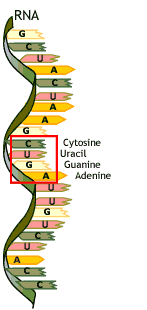
In RNA, Uracil pairs with ______. 
a)
cytosine
b)
adenine
c)
guanine
d)
thymine
37.
The process to go from DNA to mRNA is _______
a)
translation
b)
transcription
c)
replication
38.
How many amino acids are coded for by this sequence of nucleotides:
ATG GGA ACT CCA
a)
4
b)
2
c)
6
d)
12
39.
What is the mRNA strand that would result from the DNA template strand CCTA?
a)
GGAT
b)
CCAT
c)
GGAU
d)
CCAU
40.
Which of these nitrogenous bases is NOT in RNA?
a)
Uracil
b)
Thymine
c)
Cytosine
d)
Guanine
41.

During transcription, this type of ribonucleic acid is responsible for copying the DNA and brining it out of the nucleus.

a)

tRNA

b)

mRNA

c)

rRNA

d)

dRNA

42.

Which of the following are differences in the structure between RNA and DNA

a)

DNA uses deoxyribose sugar, RNA uses sugar ribose

b)

DNA pairs Adenine with Uracil, RNA pairs Adenine with Thymine

c)

DNA is a double helix, RNA is a single helix

d)

DNA pairs Adenine with Thymine, RNA pairs Adenine with Uracil

43.

These building blocks consist of a sugar, phosphate, and nitrogen base.

a)

Ribose

b)

Nucleotide

c)

Gene

d)

Protein

44.

How many amino acids are found on one tRNA?

a)

20

b)

4

c)

1

d)

3

45.
This is the triplet of bases on the end of a tRNA molecule
a)
Anticodon
b)
Codon
c)
Protein
46.

Which of the following would the codon that this molecule of tRNA will bind to?

a)
b)

ATC

c)

CUC

d)

GAG

e)

CTC

47.
Which process and type of resulting cells are represented?
a)
mitosis, gametes
b)
mitosis, body cells
c)
meiosis, gametes
d)
meiosis, body cells
48.
What causes genetic variation in meiosis?
a)
chromosomes lining up
b)
crossing over of chromosomes
c)
separation of chromosomes
d)
chromosomes pulling apart
49.
Crossing over helps promote 
a)
male genotype
b)
genetic variation
c)
DNA replication
d)
mitosis
50.
Females have ____ and males have _____ chromosomes.
a)
XX, XY
b)
XY, XX
c)
XX, XX
d)
XY, XY
51.
A human being has a somatic cell that has 46 chromosomes.  What is the haploid number found in a gamete?
a)
23
b)
46
c)
69
d)
92
52.

What type of cells does meiosis produce?

a)

2 Genetically identical cells

b)

2 Genetically different cells

c)

4 genetically identical cells

d)

4 genetically different cells

53.
In mitosis, the two resulting cells are
a)
different from the starting cell and identical to each other.
b)
different from the starting cell and different from each other.
c)
identical to the starting cell and different from each other.
d)
identical to the starting cell and identical to each other.
54.
What is occurring in this diagram?
a)
Translation
b)
Transcription
c)
Dehydration Synthesis
d)
Hydrolysis
55.
What monomers are DNA and RNA consisted of?
a)
nitrogen base
b)
nucleotides
c)
sugar-phosphate backbone
d)
blood
56.
DNA has a ______ strand; RNA has a ______ strand.
a)
double/double
b)
double/triple
c)
double/single
d)
single/single
57.
In RNA, the nitrogen base____ replaces ____ that was present in DNA. 
a)
A, U (adenine, uracil)
b)
C, G (cytosine, guanine)
c)
U, T (uracil, thymine)
d)
U, A (uracil, adenine)
58.
What kind of cells are made in MEIOSIS?
a)
Haploid cells
b)
Diploid Cells
c)
Skin Cells
d)
Liver Cells
59.
If the Diploid number of Carrots is 18, the haploid number is
a)
18
b)
9
c)
27
d)
36
60.
Meiosis makes sperm and egg cells. In humans, sperm and egg cells each have _____ chromosomes. Therefore a fertilized human egg cell (sperm and egg cell combined) would create a cell with _____ chromosomes.
a)
23, 46
b)
46, 23
c)
2, 4
d)
50, 100
61.
How many daughter cells does Meiosis create?
a)
2
b)
4
c)
8
d)
1
62.
What is the structure?
a)
oil
b)
dilute alcohol
c)
water
d)
ionic solution
63.
Which molecule serves as a catalyst? 
a)
lipid
b)
protein
c)
nucleic acid
d)
carbohydrate
64.
What differentiates one protein from another?
a)
size of amino acid
b)
color of amino acid
c)
sequence of amino acids
d)
chemical structure of amino acids
65.
Which is a general characteristic of lipids?
a)
Lipids contain nitrogen. 
b)
Lipids are soluble in water. 
c)
Lipids are insoluble in water. 
d)
Lipids contain chains of amino acids. 
66.
Which best identifies a function of carbohydrates? 
a)
building a cell
b)
source of energy
c)
development of hormones 
d)
production of antibodies
67.
Which organic molecule would a long-distance runner most likely choose to eat before a race? 
a)
A protein, because it builds muscle mass. 
b)
A carbohydrate, because it gives quick energy. 
c)
A carbohydrate, because it stores and releases energy. 
d)
A protein, because it transports oxygen in the blood stream. 
68.
What is the significance of nucleic acids for cells?
a)
They generate energy for the cell.
b)
They restrict what enters and leaves the cell. 
c)
They support and maintain the shape of the cell. 
d)
They provide instructions for cellular activities. 
69.
How are the functions of a carbohydrate and lipid similar? 
a)
Both are a source of energy. 
b)
Both are replicated during meiosis. 
c)
Both lower the activation energy of reactions. 
d)
Both dissolve nutrients in the digestive system. 
70.
Alpha-amylase, an enzyme present in saliva, breaks down starch. Which food does it help digest? 
a)
milk 
b)
candy 
c)
steak 
d)
potato
71.
To which macromolecule does this monomer belong? 
a)
Carbohydrates
b)
Lipids 
c)
Proteins
d)
Nucleic Acids
72.
To which macromolecule does this monomer belong? 
a)
Carbohdyrates
b)
Lipids
c)
Proteins
d)
Nucleic Acids
73.
To which macromolecule does this monomer belong to? 
a)
Carbohydrates
b)
Lipids
c)
Proteins 
d)
Nucleic Acids
74.
To which macromolecule does this monomer belong to? 
a)
Carbohydrates
b)
Lipids
c)
Proteins
d)
Nucleic Acids
75.
What is the function of insulin?
a)
transports oxygen in red blood cells
b)
regulates (controls) the glucose (sugar) in the blood
c)
acts as a catalyst (speeds up) for chemical reactions
76.
What is the function of cellulose? 
a)
monosaccharide/simple sugar; main source of energy in the body
b)
polysaccharide/complex carbohydrate; in plant cell walls - gives structure and support and is also called fiber
c)
polysaccharide/complex carbohydrate; stored glucose in plants; gives long-lasting energy
d)
polysaccharide/complex carbohydrate; stored glucose in animals (in liver and muscles) - ready for later use
77.
Which polymer belongs with the monomer, carbohydrates? 
a)
simple sugar/monosaccharide
b)
amino acids
c)
fatty acids and glycerol
d)
nucleotides
78.
Which polymer belongs with the monomer, proteins?
a)
simple sugar/monosaccharide
b)
amino acids
c)
fatty acids and glycerol
d)
nucleotides
79.
Which polymer belongs with the monomer, lipids? 
a)
simple sugar/monosaccharide
b)
amino acids
c)
fatty acids and glycerol
d)
nucleotides
80.
Which polymer belongs with the monomer, nucleic acids? 
a)
simple sugar/monosaccharide
b)
amino acids
c)
fatty acids and glycerol
d)
nucleotides
81.
If a protein denatures, it loses its shape.  If it loses its shape, it will lose its function.  What can cause  a protein to denature?
a)
heat
b)
electricity
c)
change in pH
d)
all of these
82.
Which part of the enzyme-substrate interacts with 2?
a)
product 
b)
active site
c)
enzyme-substrate complex
d)
substrate
83.
Which part of the enzyme-substrate interacts with 4?
a)
enzyme
b)
substrate
c)
enzyme-substrate complex
d)
product
84.
Which part of the enzyme-substrate interacts with 5?
a)
active site
b)
substrate
c)
enzyme-substrate complex
d)
product
85.
Enzymes speed up chemical reactions (like digesting food) by _________the activation energy (energy needed to start the reaction).
a)
increasing
b)
lowering
c)
maintaining
86.
What fact about enzymes does this series of pictures convey (point out)?
a)
enzymes are specific and will act on only on substrates that fit in it
b)
enzymes can change shape to act on any substrate it needs to
c)
there are only 3 different shapes of enzymes
d)
heating enzymes changes its shape
87.
Which characteristic is used to determine one amino acid from another?
a)
whether there is N present or not
b)
what is in the R group
c)
the number of carbon atoms
d)
the number of peptide bonds
88.
Plant, animal, fungi, and protists all belong to which grup of cells? Why?
a)
prokaryotes because they have no nucleus or organelles
b)
prokaryotes because they have a nucleus and organelles
c)
eukaryotes because they have no nucleus or organelles
d)
eukaryotes because they have a nucleus and organelles
89.
What is the function of the mitochondria? 
a)
produces energy for the cell from the food
b)
makes food from sunlight
c)
protein synthesis
d)
controls what goes in and comes out of the cell
90.
What is the function of the chloroplast?
a)
produces energy for the cell from the food
b)
makes food from sunlight
c)
protein synthesis
d)
controls what goes in and comes out of the cell
91.
What is the function of the ribosomes? 
a)
produces energy for the cell from the food
b)
makes food from sunlight
c)
protein synthesis
d)
controls what goes in and comes out of the cell
92.
What is the function of the cell/plasma membrane? 
a)
produces energy for the cell from the food
b)
makes food from sunlight
c)
protein synthesis
d)
controls what goes in and comes out of the cell
93.
What is the science of organizing, classifying and naming living things?
a)
taxonomy
b)
taxadermy
c)
taxicab
d)
toxicology
94.
In a properly written scientific name, which part is lowercase?
a)
species
b)
genus
c)
phylum
d)
family
95.
In the 8 levels of classification which level is the broadest category? 
a)
Kingdom
b)
Family
c)
Species
d)
Domain
96.
Things that are classified together ___________.
a)
are not related to each other.
b)
share a similar evolutionary history.
c)
are larger organisms.
d)
have a different evolutionary history
97.
What are the 8 levels of classification of living things from most general to most specific?
a)
domain, kingdom, phylum, class, order, family, genus, species
b)
domain, kingdom, class, phylum, order, family, genius, species
c)
domain, kingdom, family, class, order, family, genus, species
d)
domain, king, phillip, class, order, family, genus, species
98.
Organisms that belong to the same _________ share the MOST DNA.
a)
family
b)
kingdom
c)
genus
d)
species
99.
To what order does the first organism belong? (red)
a)
Order Diptera
b)
Order Odonata
c)
Order Ephemeroptera
d)
Order Coleoptera
100.
Which domain is capable of living in extreme environments like hot springs, geysers, or very salty waters?
a)
Bacteria
b)
Archaea
c)
Eukarya
101.
Which domain includes all animals and plants?
a)
Archaea
b)
Eukarya
c)
Bacteria
102.
Almost all bacteria are...
a)
Unicellular
b)
Multicellular
103.
Which kingdoms have some organisms that can make their own food (autotrophic)?
a)
Plantae and Animalia
b)
Fungi and Plantae
c)
Protista and Plantae
104.
Mold, yeast, and mushrooms all belong to the Kingdom _______.
a)
Archaebacteria
b)
Fungi
c)
Eubacteria
d)
Protista
105.
This organism is found in a normal environment.  What kingdom does it belong to?  
a)
Eubacteria
b)
Protista
c)
Archaebacteria
d)
Fungi
106.
Cladograms are constructed by grouping organisms together based on their____________ characteristics.
a)
shared
b)
different
c)
similar
d)
opposite
107.
According to this cladogram, sharks are MOST closely related to which organism? 
a)
Amphibians
b)
Ray finned fish
c)
Crocodiles
d)
Birds
108.
On the cladogram, which organism is the closest relative of the human?
a)
Frog
b)
Hare
c)
Caiman
d)
Parrot
109.
The first part of a scientific name is an organism's _______________ and the second part is its ________________.
a)
species, genus
b)
phylum, order
c)
class, spices
d)
genus, species
110.
Which of the following is the correct way to write the scientific name of a house cat? (imagine that these options are all in italics)
a)
Felis Domesticus
b)
felis domesticus
c)
Felis domesticus
d)
felis Domesticus
111.
The scientific name for water bear is Hypsibius dujardini.  What is its genus?
a)
Hypsibius 
b)
dujardini
c)
water 
d)
tardigrade
112.
During photosynthesis, what gas do plants release?
a)
oxygen
b)
carbon dioxide
c)
water
d)
nitrogen
113.
Gas exchange through the stems or leaves of a plant takes place through the.....
a)
stomata
b)
chloroplasts
c)
roots
d)
underside of the leaves
114.
Photosynthesis is important because....
a)
plants need air to breathe
b)
it makes the plants green
c)
it is the process by which plants make their own food
d)
without it the Earth would all be a desert
115.
The energy that starts the process of photosynthesis comes from....
a)
sunlight
b)
transpiration
c)
cellular respiration
d)
germination
116.

Why are many plants green?

a)

plant cells are green

b)

plants absorb green light

c)

chlorophyll reflects green light

d)

rigid cell walls are green

117.
Which of the following is the correct equation for PHOTOSYNTHESIS?
a)
CO+ light + H2O --> O+ Sugar
b)
CO+ sugar + H2O --> O+ light
c)
O2 + light + H2O --> CO+ Sugar
d)
CO+ O2 + H2O --> Light+ Sugar
118.
What is the pigment in chloroplasts that performs photosynthesis?
a)
Chlorosynthesis
b)
Chlorophyll
c)
ADP
d)
Electron Transport
119.
What is produced as a result of photosynthesis?
a)
Glucose and Chlorophyll
b)
Glucose and Oxygen
c)
Water and Light energy
d)
Carbon dioxide and Water
120.
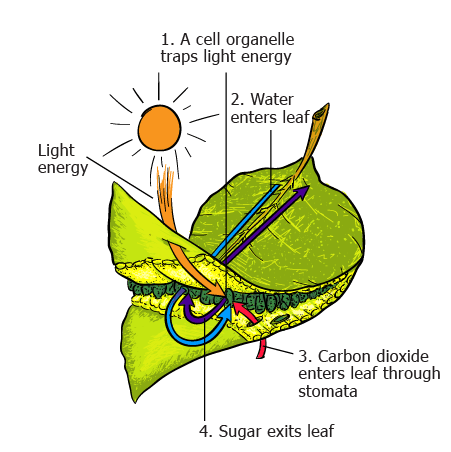
Look at the image
What substances and organelle work together to absorb sunlight to perform photosynthesis in this example?
a)
cell wall and chloroplast
b)
mitochondria and water
c)
vacuole and carbon dioxide
d)
chloroplast and chlorophyll
121.
The reactants of photosynthesis are
a)
sugar and water.
b)
sugar and oxygen.
c)
carbon dioxide and water.
d)
carbon dioxide and oxygen.
122.
Where do the light-dependent reactions occur? 
a)
thylakoid membrane
b)
stroma
c)
mesophyll
d)
mitochondria
123.
Which of the following is considered a waste product of photosynthesis?
a)
glucose
b)
oxygen
c)
carbon dioxide
d)
sunlight
124.
Why do plants conduct photosynthesis?
a)
To make light
b)
To make mitochondria
c)
To make glucose
d)
To release carbon dioxide
125.
What is one of the reactants of cellular respiration?
a)
energy
b)
glucose
c)
carbon dioxide
d)
water
126.
______________ produces the most ATP.
a)
photosnthesis
b)
aerobic respiration
c)
anaerobic respiration
d)
glycolysis
127.
The mitochondria is responsible for ...
a)
photosynthesis
b)
anaerobic respiration
c)
aerobic respiration
d)
fermentation
128.
How many ATP are produced in aerobic respiration?
a)
2
b)
33
c)
4
d)
36
129.
What is cellular respiration?
a)
the breakdown of glucose  to release ATP
b)
the breakdown of glucose to release NADH
c)
the breakdown of glucose to release FADH
d)
the breakdown of glucose to release carbon
130.
Glycolysis results in a net gain of how many ATP?
a)
0
b)
2
c)
4
d)
1
131.
The energy carrier that the cell uses to power its day to day activities is 
a)
ATP
b)
NADH
c)
FADH2
d)
glucose
132.
What is the name of the 1st step of cellular respiration?
a)
Glycolysis
b)
Kreb's Cycle
c)
ETC
d)
Anaerobic respiration
133.
Where does the Krebs Cycle take place?
a)
mitochondria
b)
chloroplast
c)
cytoplasm
d)
nucleus
134.
What are the products of anaerobic respiration?
a)
Glucose and oxygen
b)
Carbon dioxide and water
c)
Lactic acid
d)
Carbon monoxide
135.
 The expression "feel the burn" means that a person exercising is goes through...
a)
lactic acid fermentation
b)
alcoholic fermentation
c)
photosynthesis
d)
aerobic respiration
136.
which kind of cells would have the most mitochondria?
a)
brain cells
b)
bone cells
c)
plant cells
d)
muscle cells
137.
Which of the following is NOT a reactant of the dark reactions?
a)
NADPH
b)
ATP
c)
Oxygen
d)
Carbon dioxide
138.
What is the 2nd part of photosynthesis?
a)
Calvin Cycle
b)
Fermentation
c)
Kreb's Cycle
d)
Glycolysis
139.
This process is usually performed by yeast.
a)
kreb's cycle
b)
lactic acid fermentation
c)
glycolysis fermentation
d)
alcoholic fermentation
140.
This is the part of cellular respiration that makes the most ATP.
a)
glycolysis
b)
kreb's cycle
c)
ETC
d)
fermentation
141.
This is a large energy storage molecule.
a)
ATP
b)
glucose
c)
granum
d)
ATP Synthase
142.
This is the space in the Mitochondria.
a)
Granum
b)
Thylakoid
c)
ATP Synthase
d)
Matrix
143.
During cellular respiration, what do animal cells use to produce energy from food?
a)
sunlight
b)
meat
c)
water
d)
oxygen
144.
During cellular respiration, what do animal cells use to produce energy from food?
a)
sunlight
b)
meat
c)
water
d)
oxygen
145.
In passive transport, molecules move from an area of __________ concentration to an area of __________ concentraiton
a)
high, low
b)
low, high
c)
water, salt
d)
active, passive
146.
Which of the following is not a type of passive transport?
a)
Osmosis
b)
Diffusion
c)
Endocytosis
d)
Facilitated Diffusion
147.
The solution that has the highest amount of particles?
a)
Hyptonic
b)
Isotonic
c)
Hypertonic
148.
In which solution will water move into a cell?
a)
Hypertonic
b)
Hypotonic
c)
Isotonic
d)
Equilibrium
149.
What type of transport is this?
a)
Diffusion
b)
Osmosis
c)
Facilitated Diffusion
d)
Active Transport
150.
What type of transport is this?
a)
Endocytosis
b)
Exocytosis
c)
Diffusion
d)
Sodium-Potassium Pump
151.
What type of transport is this?
a)
Endocytosis
b)
Facilitated Diffusion
c)
Active Transport Pump
d)
Osmosis
152.
What type of transport is this?
a)
Facilitated Diffusion
b)
Exocytosis
c)
Active Transport
d)
Diffusion
153.
What type of transport is this?
a)
Endocytosis
b)
Diffusion
c)
Exocytosis
d)
Osmosis
154.
Even though the concentration of salt is high in some gland cells and low in the blood, these cells can move salt out of blood and into the cells.  This is an example of
a)
passive transport
b)
active transport
c)
diffusion
d)
osmosis
155.
_____________ allows some things to enter and leave cells, while keeping other things out of the cell.
a)
Osmosis
b)
Fermentation
c)
A selectively permeable membrane
d)
Metabolism
156.
The diffusion of water across a membrane is called
a)
equilibrium.
b)
osmosis.
c)
facilitated diffusion.
d)
active transport.
157.
The roots of a plant contain a high concentration of minerals and the soil contains a lower concentration.  The roots absorb minerals from the soil.  This is an example of
a)
passive transport.
b)
active transport.
c)
diffusion
d)
osmosis
158.
When does diffusion in cells stop?
a)
When vesicles burst.
b)
When equilibrium is reached.
c)
When respiration begins.
d)
When photosynthesis begins.
159.
When the concentration of molecules on both sides of a membrane is the SAME, the solution is
a)
isotonic
b)
hypertonic
c)
hypotonic
160.
If a cell is placed in a hypertonic solution, what will happen?
a)
Water will move into the cell causing it to swell.
b)
Water will move out of the cell causing it to shrink.
c)
nothing.
d)
Water will move out of the cell causing it to swell.
161.
Which is NOT a form of active transport?
a)
Endocytosis
b)
Osmosis
c)
Exocytosis
d)
Pinocytosis
162.
The cell below is in a _________ solution.
a)
Hypotonic
b)
Hypertonic
c)
Isotonic
163.
When cells take in a liquid through active transport, what is it called?
a)
Exocytosis
b)
Phagocytosis
c)
Pinocytosis
d)
Osmosis
164.
When cells take in food particles through active transport, what is it called?
a)
Pinocytosis
b)
Phagocytosis
c)
Exocytosis
d)
Osmosis
165.
What are 3 types of active transport?
a)
Riding a bike, Running through the mountains, walking on the beach
b)
Osmosis, Diffusion, Facilitated Diffusion
c)
Sodium/potassium Pump, Endocytosis, Exocytosis
d)
Throwing a ball, Playing tennis, driving a car
166.
The sodium potassium pump usually pumps
a)
potassium out of the cell 
b)
sodium out of the cell 
c)
sodium into the cell 
d)
both potassium and sodium into the cell 
167.
The sodium-potassium pump usually pumps
a)
only potassium ions and sugar molecules
b)
potassium ions out of the cell
c)
sodium ions into the cell
d)
 potassium ions into the cell
168.
How does the body control blood sugar levels? (homeostasis) 
a)
Releasing insulin when levels are too high and releasing glucagon when levels are too low
b)
By being semi-permeable 
c)
Releasing anti-diuretic hormones when dehydrated to prevent water loss, makes you stop peeing and more thirsty
d)
Releasing insulin when levels are too low and releasing glucagon when levels are too high