wayground logo

Free Printable Worksheets

Font size

S
M
L
XL
Worksheets

Unit 4

Total questions: 167

Worksheet time: 3hrs 10mins

Name
Class
Date
1.

Why is genetic drift not a type of natural selection?

a)

It's random; not due to advantages that the individual has

b)

It's due to the environment, rather than chromosomal changes

c)

Humans are involved, making genetic drift artificial selection

2.

What is the only way to create brand new alleles in an isolated population?

a)

Mutation

b)

Natural selection

c)

Genetic drift

d)

Nonrandom mating

3.

In order to have sexual selection occur, which of these must happen?

a)

Nonrandom mating

b)

Genetic drift

c)

Gene flow

d)

Nondisjunction

e)

Binary fission

4.

Male peacocks have beautiful blue and green plumage. However, this coloration makes them easier for tigers to hunt and kill. Why might they have these colors?

a)

Sexual preference by female peacocks

b)

Genetic drift randomly killed off all brown peacocks

c)

Peacocks mated with parrots a long time ago

d)

There is no reason - it's a horrible mutation with no advantage

5.

A volcano explodes and destroys half of an island. Any creature that happened to be on the north part of the island is now dead. This has changed the allele frequencies randomly. This is probably...

a)

Genetic drift

b)

Gene flow

c)

Natural selection

d)

Volcanic mutation

6.

Which of these can change allele frequencies in a population?

a)

Sexual selection

b)

Genetic drift

c)

Gene flow

d)

Natural selection

e)

All of these can change allele frequencies

7.

If the allele for long fur gives individuals an advantage, what is likely to occur over time?

a)

The frequency of that allele will increase

b)

The frequency of that allele with decrease

c)

Mutations can no longer affect that gene

8.

What is this image depicting?

a)

Gene flow

b)

Nonrandom mating

c)

Genetic drift

d)

Sexual selection

9.

Temperatures start rising in an environment with rabbits. What is a reasonable prediction for what happens to the allele for long, warm fur?

a)

Becomes less frequent in the population

b)

It is mutated by the changing temperatures

c)

Switches to its back-up mode of scales

d)

Long fur individuals war with short fur individuals

10.

In genetic drift, the allele frequencies in a gene pool change because of

a)

mutations

b)

genetic equilibrium

c)

natural selection

d)

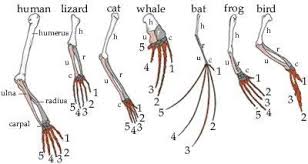
chance

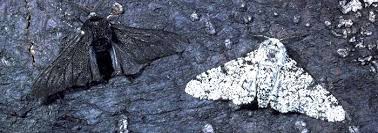
11.
Two organisms that are closely related would have
a)
very similar DNA sequence
b)
exactly the same DNA sequences
c)
no proteins in common
d)
completely different DNA sequence
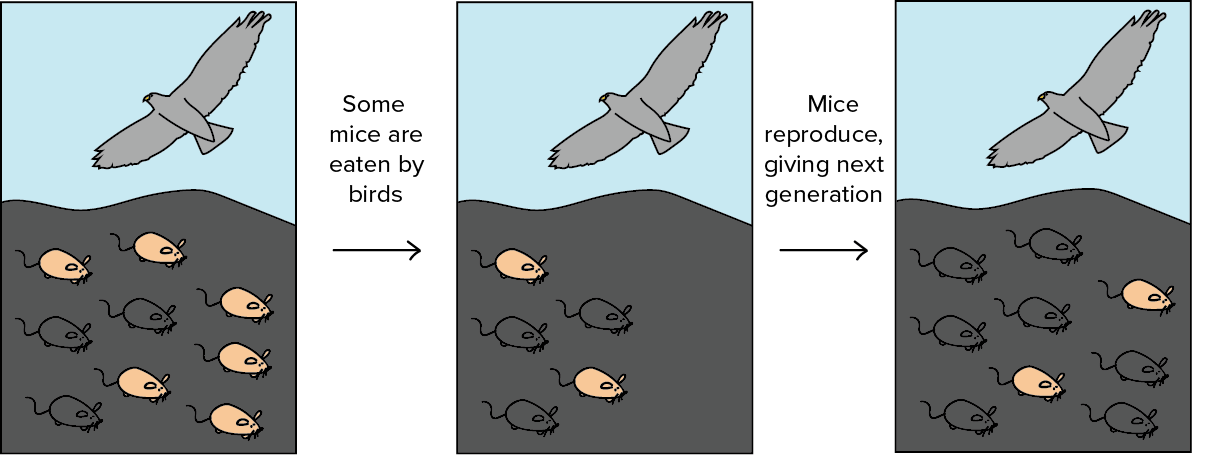
12.
Which of the following is NOT a condition for Hardy-Weinberg Equilibrium?
a)
No mutations
b)
Random Mating
c)
No natural selection
d)
No offspring
13.
When a population is in Hardy-Weinberg equilibrium,  what is NOT happening to the species?
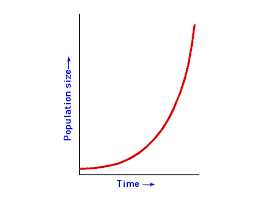
a)
Survival
b)
Reproduction
c)
Death
d)
Evolution
14.
There was once a large population of cheetah, but about 12,000 years ago most of the cheetahs were killed off by random chance.  What is this an example of?
a)
Genetic Drift
b)
Hardy Weinberg Effect
c)
Founder Effect
d)
None of These
15.
What type of selection does the image represent?
a)
Directional 
b)
Stabilizing
c)
Disruptive
16.
What type of selection does the image represent?
a)
Directional 
b)
Stabilizing
c)
Disruptive
17.
What type of selection does the image represent?
a)
Directional 
b)
Stabilizing
c)
Disruptive
18.
Genetic drift is most likely to impact a population....
a)
That has a low mutation rate
b)
In which natural selection is occurring
c)
That is very small
d)
For which environmental conditions are changing
19.
Disruptive selection will favor...
a)
Both extremes of a trait.
b)
Average traits.
c)
One phenotype over another.
d)
All possible phenotypes
20.
Which Hardy-Weinberg factor represents the frequency of heterozygous individuals in a population?
a)
p2
b)
2pq
c)
q2
d)
p2 + 2pq
21.
Which Hardy-Weinberg equation represents the genotype frequencies in a population?
a)
p + q = 1
b)
p2 + 2pq + q2 = 1
c)
p2 + pq2 + q2 = 1
d)
p + 2pq + q3 = 1
22.
What do you call all of the genes in a population?
a)
Gene pool
b)
Relative Frequency
c)
Genetic Drift
d)
Allele pool
23.
In the Hardy-Weinberg Equation, q2 is the frequency of what?
a)
The recessive allele 
b)
the dominant allele
c)
the recessive genotype
d)
the dominant genotype
24.
Two groups of chipmunks cannot mate anymore because the grand canyon separates them; this is
a)
Behavioral isolation
b)
Geographic isolation
25.
What is speciation?
a)
combining of tow species to form one with different traits
b)
isolation that affects mating behaviors
c)
timing of mating that prevents normal sexual selection
d)
divergence of two or more species from an existing one
26.
Individual organisms can acquire traits throughout their lives that help them survive and reproduce; then they can pass those acquired traits on to their offspring.
a)
true
b)
false
27.
Mutations, crossing-over, genetic recombination, and random fertilization are all sources of
a)
genetic variation
b)
stabilizing selection
c)
genetic equilibrium
d)
genetic drift
28.
An inherited characteristic that increases an organism's ability to survive and reproduce in its specific environment is called a/an
a)
vestigial structure
b)
adaptation
c)
speciation
d)
analagous structure
29.
What is the best explanation for a population being described as an evolutionary unit?
a)
Population can evolve, not individuals
b)
Natural selection only involves individuals, not populations
c)
Genetic changes only occur in populations
d)
A population's gene pool remains the same throughout time
30.
What is speciation?
a)
combining of tow species to form one with different traits
b)
isolation that affects mating behaviors
c)
timing of mating that prevents normal sexual selection
d)
divergence of two or more species from an existing one
31.
Osmosis is the movement of _____ across a membrane.
a)
glucose
b)
any molecule
c)
oxygen
d)
water
32.
This picture represents which type of cellular transport?
a)
passive transport
b)
endocytosis
c)
exocytosis
d)
osmosis
33.
The concentration of water is higher in the soil than in plant root cells. Water moves into root cells of a plant by...
a)
Facilitated Diffusion
b)
Simple Diffusion
c)
Active Transport
d)
Osmosis
34.
This cell organelle helps organisms maintain homeostasis by controlling what substances may enter or leave cells.
a)
vacuole
b)
vessicle
c)
cell membrane
d)
cell wall
35.
The cell below is in a _________ solution.
a)
Hypotonic
b)
Hypertonic
c)
Isotonic
36.
The cell below is in a _____________ solution.
a)
Hypertonic
b)
Hypotonic
c)
Isotonic
37.
What type of transport is represented by figure "B" 
a)
Active Transport
b)
Facilitated Diffusion 
c)
Protein Transport 
d)
Osmosis 
38.
A cell in an isotonic solution will
a)
swell
b)
shrink
c)
stay the same size
d)
impossible to tell
39.
The cell membrane is made mostly of
a)
phospholipid monolayer and proteins
b)
phospholipid bilayer and proteins
c)
proteins and carbohydrates bilayer
d)
triglycerides and carbohydrates
40.
Which is true of passive transport?
a)
Moves from low to high concentration 
b)
Requires energy
c)
Moves from high to low concentration 
d)
Moves against the gradient 
41.
A saltwater fish is accidentally placed in a freshwater aquarium in a few short hours it sadly died. Which explains why this occurred?
a)
The cells of the fish body were dehydrated by the quick loss of water. 
b)
The cells of the fish quickly absorbed massive amounts of water and it ended up killing the fish.  
c)
The temperature of the water was too cold
d)
The temperature of the water was too hot
42.
John is examining a muscular cell underneath a microscope in a calcium ion solution. He calculated that there were 700 calcium ion inside the muscular cells, and 900 calcium ions on the outside of the muscular cells. Which natural way will the ions flow when the protein channels are open for calcium?
a)
Calcium will move into the cell
b)
Calcium will move out of the cell
c)
Equal amounts of calcium will move in and out of the cell.
d)
puppies
43.
A nursing baby is able to obtain antibodies (LARGE proteins that aid the immune system) from its mother's milk. How are theses antibodies able to enter the cells of the body's small intestine?
a)
osmosis, duh!
b)
active transport, exocytosis
c)
active transport, endocytosis
d)
passive transport, exocytosis
44.
Phospholipids are non-polar (water fearing) and water is polar meaning it has a positively charged end and a negatively charged end.
Red blood cells have a higher ratio of phospholipid to proteins than other cell types in your body. Because of this, what will happen at a lower rate in blood cells?
a)
osmosis
b)
diffusion of gases
c)
cellular respiration
d)
photosynthesis
45.
Phospholipids are nonpolar, gases like oxygen are non-polar as well. Which of these is true due to this fact?
a)
oxygen easily diffuses into and out of red blood cells by simple diffusion
b)
oxygen needs to have a protein channel for it to diffuse across a cell membrane by facilitated diffusion
c)
I love lasagna!
d)
the pepper trick was cool
46.
Distilled water is always _______ to a cell
a)
hypertonic 
b)
hypotonic
c)
isotonic
d)
I'm thristy
47.
This picture represents what type of cell transport?
a)
endocytosis
b)
exocytosis
c)
osmosis
d)
passive transport
48.
What is a sac-like structure used to store water and nutrients? These are much larger in plant cells?
a)
Lysosomes
b)
Mitochondria
c)
Vacuoles
d)
Golgi Body
49.
 An animal cell placed in a hypertonic (salty) solution will
a)
Stay the same
b)
Shrink- get smaller
c)
Swell- get bigger
50.
Which way will the water molecules move during osmosis?
a)
Out of the cell, so the cell shrinks.
b)
Out of the cell, so the cell swells.
c)
Into the cell, so the cell shrinks.
d)
Into the cell, so the cell swells.
51.
 If a cell containing 5% salt is placed into a glass of water with 20% salt, the water is _______ compared to the cell.
a)
hypertonic-
b)
hypotonic
c)
isotonic
52.
_______ regulates what enters and leaves a cell.  
a)
Cell Membrane
b)
Nucleus
c)
Mitochondria
d)
Cytoplasm
53.
All of the following require ATP energy EXCEPT
a)
facilitated diffusion
b)
pinocytosis
c)
exocytosis
d)
Na+/K+ pump
54.
Which cell is placed into a hypotonic environment? 
a)
A
b)
B
c)
C
d)
D
55.
Which diagram best shows the end result of diffusion?
a)
F
b)
G
c)
H
d)
J
56.
All of the following are ways animals communicate except
a)
pheromones
b)
tropisms
c)
sounds 
d)
body movements
57.
Which of the following is a learned behavior?
a)
Building a nest
b)
Spinning a web
c)
Migrating
d)
Responding to a treat
58.
A signal that causes an organism to react is called 
a)
tropism
b)
pheromone
c)
stimulus
d)
auxin
59.
A baby kangaroo jumps into its mother's pouch when it is born. This behavior is called a(n)
a)
stimilus
b)
instinct
c)
learned behavior
d)
insight
60.
Poison Ivy growing on a tree by touch.
a)
Gravitropism 
b)
Phototropism
c)
Thigmotropism
d)
Hydrotropism
61.
Plant’s roots grow down, anchoring it into the soil. To what stimulus is the plant responding?
a)
thigmotropism
b)
hydrotropism
c)
phototropism
d)
gravitropism
62.

Shivering is the body's response to:

a)

too much food

b)

extreme thirst

c)

reduced body temperature

d)

increased body temperature

63.

Horns, claws, quills, and stingers are physical adaptations that are used for:

a)

defense

b)

movement

c)

food gathering

d)

obtaining resources

64.

A porcupine has sharp quills. Why would a porcupine need this adaptation?

a)

to keep warm

b)

to cover its skin

c)

to protect itself

d)

to kill its prey

65.

The arctic fox and snowshoe hare develop a white coat of fur during the winter months. What statement best describes this behavioral response?

a)

The color of the fur will attract a mate

b)

White fur allows the animals to reflect light and stay warm

c)

It becomes colder during the winter, so these animals need more fur to stay warm

d)

Snow falls during the winter and the white fur will camouflage the animals

66.
(6-3.5) In the fall, black bears eat so much that they can gain up to 68 kg of fat in just two months.Why do black bears gain so much weight?
a)
to become stronger so they can better defend themselves
b)
to prepare for migration
c)
to attract a mate
d)
to prepare for hibernation
67.
An octopus can change its color to match its surroundings. This is an example of which type of behavior?
a)
camouflage
b)
mimicry
c)
cooperative behavior
d)
estivation
68.
An example of a physical adaptation is...
a)
a turtle hiding inside its shell
b)
The spikes on a porcupine fish
c)
a rabbit burrowing underground
d)
a viper biting when threatened
69.
Cactus has spines instead of leaves. The spines reduces water loss through the stomata.
a)
Structural
b)
Behavioural
70.
Which feature of a rose helps it grow without being eaten by large animals?
a)
flowers with bright colors
b)
sharp thorns
c)
small seeds
d)
deep roots
71.
Some plants have small leaves that help them do which of these?
a)
grow tall
b)
save water
c)
make seeds
make seeds
d)
fall off in winter
72.
How are hardwood trees adapted to live in cold winters?
a)
They have long stems buried in mud.
b)
They live on tree islands.
c)
They lose their leaves in winter.
d)
They grow low to the ground.
73.
A nice smell is an adaptation that __________________.
a)
helps the plant keep water inside the leaves.
b)
pokes animals that try to eat the plant.
c)
attracts pollinators to the plant.
74.
Plants with spines and waxy leaves are well suited for life in which environment?
a)
Desert
b)
Temperate forest
c)
Grassland
d)
Tropical Rainfroest
75.
An organism that hunts and feeds on another organism is a ______________________.
a)
prey
b)
producer
c)
predator
d)
decomposer
76.
An inherited trait that helps those organisms that have it to survive
a)
niche
b)
structure
c)
characteristic
d)
adaptation
77.
Coloring or another physical characteristic that help an organism blend in with its environment
a)
mimicry
b)
camouflage
c)
hibernation
d)
migration
78.
When an organism copies a characteristic of something else in order to better its chances for survival and reproduction
a)
hibernation
b)
camouflage
c)
mimicry
d)
migration
79.
When an organism slows its life functions for a period of time to better its chances for survival during harsh conditions
a)
camouflage
b)
migration
c)
mimicry
d)
hibernation
80.
The seasonal movement of an organism from one place to another
a)
camouflage
b)
migration
c)
hibernation
d)
function
81.
In this tundra food web, if grasses were removed what would happen to the sustainability of the ecosystem?
a)
There would be an overpopulation of arctic hares and lemmings.
b)
Polar bears would move to a new ecosystem.
c)
The ecosystem would collapse, because it lost its main producer.
d)
Wildflowers would die out from the ecosystem.
82.
Which graph shows a situation in which the number of predatorss in a population depends on the number of prey?
a)
Graph F
b)
Graph G
c)
Graph H
d)
Graph J
83.
All of the following statements concerning characteristics of predator-prey relationship are correct EXCEPT:
a)
The population of predators most often eliminates the population of prey
b)
A rise in the population of predators is followed by a decrease in the population of prey.
c)
A rise in the population of prey is often followed by a rise in the population of predators.
84.
Which human activity has had a negative impact on ocean systems?
a)
Monitoring
b)
Over-fishing
c)
Creation of artificial reefs
d)
Reduction in coastal developments
85.
A constant input of energy from the Sun is necessary to maintain any ecosystem. What contributes to the sustainability of an ecosystem?
a)
Small population sizes
b)
Lack of adaptations
c)
Biodiversity
d)
Unstable environment
86.
Which of the following describes a predator/prey relationship in a marine environment?
a)
Phytoplankton in the sea make food from sunlight.
b)
Sharks consume smaller fish they catch in the ocean.
c)
Frogs in a pond catch and eat flying insects.
d)
Fish of the same species compete for plants to eat.
87.
How might the use of fertilizers negatively impact the ocean?
a)
Algae populations will decrease due to the harmful chemicals.
b)
The fertilizer creates artificial reefs that provide new habitats for fish.
c)
Algae populations will increase and create "dead zones" or areas where oxygen levels are very low.
d)
Marine predators will increase.
88.
Why is biodiversity in an ecosystem essential to the sustainability of the ecosystem?
a)
More genetic variation within a species makes it more likely that some individuals will survive a disease outbreak.
b)
A wide variety of herbivore species that can feed on a wide variety of producers ensures that there is sufficient prey for predators in the ecosystem.
c)
The presence of more species with different adaptations makes it more likely that some organisms will survive a natural disaster.
d)
All of the above indicate why biodiversity is an indicator of the stability of an ecosystem.
89.
Temperature, light, air, water, and soil are all  _____  parts of the environment
a)
alive
b)
biotic 
c)
abiotic
d)
living
90.
This is an example of a:
a)
Nitrogen Cycle
b)
Water Cycle
c)
Biosphere
d)
Predator Prey Relationship
91.
What statement is TRUE about the graph?
a)
The prey is the green line because there needs to be more prey than predators.
b)
The prey is the red line because there needs to be more predators than prey.
c)
The green line is the producers
d)
The red line is the producers
92.

Predator population lags behind prey population because:

a)

Increase in predators leads to decrease in prey

b)

Increase in predators leads to increase in prey

c)

Increase in predators leads to decrease in producers

93.
What type of symbiosis?
  * Hummingbirds feed on nectar from flowers.
 * 
Flowers are pollinated by hummingbirds as they move from flower to flower.
a)
commensalism
b)
mutualism
c)
parasitism
d)
predation
94.
What type of symbiosis?
*
Snapping Shrimp have poor and depend on their goby fish roommate to give the danger signal when predators come and guide them
back home if they wander too far.   
*
  Goby fish who don't have a place to hide are quickly eaten. They find a Snapping Shrimp roommate who digs a hole for both to live in.
a)
commensalism
b)
mutualism
c)
parasitism
d)
predation
95.
What type of symbiosis?
*
The tick lives on dog and feeds on its blood and tissue.
*
  The dog gets skin irritation and can pick up diseases carried by tick.
a)
commensalism
b)
mutualism
c)
parasitism
d)
predfation
96.
What type of symbiosis?
*
  The Red-Chested cuckoo birds find an unattended robin nest, push out the robin eggs, and lay their eggs in the robin’s nest, and leave.
*
 Robin babies die and robin parents feed  and take care of the cuckoo babies.
a)
commensalism
b)
mutualism
c)
parasitism
d)
predation
97.
What type of symbiosis?
*Mycorrhizal fungi invade and live in or among roots cells of many plants. The plant provides nutrients to the fungi.
*
The Mycorrhizal fungi help the host plant absorb inorganic nitrogen and phosphorus from the soil. Some mycorrhizal  fungi also secrete antibiotics which may help protect their host from invasion by parasitic fungi and bacteria.
a)
commensalism
b)
mutualism
c)
parasitism
d)
predation
98.
What type of symbiosis?
*
 Mycorrhizal fungi invade and live in or among roots cells of many plants. The plant provides nutrients to the fungi.
*
  The Mycorrhizal fungi help the host plant absorb inorganic nitrogen and phosphorus from the soil. Some mycorrhizal  fungi also secrete antibiotics which may help protect their host from invasion by parasitic fungi and bacteria.
a)
commensalism
b)
mutualism
c)
parasitism
d)
predation
99.
What type of symbiosis?
*
Remora use suckers to attach temporarily to large marine animals such as sharks, manta rays, whales, turtles, or large fish.
*
The shark provides free transportation, protection, and dropped food and feces which the remora feeds on. The host is not injured.
a)
commensalism
b)
mutualism
c)
parasitism
d)
predation
100.
What type of symbiosis?
*
Fungi form lichens by living in a close relationship with an algae. The fungus provides a protective home for the algae,  and gathers mineral nutrients from rainwater and from dissolving the rock underneath.
*
The algae gathers energy from the sun using photosynthesis. Both organisms share their nutrients with each other. 
a)
commensalism
b)
mutualism
c)
parasitism
d)
predation
101.
What type of symbiosis?
*
Honeyguide birds find a bee hive, then chatter loudly to attract the Honey badger. They fly toward the hive making sure the badger is following. 
*
Upon arrival at the bee hive, the badger tears open the hive and feasts on the honey. Then the Honeyguide bird feeds on the remaining wax and larvae.
a)
commensalism
b)
mutualism
c)
parasitism
d)
predation
102.
What type of symbiosis?
*
  Skunk Cabbage plants attract flies in cool weather by making heat and provide food to the flies that come. 
*
  Flies move from one Skunk Cabbage plant to the next feeding and transferring pollen as they go.
a)
commensalism
b)
mutualism
c)
parasititsm
d)
predation
103.
What type of symbiosis?
*
Kudzu vines grow by climbing, and wrapping around trees.   
*
Kundzu covered trees die as they are smothered and break under the weight of the growing Kudzu vines.
a)
commensalism
b)
mutualism
c)
parasitism
d)
predation
104.
What type of symbiosis?
*
Hermit crabs find shells left by snails that have died and move in.
*
  Snails die and leave behind their shells.
a)
commensalism
b)
mutualism
c)
parasitism
d)
predation
105.
A lichen is a combination of fungus and algae that lives on the sides of trees, rocks, and other materials.  The fungus provides the algae with water and minerals and the algae uses the water and minerals to make food for both organisms.  What type of relationship does the lichen represent?
a)
commensalsim
b)
mutualism
c)
parasitism
d)
predation
106.
What does symbiosis mean?
a)
living separately, no relationship between 2 species
b)
living together, close relationship between 2 species
c)
Living separately, long distance relationship between 2 species
d)
When one species kills and eats another
107.
The stork uses its saw-like bill to cut up the dead animals it eats.  As a result, the dead animal carcass is accessible to some bees for food and egg laying.  
a)
Commensalism
b)
Mutualism
c)
Parasitism
d)
Predation
108.
Mistletoe extracts water and nutrients from the spruce tree to the trees detriment.  
a)
Parasitism
b)
Mutualism
c)
Commensalism
d)
Predation
109.
Who is the father of evolution?
a)
Darwin
b)
Mendel
c)
Newton
d)
Einstein
110.
What is a change in an organism that allows for it to survive in its environment?
a)
homologous
b)
vestigial
c)
variation
d)
adaptation
111.
When all of the organisms of a species have died it is called
a)
evolution
b)
extinction
c)
adaptation
d)
natural selection
112.
What is this an example of?
a)
diversity of species
b)
variation
c)
vestigial structures
d)
DNA studies
113.
What is this an example of?
a)
vestigial structures
b)
embryology
c)
homologous structures
d)
fossil record
114.
Predict which moth would increase in population
a)
light 
b)
dark
115.
When the DNA of an organism is altered it is referred to as…
a)
Mutation
b)
Gene Flow
c)
Genetic Drift
d)
Sexual Selection
116.
When individuals choose traits possessed by the opposite sex it is called…
a)
Mutation
b)
Gene Flow
c)
Genetic Drift
d)
Sexual Selection
117.
Darwin wrote that organisms with traits that are best suited to the environment will ________________
a)
increase in number
b)
become extinct
118.
Which of the following is NOT an example of natural selection? 
a)
People selectively breeding hamsters.
b)
Insect populations developing resistance to certain pesticides.
c)
Bacteria becoming resistant to antibiotics.
d)
Male birds of certain species developing colorful feathers to attract female mates.
119.
Which term refers to the process by which individuals that are better suited to the environment survive and reproduce therefore passing down their genes to their offspring? 
a)
Evolution 
b)
Variation 
c)
Adaptation
d)
Natural Selection 
120.
The ability of an organism to survive and reproduce in its specific environment 
a)
diversity.
b)
evolution
c)
adaptation
d)
 fitness
121.
If an organism has a vestigial structure, that structure likely once had a function in a(n)
a)
close relative
b)
early ancestor
c)
unrelated organism
d)
embryological stage
122.
To survive, organisms must maintain what state?
a)
Classified
b)
Breathing
c)
Homeostasis
d)
Living
123.
Since the 1800s humans have stopped burning coal, and the trees have returned to their original color. Which moth will be more successful in this environment?
a)
Dark moth
b)
Light moth
c)
Both will be equally successful
d)
Neither will be successful
124.
Why is the mouse population changing over time?
a)
The light mice can reproduce more successfully than the dark mice
b)
The hawks eat more dark mice than light mice because the dark mice taste better
c)
The hawks eat more light mice than dark mice because they can see the light mice more easily
d)
The hawks eat more dark mice than light mice because they can see the dark mice more easily
125.
Which term describes a group of the same species that live in the same area?
a)
Population
b)
Community
c)
Biome
d)
Ecosystem
126.
If the environment suddenly changed, how could a species go extinct?
a)
The environmental change means fewer predators are around
b)
There are more homes available in the newly changed environment
c)
New resources are available with less competition
d)
There aren't enough members of the species with a trait necessary to survive in the new environment
127.
What is the advantage of having different shaped beaks?
a)
To look different from other species.
b)
To be able to eat the food readily available in the environment.
c)
To protect itself against predators.
d)
To protect itself against prey.
128.
The theory of evolution by natural selection means that what is changing over time?
a)
The inherited traits of a population.
b)
The acquired traits of a population.
c)
Hair color and eye color
d)
Attractive features.
129.
Why did the population of peppered moths in England change from light to dark after the Industrial Revolution?
a)
Light moths were easy to see against sooty trees and were eaten
b)
Light moths were killed by soot
c)
The birds that ate the dark moths were killed by soot
d)
Dark moths were produced by industrial processes
130.
Modern whales developed their traits through natural selection.  What occurs during the process of natural selection?
a)
Organisms choose mates from other species to create new species
b)
Breeders selectively cross organisms with desired traits
c)
Only the fittest organisms can survive and reproduce
d)
Organisms remain exactly the same over time.
131.
The example of the peppered (brown) moths living near English industrial cities demonstrates that
a)
A change in an environment can result in the evolution of species living there
b)
Evolution occurs so slowly that is it not possible to determine that it has happened in less than a million years
c)
The environment near these cities has always favored dark colored moths
132.
Robins typically lay fours eggs. If more then four eggs are produced then the baby chicks are malnourished while smaller egg numbers result in no viable (able to live) baby chicks. This is an example of
a)
stabalizing
b)
disruptive
c)
direction
d)
none of the above
133.
Only populations can evolve.
Individuals can not evolve.
a)
True
b)
False
134.
If finches with large beaks and finches with small beaks increase in a population while finches with average sized beaks decreases, which pattern of natural selection has occurred?
a)
Directional selection
b)
Disruptive selection 
c)
Stabilizing selection
135.
If the number of births in a population is the same as the number of deaths in a population, what will happen to the growth of the population?
a)
It will increase.
b)
It will decrease.
c)
It will stay the same.
d)
It will fluctuate.
136.
What type of growth is shown in the diagram?
a)
exponential growth
b)
logistic growth 
c)
predator-prey cycle
d)
boom-bust curve
137.
What growth pattern describes a population whose growth rate slows or stops following a period of exponential growth?
a)
logistic growth
b)
population growth
c)
exponential growth
d)
predator-prey cycle
138.
Which type of growth is best illustrated by this rabbit population?
a)
exponential
b)
logistic
c)
S-shaped
d)
predator-prey
139.
Largest number of individuals of a population that the environment can support...  
a)
carrying capacity
b)
population crash
c)
lag phase
d)
mutualism
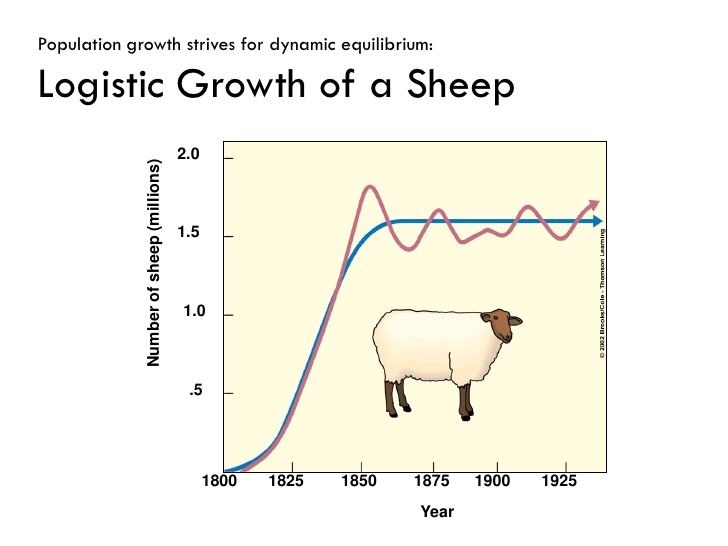
140.
What is the carrying capacity for this sheep population?
a)
1.8 million
b)
1.25 million
c)
1.6 million
d)
1.o million
141.
When a population grows past the ecosystem's carrying capacity, what happens to the population?
a)
Continues to grow
b)
The population starts to die off to return to carrying capcity
c)
The population will go extinct due to lack of resources
d)
The population grows then finds a new carrying capacity
142.
Food, water, sunlight, shelter, and space are resources that are often __________.
a)
limiting factors
b)
wet
c)
messy
d)
found in rocks
143.
Competition, disease, predation, and parasitism are considered ___________ ____________ limiting factors
a)
Density-dependent
b)
Density-independent
144.
Natural disasters and weather patterns like earthquakes, floods, and tornadoes, blizzards, and heatwaves are considered ___________ ____________ limiting factors
a)
Density-dependent
b)
Density-independent
145.
What growth pattern describes a population whose growth rate slows or stops following a period of exponential growth?
a)
logistic growth
b)
population growth
c)
exponential growth
d)
predator-prey cycle
146.
Logistic growth is representative of a population in an environment with ________________ resources.
a)
limited
b)
plenty of
c)
no resources 
d)
biotic
147.
Succession that occurs in an area with NO SOIL
a)
ecological succession 
b)
primary succession 
c)
secondary succession
d)
pioneer speciles
148.
The picture shows what type of succession?
a)
primary
b)
secondary
c)
tertiary
d)
quadanary
149.
The first organisms that appear in an ecological community
a)
ecological succession 
b)
primary succession 
c)
secondary succession
d)
pioneer speciles
150.
Starts with BARE ROCK followed by lichen
a)
primary succession 
b)
secondary succession
c)
both types of succession
151.
How do lichens contribute to primary succession?
a)
Lichens decompose organic matter from animals and plants
b)
Lichens begin to break down rock to form soil
c)
Lichens are nitrogen fixing bacteria
152.
The picture shows what type of succession?
a)
primary
b)
secondary
c)
tertiary
d)
quadanary
153.
Natural disasters such as flooding and tornadoes are linked to ________________.
a)
primary
b)
secondary
c)
old field
d)
ecosystem
154.
The final stable community of plants and animals is called:
a)
pioneer community
b)
farmland
c)
climax community
d)
old field
155.
What is the order of succession shown in this figure?
a)
A, B, C, D
b)
B, A, D, C
c)
C, D, A, B
d)
D, A, B, C
156.
What type of succession is shown going from figure A to figure B?
a)
primary succession
b)
eutrophication
c)
secondary succession
d)
intermediate
157.
What is a Mass Extinction?
a)
One species goes extinct.
b)
A large percentage of species go extinct in a short period of time.
c)
The natural, gradual extinction of species over time.
d)
Several species go extinct in one ecosystem.
158.
Humans are causing extiction in which ways?
a)
By over hunting animals for food or products.
b)
By destroying the natural habitat of species.
c)
By polluting the environments of the world.
d)
All of the above.
159.
What effect is shown in this picture? (The pond is green from algae).
a)
biomagnification
b)
eutrophication
c)
habitat fragmentation
d)
invasive species
160.
The normal extinction of various species as a result of changes in local environmental conditions.
a)
background extinction
b)
mass extinction
161.
The practice of harvesting or hunting to such a degree that remaining individuals may not be able to replenish the population is called _____.
a)
biomagnification
b)
overexploitation
c)
edge effects
d)
natural resource
162.
The process shown here is called __.
a)
biomagnification
b)
eutrophication
c)
invasive species
d)
mass extinction
163.
Kudzu vine is native to Japan, but was first brought to the United States in 1876. It has spread so fast that it has earned the nickname, "the vine that ate the South," because it smothers trees. What is this an example of?
a)
mass extinction
b)
invasive species
c)
eutrophication
d)
biomagnification
164.
What is THE most major cause of extinction today?
a)
habitat destruction by humans
b)
poaching
c)
disease
d)
hunting
165.
Eutrophication is caused by
a)
runoff of excessive fertilizer and nutrients
b)
cleaning up waterways
c)
using nuclear energy
d)
using solar energy
166.
Which of these describes what happened when buffaloes were almost hunted to extinction in United States?
a)
Biomagnification
b)
Eutrophication
c)
Pollution
d)
Overexploitation
167.
Eutrophication causes low levels of dissolved oxygen in the water which in turn causes:
a)
production of excessive organic matter
b)
the dying off of many fish
c)
an explosion in the fish population
d)
biomagnification of toxins in the food chain.