wayground logo

Free Printable Worksheets

Font size

S
M
L
XL
Worksheets

Biology Midterm review

Total questions: 164

Worksheet time: 4hrs 40mins

Name
Class
Date
1.
Fruit fly body cells have 8 chromosomes. After mitosis, you would expect a resulting fruit fly daughter cell to have ...
a)
16 chromosomes.
b)
46 chromosomes.
c)
8 chromosomes.
d)
4 chromosomes.
2.
Structure (b) is a ____.
a)
chromosome
b)
chromatid
c)
centromere
3.
Structure (a) is a ____.
a)
chromosome
b)
chromatid
c)
centromere
4.
Structure (c) is a ____.
a)
chromosome
b)
chromatid
c)
centromere
5.
The organelle that helps in cell division and produces spindle fibers.
a)
Chromosome
b)
Centriole
c)
Cytoplasm
d)
Chloroplast
6.
The stages of mitosis in order
a)
Metaphase, Anaphase, Prophase, Telophase
b)
Prophase, Anaphase, Metaphase, Telophase
c)
Prophase, Metaphase, Anaphase, Telophase
d)
Anaphase, Prophase, Telophase, Metaphase
7.
Why would it be important to replicate DNA before a cell divides in mitosis or meiosis?
a)
In order for genetic information to be transferred into daughter cells.
b)
In order for the cell to be able to increase in size.
c)
In order for the DNA to be contained in the nucleus.
d)
In order for the cell to re-order the DNA sequencing in the new cells.
8.
The time between cell divisions in the life cycle of the cell is called
a)
anaphase
b)
interphase
c)
prophase
d)
metaphase
9.
Chromatid pairs line up in the middle of the cell.
a)
Metaphase
b)
Telophase
c)
Anaphase
d)
Interphase
10.
A new organism is produced from one parent organism.
a)
Sexual Reproduction
b)
Asexual Reproduction
11.
How many daughter cells are produced in mitosis?
a)
1
b)
2
c)
4
d)
6
12.

Which is Metaphase?

a)

A

b)

E

c)

C

d)

F

13.
Nuclear membrane forms around chromosomes and begins to separate.
a)
Anaphase
b)
Telophase
14.
The phase in mitosis where chromosomes move away and are pulled apart by spindles to opposite sides of the cell.
a)
prophase
b)
anaphase
c)
metaphase
d)
telephase
15.
Which of the following is NOT occuring during interphase?
a)
Cell growth
b)
DNA being copied
c)
DNA condensing
d)
Two new cells are made
16.
How many daughter cells are produced from meiosis ?
a)
10
b)
6
c)
4
d)
2
17.
The female sex cell is called
a)
zygote
b)
sperm
c)
fertilization
d)
egg
18.
The male sex cell is called
a)
egg
b)
zygote
c)
sperm
d)
mitosis
19.
Humans have how may chromosomes ?
a)
112
b)
46
c)
8
d)
67
20.
Human eggs and sperm are _____, and each has ____ chromosomes.
a)
diploid, 23
b)
diploid, 46
c)
haploid, 23
d)
haploid, 46
21.
Most of the cells in the human body are produced by
a)
mitosis
b)
meiosis
22.
products of meiosis are genetically
a)
different
b)
identical
23.
Name this phase of meiosis.
a)
Prophase 1
b)
Metaphase 2
c)
Metaphase 1
d)
Anaphase 1
24.
The union of male and female gametes to form a zygote
a)
sperm
b)
egg
c)
fertilization
d)
tetrads
25.
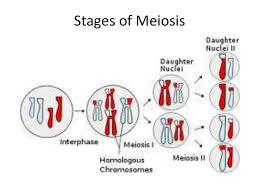
Which process and type of resulting cells are represented in the diagram?
a)
meiosis, which produces body cells
b)
mitosis, which produces body cells
c)
meiosis, which produces body cells
d)
meiosis, which produces gametes
26.
When an area of a chromatid is exchanged with the matching area on a chromatid of its homologous chromosome, ____ occurs.
a)
mutagenesis
b)
hybridization
c)
crossing over
d)
fertilization
27.
Which of the following statements correctly describes meiosis?
a)
Meiosis does not occur in reproductive cells.
b)
The cells produced at the end are identical 
c)
the cells produced at the end contain half the # of chromosomes
d)
cells divide only once during meiosis
28.
The cells produced via meiosis are called:
a)
sex cells
b)
somatic cells
c)
body cells
d)
skin cells
29.
What does ATP stand for?
a)
Adenosine triphosphate
b)
Adenosine diphosphate
c)
Adenosine biphosphate
d)
Adenosine triphate
30.
What are the products of photosynthesis?
a)
water, oxygen and carbon dioxide
b)
carbon dioxide and glucose
c)
glucose, oxygen and water
d)
glucose and water
31.
Which substance in leaves absorbs light?
a)
Stomata
b)
Chloroplast
c)
Chlorophyll
d)
Xylem
32.
What wavelengths of light does chlorophyll reflect?
a)
blue
b)
yellow
c)
red
d)
green
33.
What is the name for the gel-like matrix, rich in enzymes that is enclosed by the inner membrane of the chloroplast?
a)
stroma
b)
stomata
c)
grana
d)
thylakoid membranes
34.
When thylakoid membranes are stacked together they are known as _____?
a)
granda
b)
grande
c)
gaga
d)
grana
35.
The light absorbing pigments, such as chlorophyll and carotenoids, are located in the ________?
a)
cell wall
b)
stroma
c)
thylakoid membrane
d)
stomata
36.
When a chlorophyll molecule in the thylakoid membrane absorbs light energy and the electrons within become energised, this is know as the.....?
a)
Light dependent stage
b)
Light independent stage
37.
The light energy absorbed in photosynthesis splits water molecules into.......?
a)
hydrogen and oxygen
b)
hydrogen ions and oxygen
c)
hydrogen ions and oxygen gas
d)
hydrogen and oxygen gas
38.
Which of the following is the correct equation for photosynthesis?
a)
6CO2 + 12H2O ---> C6H12O6 + 6O2
b)
6CO2 + 6H2O ---> C6H12O6 + 6O2 + 6H2O
c)
6CO2 + 12H2O ---> C6H12O6 + 6O2 + 6H2O
d)
6O2 + 12H2O ---> C6H12O6 + 6CO2 + 6H2O
39.
Where does the light independent stage of photosynthesis occur?
a)
grana
b)
stroma
c)
thylakoid membranes
d)
cytosol
40.
Which organisms perform Photosynthesis?
a)
Only Autotrophs
b)
Only Heterotrophs
c)
Autotrophs and Heterotrophs
41.
What is the pigment in chloroplasts that performs photosynthesis?
a)
Chlorosynthesis
b)
Chlorophyll
c)
ADP
d)
Electron Transport
42.
Which gas is removed from the atmosphere during photosynthesis?
a)
hydrogen
b)
oxygen
c)
nitrogen
d)
carbon dioxide
43.
Which of the following is NOT a product of the light-dependent reactions?
a)
ATP
b)
NADPH
c)
Oxygen
d)
Glucose
44.
What is the primary function of the light-dependent reactions of photosynthesis?
a)
To produce glucose
b)
To produce NADPH and ATP
c)
To use ATP
d)
To produce RuBP
45.
Use the diagram to answer the question. Which chemical is an electron carrier molecule?
a)
H2O
b)
carbon dioxide
c)
NADP+
d)
oxygen
46.
Which of the following is considered a waste product of photosynthesis?
a)
glucose
b)
oxygen
c)
carbon dioxide
d)
sunlight
47.
Animal cells do not have chloroplasts.
a)
TRUE
b)
FALSE
48.

What stage of photosynthesis would letter "E" be called?

a)

Calvin cycle

b)

Light Independent reactions

c)

Light dependent reactions

d)

Krebs cycle

49.
What does the prefix photo-  mean?
a)
Putting togher
b)
Light
c)
Camera
d)
To make energy
50.
What gives plants their green color?
a)
stomata
b)
Chloroplasts
c)
Ribosomes
d)
Mitochondria
51.
What are the raw materials of photosynthesis?
a)
water and carbon dioxide
b)
glucose and energy
c)
glucose and water
d)
carbon dioxide and oxygen
52.
What are the products of photosynthesis?
a)
oxygen and carbon dioxide
b)
water and glucose
c)
carbon dioxide and water
d)
glucose and oxygen
53.

_____ + 6H2O yields C6H12O6 + 602

a)

2CO6

b)

CO2

c)

6CO2

d)

6O2

54.

6CO2 + ______ yields C6H12O6 + 6O2

a)

6HO

b)

12H2O

c)

6H2O

d)

H6O

55.

Where does the Calvin Cycle take place?

a)

thylakoids

b)

granum

c)

stroma

56.

What does the Calvin Cycle produce?

a)

carbohydrates (glucose)

b)

ATP

c)

ADP

d)

water

57.

Which stage of photosynthesis uses carbon dioxide to produce glucose (carbohydrates/sugars)?

a)

Light dependent reaction

b)

Kreb Cycle

c)

cytoplasm

d)

Calvin Cycle / Light-Independent reaction

58.

What is another name for the Light-independent reaction?

a)

Kreb cycle

b)

Calvin Cycle

c)

Kelvin Cycle

d)

Bicycle

59.
The two main stages of photosynthesis are the
a)
light reactions and respiration
b)
dark reactions and the Calvin cycle 
c)
light reactions and the Calvin cycle
d)
dark reactions and fermentation
60.

What does ATP synthase do?

a)

Create ATP

b)

Break down ATP.

c)

Break down NADPH.

d)

Create NADPH.

61.
This molecule contains three phosphate groups
a)
ADP
b)
ATP
c)
Mitochondria
d)
Nucleus
62.
This molecule contains two phosphate groups
a)
ADP
b)
ATP
c)
Mitochondria
d)
Nucleus
63.
This process releases chemical energy from sugars and other carbon-based molecules to make ATP when oxygen is present.
a)
photosynthesis
b)
light-independent reaction
c)
cellular respiration
d)
light-dependent reaction
64.
Glucose is broken down during which process
a)
Krebs cycle
b)
Calvin cycle
c)
Glycolysis
d)
Photosynthesis
65.
What is the net gain of ATP during glycolysis?
a)
1
b)
2
c)
3
d)
4
66.
Glycolysis takes place in the 
a)
mitochondria
b)
cell membrane
c)
cytoplasm
d)
nucleus
67.
This is the first step of cellular respiration
a)
Glycolysis
b)
Lactic Acid Fermentation
c)
Alcoholic Fermentation
d)
Aerobic Respiration
68.
This process produces molecules that carry energy to the second part of cellular respiration
a)
Photosynthesis
b)
Kreb's Cycle
c)
Glycolysis
d)
Electron Transport Chain
69.
Which is not a waste product of cellular respiration?
a)
Water
b)
Heat
c)
Carbon Dioxide
d)
Oxygen
70.
Up to how many ATP molecules are made from the breakdown of one glucose molecule?
a)
2
b)
24
c)
38
d)
45
71.
This process does not make ATP alone, but it allows glycolysis to continue making ATP when oxygen is unavailable for cellular respiration.
a)
Fermentation
b)
Electron Transport Chain
c)
Glycolysis
d)
Kreb's cycle
72.
This means that oxygen is needed
a)
anaerobic 
b)
aerobic
73.
This means that oxygen is not needed
a)
anaerobic 
b)
aerobic
74.
The number of ATP molecules produced out of Krebs Cycle is:
a)
2
b)
3
c)
4
d)
0
75.
How many FADH2 molecules are produced by 1 molecule of glucose?
a)
1
b)
2
c)
3
d)
4
76.
How many FADH2 molecules are produced by 1 turn of the Krebs Cycle?
a)
1
b)
2
c)
3
d)
4
77.
How many NADH molecules are produced by a molecule of glucose through the Krebs' Cycle?
a)
2
b)
3
c)
4
d)
6
78.
Which of the following is not a requirement for the Krebs Cycle?
a)
NAD+
b)
FAD+
c)
Water
d)
Pyruvate
79.
Krebs Cycle takes place in the:
a)
Cytoplasm
b)
Matrix
c)
Ribsome
d)
InterMembrane Space
80.
Krebs Cycle is part of_______________ respiration.
a)
Aerobic
b)
Anaerobic
81.
Prior to entering the Krebs Cycle, each pyruvate molecule loses electrons, hydrogen ions, and a carbon, forming an energy-rich molecule of
a)
Acetyl-CoA
b)
Citrate
c)
Oxaloacetate
d)
Malate
82.
A single water molecule is held together by
a)
polar covalent bonds
b)
nonpolar covalent bonds
c)
hydrogen bonds
d)
ionic bonds
83.
Which of the following are characteristics of water that contribute to its biological 'usefulness'?
a)
hydrogen bonds allow for cohesion & adhesion
b)
polar covalent bonds allow for cohesion & adhesion
c)
nonpolar shape allows dissolving of nonpolar particles
d)
polar shape allows dissolving of nonpolar particles
84.
Isotopes differ in their
a)
number of neutrons
b)
number of protons
c)
number of electrons
d)
atomic number
85.
When an atom gains electrons, it
a)
forms a negatively charged ion
b)
forms a positively charged ion
c)
forms covalent bonds
d)
gains atomic mass
86.

Elements are made of what?

a)

Atoms

b)

Ions

c)

Cells

d)

Tissue

87.

Atoms are made of these particles.

a)

Ions

b)

Electrons and Protons

c)

Neutrons and Protons

d)

Protons, Neutrons, and electrons

88.

Atoms form bonds by losing, gaining, and sharing what?

a)

Protons

b)

Neutrons

c)

Electrons

d)

Particles

89.

These are types of bonds between atoms (click all that apply)

a)

Ionic bond

b)

Covalent bond

c)

Atom bond

d)

Hydrogen bond

90.

Chemical bonds form when neutral atoms _____ and ______ electrons

a)

lose and gain

b)

ionize and repel

c)

share and care

d)

repel and replace

91.

Chemical bonds form when neutral atoms share protons

a)

True

b)

False

92.

Enzymes

a)

are able to heat up molecules so that they can react.

b)

provide CO2 for chemical reactions.

c)

are biological catalysts.

d)

absorb excess heat so that reactions occur at low temperatures.

93.

Which of the following is a macromolecule?

a)

Glucose

b)

Protein

c)

Amino Acid

d)

Water

94.

Which 3 elements are often found in organic compounds?

a)

Nitrogen, Hydrogen, and Oxygen

b)

Carbon, Hydrogen, and Neon

c)

Carbon, Hydrogen, and Oxygen

d)

Nitrogen, Chlorine, and Phosphorus

95.

Which of the following is NOT an organic macromolecule?

a)

Ice

b)

Protein

c)

Carbohydrate

d)

Nucleic Acid

96.

All organic compounds contain the element...

a)

N

b)

Na

c)

Ca

d)

C

97.

What pH is neutral?

a)

1

b)

7

c)

14

d)

6

98.

What pH are acids?

a)

7

b)

0-6

c)

16

d)

8-14

99.

What is the phrase on how enzymes fit together?

a)

They don't

b)

Like a door frame

c)

Like a tooth and socket

d)

Like a lock and Key

100.

Which organic macromolecule is metabolized to provide cells with "quick energy"?

a)

protein

b)

lipid

c)

carbohydrate

d)

nucleic acid

101.

Which organic macromolecule is used for long-term energy and waterproofing?

a)

protein

b)

lipid

c)

carbohydrate

d)

nucleic acid

102.

"Genetic material" always describes...

a)

carbs

b)

lipids

c)

proteins

d)

nucleic acids

103.

The substances that start a chemical reaction are called products.

a)

true

b)

false

104.

Which of the following is an example of a compound?

a)

carbon

b)

sodium dioxide

c)

hydrogen

d)

helium

105.

Proteins that speed up biochemical reactions are_________?

a)

DNA

b)

chromosomes

c)

enzymes

d)

genes

106.

Long chains of amino acids are found in...

a)

Sugars

b)

Proteins

c)

Lipids

d)

Carbohydrates

107.

What do nucleic acids include?

a)

DNA and RNA

b)

Glucose and Glycogen

c)

Lipids and Sugars

d)

Chlorophyll and Retinal

108.

Amino Acids are units of what?

a)

Proteins

b)

Disaccharides

c)

Nucleotides

d)

Steroids

109.
Which is an example of a carbohyrdate?
a)
wax
b)
bread
c)
DNA
d)
red meat
110.
What substance speeds up a chemical reaction?
a)
reusable
b)
catalyst
c)
specific
d)
fragile
111.

What is the best definition of genotype?

a)

the physical appearance of an organism

b)

set of alleles for a given trait

112.

What is an allele?

a)

an alternative form a gene

b)

the correct form a gene

c)

a mutated form a gene

d)

the gene that is expressed

113.

Which genotype represents a recessive trait?

a)

PP

b)

Pp

c)

pp

114.

Recessive traits are always homozygous.

a)

True

b)

False

115.

Which statement is true of a plant with genotype TT and another with genotype Tt?

a)

each would have differing phenotypes

b)

all alleles are dominant

c)

all alleles are recessive

d)

both have the same phenotype

116.

Which statement is true of the plant offspring using the Punnett Square above

a)

50% of the offspring will be short

b)

100% of the offspring will be dominant

c)

75% of the offspring will be tall.

d)

25% of the offspring will be tall.

117.

Which is an example of incomplete dominance?

a)

the adult height of a human

b)

Blood types

c)

hair color in humans

d)

a pink snap dragon flower with red and white parents

118.

The law of segregation states that ________.

a)

alleles for different traits are distributed independently

b)

only one form of the trait will appear in the offspring

c)

allele pairs separate during gamete formation

119.

____ of offspring would have the same phenotype as the parents if the cross was Yy by Yy?

a)

25%

b)

50%

c)

75%

d)

100%

120.

What is the ratio of offspring when 2 heterozygous plants (Tt) for a certain trait are crossed?

a)

50% TT : 50% Tt

b)

50% TT : 50% tt

c)

100% TT : 0% tt

d)

25% TT : 50% Tt : 25% tt

121.

What are the genotypes for a purebred dominant and purebred recessive plant for a given trait?

a)

All are homozygous dominant

b)

All are heterozygous dominant

c)

All are homozygous recessive

d)

50% homozygous dominant and 50% heterozygous dominant

122.

Which is an example of a polygenic trait?

a)

eye color

b)

snapdragon flower color

c)

clef palate

d)

blood type

123.

What term describes a gene with two dominant alleles that are both expressed at the same time?

a)

codominance

b)

incomplete dominance

c)

polygenic

d)

mutations

124.

What contains the alleles/genes for a cell?

a)

Chromosomes

b)

Punnetts

c)

Vacuoles

d)

Meiosis

125.

A white flower is pp. What is it's GENOTYPE?

a)

Flower

b)

pp

c)

white

d)

Pp

126.

A white flower is pp. What is it's PHENOTYPE?

a)

Flower

b)

pp

c)

white

d)

Pp

127.

If red and white are INCOMPLETE dominance, what color would a RW flower be?

a)

Red

b)

White

c)

Pink

d)

Purple

128.

Which one is a hetrozygous genotype?

a)

Pink

b)

Short

c)

Gg

d)

PP

129.
What is being represented by the letter A in the image?
a)
Substrate
b)
Enzyme
c)
Product
d)
Complex
130.
What is being represented by the letter B in the image?
a)
Substrate
b)
Enzyme
c)
Substrate
d)
Product
131.
If an enzyme becomes over heated what effect, if any, will the heat have on the enzymatic activity? 
a)
The enzyme will not store much chemical energy.
b)
The enzyme will not be able to catalyze reactions.
c)
The enzyme will lose its net electrical charge.
d)
The enzyme will lose stored genetic information.
132.
What is an Enzyme?
a)
energy needed to get a reaction started
b)
arge compound formed from combinations of many monomers
c)
proteins that act as biological catalyst
d)
an organic compound
133.
What is a Cataylst?
a)
A substance that speeds up a rate of chemical reaction.
b)
Molecules that make enzymes work harder and faster 
c)
reaction of an enzyme
d)
A substance that slows down a rate of chemical reaction.
134.
Enzymes are usually....
a)
Protiens
b)
Lipids
c)
Carbohydrates
d)
None of the Above
135.
Enzymes will make a reaction go _______ and use ______ energy.
a)
faster, less
b)
faster, more
c)
slower, less
d)
slower, more
136.
What makes an enzyme substrate specific?
a)
Size
b)
Shape
c)
Name
d)
Location it is found in
137.
The name given to the internal balance that a cell maintains with its external environment.
a)
velocity
b)
membrane
c)
homeostasis
d)
circulation
138.
What type of reproduction requires two parents?
a)
asexual
b)
sexual
139.
This is an organism made of one cell.
a)
multicellular
b)
unicellular
c)
colonial
d)
plant kingdom
140.
Sexual reproduction involves...
a)
One parent
b)
Two parents
141.
All living things are all made of: 
a)
tissues 
b)
organs
c)
cells
d)
atoms
142.
Living things need to take in_____________.
a)
atoms
b)
molecules
c)
energy
d)
air
143.
Living things get larger and mature through their life cycle. This is an example of: 
a)
homeostasis
b)
DNA
c)
Growth and development
d)
Evolution
144.
A group of tissues that works together for a common function is called ___.
a)
organ
b)
cell
c)
organ system
d)
organism
145.
A group of tissues that works together for a common function is called ___.
a)
organ
b)
cell
c)
organ system
d)
organism
146.
Define BIOLOGY.
a)
The study of life and living organisms.
b)
The study of animals.
c)
They study of matter.
d)
The study of earth and its atmosphere.
147.
The study of heredity and the variation of inherited characteristics 
a)
gene
b)
genetics 
c)
meiosis 
d)
hybrid 
148.
The powerhouse of the cell. 
a)
golgi apparatus
b)
mitochondria
c)
vacuole
d)
ribosome
149.
Modifies, sorts and packages proteins
a)
golgi apparatus
b)
mitochondria
c)
vacuole
d)
ribosome
150.
Controls what enters and leaves the cell
a)
golgi apparatus
b)
mitochondria
c)
vacuole
d)
cell membrane
151.
The control center of the cell, the "brain"
a)
golgi apparatus
b)
nucleus
c)
vacuole
d)
cell membrane
152.
Do bacteria cells have a nucleus?
a)
Yes
b)
No
153.
Energy for active transport comes from a cell's 
a)
golgi apparatus
b)
lysosomes
c)
vacuoles
d)
mitochondria
154.
A large fluid-filled vesicle located in the cytoplasm of a plant cell; stores water, enzymes, and waste
a)
Lysosome
b)
Vacuole
c)
Flagella
d)
Centrioles
155.
__________ cells have chloroplasts. 
a)
Plant 
b)
Animal 
156.
surrounds the cell; regulates what enters/leaves cell; maintains homeostasis
a)
vacuole
b)
cell wall
c)
cell membrane
d)
lysosome
157.
The main function of chloroplasts is:
a)
To control what enters and leaves the cell.
b)
To break down food to release energy for the cell.
c)
To control all activities of the cell.
d)
To produce food for the cell using the sun's energy.
158.

Check the 3 parts of the cell theory

a)

only prokaryotic cells exist

b)

plant cells do not have a nucleus

c)

all cells come from pre-existing cells

d)

all animal cells are prokaryotes

e)

all living things are made of cells

159.

_______________ discovered and named cells.

a)

Anton Van Leeuwenhoek

b)

Robert Hooke

c)

Captain Hook

d)

Alfred Henry Hook

160.

has a nucleus

a)

eukaryote

b)

prokaryote

c)

both

161.

doesn't have membrane bound organelles

a)

eukaryote

b)

prokaryote

c)

both

162.

includes all animals

a)

eukaryote

b)

prokaryote

c)

both

163.

has cytoplasm

a)

eukaryote

b)

prokaryote

c)

both

164.

includes all bacteria

a)

eukaryote

b)

prokaryote

c)

both