wayground logo

Free Printable Worksheets

Font size

S
M
L
XL
Worksheets

SOL Questions Biology

Total questions: 165

Worksheet time: 2hrs 29mins

Name
Class
Date
1.
Which variable do "I" change intentionally?
a)
Independent variable
b)
Dependent variable
c)
Constant
d)
s
2.
What is happening to the temperature in New York City?
a)
It is remaining about the same.
b)
It is mostly decreasing.
c)
It is mostly increasing.
d)
There is a pattern of increasing and decreasing.
3.
Which variable may change and probably will change in the experiment, but "I" don't change it?
a)
Independent variable
b)
Dependent variable
c)
Constant
4.
The number of apples in this basket is ______________________ data?
a)
quantitative
b)
qualitative
c)
independent
d)
dependent
5.
The dependent variable in this experiment is - 
a)
Number of Bacteria
b)
Time of Incubation
c)
Culture Number
d)
Type of Bacteria
6.
What can you infer about the temperature for E.coli bacterial growth?
a)
E. coli does not grow well at low and high temperatures.
b)
E coli will continue to grow at very high temperatures.
c)
E.coli grows best at very low temperatures
d)
E.coli grows best at very high temperatures.
7.

How many Macro-Molecules are we learning about?

a)

1

b)

2

c)

3

d)

4

8.

What are Carbohydrates made from?

a)

Carbon

b)

Hydrogen

c)

Oxygen

d)

Nitrogen

e)

Phosphorus

9.

What are Lipids made from?

a)

Carbon

b)

Hydrogen

c)

Oxygen

d)

Nitrogen

e)

Phosphorus

10.

What are Nucleic Acids made from?

a)

Carbon

b)

Hydrogen

c)

Oxygen

d)

Nitrogen

e)

Phosphorus

11.

What are Proteins made from?

a)

Carbon

b)

Hydrogen

c)

Oxygen

d)

Nitrogen

e)

Phosphorus

12.

What is the monomer of a carbohydrate?

a)

monosaccharide

b)

nucleotide

c)

amino acid

d)

Glycerol "heads" and fatty acid "tails"

13.

What is the monomer of a lipid?

a)

monosaccharide

b)

nucleotide

c)

amino acid

d)

Glycerol "heads" and fatty acid "tails"

14.

What is the monomer of a protein?

a)

monosaccharide

b)

nucleotide

c)

amino acid

d)

Glycerol "heads" and fatty acid "tails"

15.

What is the function of a carbohydrate?

a)

store genetic information

b)

long term energy storage

c)

short term energy storage

d)

many many many things...muscle growth, cell transport, lower activation energy...

16.

What is the function of a lipid?

a)

store genetic information

b)

long term energy storage

c)

short term energy storage

d)

many many many things...muscle growth, cell transport, lower activation energy...

17.

What is the function of a nucleic acid?

a)

store genetic information

b)

long term energy storage

c)

short term energy storage

d)

many many many things...muscle growth, cell transport, lower activation energy...

18.

What is the function of a protein?

a)

store genetic information

b)

long term energy storage

c)

short term energy storage

d)

many many many things...muscle growth, cell transport, lower activation energy...

19.

Example of a carbohydrate

a)

Glucose

b)

DNA

c)

Oils

d)

Meat

20.

Example of a lipid

a)

Glucose

b)

DNA

c)

Oils

d)

Meat

21.

Example of a nucleic acid

a)

Glucose

b)

DNA

c)

Oils

d)

Meat

22.
DNA and RNA are examples of...
a)
proteins
b)
nucleic acids
c)
carbohydrates
d)
lipids
23.
What is the function of ATP in living things?
a)
provides energy for cells
b)
stores genetic information
c)
provides structure in the nucleus
24.
Autotroph or Heterotroph?
a)
Autotroph
b)
Heterotroph
25.
The mitochondria is responsible for ...
a)
photosynthesis
b)
anaerobic respiration
c)
aerobic respiration
d)
fermentation
26.

The process of photosynthesis enables plants to sustain themselves by creating...?

a)

glucose

b)

chlorophyll

c)

water vapor

d)

carbon dioxide

27.

Which of the following illustrate energy transformation that occurs during photosynthesis?

a)

Light--> leaf--> chemical energy

b)

electrical --> leaf --> thermal energy

c)

Thermal energy --> leaf --> light energy

d)

chemical energy --> leaf --> mechanical energy

28.

Photosynthetic plants transform radiant energy into...?

a)

chemical energy

b)

electricity

c)

solar energy

d)

heat energy

29.

Which of these best classifies the form of energy that is converted to consumable forms in the food chain?

a)

Heat

b)

light

c)

mechanical

d)

gravitational

30.

Which of the following is REQUIRED for cell respiration?

a)

ATP

b)

Carbon Dioxide

c)

Oxygen

d)

Sunlight

31.

Which of the following is the correct chemical equation for cell respiration?

a)

6CO₂ + C₆H₁₂O₆ + 6O₂+ ATP --> H₂0

b)

CO₂ + H₂0 + light energy in Chlorophyll ---> C₆H₁₂O₆ + 6O₂

c)

6CO₂ + 6H₂0 + light energy in Chlorophyll ---> C₆H₁₂O₆ + 6O₂

d)

C₆H₁₂O₆ + 6O₂ ---> 6CO₂ + 6H₂0 + ATP

32.

Which of the following is the correct chemical equation for photosynthesis?

a)

6CO₂ + C₆H₁₂O₆ + 6O₂+ light energy in Chlorophyll ---> H₂0

b)

CO₂ + H₂0 + light energy in Chlorophyll ---> C₆H₁₂O₆ + 6O₂

c)

6CO₂ + 6H₂0 + light energy in Chlorophyll ---> C₆H₁₂O₆ + 6O₂

d)

C₆H₁₂O₆ + 6O₂ ---> 6CO₂ + 6H₂0 + ATP

33.
When a cell is not actively dividing, it is in what phase?
a)
interphase
b)
anaphase
c)
prophase
d)
telophase
34.
When a cell divides, what do we call the 2 new cells?
a)
mother cells
b)
father cells
c)
daughter cells
d)
son cells
35.
a)
Cytokinesis
b)
Interphase
c)
Anaphase
d)
Metaphase
36.
In meiosis, the haploid number of chromosomes in a human sex cell is:
a)
46
b)
92
c)
22
d)
23
37.
When you start with 1 cell, at the end of mitosis, how many identical cells will you have?
a)
1
b)
2
c)
3
d)
4
38.
a)
Anaphase
b)
Cytonkinesis
c)
Interphase
d)
Prophase
39.
After meiosis is complete how many cells will there be?
a)
1
b)
2
c)
3
d)
4
40.
Another name for a sex cell is a:
a)
gamete
b)
embryo
c)
bone cell
d)
muscle cell
41.
Place these cells in order of mitosis.
a)
A, B, C, D, E
b)
B, E, D, A, C
c)
C, E, A, D, B
d)
B, D, A, E, C
42.
a)
Anaphase
b)
Cytokinesis
c)
Telophase
d)
Metaphase
43.
Which is the correct order for organisation in multi-celluar organisms:
a)
Cell, Tissue, Organ system, Organism
b)
Organ, Tissue, Cell, Organism
c)
Cell, Tissue, Organ, Organ System
d)
Tissue, Cell, Organ, Organ System
44.
What is the cell cycle in order?
a)
Interphase, Prophase, Metaphase, and Cytokinesis
b)
Prophase, Metaphase, Anaphase, and Telophase
c)
Interphase, Prophase, Metaphase,  Anaphase, Telophase, and Cytokinesis
d)
Cytokinesis, Anaphase, Prophase, Interphase, and Metaphase
45.
a)
Cytokinesis
b)
Anaphase
c)
Telophase
d)
Prophase
46.
You inherited...
a)
most of your chromosomes from your mother
b)
most of your chromosomes from your father
c)
a random number of chromosomes from each parent
d)
half your chromosomes from your mother and half from your father.
47.
a)
Prophase
b)
Interphase
c)
Anaphase
d)
Telophase
48.
Human eggs and sperm are _____, and each has ____ chromosomes.
a)
diploid, 23
b)
diploid, 46
c)
haploid, 23
d)
haploid, 46
49.
What is the first phase of Mitosis?
a)
Prophase
b)
Metaphase
c)
Anaphase
d)
Telophase
50.
Why do we need meiosis?
a)
To double the number of chromosomes going into sex cells
b)
To halve the number of chromosomes going into sex cells
c)
To triple the number of chromosomes going into sex cells
d)
To not change the number of chromosomes going into sex cells
51.
The result of meiosis is:
a)
two diploid cells
b)
two haploid cells
c)
four diploid cells
d)
four haploid cells
52.
The chromosomes that pair up during meiosis, are called __________ chromosomes.  
a)
homozygous 
b)
asexual
c)
homologous
d)
genes
53.
A human zygote should have _____ chromosomes inside.
a)
46
b)
23
c)
92
d)
64
54.
During what phase of the cell cycle is DNA replicated?
a)
G1 phase
b)
S phase
c)
G2 phase
d)
M phase
55.

In the following structure, the circled item is a

a)

chromosome

b)

chromatid

c)

centromere

d)

chromatin

56.
Structure (b) is a ____.
a)
chromosome
b)
chromatid
c)
centromere
57.
In which type of cells will mitosis occur?
a)
egg cells
b)
sperm cells
c)
jail cells
d)
Body cells except the sperm and egg cells
58.
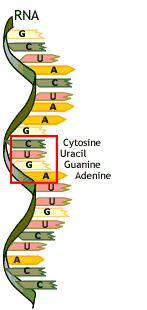
In RNA, Uracil pairs with ______. 
a)
cytosine
b)
adenine
c)
guanine
d)
thymine
59.
The process to go from DNA to mRNA is _______
a)
translation
b)
transcription
c)
replication
60.
The process to go from mRNA to a protein is called ____
a)
transcription
b)
rRNA
c)
replication
d)
translation
61.
DNA holds the code for
a)
lipids
b)
carbohydrates
c)
protein
d)
sugar
62.
Choose the nucleotide sequence of the RNA strand that would be complementary to the following strand: 
GTAGTCA
a)
UATUAGA
b)
ACGACTG
c)
CAUCAGU
d)
CATCAGT
63.
The main function of tRNA is to...
a)
carry a message that, when translated, forms proteins
b)
form a portion of ribosomes
c)
string together complementary RNA and DNA strands
d)
bring amino acids from the cytoplasm to the ribosomes
64.
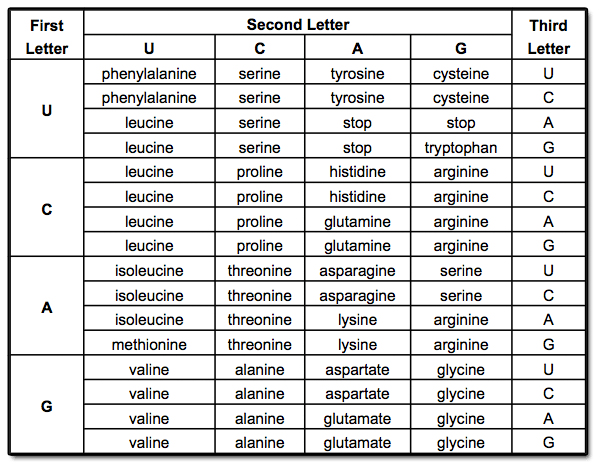
What amino acid is represented by the codon UUA?
a)
Phenylalanine
b)
Tyrosine
c)
Leucine
d)
Stop codon
65.
What process is going on in this photo? 
a)
Transcription 
b)
Translation 
c)
Replication 
d)
All the above 
66.
Which component of DNA determines the traits of an organism? 
a)
Nitrogen Bases
b)
Sugar-Phosphate Backbone
c)
Hydrogen bonds
67.

What is the location in the cell for translation?

a)

nucleus

b)

mitochondria in cytoplasm

c)

ribosome in cytoplasm

d)

chloroplast in cytoplasm

68.
What is the three base sequence of mRNA that codes for a single amino acid?
a)
Anticodon
b)
Codon
c)
Protein
69.
What is the location in the cell for transcription?
a)
nucleus
b)
cytoplasm
c)
ribosome
d)
mitochondria
70.
Translation is the process where
a)
mRNA is created in the Nucleus
b)
mRNA is decoded to form a protein 
c)
glucose molecules are made
d)
is where lipids are synthesised
71.
Does the order of amino acids in a protein matter?
a)
YES!
b)
NO!
72.

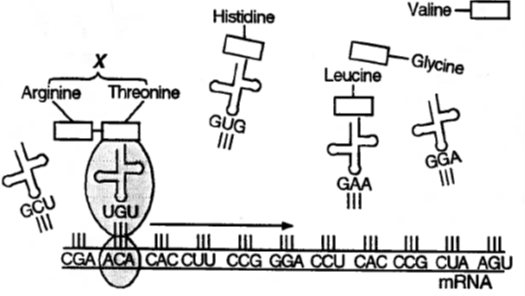
What process is happening in the diagram?

a)

transcription

b)

translation

c)

dna replication

d)

mitosis

73.
Genotype refers to the ...
a)
physical expression of the genes
b)
the possible combination of alleles in a gene
c)
whether an allele is dominant or recessive
d)
how an organism will appear
74.
What is a phenotype
a)
The genetic make up (code)
b)
The physical trait
75.
having two of the same genes for the trait (sometimes called purebred).
a)
homozygous
b)
hetrozygous
c)
protein
d)
chromosome
76.
having two different genes for a trait (sometimes called hybrid).
a)
protein
b)
homozygous
c)
heterozygous
d)
genotype
77.
G = green, g = yellow
The genotype for a yellow plant is...
a)
GG
b)
Gg
c)
gg
d)
all of the choices result in yellow
78.
Where, in the eukaryotic cell, is DNA located?
a)
ribosomes
b)
nucleus
c)
E.R.
d)
cytoplasm
79.
Term for an organism that display two dominant phenotypes at the same time
a)
codominance
b)
incomplete dominance
c)
multiple alleles
d)
linked genes
80.
What does heterozygous mean?
a)
An organism that has the same genes for a trait (TT or tt)
b)
An organism that has different genes for a trait (Tt)
c)
When neither gene is fully dominant; offspring is a mixture of both
d)
the different forms of a trait (hair color--> brown, blonde, red
81.
Incomplete dominance means that the traits are
a)
expressed equally
b)
dominant
c)
recessive
d)
blended
82.
Which of the following is homozygous dominant?
a)
Yy
b)
Y
c)
yy
d)
YY
83.
An allele whose trait only shows up when no dominant allele is present.
a)
hidden allele
b)
dominant allele
c)
recessive allele
d)
present allele
84.
What type of "square" helps us solve genetic problems?
a)
carpenter square
b)
Mendel square
c)
Punnett square
d)
genetic square
85.
A single cross such as flower color.
a)
mono hybrid
b)
dihybrid
c)
crossing over
d)
homozygous
86.
TT,tt,PP,pp,SS,ss are examples of alleles that are?
a)
homozygous
b)
heterozygous
c)
different
d)
homologous 
87.
The exact genetic makeup of an organism, such as RR, Tt, PP is its?
a)
phenotype
b)
dominance
c)
genotype
d)
trait
88.
Females-XX; MalesXY.  A couple has 4 girls.  What is the chance the next child will be a boy?
a)
75%
b)
100%
c)
25%
d)
50%
89.
A physical characteristic that can be passed from parent to offspring.
a)
behavior
b)
trait
c)
strong muscles
d)
ability to fly a plane.
90.

Which of the following alleles is homozygous (purebred) recessive?

a)

TT

b)

Tt

c)

tt

d)

ts

91.
Which of the following genotypes is homozygous dominant?
a)
A
b)
Aa
c)
AA
d)
aa
92.
Which of the following genotypes is heterozygous?
a)
Bb
b)
BB
c)
bb
d)
B
93.
This type of allele masks the recessive allele and is capital ________________
a)
Dominant
b)
Homozygous
c)
Genotype
d)
Phenotype
94.
In rabbits, black fur (B) is dominant over brown fur (b). If a rabbit has brown fur, what can you conclude about its genotype?
a)
It is BB.
b)
It is Bb
c)
It is brown
d)
It is bb.
95.
T - tall and t = short
In the punnett square below, what belongs in the missing square
a)
tt
b)
Tt
c)
Bb
d)
TT
96.
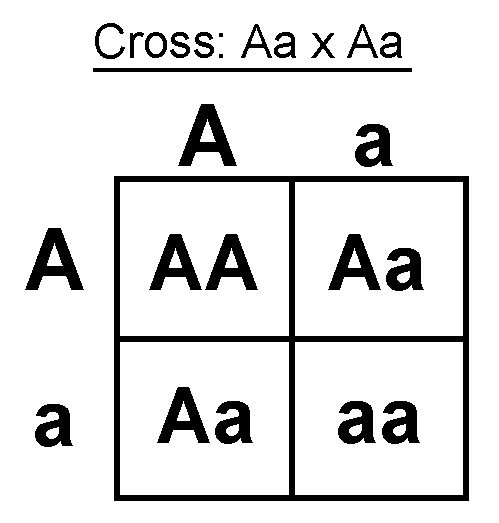
What allele combination should go in the missing box?
a)
AA
b)
Aa
c)
aa
d)
none of these
97.
If B = brown hair and b = blonde hair, what is the probability of brown hair?
a)
25%
b)
50%
c)
0%
d)
75%
98.
What is the phenotype of the offspring? (A-Brown hair; a-blond hair) 
a)
50 % Brown Hair and 50% Blond Hair 
b)
25 % Brown Hair and 75% Blond Hair 
c)
75 % Brown Hair and 25% Blond Hair 
d)
0% Brown Hair and 100% Blond Hair 
99.
This is an example of ___________.
a)
 Incomplete Dominance
b)
 Codominance
100.
A calico cat shows both the traits for orange fur and black fur. What kind of allele expression is this?
a)
Incomplete Dominance
b)
Co dominance
101.
This is an example of ___________.
a)
Incomplete Dominance
b)
Codominance
102.

This type of inheritance pattern is a MIXTURE of both traits.

a)

incomplete dominance

b)

co-dominance

c)

complete dominance

103.
A tall plant (TT) is crossed with a short plant (SS) and a medium plant (TS) results. This is what type of inheritance pattern?
a)
Incomplete Dominance
b)
Codominance
104.
If you cross a black chicken with a white chicken, only checkered chickens would be produced.  What kind of inheritance pattern does this follow?
a)
incomplete Dominance
b)
Co-Dominance
105.

What is the genotype for the unknown organism?

a)

Aa

b)

aa

c)

AA

d)

AaA

106.
What are the possible genotypes for this cross?
a)
TT = 25% Tt= 50% tt=25%
b)
all tall
c)
TT= 75% tt = 25%
d)
Tt = 100%
107.
Change over time...
a)
Evolution
b)
Nucleotide 
108.
Charles Darwin came up with this theory 
a)
Natural Selection
b)
Mutation
109.
To adjust to a changing environment
a)
Mutation
b)
Adapt
110.
Darwin wrote that organisms with traits that are best suited to the environment will ________________
a)
increase in number
b)
become extinct
111.
Another word for adapt is ____________.
a)
change
b)
create
112.
Which of the following is NOT an example of natural selection? 
a)
People selectively breeding hamsters.
b)
Insect populations developing resistance to certain pesticides.
c)
Bacteria becoming resistant to antibiotics.
d)
Male birds of certain species developing colorful feathers to attract female mates.
113.
Which term refers to the process by which individuals that are better suited to the environment survive and reproduce therefore passing down their genes to their offspring? 
a)
Evolution 
b)
Variation 
c)
Adaptation
d)
Natural Selection 
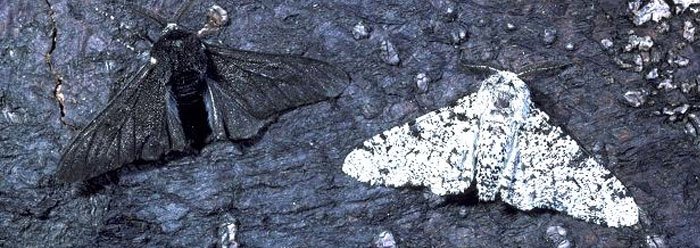
114.
The environment around Manchester, England, changed during the Industrial Revolution.  How did this change affect peppered moths living in the area?
a)
Natural selection favored moths with dark wings because predators could not see them on the soot-colored trees.
b)
Natural selection favored moths with white wings that were easy for predators to see.
c)
Natural selection favored moths with white wings because predators could not see them on the soot-colored trees.
d)
Natural selection caused moths with white wings to become extinct.
115.
When an organism completely dies out, it is called.....
a)
Adaption
b)
Extinction
c)
Fossilization
d)
Mutation
116.
The separation of a group of individuals from the rest of the population is referred to as 
a)
genetic drift
b)
natural selection
c)
geographic isolation
d)
survival of the fittest
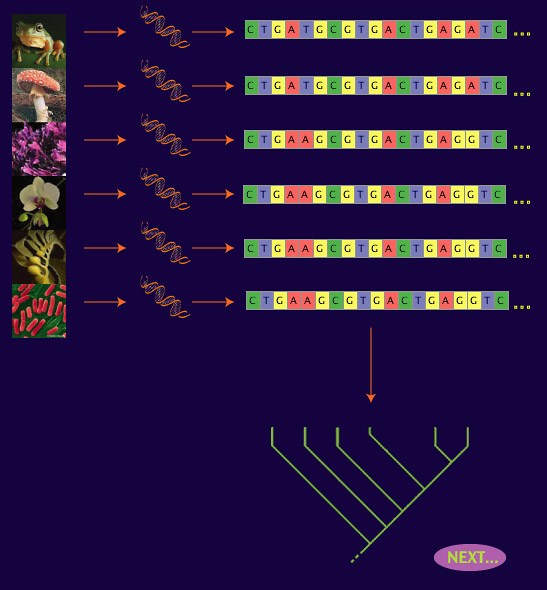
117.
Two organisms that are closely related would have
a)
very similar DNA sequence
b)
exactly the same DNA sequences
c)
no proteins in common
d)
completely different DNA sequence
118.
what did Charles Darwin observe in finch populations of the Galapagos Islands off the coast of South America?
a)
different species on different islands
b)
all species on one of the islands
c)
identical species on all the islands
d)
the same species as North America
119.
Mutations are important because they bring about
a)
death of the organism in which they develop
b)
genetic variation needed for a population to evolve
c)
benefits for the individual, not for the population
d)
Hardey-Weinberg equilibrium within a population
120.
What is the process in which humans breed organisms for certain traits?
a)
natural selection
b)
inheritance
c)
artificial selection
d)
descent withOUT modification
121.
What increases genetic variation when animals move from one population to another
a)
genetic drift
b)
sexual selection
c)
bottleneck effect
d)
gene flow
122.
What is another name for natural selection?
a)
survival of the smartest
b)
survival of the fastest
c)
survival of the biggest
d)
survival of the fittest
123.
What is the study of organisms at the early stages of development?
a)
DNA studies
b)
embryology 
c)
extinction
d)
fossil record
124.
Why are advantageous traits more likely to be passed onto offspring?
a)
Because they are more likely to survive and reproduce.
b)
Because they come from dominant alleles.
c)
Because they come from recessive alleles.
d)
Because the trait is an acquired phenotype.
125.
The trees these moths used to live on were white, but have been covered in soot from coal factories. Which moth will be more successful in this environment?
a)
Dark moth
b)
Light moth
c)
Both will be equally successful
d)
Neither will be successful
126.
Structures with the same parts have different functions; suggests that organisms share a common ancestry
a)
vestigial structures
b)
homologous structures
c)
adaptive radiation
d)
fossil
127.
Study of embryos of various organisms to show a common ancestor because of similarities in development
a)
natural selection
b)
embryology
c)
speciation
d)
evolution
128.
The diagram shows fossils in different rock layers. Which of these statements about the age of these fossils is most likely correct?
a)
Fossil A and C are the same age
b)
Fossil B is older than fossil C
c)
Fossils A is older than fossil B
d)
Fossil D is older than fossil C
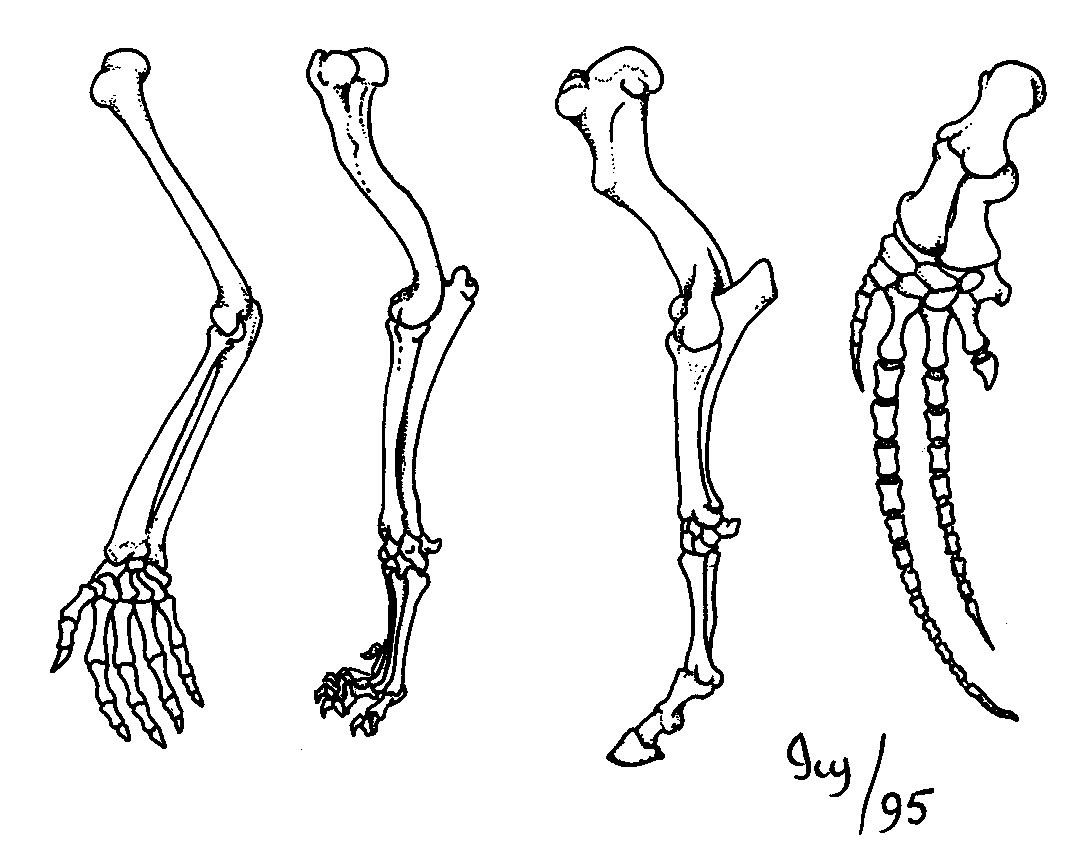
129.
What type of structures are these?
a)
homologous
b)
vestigial 
c)
analogous
d)
fossil
130.

Whales are aquatic mammals that contain a pelvis (hip) bone. Even though it does not aid in its movement, the function must have been used by a common ancestor of the whale. Thus, the pelvis is referred to as a(n)

a)

vestigial structure

b)

analogous structure

c)

homologous structure

131.
A theory has significant evidence to support it.  True or False
a)
True
b)
False
132.
Genetic differences between organisms of the same species
a)
Variation
b)
Adaptation
c)
Behavior
d)
Environment
133.
An error in DNA copying that results in a new trait
a)
Homeostasis
b)
Mutation
c)
Natural Selection
d)
Selective Breeding
134.
Study of interactions between organisms and their environment 
a)
niche
b)
community 
c)
ecology
d)
ecosystem
135.
Members of a species in a defined area
a)
Ecosystem
b)
community
c)
biodiversity
d)
population
136.
Non-living factor that affects an ecosystem
a)
biotic factor
b)
abiotic factor
c)
food chain 
d)
biome
137.
What is the original source of almost all energy in most ecosystems?
a)
carbohydrates
b)
sunlight
c)
water
d)
carbon
138.
The nonliving aspects of an ecosystem.
a)
Abiotic factors
b)
Biotic factors
139.
A collection of organisms that belong to different populations but all live in the same area and interact with one another.
a)
Population
b)
Ecosystem
c)
Community
d)
Ecosphere
140.
Evaporation of water from the leaves of a plant gives of purified water to be evaporated.
a)
precipitation
b)
concentration
c)
transpiration
d)
evaporation
141.
Individuals that can breed with one another make up a
a)
species
b)
population
c)
community
d)
ecosystem
142.
Organisms that obtains its energy from abiotic sources, such as sunlight or inorganic chemicals
a)
Autotroph
b)
Heterotroph
c)
Omnivore
d)
Carnivore
143.

A bee receives nectar from a flower and carries the pollen to other flowers:

a)

predation

b)

parasitism

c)

mutualism

d)

commensalism

144.

Mistletoe grows and spreads on trees, taking their nutrients:

a)

predation

b)

parasitism

c)

mutualism

d)

commensalism

145.

What would happen within a few months after the formation of a volcanic island?

a)

pioneer species would grow

b)

no pioneer species would grow

c)

trees and large plants would grow

d)

rich, organic soil would be present

146.

What would be a good example of a primary consumer?

a)

carnivore

b)

detrivore

c)

decomposer

d)

herbivore

147.

Which organisms would be at the top or last trophic level?

a)

plant

b)

herbivore

c)

omnivore

d)

carnivore

148.

The monkey would be a

a)

decomposer

b)

producer

c)

primary consumer

d)

secondary consumer

149.

Introduced species disrupt ecosystems because they are a/an

a)

Keystone Species

b)

Endemic Species

c)

Invasive Species

d)

Native Species

150.

These organisms are often not shown in a food chain, but are important for recycling nutrients

a)

producers

b)

decomposers

c)

primary consumers

d)

carnivores

151.

What percentage of energy is passed on to the next trophic level?

a)

5%

b)

10%

c)

50%

d)

90%

152.
All these organisms share the same
a)
Biome
b)
Population
c)
Community
d)
Habitat
153.
Bacteria which convert nitrogen gas into bio-available forms of nitrogen, such as ammonia and nitrate, are known as _____
a)
De-nitrification bacteria 
b)
Nitrogen fixing bacteria
c)
Oxidizers
d)
Buffers
154.
In which reservoir is carbon stored the shortest period of time ______
a)
Limestone rocks
b)
The ocean
c)
The atmosphere
d)
Coal
155.
relationship in which two species live closely together
a)
resource
b)
mutualism
c)
succession
d)
symbiosis
156.
What is the term for each step in the transfer of energy and matter within a biological community?
a)
energy path
b)
food web
c)
trophic level
d)
food pyramid
157.
Who organized living things by creating binomial nomenclature?
a)
Carolus Linnaeus
b)
Robert Hooke
c)
Anton van Leeuwenhoek
d)
James Watson
158.
What are the 8 levels of classification of living things from most general to most specific?
a)
domain, kingdom, phylum, class, order, family, genus, species
b)
domain, kingdom, phylum, class, order, family, genius, species
c)
domain, kingdom, phamily, class, order, family, genus, species
d)
domain, king, phillip, class, order, family, genus, species
159.
How do scientists organize living things?
a)
by looks
b)
by shared characteristics
c)
by size
d)
by differences
160.
What is the science of organizing, classifying and naming living things.
a)
taxonomy
b)
taxadermy
c)
taxicab
d)
toxicology
161.
If two species share the same class, they also share the same______.
a)
phylum
b)
order
c)
genus
d)
species
162.
In a properly written scientific name, which part is lowercase?
a)
species
b)
genus
163.
In a properly written scientific name, which part is capitalized?
a)
species
b)
genus
164.
Who is the closest relative to the birds?
a)
crocodiles
b)
sharks
c)
fish
d)
amphibians
165.
Who is the closest relative to the sharks?
a)
crocodiles
b)
sharks
c)
ray-finned fish
d)
amphibians