
 Worksheets
Environmental Systems S1 Review
Total questions: 170
Worksheet time: 4hrs 38mins
Plants interact with living and nonliving components in their environment. Which of the following is an interaction between the plant and a nonliving element?
Small insects eating the stems of the plants
Humans breathing oxygen released by plants
Bees gathering pollen from flowers of plants
Sandy soil holding the roots of the plants
Which of these is an example of one living thing depending on another living thing?
Cat walking on the sand
Bird building a nest in a tree
Dog warming in the sunlight
Squirrel drinking water
All of the following are examples of living things interacting with each other EXCEPT —
birds preying on insects living in the grass
squirrels spreading the seeds of trees by burying them
frogs sleeping in the mud at the bottom of the pond
fish eating plants and other smaller fish

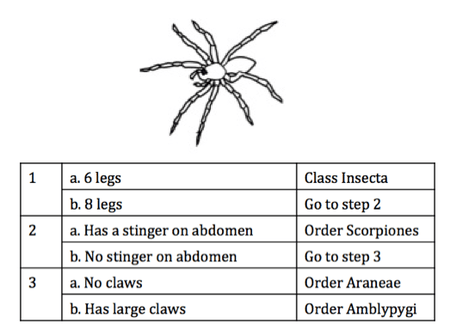
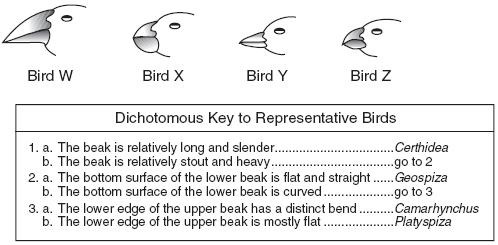

A student discovers an arachnid with a segmented abdomen, long legs, and a tail with no stinger.
The student uses the dichotomous key below to identify it.
1. a) Abdomen segmented.............go to 2
b) Abdomen not segmented ......go to 4
2. a) Abdomen with tail....................go to 3
b) Abdomen without tail...............go to 5
3. a) Tail with stinger..........................Scorpion
b) Tail without stinger.....................Whip scorpion
4. a) Legs longer than body.............Daddy Long Legs
b) Legs not longer than body……….Wind scorpion
5. a) Covered with spines .......................Mite
b) Few spines.....................................Tick
Whip Scorpion
Daddy Long Legs
Mite
Tick

Which of the paired statements could be used to tell the difference between the two insects using a dichotomous key?
Has 6 legs
Has 8 legs
Large hind legs
Small hind legs
2 pairs of spots on wing cover
3 pairs of spots on wing cover
Antennae absent
Antennae present
Species that is NOT native to a specific location AND has a tendency to spread/damage the environment:
native species
invasive species
endemic species
exotic species
extinct species
Species that are crucial to the functioning of an ecosystem
keystone species
exotic species
invasive species
indicator species
endangered species
Native to a particular place and is ONLY found there.
keystone species
native species
indicator species
endemic species
extinct species
Species that normally lives and thrives in a particular area.
keystone species
endangered species
native species
indicator species
extinct species
The variety of organisms in a given area is called:
a species
a gene
abiotic factors
biodiversity

A species that plays a critical role in the health, maintenance, growth, or definition of an ecosystem.
keystone
invasive
engineer
predator
Why are bees considered a keystone species?
The honey they make supports the bear population
They pollinate flowers that produce fruit which supports the ecosystem
They sting when threatened
They live in hives
The ecological relationship between plants and pollinators can be best described as _____________________.
parasitic
mutualistic
commensalistic
nonobligate
Match the following
Native
Occurs without human introduction
Introduced
Accidentally or deliberately brought
Invasive
Negatively impacts an ecosystem
Why do invasive species negatively impact their environment?
Invasive species only negatively impact their environment when they are animals, not plants


Invasive species alter an ecosystem by ___________in number quickly, which decreases native species and ___________ genetic diversity.
increasing / increases
increasing / decreases
decreasing / decreases
decreasing / increases

Biome with plants and grasses, but very few trees.
Grasslands
Desert
Deciduous Forest

Biome with many different species of cacti and reptiles and very little rainfall.
Desert
Tropical Rainforest

Which biome is near the equator?
Tundra
Rainforest

Which biome is the most biodiverse?
Desert
Rainforest

Two examples of fossil fuels are (a) and (b) .

Some organisms in an ecosystem are represented in
the pyramid below. In the pyramid, the arrows
labeled X represent
the loss of organisms due to predation
a decrease in photosynthetic organisms
the loss of energy in the form of heat
a decrease in available oxygen
An organism that produces its own food supply
Heterotroph
Consumer
Omnivore
Autotroph

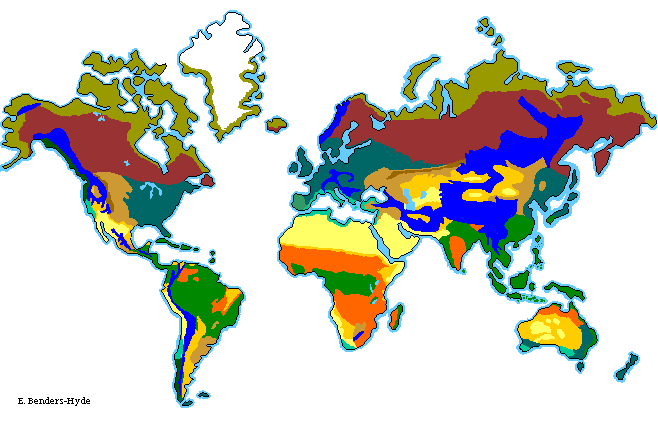

Which climate graph is for a wet and hot rainforest?

tropical rain forest

temperate deciduous forest

desert
Nonliving
Living
Populations
Vegetation
Select the tundra biome on the map

Look at the following graph to determine biome
*Hint - Temperature is the red line and the blue bars are precipitation.
25°C = 77°F
distance of any point on the surface of Earth north or south from the equator
altitude
climate
latitude

According to the graph, which Biome has the highest annual temperature along with the lowest annual precipitation?
According to the graph, which Biome has the highest annual temperature along with the highest annual precipitation?

All energy in an ecosystem comes from the sun. This energy is passed through the ecosystem as organisms eat other organsims.
Ominvores
Herbivores
Detritivores
Flow of energy

Organisms that produce their own food mostly through photosynthesis (producers). Examples are plants and algae.
Ominvore
Detritivore
Heterotroph
Autotroph

Parts of an ecosystem that are living or deal with the living. Examples include producers, consumers, decomposers, predation, disease, competition, parasitism, and symbiosis.
Abiotic Factors
Biotic Factors
Community
Population
If the producers have 1,000 joules of energy, click on the level that will have 100 joules.
Which nutrients are primarily responsible for eutrophication?
Phosphorus and nitrogen
Carbon and oxygen
Hydrogen and helium
Sulfur and potassium
Eutrophication is caused by
excess nutrients building up in the water.
industrial point-source pollution.
unlined landfills and septic tanks.
wastewater from homes mixing with drinking water.
How does eutrophication cause the death of aquatic organisms
the build up of carbon dioxide in the water
the lack of nitrogen in the water
the lack of carbon dioxide in the water
the lack of oxygen in the water
What is the original cause of eutrophication?
Too many predators
Too many herbivores
Excess fertilizer
Too much oxygen

Forests are carbon sinks because they remove carbon dioxide from the atmosphere through ____________.
combustion
respiration
photosynthesis
decomposition
Select all that apply.
Which of the following are carbon sinks.
soil and rocks
fossil fuels
forests
oceans
Select all that apply.
Which of the following are carbon sources.
fossil fuel combustion
volcanic eruptions
forests
oceans
Why should you be concerned with the size of your carbon footprint?
Sometimes its hard to find shoes that are the right size.
If we don't decrease greenhouse gas emissions Earth will continue to cool.
Greenhouse gases are becoming scarce in Earth's atmosphere.
Increases in greenhouse gases in the atmosphere are contributing to global climate change.
The main human activity that adds to an individual's carbon footprint.
usage of alternative energies (wind, solar, etc)
respiration and growth
photosynthesis by plants
usage of fossil fuels for energy

Why do living things need nitrogen?
To get energy
To make amino acids
To make proteins
To make proteins AND amino acids
What is the largest reservoir for nitrogen?
the ocean
rocks and minerals
the atmosphere
bacteria
What is the largest reservoir for water?
the ocean
rocks and minerals
the atmosphere
glaciers
A particular golf course is using large amounts of nitrogen fertilizer. What process could move this nitrogen into a local stream?
volatilization
nitrogen fixation
runoff and leaching
ammonification
The carbon in coal, oil, and natural gas came from
the combustion of fossil fuels
the remains of dead organisms
carbon-fixing bacteria in swamp soil
carbon dioxide dissolved in ocean water

According to the diagram, geologic activity, such as volcanoes,
Increases the levels of CO2 in the atmosphere.
Decreases the levels of CO2 in the atmosphere.
Carbon Dioxide (CO2) is released in which of the following processes?
photosynthesis
decomposition
combustion
cellular respiration
Animals get the carbon they need by
Nitrogen fixation
photosynthesis
cellular respiration
ingestion of plants and animals
Biogeochemical Cycles are important because
matter in an ecosystem is finite and must be recycled
living things need Nitrogen, Carbon, and Phosphorus to make the building blocks of cells
they aren't important and it is a waste of time learning about them
If matter didn't cycle, organisms would eventually run out of materials to build new cells
Legumes are plants like beans, clover, and alfalfa that have bacteria living in nodules on their roots. These bacteria fix nitrogen into a form the plant can use and in return the bacteria get nutrients from the plant as well as a place to live.
This relationship can be best described as ____.
Competition
parasitism
mutualism
commensalism

Match the following description to the name of the process.
condensation
clouds
evaporation
water vapor
precipitation
rain, snow, sleet
transpiration
evaporation of water in plants

What is the geosphere?
all the air and gases on the planet
all the frozen water on the Earth
the non-living soil, rocks, and minerals of the Earth
the rivers, lakes, and oceans of the Earth

What is the biosphere?
all the air and gases on the planet
made up of living things
the non-living soil, rocks, and minerals of the Earth
the rivers, lakes, and oceans of the Earth

What is the hydrosphere?
all the air and gases on the planet
made up of living things
the non-living soil, rocks, and minerals of the Earth
the rivers, lakes, and oceans of the Earth

What is the atmosphere?
all the air and gases on the planet
made up of living things
the non-living soil, rocks, and minerals of the Earth
the rivers, lakes, and oceans of the Earth

Comes from the Greek word for "life"
bio-
hydro-
atmo-
geo-

Comes from the Greek word for "ground"
bio-
hydro-
atmo-
geo-

Comes from the Greek word for "water"
bio-
hydro-
atmo-
geo-

Comes from the Greek word for "air"
bio-
hydro-
atmo-
geo-

When a dead plant decomposes into the soil, the interaction is between the __________ and the _____________.
atmosphere and hydrosphere
biosphere and geosphere
hydrosphere and biosphere
atmosphere and geosphere
When an animal or human breathes air, the interaction is between the __________ and the _____________.
atmosphere and hydrosphere
biosphere and geosphere
hydrosphere and biosphere
atmosphere and biosphere

When a river current erodes the banks of the river, the interaction is between the __________ and the _____________.
atmosphere and hydrosphere
biosphere and geosphere
hydrosphere and geosphere
atmosphere and biosphere

When lake water evaporates, the interaction is between the __________ and the _____________.
atmosphere and hydrosphere
biosphere and geosphere
hydrosphere and geosphere
atmosphere and biosphere
Choose the picture that best represents the "geosphere".


When living organisms give off moisture through respiration (breathing) the interaction is between the ______________ and ___________
biosphere and geosphere
biosphere and hydrosphere
atmosphere and geosphere
atmosphere and hydrosphere
When the availability of water impacts plant growth and animals who depend on plants for food the interaction is between the ______________ and ___________ .
biosphere and geosphere
hydrosphere and biosphere
atmosphere and geosphere
atmosphere and hydrosphere
Match the following images to the correct sphere.

Biosphere

Hydrosphere

Atmosphere

Geosphere
Which example best shows the interaction between the biosphere and hydrosphere?
A river eroding a rock
Trees absorbing water from the ground
The sun heating the ocean
A volcano erupting
The layer of gases surrounding Earth is called (a) .
Biosphere
Hydrosphere
Atmosphere
Geosphere
Label the layers of Earth's geosphere.
CRUST
INNER CORE
OUTER CORE
MANTLE


The function or position of a species within an ecological community.
Invasive species
Consumers
Niche
Prey
Producers
A species________ also includes the physical environment to which it has adapted.
Predators
Habitat
Plants
Invasive species
Consumers
Niche
Prey
Producers
Fill in the levels of the ecological pyramid with the organisms in the food web.

Match the following:
Producer
Plant
Secondary Consumer
Bird
Tertiary Consumer
Snake
Quaternary Consumer
Owl
Primary Consumer
Grasshopper

If there is 2000 kcal (units) of energy at the producer level in this particular ecosystem, how many kcal of energy will be available for hawk?
2000 kcal
200 kcal
20 kcal
2 kcal
0.2 kcal

A food pyramid is shown to represent the transfer of energy in a food chain. Label the amount of energy available to each trophic level if producers have 10,000 kJ of energy.
Plants, algae, or bacteria that produce their own food via photosynthesis or chemosynthesis. (a)
Plant eating organisms or herbivores. (b)
Carnivores that eat herbivores. (c)
Carnivores which eat other carnivores. (d)
Organism, especially a soil bacterium, fungus, or invertebrate, that break down organic material. (e)
A role played by an organism in an ecosystem is known at its
Niche
Job
Role
Duty
Match the following relationships to their definitions
Mutualism
Relationship where both species benefit
Commensalism
One species benefits, the other is neither helped nor harmed
Competition
Interaction where both species are harmed
Parasitism
One species benefits at the expense of the other
Predation
One species kills and consumes the other
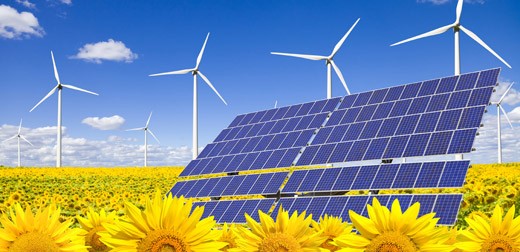
__________ is an energy resource that WILL NOT run out in the next several hundred years.
Renewable Energy Resource
Nonrenewable Energy Resource
Fossil fuels
biodegradable
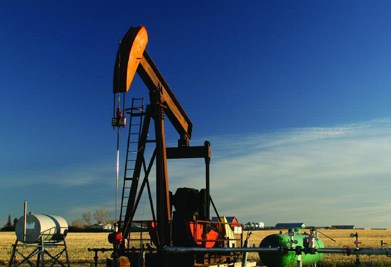
__________ is an energy resource that WILL run out in the next several hundred years.
Renewable Energy Resource
Nonrenewable Energy Resource
natural resources
pollution

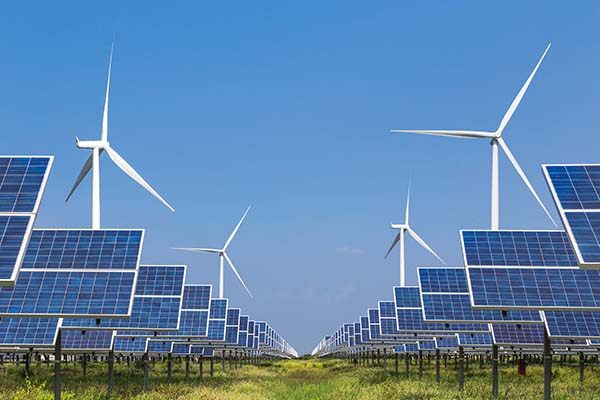
What are renewable resources?
A limited amount and cannot be replaced in a human life time.
Plastic bags
Coal, oil, and natural gas
Can be replaced in our lifetime through natural processes

Trees are renewable resources.
True
False

Coal is a renewable resource.
True
False

Wind is a renewable resource.
True
False

Oil is a renewable resource.
True
False

Water is a renewable resource.
True
False
What are renewable resources?
A limited amount and cannot be replaced in a human life time.
Plastic bags
Coal, oil, and natural gas
Can be replaced in our lifetime through natural processes
What type of power plant uses scraps from farming and waste products to generate electricity?
Hydroelectric Power Plant
Geothermal Power Plant
Biomass Power Plant
Nuclear Power Plant
Energy that is made from the power of moving water
Hydroelectric
Coal
Biomass
Wind
Which of the following are fossil fuels? (Select all that apply.)
Coal
Oil
Natural Gas
Nuclear Energy
Which of the following are nonrenewable energy sources? (Select all that apply.)
Coal
Oil
Natural Gas
Nuclear Energy
Which of the following are renewable energy sources? (Select all that apply.)
Solar
Wind
Hydroelectric
Geothermal
Biomass
For what reason do nuclear power plants use uranium as fuel?
Uranium atoms have nuclei that can be easily split
Uranium is less expensive than most other metals
Uranium is easier to obtain than most other metals
Unlike most other metals, uranium is not radioactive

Oil is a ____________ resource
Renewable
Nonrenewable

Nuclear energy is a ____________ resource
Renewable
Nonrenewable

What is the definition of ecological footprint?
is the footprint of ecologist
is a measure of the impact living things have on the environment.
is a kind of plant that grows in the rainforrest.
a measure of the amount of land needed to support one person in a particular country.
A company is considering whether to invest in a new project. They need to weigh the cost of the project against the expected benefits. What is this process called?
Cost-Benefit Analysis
Law of Supply and Demand
Risk Assessment
Tragedy of the Commons
What is the primary purpose of the EPA?
To oversee financial markets
To regulate international trade
To protect human health and the environment
To manage national defense
You go fishing in the same river once you are done Kayaking. You catch 3 fish to take home and cook for dinner, therefor harming the ecosystem. What type of ecosystem service is represented here?
provisioning
cultural
supporting
Which type of environmental policy is often the most expensive because it requires significant governmental enforcement to give everyone doing something wrong a penalty?
incentives
regulations
The number of people that need a resource is
Supply
Demand
The amount of resource available to use is the
Supply
Demand
Why are environmental policies necessary, why do we need rules to protect the environment?
Resources are infinite
Resources are limited
When a policy has a regulation and an incentive.
Cost benefit analysis
Cap and trade
Rotating crops
conserves nutrients
increases soil erosion
is a cause for deforestation
is the same thing as cover crops
No-till farming
decreases soil erosion
increases soil erosion
is not sustainable
is a rare practice in agriculture
Agriculture uses this part of the lithosphere.
The rockbed
The subsoil
The magma
The topsoil
What is a con of oil?
Non-renewable
It is cheap
It is reliable
It encourages economic growth
What are the 3 major types of rocks?
Metamorphic, Igneous, Cementation
magma, lava, crystals
Igneous, Metamorphic, Sedimentary
Metamorphic, Sediment, Igneous
Shale (Sedimentary rock) needs _______ to become slate (metamorphic rock)?
Cooling
Erosion and deposition
Melting and Solidification
Increased heat and pressure
Which of the following takes place when magma turns into igneous rock?
Heating
Cooling
Uplifting
Weathering
Which of the following takes place when an igneous rock turns into a sediment?
Weathering
Pressure increase
Deformation
Temperature decrease


A natural resource that can only be replaced only through geological, physical, and chemical processes that take millions of years.
Renewable Resource
Nonrenewable Resource
The controversial method for getting natural gas in rock deep underground is called...
fracking.
rigging.
contouring.
derricks.

Label the horizons in the soil profile.
R Horizon
C Horizon
B Horizon
A Horizon
O Horizon
The amount of sand, silt, and clay help determine the _____ and _____ of a soil.
(a)
About 97% of Earth's water is found in (a)
watershed
reservior
flood prone
Headwaters
Meander
Match the following
Transpiration
Water Evaporated from plant respiration
Precipitation
Water falls to earths surface
Process that forms clouds
Condensation
Energy that drives the water cycle
The sun's radiation
draining of water on and in earths surface
runoff
All of the land area whose water drains into a stream system.
Watershed
Reservior
Headwaters
Erosion
Which of the following is NOT an example of surface water?
aquifers
lakes
rivers
streams
wetlands
A water molecule is made up of ___ hydrogen atoms and one oxygen molecule
two
one
three
3% of water is ____
surface water
freshwater
saltwater
frozen
Which of the following implies the same thing as the word "aquifer"?
zone of saturation
zone of aeration
zone of soil moisture
zone of twilight

