wayground logo

Free Printable Worksheets

Font size

S
M
L
XL
Worksheets

District Review

Total questions: 159

Worksheet time: 2hrs 6mins

Name
Class
Date
1.
Cellular Respiration's goal is to
a)
make water
b)
make ATP
c)
make glucose
d)
make  oxygen
2.
What is cellular respiration?
a)
the breakdown of glucose  to release ATP
b)
the breakdown of glucose to release NADH
c)
the breakdown of glucose to release FADH
d)
the breakdown of glucose to release carbon
3.
What are the PRODUCTS for cellular respiration?
a)
oxygen and ATP (energy)
b)
water and glucose and ATP (energy)
c)
carbon dioxide and water and ATP (energy)
d)
glucose and oxygen
4.
What are the REACTANTS for cellular respiration?
a)
oxygen and carbon dioxide
b)
water and glucose
c)
carbon dioxide and water
d)
glucose and oxygen
5.
Which is the correct chemical equation for CELLULAR RESPIRATION?
a)
Glucose (Sugar) + Oxygen --> Carbon Dioxide + Water + ATP (Energy)
b)
ATP (Energy) + Oxygen --> Carbon Dioxide + Water + Glucose (Sugar)
c)
Glucose (Sugar) + Carbon Dioxide --> Oxygen + Water + ATP (Energy)
d)
Glucose (Sugar) + Water + Oxygen --> Carbon Dioxide + Oxygen + ATP (Energy)
6.
An autotroph is...
a)
An organism that makes its own food
b)
An organism that gets its food from other living organisms
7.
A heterotroph is
a)
an organism that must eat other organisms for energy
b)
an organism that makes its own food
c)
a plant
d)
an organism that has cells with chloroplasts
8.
What kind of things perform cellular respiration?
a)
living things only
b)
nonliving things only
c)
living and nonliving things
9.
What is the ultimate ORIGINAL source of energy for living things
a)
Sugar
b)
Sun
c)
Moon
d)
Carbon Dioxide
10.
In which eukaryotic organelles does photosynthesis occur?
a)
mitochondria
b)
stomata
c)
xylem
d)
chloroplast
11.
The main function of stomata is to
a)
take in sunlight
b)
tells the guard cells to open or close
c)
allows gas exchange
d)
carry out photosynthesis
12.
What is the term for each level in the transfer of energy and matter within a biological community?
a)
energy path
b)
food web
c)
trophic level
d)
food pyramid
13.
Autotrophs make up the _______ level in all ecosystems.
a)
First
b)
Second
c)
Third
d)
Fourth
14.
What does a food web represent?
a)
All connections of energy flow throughout all organisms in a habitat.
b)
The specific ways that mutualism is carried out.
c)
A single pathway or energy flow between organisms. 
d)
How carnivores get their food. 
15.
Why are quaternary consumers so rare?
a)
It is too hard to catch prey
b)
There isn't enough energy left in the food
c)
The food sources do not taste good
d)
There is not enough room for them on the food chain
16.
One reason predators might increase is
a)
The weather is warmer
b)
Parasites have increased
c)
The prey have increased
d)
Food has decreased
17.
When a population has reached carrying capacity
a)
Growth & Immigration are equal to Death & emigration
b)
Growth & Immigration are less than Death & emigration
c)
Growth & Immigration are greater than Death & emigration
d)
Growth is exponential
18.
what does the environment loss at each trophic level in this ecosystem?
a)
food sources
b)
heat
c)
living space
d)
nutrients from the soil
19.
If the amount of food or resources available increases, the carrying capacity for an animal:
a)
Stays the same
b)
Increases
c)
Decreases
d)
Fluctuates
20.
What is the chemical formula for Carbon Dioxide?
a)
CO2 
b)
C6H12O6
c)
O2
d)
H20
21.
What is the chemical formula for Oxygen?
a)
CO2 
b)
C6H12O6
c)
O2
d)
H20
22.
What is the chemical formula for Water?
a)
CO2 
b)
C6H12O6
c)
O2
d)
H20
23.
What process is represented in this chemical formula?
Light + 6CO2 + 6H20 --> C6H12O6 + 6O2
a)
Photosynthesis
b)
Cellular Respiration
24.
What is it called when plants give off water vapor as a waste product?
a)
condensation
b)
evaporation
c)
sublimation
d)
transpiration
25.
Which of the following is a consequence of excess carbon building up in Earth’s atmosphere?
a)
The amount of breathable oxygen available to living things decreases
b)
Global temperatures change, affecting normal weather patterns.
c)
The amount of solar energy reaching the earth’s surface decreases.
d)
Global air pressure increases making it more difficult for plants and animals to breathe.
26.
A jar has two fish in it. What will happen?
a)
Carbon dioxide will increase
b)
Oxygen will increase
c)
Carbon dioxide will decrease
d)
Nitrogen will decrease
27.
A species that is introduced to another environment that causes problems with the native food web is called a(n)...
a)
invasive species
b)
destructive species
c)
herbivores
d)
omnivores
28.
Which of the following is the orderly change that occurs in a place where soil remains after a community of organisms has been removed?
a)
primary succession
b)
secondary succession
29.
grass --> moose --> wolves
What happens to wolves when grass goes up?
a)
goes up
b)
stays the same
c)
goes down
30.
When observing cells, which of the following optical tools is most appropriate?
a)
Hand lens
b)
Telescope
c)
Petri dish
d)
Microscope
31.
what is a cell classified as?
a)
a basic unit of structure and function
b)
a unit based on only plants and animals
32.
Is a plant cell prokaryotic or eukaryotic?
a)
eukaryotic
b)
 prokaryotic 
33.
Those organisms that are made of more than 2 cells are referred to as ___________________.
a)
unicellular
b)
multicellular
c)
colonized
d)
Michael Jackson
34.
What is the difference between prokaryotic and eukaryotic. 
a)
prokaryotic has a nucleus and eukaryotic does not
b)
eukaryotic has a nucleus and prokaryotic does not 
c)
prokaryotic has DNA and eukaryotic does not
d)
eucaryotic have a cell wall and prokaryotic 
35.
Mitochondria is in
a)
Eukaryote
b)
Prokaryote
c)
Both
36.
Vacuole is in
a)
Eukaryote
b)
Prokaryote
c)
Both
37.
Cell Wall is in
a)
Eukaryote
b)
Prokaryote
c)
Both
38.
Which has no membrane bound organelles
a)
Eukaryote
b)
Prokaryote
c)
Both
39.
Which usually is single-celled
a)
Eukaryote
b)
Prokaryote
c)
Both
40.
 Which has no nucleus
a)
Eukaryote
b)
Prokaryote
c)
Both
41.
Prokaryote vs. Eukaryote              Golgi Apparatus
a)
Eukaryote
b)
Prokaryote
c)
Both
42.
Which structure can be found in both eukaryotic and prokaryotic cells?
a)
Nucleus
b)
Centriole
c)
Chloroplast
d)
Nucleic Acid
43.
Original DNA: CAT GAT
New DNA: CAT AT
What mutation occurred?
a)
deletion
b)
substitution 
c)
tranverse
d)
insertion
44.
Original: ATC CAT
Mutation: ATC GCAT
What mutation occurred?
a)
deletion
b)
insertion
c)
silent
d)
transverse
45.
Which organelle is DNA usually found in?
a)
cell membrane
b)
vacuole
c)
chloroplast
d)
nucleus
46.
DNA molecule segment is : TTACGCAAG
The mutated DNA segment is TTACGCAAC. This is an example of ___ mutation.
a)
Substitution
b)
Insertion
c)
Inversion
d)
Translocation
47.
What are the building blocks of proteins call?
a)
DNA
b)
RNA
c)
Ribosomes
d)
Amino Acids
48.
What is the region of rapid cell division (growth) in plants?
a)
Guard
b)
Stomata
c)
Xylem
d)
Meristem
49.
The root performs all of the functions EXCEPT:
a)
stores food
b)
transports water
c)
draws in water
d)
takes in minerals
50.
Which tissue is responsible for creating a water tight seal around the plant?
a)
Dermis
b)
Ground
c)
Meristematic
d)
Vascular
51.
What is the function of vascular tissue?
a)
physical support of the plant
b)
transport water and nutrients
c)
defend against predators
d)
complete photosynthesis
52.
The veins of the plant
a)
dermal
b)
vascular
c)
ground
d)
meristematic
53.
This organelle creates energy.
a)
Nucleus
b)
Ribosome
c)
Mitochondria
d)
ER
54.
Which of these is NOT a part of the Cell Theory?
a)
All cells are independent.
b)
Cells are the basic unit of living things. 
c)
All living things are one or more cells.
d)
Cells come from cells.
55.
This organelle moves materials throughout the cell. 
a)
ER
b)
Ribosomes
c)
FedEx
d)
Golgi Complex
56.
This organelle eliminates waste. 
a)
Nucleus
b)
ER
c)
Vacuole
d)
Lysosome
57.
This organelle makes proteins. 
a)
Cell membrane
b)
Nucleus
c)
Ribosome
d)
ER
58.
In which kingdom do I belong if I am unicellular, autotrophic, and eukaryotic?
a)
Archaebacteria
b)
Protista
c)
Animalia
d)
Plantae
59.
Eubacteria...
a)
are eukaryotic
b)
live in normal conditions
c)
are non-living
d)
are multicellular
60.
This kingdom contains heterotrophic organisms that can be unicellular or multicellular. Organisms from this kingdom can sometimes cause athlete's foot or ringworm.
a)
Fungi
b)
Animalia
c)
Protista
d)
Archaebacteria
61.
Tigers, Jellyfish, Gorillas and Sponges are all part of kingdom _______.
a)
Animalia
b)
Plantae
c)
Fungi
d)
Bacteria
62.
What is the classification level directly below domain?
a)
Phylum
b)
Genus
c)
Species
d)
Kingdom
63.
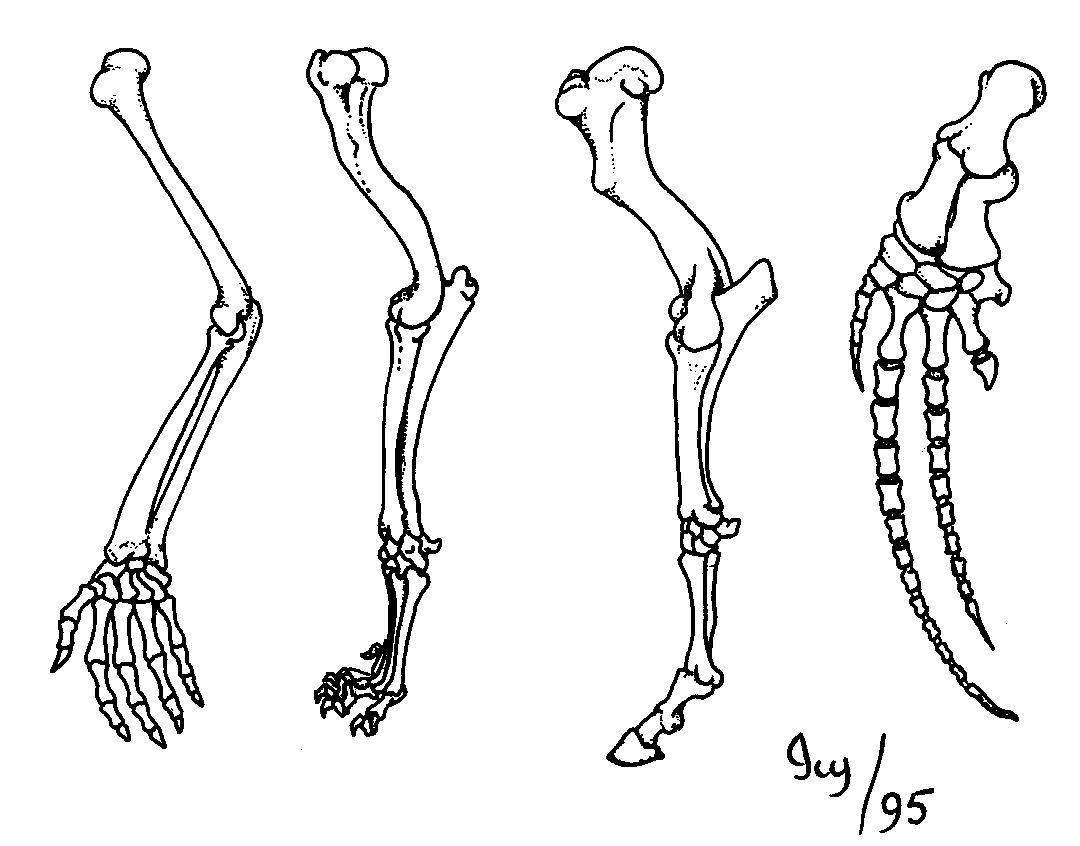
Structures with the same parts have different functions; suggests that organisms share a common ancestry
a)
vestigial structures
b)
homologous structures
c)
adaptive radiation
d)
fossil
64.
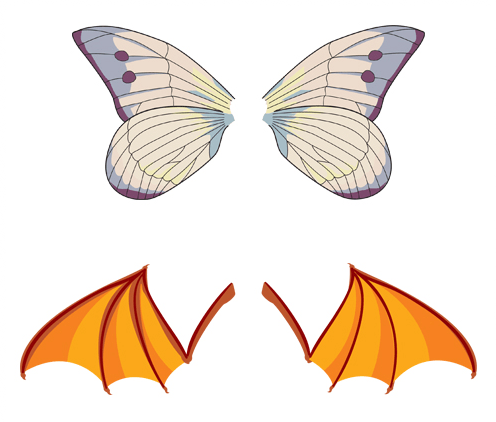
How would you describe this evolution?
a)
Homologous structure
b)
Analogous structure
c)
Structural adaption
d)
Functional adaption
65.
Two organisms that are closely related would have
a)
very similar DNA sequence
b)
exactly the same DNA sequences
c)
no proteins in common
d)
completely different DNA sequence
66.
Study of embryos of various organisms to show a common ancestor because of similarities in development
a)
natural selection
b)
embryology
c)
speciation
d)
evolution
67.
When there is not enough oxygen in your body
a)
You stop aerobic respiration and start lactic acid fermentation
b)
You start aerobic respiration
c)
You stop anaerobic respiration
d)
You stop lactic acid fermentation and start aerobic fermentation 
68.
Which is true of aerobic respiration but not true of anaerobic respiration?
a)
CO2 is produced
b)
ATP is produced
c)
water is produced
d)
alcohol is produced
69.
Before the cell divides, what process needs to happen?
a)
Transcription
b)
Translation
c)
Replication
d)
Protein synthesis
70.
Which of the following complementary base pairs are correct?
a)
A  - T
b)
A - G
c)
T - C
d)
G - U
71.
Which of the following best describes a DNA molecule?
a)
double helix
b)
contains ribose
c)
made of amino acids
d)
contains Uracil
72.
When does DNA replication happen?
a)
Before Mitosis begins
b)
During prophase
c)
During metaphase
d)
During anaphase
73.
Where does transcription take place?
a)
nucleus
b)
ribosome
c)
cytoplasm
d)
smooth ER
74.
Which of these are 3 parts of an DNA nucleotide?
a)
Deoxyribose, thymine, phosphate
b)
Ribose, thymine, phosphate
c)
Ribose, uracil, phosphate
d)
Deoxyribose, uracil, phosphate
75.
Which of these are 3 parts of an RNA nucleotide?
a)
Deoxyribose, thymine, phosphate
b)
Ribose, thymine, phosphate
c)
Ribose, uracil, phosphate
d)
Deoxyribose, uracil, phosphate
76.
How would you describe this evolution?
a)
Homologous structure
b)
Analogous structure
c)
Structural adaption
d)
Functional adaption
77.
Structures with the same parts have different functions; suggests that organisms share a common ancestry
a)
vestigial structures
b)
homologous structures
c)
adaptive radiation
d)
fossil
78.
Scientists compare organisms' DNA to support the theory that all species share a common _________________
a)
separation
b)
ancestor
c)
population
d)
environment
79.
Study of embryos of various organisms to show a common ancestor because of similarities in development
a)
natural selection
b)
embryology
c)
speciation
d)
evolution
80.
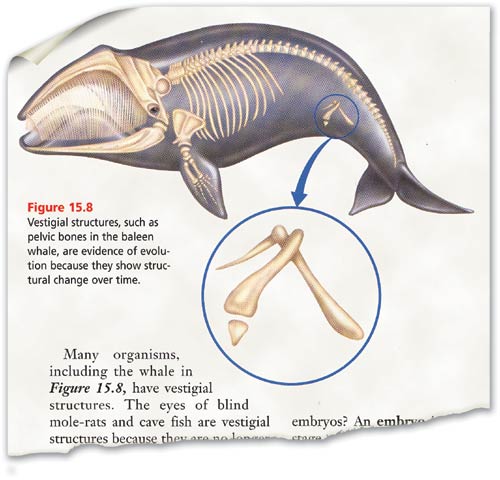
Which of the following is an example of a vestigial structure?
a)
the wings of a red-tailed hawk
b)
the hind limbs of a house cat
c)
the fins of sharks
d)
the tailbone of a human
81.
Which two species are most related?
a)
B&C
b)
A&B
c)
A&C
d)
C&B
82.
Charles Darwin called the ability of an organism to survive and reproduce in its specific environment 
a)
diversity.
b)
evolution
c)
adaptation. 
d)
 fitness.
83.
What do we call differences among heritable traits?
a)
Variation
b)
Adaptation
c)
Evolution
d)
Speciation
84.
What is survival of the fittest?
a)
It is where the fittest die out and therefore reproduce and pass on their genes
b)
It is where the fittest die out and therefore can't reproduce and pass on their genes
c)
It is where the fittest don't die out and therefore can't reproduce and pass on their genes
d)
It is where the fittest don't die out and therefore reproduce and pass on their genes
85.
Which types of organisms developed first due to the early environmental conditions on Earth? 
a)
prokaryotic and aerobic
b)
prokaryotic and anaerobic 
c)
eukaryotic and aerobic
d)
eukaryotic and anaerobic
86.
According to the data, the unknown bacterial species is most closely related to
a)
Species I
b)
Species II
c)
Species III
d)
Species IV
87.
What are the three domains within classification?
a)
Green, Blue, Red
b)
Autotrophic, Heterotrophic, Both
c)
Archea, Eukarya, Bacteria
d)
Marine Organism, Land Organism, or Both
88.
What is the classification level directly below domain?
a)
Phylum
b)
Genus
c)
Species
d)
Kingdom
89.
All organisms that do not fit into plant, fungi, and animal kingdoms but have a nucleus are:
a)
archaebacteria
b)
eubacteria
c)
protists
d)
fungus
90.
Tigers, Jellyfish, Gorillas and Sponges are all part of kingdom _______.
a)
Animalia
b)
Plantae
c)
Fungi
d)
Bacteria
91.
 You would find mushrooms in which kingdom?
a)
Plantae
b)
Protists
c)
Fungi
d)
Animalia
92.
Which kingdom has all multicellular organisms that produce glucose
a)
Plantae
b)
Archaebacteria
c)
Protista
d)
Animalia
93.
This domain is characterized by ancient bacteria that can live in extreme environments, such as hot springs.
a)
Archaea
b)
Bacteria
c)
Eukarya
d)
Prokarya
94.
Which kingdoms are prokaryotic?
a)
Archaebacteria and Animalia
b)
Eubacteria and Archaebacteria
c)
Fungi and Protista
d)
Plantae and Eubacteria
95.
Which of the following are true of the cell cycle?
a)
The cell spends most of its time dividing 
b)
The cell spends most of its time growing
c)
Replication of DNA occurs at M 
d)
Cells enter G0 after M
96.
All of the following are true of the cell cycle shown in the diagram except ___.
a)
A, B, and C represent interphase
b)
DNA is replicated at B 
c)
Cytokinesis and new daughter cells are found at E
d)
Mitosis and cytokinesis are represented by D 
97.
What best describes the genetic material shown in photograph B. 
a)
The chromosomes are in anaphase
b)
The chromosomes are in metaphase
c)
DNA is possibly being replicated 
d)
The genetic material is around the poles and cytokinesis is occurring
98.
When is DNA replicated during the cell cycle?
a)
During the G1 phase
b)
During the G2 phase 
c)
During the S phase
d)
 During the M phase
99.
Identify this process.
a)
Replication
b)
Transcription
c)
Translation
d)
Proof reading 
100.
When step d is completed, the two DNA molecules formed will be ___.
a)
Identical to each other but not to the parent 
b)
 Identical to the parent but not to each other 
c)
Identical to each other and to the parent
d)
Different from each other and from the parent 
101.
Which is a characteristic of cancer?
a)
rapid and uncontrolled cell growth
b)
 cell growth delayed at the G1 checkpoint. 
c)
cell growth delayed at the G2 checkpoint. 
d)
damage to a cell’s cytoplasm
102.
During the process of protein synthesis, a section of the DNA molecule is copied into which other molecule?
a)
nucleic DNA 
b)
cytoplasmic DNA
c)
messenger RNA
d)
transfer RNA
103.
What is occurring in this picture?
 
(Figure 1)
a)
Translation
b)
DNA Replication
c)
Polymerase is unzipping the DNA
d)
Transcription
104.
What is the name of 3 bases on mRNA called?
a)
gene
b)
triplet
c)
codon
d)
anticodon
105.
What is the function of mRNA?
a)
Carries genetic message from DNA to cytoplasm
b)
Transfers amino acids from cytoplasm to ribosome
c)
Stores genetic information in the nucleus
d)
Links amino acids to form protein
106.
During transcription, the DNA base "T" will be paired with the RNA base ____.
a)
A
b)
T
c)
G
d)
U
107.
During transcription, the DNA base "A" will be paired with the RNA base ____.
a)
A
b)
T
c)
G
d)
U
108.
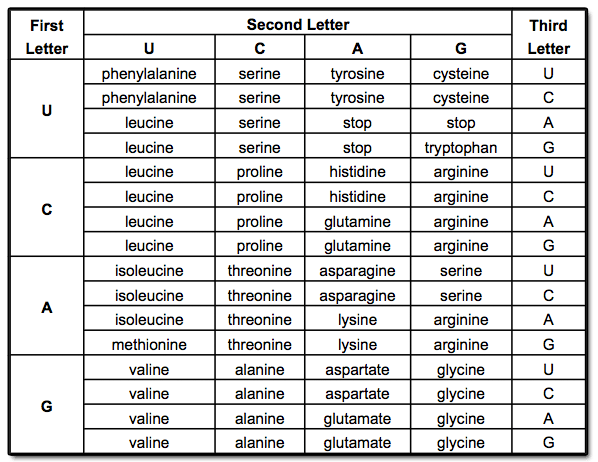
Which amino acid does the codon GCA code for?
a)
ala (alanine)
b)
met (methionine)
c)
arg (arginine)
d)
val (valine)
109.
Nucleotides are made up of a sugar, phosphate, and..?
a)
nitrogenous base
b)
nucleic acid
c)
cholesterol
d)
fatty acid
110.
What structure of this molecule binds with the mRNA molecule?
a)
Amino Acid
b)
tRNA
c)
Anticodon
d)
Codon
111.
What is the correct amino acid sequence for the mRNA code AUGCCAGUAUGA
a)
Met-Pro-Ala-Val
b)
Met-Pro-Val
c)
Tyr-Gly-His
d)
Tyr-Gly-Arg-His
112.
This process uses DNA code to produce RNA.
a)
Replication
b)
Transcription
c)
Translation
d)
Protein Synthesis
113.
Which term means "water-fearing"?
a)
Adhesion
b)
Polar
c)
Hydrophilic
d)
Hydrophobic
114.
What type of transport is represented by figure "C" 
(Figure 1)
a)
Active Transport
b)
Facilitated Diffusion 
c)
Protein Transport 
d)
Osmosis 
115.
Your gums are swollen. How will rinsing with warm salt water help the swelling?
a)
swollen gums will absorb the salt
b)
salt lowers the temp
c)
salt goes against the concentration gradient
d)
water in the gums has diffused out of the cells
116.

All of the following are parts of the male reproductive system except ___________________.

a)

Penis

b)

Scrotum

c)

Uterus

d)

Testicles

117.
What is the function of the organ shown in the picture?
a)
Scrotum
b)
used to cool down the temperature in the testes
c)
testes
d)
produces sperm cells and semen
118.
a)
ovary
b)
cervix
c)
vagina
d)
uterus
119.
a)
Fallopian tubes
b)
Ovarian ligaments
c)
Oviducts
d)
Vas deferens
120.
a)
ovum
b)
oviduct
c)
ovary
d)
ovarian
121.
a)
uterine lining
b)
endometrium
c)
uterus
d)
myometrium
122.
Fertilization occurs in which structure?
a)
#4 uterus
b)
#3 fallopian tube
c)
#7 vagina
d)
# 5 bladder
123.
Structure #1 is the 
a)
vagina
b)
uterus
c)
cervix
d)
fallopian tube
124.
structure # 4 is the 
a)
uterus
b)
fallopian tube
c)
vagina 
d)
ovary
125.
Structure #6 is the 
a)
vagina
b)
fallopian tube
c)
urethra
d)
vas deferens
126.
Structure #7 is the
a)
cervix
b)
vagina
c)
uterus
d)
fallopian tube
127.
Below is a diagram of the male reproductive system. Which structure is represented by the letter D? 
a)
scrotum
b)
testes
c)
prostrate gland
d)
epididymus
128.
a)
Testes
b)
Prostate gland
c)
Bladder
d)
Seminal gland
129.
a)
Produces sperm
b)
Carries the sperm to the urethra
c)
Produces semen (seminal fluid)
d)
Carries the sperm out of the body
130.
Urethra
a)
A
b)
B
c)
E
d)
F
131.
Vas Deferens
a)
A
b)
B
c)
E
d)
F
132.
Epididymus
a)
D
b)
E
c)
F
d)
G
133.

Where does meiosis occur in females?

a)

Fallopian tube

b)

Ovary

c)

Uterus

d)

Vagina

134.

What kind of cells are made in MEIOSIS?

a)

Haploid Gametes

b)

Diploid Somatic Cells

c)

Skin Cells

d)

Liver Cells

135.

A human body (somatic) cell usually has how many chromosomes?

a)

6

b)

22

c)

4

d)

46

136.
If a somatic (body) cell in a butterfly contains 24 chromosomes, a butterfly egg would contain
a)
3
b)
6
c)
12
d)
24
137.
Meiosis makes sperm and egg cells. In humans, sperm and egg cells each have _____ chromosomes. Therefore a fertilized human egg cell (sperm and egg cell combined) would create a cell with _____ chromosomes.
a)
23, 46
b)
46, 23
c)
2, 4
d)
50, 100
138.
Which letter on the illustration represents the frontal lobe
a)
A
b)
B
c)
C
d)
D
139.
Which letter on the illustration represents the temporal lobe
a)
A
b)
B
c)
C
d)
D
140.
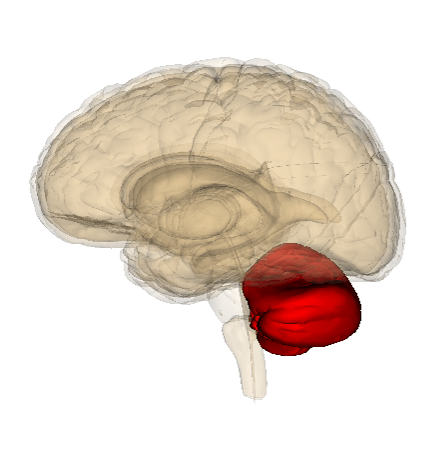
The red portion is the ________
a)
Cerebrum
b)
Cerebellum
c)
Brain Stem
d)
Diencephalon
141.
a)
frontal
b)
temporal
c)
occipital
d)
parietal
142.
a)
frontal
b)
temporal
c)
occipital
d)
parietal
143.
a)
Frontal
b)
Occipital
c)
Parietal
d)
Temportal
144.
The function of a ___ is to absorb water, store food, and anchor plants. 
a)
phloem
b)
tissue
c)
xylem
d)
root
145.
When water leaves a plants' leaves in the water cycle
a)
evaporation
b)
transpiration
c)
precipitation
d)
condensation
146.
When property of water causes transpiration occur as a result of water going from the roots to the leaves of the plant?
a)
high specific heat
b)
capillary action
c)
surface tension
d)
being a solvent
147.
The root performs all of the functions EXCEPT:
a)
stores food
b)
transports water
c)
draws in water
d)
takes in minerals
148.
6CO2 + 6H20 + light energy    -> C6H12O6 + 6O2
In this chemcial equation, the highlight red is called the ______. 
a)
product
b)
reactant
c)
yields
d)
production
149.

Why was having a larger brain advantageous for early hominins?

a)

It made them able to walk upright

b)

It helped them to see better

c)

It increased intelligence and helped them hunt and survive

d)

It prevented them from making dangerous weapons

150.
An _______________ first digit, either a thumb or a toe,  can be brought across the palm or foot to touch   (or nearly touch) the other digits allowing primates to grasp objects.
a)
opposable
b)
flexible
c)
operable
d)
adjustable
151.

Scientists have found evidence that about 2.4 million years ago a gene regulating jaw muscles mutated and may have led to the more graceful human jaw we see today. The diagram below shows the skulls of 3 hominid species

Which statement below most closely explains the link between JAW size and hominid evolution?

a)

The jaws of hominids evolved to be smaller and less protruding over time.

b)

The jaws of hominids evolved to be larger and more protruding over time.

c)

There appears to be no change in the jaws of hominids over time.

d)

The jaws of hominids changed over time due to a change in brain size.

152.
When an individual has high cholesterol, certain substances, such as calcium and fats, form plaque in arteries. How is this plaque, known as arterial plaque, most likely to affect blood flow?
a)
Arterial plaque clogs the arteries, limiting or stopping blood flow.
b)
Arterial plaque changes the direction of blood flow, which forces oxygenated blood to the heart.
c)
Arterial plaque changes the size of blood cells, which prevents blood from flowing in the arteries.
d)
Arterial plaque clears the arteries, increasing blood flow.
153.
Which of the following statements best describes blood flow in the human body?
a)
As the thickness of the blood decreases, the rate of blood flow increases.
b)
As the diameter of a blood vessel decreases, the rate of blood flow increases.
c)
As the length of a vein decreases, the resistance to blood flow decreases
d)
As blood pressure increases, the rate of blood flow decreases.
154.
Elasticity in blood vessels allows the vessels to stretch and move based on changes in blood volume. A number of factors, including genetic disease, can cause the arteries to harden and lose their elasticity. How would the hardening of the arteries most likely affect blood flow?
a)
The hardening of the arteries would likely cause blood flow to remain constant.
b)
The hardening of the arteries would likely increase blood flow.
c)
The hardening of the arteries would likely cause blood flow to stop completely.
d)
The hardening of the arteries would likely restrict blood flow.
155.
How many chromosomes are in a diploid human cell?
a)
46
b)
21
c)
10
d)
23
156.
In mitosis, the two resulting cells are
a)
different from the starting cell and identical to each other.
b)
different from the starting cell and different from each other.
c)
identical to the starting cell and different from each other.
d)
identical to the starting cell and identical to each other.
157.
Chormatids are found in  
a)
Meiosis I
b)
Meiosis II
158.
Homologous Chromosomes are found in  
a)
Meiosis I
b)
Meiosis II
159.
Human eggs and sperm are _____, and each has ____ chromosomes.
a)
diploid, 23
b)
diploid, 46
c)
haploid, 23
d)
haploid, 46