
 Worksheets
AP Bio Unit 3 - Cellular Energy
Total questions: 164
Worksheet time: 3hrs 38mins


Enzymes ___________________ activation energy to speed up chemical reactions.
increase
decrease
How does the active site of an enzyme determine the substrate for that enzyme?
The active site has the right polarity to interact with the substrate.
The active site is hydrophobic and interacts with other hydrophobic amino acids on the substrate
The active site has a specific shape that fits the shape of the substrate
The active site uses energy to form covalent bonds with the substrate
How does a competitive inhibitor affect an enzymes function?
It binds to an allosteric site that alters the shape of the enzyme
It changes the polarity of the enzyme, decreasing the rate of reaction
It denatures the enzyme which increases the activation energy for the reaction.
It binds to the active site, preventing the enzyme from catalyzing the reaction
Which of these factors can affect the initial rate of an enzyme reaction?
Enzyme concentration
Substrate concentration
Temperature
pH
All of the above

Based on this graph, which enzyme would function best in a basic environment?
A
B
Why is the hydrolysis of ATP important to a cells function?
It provides a source of phosphate for the cell.
It releases energy that can be used to power cellular processes
It absorbs excess hydrogen ions in the cell to regulate the internal pH
It acts as a catalyst for chemical reactions in the cell.
What is the best reason that plants do not perform photosynthesis at night?
They close their stomata at night to rest
They do not have an energy source to power the light reactions
Only a few types of plants are nocturnal
There is less carbon dioxide released into the air at night
How does a plant obtain the carbon necessary to form glucose?
Through the light reactions
From stored sugars in the roots of the plant
From the catabolic breakdown of water
Through CO2 absorbed from the atmosphere
What are the products of the light reaction directly needed by the Calvin cycle in photosynthesis?
H ions and carbon dioxide
Photons absorbed by chlorophyll
FADH2 and Oxygen
ATP and NADPH
Which phase of photosynthesis produces organic sugars?
The light reactions
The Calvin cycle
The link reaction
Electron transport chain
What are the products of the Krebs Cycle?
Pyruvate, water, ATP, NADH
Acetyl CoA, NADH
NADH, FADH2, carbon dioxide, ATP
ATP, glucose
What are the products of glycolysis?
Pyruvate, ATP, water, NADH
Carbon dioxide, FADH2, NADH, ATP
32 ATP
NADPH and ATP
What are the products of the light reaction of photosynthesis?
Oxygen, NADPH, ATP
Glucose, NADP, ADP
Carbon dioxide, water, ATP
Oxygen, FADH2, ATP
What is the function of NAD in cellular respiration?
It catalyzes the conversion of glucose into ATP
It provides inorganic phosphate needed by ATP synthase
It acts as an electron and proton acceptor to carry energy to the electron transport chain
It is the coenzyme needed to convert glucose into pyruvate
What powers the ATP synthase enzymes in mitochondria and chloroplasts?
The energy absorbed during the light reactions.
The electronegativity of oxygen
Energy released by breaking the chemical bonds in glucose
The diffusion of hydrogen
How are the ATP synthase enzymes in photosynthesis and cellular respiration similar?
They both rely on chemiosmosis of hydrogens down a gradient to power phosphorylation
They are both located in the cytoplasm of the cell
They both use oxygen to create a concentration gradient
They both receive hydrogen ions from FADH2
When will lactic acid build up in animal cells?
When there is excess carbon dioxide
When the cells produce too much ATP
When there is not enough oxygen to fuel the mitochondria
When the cells need to remove excess oxygen to avoid damaging their components.


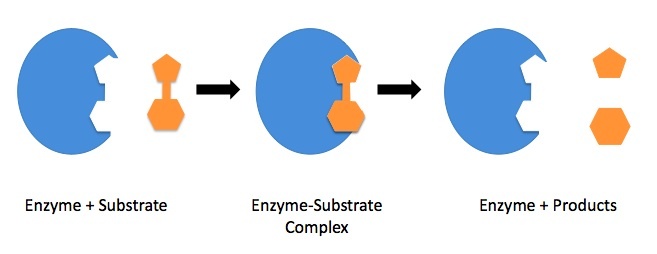
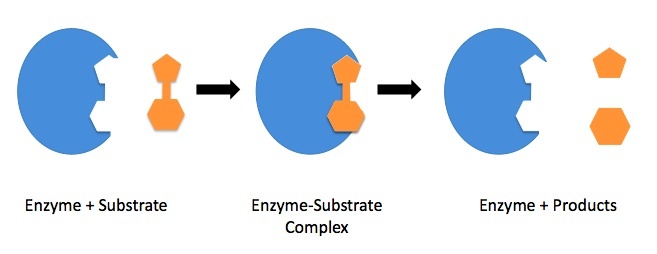
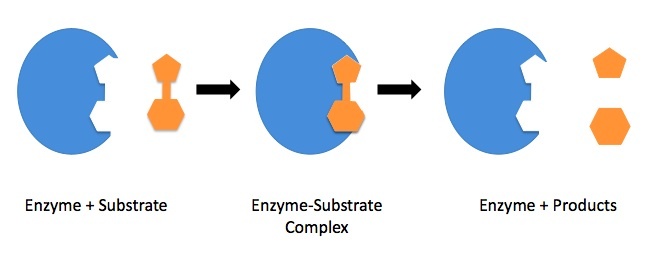


On an enzyme, the site that attaches to a substrate
Polypeptide
Base
Substrate
Active site
The molecule an enzyme is working on is called the:
Substrate
Cofactor
Inhibitor
Coenzyme
Which chemical is classified as an enzyme?
Galactose
DNA
Protease
Carbon Dioxide
What reduces the productivity of enzymes by blocking substrates from entering active sites?
noncompetative inhibitor
competative inhibitors
coenzymes
cofactors
The process that involves an end product acting as an inhibitor of an earlier step in a metabolic pathway is called
Feedback Inhibition
Competitive Inhibition
Protein Denaturing
Allosteric Activation
In an Endergonic reaction, heat is ________.
Absorbed
Created
Destroyed
Released
Enzymes are
Protiens
Lipids
Carbohydrates
DNA
Sucrase has an optimum temperature of 37 C and an optimum pH of 6.2. What would happen if the pH changed from 6 to 3?
Sucrase would continue to work the same
The reaction sucrase catalyzes would speed up
The reaction sucrase catalyzes would slow down

what Does the illustration represent?
Competitive inhibition
Non-competitive inhibition
An enzyme pathway
Allosteric Activation

What does the image show?
Enzyme pathway
Activation energy graph
Exergonic reaction
Activation site
Protein synthesis

Which factor that effects enzyme rate does the graph illustrate?
Temperature
pH
Enzyme concentration
Substrate concentration

Which factor that effects enzyme rate does the graph illustrate?
Temperature
pH
Enzyme concentration
Substrate concentration

Which factor that effects enzyme rate does the graph illustrate?
Temperature
pH
Enzyme concentration
Substrate concentration
The endosymbiotic theory states that eukaryotic cells engulfed smaller cells and kept them around. This gave the smaller cells a protection while giving the eukaryotic cells a smaller localized area for reactions to occur. What is it called when smaller spaces within a larger area are given specific tasks?
Compartmentalization
Denaturation
Protein Folding
Polarization


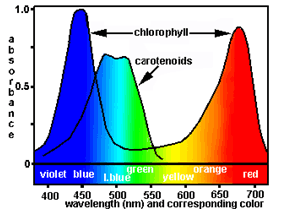
Why does photorespiration occur?
stomata are closed and CO2 levels are too low.
stomata are closed and O2 levels are too low.
stomata are open and too much water is leaving the plant
stomata are open and the plant receives too much CO2
What is represented by "D" in this image?
ATP
NADPH
CO2
Glucose
C4 and CAM plants use which enzyme(s) for photosynthesis?
PEP Carboxylase
PEP Carboxylase and Rubisco
Rubisco
Neither PEP Carboxylase and Rubisco
Compared to C3 plants, C4 plants
have higher rates of photorespiration.
can continue to fix CO2 even at relatively low CO2 concentrations and high oxygen concentrations.
do not use rubisco for carbon fixation.
grow better under cool, moist conditions.
In photosynthetic cells, synthesis of ATP occurs during
photosynthesis only
cellular respiration only
both photosynthesis and cellular respiration
photophosphorylation only
RuBisCO is the most abundant enzyme on the planet.
True
False
What is the name of a pigment-containing complex found in a thylakoid?
chlorophyll a
photosystem
grana
stroma


____________ & _________________ are organelles that arose from endosymbiosis.
Rough ER & Smooth ER
Mitochondria & Flagellum
Chloroplast & Mitochondria
Chloroplast and Golgi apparatus
Aerobic respiration yields about ___ ATP molecules per glucose, whereas anaerobic respiration yields ____ ATP molecules per glucose.
38; 2
2; 38
6; 2
38; 18
Aerobic respiration produces how many ATP molecules
2
26
38
50

