wayground logo

Free Printable Worksheets

Font size

S
M
L
XL
Worksheets

AP Bio 2nd Trimester Final Exam 2023

Total questions: 165

Worksheet time: 4hrs 23mins

Name
Class
Date
1.
The enzyme that unwinds the DNA to prepare for replication
a)
helicase
b)
replicase
c)
polymerase
d)
synthase
2.
DNA replication results in two DNA molecules,
a)
each one with two original strands
b)
each one with two new strands
c)
each one with one new strand and one original strand
d)
one with two new strands and the other with two original strands
3.
A process in which DNA has the unique ability to make an exact copy of itself.
a)
Replication
b)
Translation
c)
Transcription
4.
In what phase of the cell cycle does DNA replication take place?
a)
G1
b)
S
c)
G2
d)
M
5.
Which enzyme is responsible for adding nucleotides?
a)
Topoisomerase
b)
DNA Polymerase
c)
Ligase
d)
Primase
6.
If the percentage of DNA is made of 30% Thymine, what is the correct percentage of Guanine?
a)
30
b)
15
c)
20
d)
60
7.
A scientist observes a base sequence of AGCTAGCTAGCT.  Which of the following would be the complimentary strand?
a)
TGCATGCATGCA
b)
TCGATCGATCGA
c)
TAGCTAGCTAGC
d)
TTAAGGCCTTCC
8.
The bonds that hold the two strands of DNA together come from...
a)
the attraction of phosphate groups 
b)
strong bonds between  bases and sugars
c)
carbon to carbon bonds in the sugar
d)
weak hydrogen bonds between the bases
9.
The DNA nucleotide is composed of three parts. Which two components make up the nucleotide backbone?
a)
ribose sugar and base
b)
ribose sugar and phosphate group
c)
nitrogen base and deoxyribose sugar
d)
deoxyribose sugar and phosphate group
10.
What are the 4 nitrogen bases?
a)
adenine, thymine, cytoplasm, and guanine
b)
adenine, thymine cytosine, and guanine
c)
adenine, thymine, cytosine, and gylcerol
d)
adenine, thymine, cytosine, and glucose
11.
Which component of DNA specifies the traits of an organism?
a)
5-carbon sugar (deoxyribose)
b)
hydrogen bonds
c)
phosphate groups
d)
nitrogenous base pairs
12.
After analyzing a sample of DNA, a scientist recorded the data shown in the table. What percentage of the DNA sample is cytosine?
a)
22%
b)
25%
c)
28%
d)
56%
13.
Which enzyme has the job of unzipping the double helix?
a)
Helicase
b)
Polymerase
c)
Ligase
d)
Primerase
14.
Which enzyme fixes the Okazaki fragments in the lagging strand?
a)
Helicase
b)
Polymerase
c)
Ligase
d)
Primerase
15.
If a strand reads:
3' A A A T T T C 5'
The matching strand would read...
a)
5' T T T A A A G 3'
b)
3' T T T A A A G 5'
c)
5' A A A T T T C 3'
d)
3' U U U A A A G 5'
16.
What are the gaps between the newly synthesized DNA on the lagging strand called?
a)
Okazaki fragments
b)
Polymer gaps
c)
Helicase fragments
d)
Acidic gaps
17.
Polymerase is able to replicate the new DNA ______ along the leading strand.
a)
continuously
b)
only in short fragments
c)
very slowly
d)
prokaryotically
18.
Which enzyme seals okazaki fragments together on the lagging strand?
a)
Topoisomerase
b)
Helicase
c)
Polymerase
d)
Ligase
19.

This enzyme helps helicase unzip DNA by relieving supercoiling

a)

Topoisomerase

b)

Exonuclease

c)

DNA Primase

d)

DNA Polymerase

20.

This enzyme synthesizes short RNA sequences to guide DNA Polymerase

a)

Primers

b)

DNA Primase

c)

DNA Polymerase

d)

Topoisomerase

21.
How does RNA differ from DNA?
a)
RNA contains uracil and deoxyribose
b)
RNA contains ribose and thymine
c)
RNA contains uracil and ribose
d)
RNA contains adenine and ribose
22.
How would the DNA sequence GCTATA be transcribed to mRNA?
a)
GCUAUA
b)
CGATAT
c)
CGAUAU
d)
GCUTUT
23.
The process by which the genetic code of DNA is copied into a strand of RNA is called
a)
translation
b)
transcription
c)
transformation
d)
replication
24.
Which of the following describes RNA?
a)
RNA is usually double-stranded and contains the base thymine
b)
RNA is usually single-stranded and contains the base uracil
c)
RNA is longer than DNA and uses five bases to encode information
d)
RNA is made in the nucleus of eukaryotic cells and stays there to carry out its functions
25.

Transcribe the following DNA sequence:


AAT TAG GGC TCG

a)

AAT TAG GGC TCG

b)

TTA ATC CCG AGC

c)

UUA AUC CCG AGC

d)

TTU UTC CCG UGC

26.
Replicate the following strand of DNA: 
AATCATGGA
a)
AATCATGGA
b)
TTAGTACCT
c)
UUAGUACCU
d)
GGATAUCUA
27.

What is the correct order to make a protein?

a)

Protein, DNA, RNA

b)

RNA, DNA, Protein

c)

DNA, RNA, Protein

d)

Protein, RNA, DNA

28.

Which RNA brings amino acids?

a)

rRNA

b)

tRNA

c)

mRNA

29.

Which RNA carries the message?

a)

mRNA

b)

rRNA

c)

tRNA

30.

Where does Transcription take place?

a)

Inside the nucleus

b)

Inside the cytoplasm

c)

Inside the Ribosome

d)

Inside the Rough ER

31.

What is the monomer of RNA?

a)

Nucleotides

b)

Amino Acids

c)

Monosaccharides

d)

Fatty Acids & Glycerol

32.

What is the central dogma of molecular biology?

a)

RNA-protein-DNA

b)

RNA-DNA-protein

c)

DNA-protein-RNA

d)

DNA-RNA-protein

33.
How many nucleotides make a codon?
a)
1
b)
2
c)
3
d)
6
34.

What is the building block of the biomolecule, Nucleic Acid?

a)
b)
c)
d)
35.

RNA must be edited before it can be used to make Proteins, what happens during this editing process?

a)

A spliceosome cuts out exons

b)

A spliceosome cuts out the introns

c)

A splicesome pairs nucleotides with the DNA base pairs

d)

The RNA is checked for typos

36.
The number of codons in the genetic code is
a)
3
b)
4
c)
20
d)
64
37.
The segment of mRNA that is cut out is called the
a)
exon
b)
intron
c)
cap 
d)
tail
38.
This is an image of a 
a)
mRNA
b)
tRNA
c)
rRNA
d)
DNA
39.
Proteins are made
a)
on a mRNA
b)
on the ribosome
c)
in the nucleus
d)
by the DNA
40.
There are ___ different types of amino acids
a)

three

b)

twenty four

c)

twenty

d)

sixty four

41.

What does DNA stand for?

a)

Deoxyribonucleic acid

b)

Denitrogenous acid

c)

Deribonucleic acid

d)

Dexoyribonucic acid

e)

Deoxyribonuclic acid

42.

Place the order of events for

creating a protein in order (1- 6)

____mRNA attaches to rRNA

____codons are continuously read by tRNA

____tRNA reaches a stop codon

____ tRNA connects second amino acid by peptide bond to Methionine

____Polypeptide chain is created

____ mRNA’s start codon AUG is translated by tRNA’s anticodon (Methionine)

a)

1,5,4,3,6,2

b)

2,4,5,3,6,1

c)

1,2,3,4,5,6

d)

1,4,5,3,6,2

43.
What happens in RNA processing and where does it occur?
a)
5' cap and 3' poly A tail added, in nucleus
b)
3' cap and 5' poly A tail added, in cytoplasm
c)
introns cut out and exons reattached, nucleus
d)
introns cut out and exons reattached, cytoplasm
44.

A mRNA sequence consist of 171 nucleotides. How many amino acids make up the protein this sequence will code for?

a)

57

b)

56

c)

58

d)

513

45.
Where is the TATA box found?
a)
in the promoter sequence of prokaryotes
b)
in the terminator sequence of prokaryotes
c)
in the promoter sequence of eukaryotes
d)
in the terminator sequence of eukaryotes
46.
What is an exon?
a)
section of mRNA that codes for protein
b)
section of mRNA that does not code for protein
c)
section of tRNA that codes for protein
d)
section of rRNA that codes for protein
47.
Each amino acid is different from the other due to....
a)
The R group
b)
The amino group
c)
The carboxyl group
d)
The central carbon
48.
What must happen to a newly made polypeptide before it can be secreted from a cell?
a)
it must be translated by a ribosome that remains free of attachment to the ER
b)
its signal sequence must target it to the ER, after which it goes to the Golgi
c)
Its signal sequence must be cleaved off
d)
Its signal sequence must target it to the plasma membrane
49.
What is the function of the poly-A tail in mRNA?
a)
to add modified guanin to the 3' end of the mRNA
b)
to indicate the site of translational termination
c)
to code for the binding of RNA polymerase to the DNA
d)
to help protect the mRNA from degradation by hydrolytic enzymes 
50.
The process to go from mRNA to a protein is called ____
a)
transcription
b)
rRNA
c)
replication
d)
translation
51.

What is the correct sequence of protein synthesis?

A. tRNA brings amino acids to the ribosome

B. DNA molecules serve as the templates for mRNA.

C. mRNA molecules move to ribosomes.

D. Polypeptides are formed on ribosomes.

a)

A-B-C-D

b)

B-C-A-D

c)

C-B-A-D

d)

D-B-A-C

52.
Which amino acid is made from the RNA codon UUA?
a)
Phenylalanine
b)
Leucine
c)
Serine
d)
Tyrosine
53.

. What are the building blocks of proteins called?

a)

nucleotides

b)

proteins

c)

amino acids

d)

carbohydrates

54.
Using the codon identify the amino acid sequence:
AUG-CCA-GUA-GGG-UAA
a)
MET-HIS-ALA-GLY-STOP
b)
MET-PRO-GLY-VAL-STOP
c)
MET-PRO-VAL-GLY-STOP
d)
MET-THR-SER-ASP-STOP
55.
Which phase of which process does this picture show?
a)
Transcription
b)
Translation
c)
Replication
56.
What would be the tRNA anticodon for the mRNA codon CAG?
a)
GTC
b)
GUC
c)
CUG
d)
CAG
57.
The reaction used to digest and break the bond in red is:
a)
Hydrolysis
b)
Dehydration Synthesis
c)
Oxidation
d)
Single Displacement
58.

The difference between tertiary and quartenary structure is:

a)

Tertiary structure has double bond whereas quartenary structure does not have double bond

b)

Tertiary structure consists of one polypeptide chain whereas quartenary structure consists of more than one polypeptide chains

c)

Tertiary structure is fibrous whereas quartenary structure is globular

d)

Tertiary structure is water-soluble whereas quartenary structure is lipid soluble

59.
Brings the amino acids to the ribosome
a)
mRNA
b)
tRNA
c)
rRNA
d)
DNA
60.

Which of the following statements correctly describes alternative RNA splicing?

a)

It increases the rate of transcription.

b)

It is a mechanism that can increase the rate of transcription.

c)

It can allow the production of proteins of different sizes and functions from a single mRNA.

d)

It allows the production of similar proteins from different RNAs.

61.

A eukaryotic transcription unit that is 8,000 nucleotides long may use 1,200 nucleotides to make a protein consisting of approximately 400 amino acids. This is best explained by the fact that

a)

there is redundancy in the genetic code.

b)

there are termination exons near the beginning of mRNA.

c)

many nucleotides are needed to code for each amino acid.

d)

many noncoding stretches of nucleotides are present in eukaryotic DNA.

62.

Given the locally unwound double strand in Figure 14.3, in which direction does the RNA polymerase move?

a)

5' → 3' along the double-stranded DNA

b)

3' → 5' along the complementary strand

c)

5' → 3' along the template strand

d)

5' → 3' along the complementary strand

e)

3' → 5' along the template strand

63.

What is the genotype that should be in the blank square?

a)

yyRr

b)

YYRR

c)

yyrr

d)

YrYr

64.

What would be the gametes for the YyRr plant?

a)

YR, YR, yR, yR

b)

YR, Yr, yR, yr

c)

Yy, Rr, YY, RR

d)

yy, rr, yy, rr

65.
A male beetle has the genotype Ttbb. If this beetle mates with a female with genotype TTBb, what is the chance their offspring will have the genotype TtBb?
a)
3/16
b)
4/16
c)
8/16
d)
12/16
66.

What goes in box 3

a)

Aabb

b)

AABB

c)

AAbb

d)

aaBb

67.

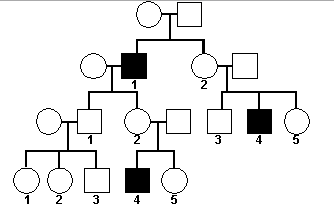
The pedigree is showing a _____________ trait.

a)

autosomal dominant

b)

autosomal recessive

c)

sex linked recessive

68.

What type of heredity is shown in the pedigree?

a)

Sex-Linked Dominant

b)

Sex-Linked Recessive

c)

Autosomal Dominant

d)

Autosomal Recessive

69.

What is the mode of inheritance shown here?

a)

Recessive because it "skips" a generation

b)

Dominant because it shows up in every generation

70.

How are individuals III-2 and II-4 related?

a)

Brother and sister

b)

Dad and daughter

c)

Uncle and niece

d)

Grandfather and granddaughter

71.

Who could a daughter inherit a sex linked allele from?

a)

Her mother only

b)

Her father only

c)

Either parent

72.
In peas, the trait for tall plants is dominant (T) and the trait for short plants is recessive (t).  The trait for yellow seeds is dominant (Y) and the trait for green seeds is recessive (y).
A cross between two plants results in 292 tall, yellow plants and 103 short, green plants.  What are the most likely genotypes of the parents?
a)
TtYY x Ttyy
b)
TTYy x TTYy
c)
TTyy x TTYy
d)
TtYy x TtYy
73.
A child has type O blood, if mother has type A blood, what would the fathers blood type be
a)
A,B, or O
b)
AB or A
c)
AB or B
d)
O only
74.
A child born with blood type O could have parents with all of the following blood types except...?
a)
A and B
b)
A and O
c)
A and A
d)
AB and O
75.
Freckles (F) are dominant over nonfreckles.   What is the phenotype of individual #3
a)
Ff
b)
ff
c)
freckles 
d)
nonfreckles 
76.
If a heterozygous tall pea plant is crossed with a short pea plant, what are the possible genotypes of the future offspring?
a)
100% Tt
b)
50% Tt, 50% tt
c)
75%Tt, 25%tt
d)
25%TT, 50%Tt, 25%tt
77.
Two brown eyed parents (Bb) have a baby. What is the chance the baby is blue eyed?
a)
0 %
b)
25%
c)
50%
d)
75%
78.
The inherited combination of alleles is known as the offspring's
a)
heredity
b)
phenotype
c)
genotype
d)
redigree
79.
In certain rats, black fur is dominant over white fur. If two rats, both heterozygous for fur color are mated, their offspring would be expected to have 
a)
four different genotypes and two different colors
b)
two different genotypes and three different colors
c)
three different genotypes and two different colors
d)
three different genotypes and three different colors
80.
In screech owls, red feathers are dominant over gray feathers. If two heterozygous red-feathered owls are mated, what percentage of their offspring would be expected to have red feathers?
a)
25%
b)
50%
c)
75%
d)
100%
81.
If the four existing children in a family are all sons, what chance would there be that the next child would also be a son?
a)
75%
b)
50%
c)
25%
d)
20%
82.
A cross between two tall garden pea plants produced 314 tall plants and 98 short plants. What genotypes are the parents?
a)
TT and tt
b)
TT and Tt
c)
Tt and Tt
d)
TT and TT
83.
B - black, b - brown.  Two black mice mate and have some black and some brown mice.  What is the genotype of the parents?
a)
BB x Bb
b)
BB x bb
c)
Bb x Bb
d)
Bb x bb
84.

Labrador retriever's fur color is an example of epistasis. In this case the E gene controls the expression of the B gene. It a puppy was born with the genotype eeBB its fur color would be ________ and if it was born with the genotype EEbb it would be __________

a)

yellow, yellow

b)

yellow, black

c)

chocolate, black

d)

yellow, chocolate

85.
What goes in box 6
a)
AaBB
b)
AABB
c)
aaBB
d)
AAbb
86.
What goes in box 15
a)
abab
b)
ABAB
c)
aBaB
d)
AbAb
87.
Imagine you are performing a cross involving seed color in garden pea plants. What F1 offspring would you expect if you cross true-breeding parents with green seeds and yellow seeds? Yellow seed color is dominant over green.
a)
100 percent yellow-green seeds
b)
100 percent yellow seeds
c)
50 percent yellow, 50 percent green seeds
d)
25 percent green, 75 percent yellow seeds
88.
Hemophilia is a recessive x-linked disorder.
Which genotype represents a male with hemophilia?
a)
XHXh
b)
XhXh
c)
XHY
d)
XhY
89.
A homozygous dominant dog with brown fur is crossed with a heterozygous dog with brown fur. What are the percentages of the possible genotypes?
a)
100% BB
b)
75% BB and 25%Bb
c)
50 % BB and 50% Bb
d)
50% Bb and 50% bb
90.
Two heterozygous (Tt) tall pea plants are crossed. Which describes their offspring?
a)
50% tall and 50% short
b)
75%tall and 25% short
c)
100%short
91.
T - tall and t = short
In the punnett square below, what belongs in the missing square
a)
tt
b)
Tt
c)
Bb
d)
TT
92.

Bristle-like structures in which help the worm move

a)

Setae

b)

Clitellum

c)

Gizzard

d)

Crop

93.

Earthworms don't have teeth to grind their food so they use another organ to do so. It is called a

a)

Setae

b)

Crop

c)

Gizzard

d)

Clitellum

94.

Thickened non-segmented structure of the body indicating an adult worm that is available for reproduction. (the hump of the earthworm)

a)

Setae

b)

Clitellum

c)

Crop

d)

Gizzard

95.

This structure is used for food storage.

a)

Clitellum

b)

Crop

c)

Setae

d)

Gizzard

96.

Indicates toward the head

a)

Anterior

b)

Posterior

c)

Ventral

d)

Dorsal

97.

Backside or Top

a)

Anterior

b)

Posterior

c)

Ventral

d)

Dorsal

98.

Abdominal Side or Bottom

a)

Anterior

b)

Posterior

c)

Ventral

d)

Dorsal

99.

What phylum does the earthworm belong?

a)

Annelid

b)

Anthropod

c)

Insecta

d)

Invertebra

100.

Earthworms have which type of symmetry?

a)

Radial

b)

Bilateral

c)

No Symmetry

d)

Prismatic

101.
Earthworms have a ____ circulatory system 
a)
open 
b)
closed 
c)
false
d)
transitional
102.
Identify the structure labeled D.
a)
Clitellum
b)
Prostomium
c)
Female Genital Pore
d)
Male Genital Pore
103.
Layer that covers the body to prevent water loss
a)
Skin
b)
Setae
c)
Coelom
d)
Cuticle
104.
Oxygen and carbon dioxide move into and out of the body through this
a)
Skin
b)
Cuticle
c)
Setae
d)
Clitellum
105.
Stores the sperm produced by worm
a)
Seminal Receptacles
b)
Seminal Vesicles
c)
Prostomium
d)
Hermarphrodite
106.
What class / subclass?
a)
Oligochaeta 
b)
Polychaeta
c)
Hirudinea
107.
What are the reactants for Cell Respiration?
a)
CO2 + H20
b)
Sugar + CO2
c)
Sugar + O2
d)
CO2 + H20 + 38 ATP
108.
What is the first step of Cell Respiration?
a)
Glycolysis
b)
Krebs Cycle
c)
Calvin Cycle
d)
Electron Transport Chain
109.
What is the second step of Cell Respiration?
a)
Glycolysis
b)
Krebs Cycle
c)
Calvin Cycle
d)
Electron Transport Chain
110.
What is the third step of Cell Respiration?
a)
Glycolysis
b)
Krebs Cycle
c)
Calvin Cycle
d)
Electron Transport Chain
111.
In what organelle does cell respiration take place?
a)
Mitochondria
b)
Chloroplast
c)
Golgi Apparatus
d)
Nucleus
112.
Using the figure, which parts of the molecule must the bonds be broken to form an ADP molecule?
a)
A and B
b)
B and C
c)
C and D
d)
all of the above
113.
Energy is released from ATP when
a)
a phosphate group is added
b)
adenine bonds to ribose
c)
ATP is exposed to sunlight
d)
a phosphate group is removed
114.
Which of the following is not a requirement for glycolysis?
a)
Oxygen
b)
ATP
c)
NAD+
d)
Glucose
115.
Glycolysis results in the net gain of:
a)
2 ATP
b)
4 ATP
c)
4 NADH
d)
2 Acetyl CoA
116.
What is the starting molecule for glycolysis?
a)
Glucose
b)
ADP
c)
Oxygen
d)
Pyruvic Acid
117.
Glycolysis requires
a)
ATP
b)
Oxygen
c)
sunlight
d)
NADP+
118.
Where does glycolysis occur?
a)
mitochondrial matrix
b)
cytoplasm
c)
inner membrane of mitochondria
d)
outer membrane of mitochondria
119.
Krebs Cycle is part of_______________ respiration.
a)
Aerobic
b)
Anaerobic
120.
What is the correct equation for cellular respiration?
a)
6O2 + C6H12O6 -> 6CO2 + 6H2O + Energy
b)
6O2 + C6H12O6 + Energy -> 6CO2 + 6H2O
c)
6CO2 + 6H2O -> 6O2 + C6H12O6 + Energy
d)
6CO2 + 6H2O + Energy -> 6O2 + C6H12O6
121.
NADH and FADH
a)
carry electrons to the ETC.
b)
bind with Acetyl CoA.
c)
supply energy for the cell.
d)
make water.
122.
Which of the following is not an end product of the Kreb's cycle?
a)
FADH2
b)
CO2
c)
pyruvate
d)
ATP
123.
Which cell process is represented by this equation:
C6H12O6 + 6O2 →          6CO2  +  6H2O +  ATP
a)
diffusion
b)
photosynthesis
c)
cell respiration
d)
mitosis
124.
What are the three stages that make up cellular respiration?
a)
light reactions, calvin cycle and electron transport
b)
glycolysis, kreb's cycle and Calvin cycle
c)
Glycolysis, Kreb's cycle and electron transport
d)
Light Reactions, Calvin Cycle and Glycolysis
125.
How many ATP are produced in Alcoholic respiration?
a)
2
b)
33
c)
4
d)
36
126.
What enzyme in the ETC is responsible for generating the ATP molecules?
a)
ATPase
b)
ATP synthase
c)
Hexokinase
d)
none of the above
127.
What determines the fate of pyruvate?
a)
carbon dioxide
b)
oxygen
c)
ATP
d)
water
128.
Which molecules are made during the Krebs Cycle to power the electron transport chain?
a)
ATP and CO2
b)
ATP and NADH
c)
NADH and FADH2
d)
ADP, NADand FAD+
129.

Glycolysis occurs in the cytoplasm and produces all of the following EXCEPT

a)

ATP

b)

Carbon Dioxide

c)

3 carbon chain (pyruvate)

d)

NADH (electron carrier)

130.

If the ETC was blocked by cyanide what would happen?

a)

the mitochondrion would over heat

b)

excessive NAD+ would build up in the cells and blood

c)

oxygen levels would decrease

d)

NADH and FADH2 would be in high levels

131.

Which of the following can still happen without oxygen gas present in the cell

a)

production of NAD+ at the electron transport chain

b)

production of NADH during krebs cycle

c)

production of NADH during glycolysis

d)

oxidative phosphorylation at the ATP synthase

132.
Which process takes place in the presence of oxygen and produces nearly 20 times as much as ATP as glycolysis alone?
a)
photosynthesis
b)
lactic acid fermentation
c)
aerobic respiration
d)
alcoholic fermentation
133.
What are the reactants in the equation for cellular respiration?
a)
oxygen and lactic acid
b)
carbon dioxide and water
c)
glucose and oxygen
d)
water and glucose
134.

Which of the following is a product of the Electron Transport Chain?

a)

CO2

b)

O2

c)

C6H1206

d)

H2O

135.

What does carbon dioxide combine with to eventually form glucose? 

a)
NADPH
b)
ATP
c)
RuBP
d)
G3P
136.
How many G3P molecules make one molecule of glucose? 
a)
1
b)
2
c)
3
d)
4
137.
Where do the dark reactions take place? 
a)
thylakoid membrane
b)
lumen
c)
stroma
138.
What does NADPH do? 
a)
carries electrons to the Calvin cycle
b)
carries electrons to the ETC
139.
The two main stages of photosynthesis are the
a)
light reactions and respiration
b)
dark reactions and the Calvin cycle 
c)
light reactions and the Calvin cycle
d)
dark reactions and fermentation
140.
In green plants, the primary function of the Calvin cycle is to
a)
Use ATP to release carbon
b)
Split water to release oxygen.
c)
Construct simple sugars from carbon dioxide.
d)
Use NADPH to release carbon
141.
Which of the following is NOT a reactant of the dark reactions?
a)
NADPH
b)
ATP
c)
Oxygen
d)
Carbon dioxide
142.
What is made during the light independent reactions?
a)
ATP
b)
NADPH
c)
sugar
d)
fat
143.
What is the name of the simple sugar that is produced in photosynthesis?
a)
Sucrose
b)
Dextrose
c)
Glucose
d)
Lactose
144.
What is the product of the Calvin Cycle?
a)
Rubisco
b)
Glyceraldehyde 3-Phosphate (G3P)
c)
Oxygen
d)
Starch
145.
Corn and sugarcane are examples of plants that carry out the _____ pathway in photosynthesis.
a)
CAM
b)
C4
c)
C3
146.
Which enzyme joins CO2 and RuBP?
a)
NADP+ reductase
b)
rubisco
c)
ATP synthase
147.
Most plants carry out the _____ pathway in photosynthesis.
a)
CAM
b)
C4
c)
C3
148.

Main products of the Calvin Cycle

a)

Oxygen, NADP+, ADP

b)

Glucose, CO2, ADP

c)

ADP, NADP+, Glucose

d)

ATP, NADPH, Oxygen

149.

Tiny pores on the underside of leaves

a)

Stroma

b)

Stomata

c)

Thylakoids

d)

Chloroplasts

150.

Which of the following is a way to increase the rate of photosynthesis?

a)

Increase oxygen levels

b)

Decrease CO2 levels

c)

Increase light intensity

d)

Decrease water level

151.
The loss of H2O through stomata is referred to as:
a)
Transpiration
b)
Respiration
c)
Evaporation
d)
Photorespiration
152.
The main advantage of CAM Photosynthesis is the ability to avoid:
a)
Transpiration
b)
Photorespiration
c)
Photosynthesis
d)
Signal Transduction
153.
Which of the following molecules is not needed for the Calvin Cycle?
a)
CO2
b)
ATP
c)
NADPH
d)
H2O
154.

What product of the light-dependent reactions is used in the Calvin cycle?

a)

Oxygen

b)

Carbon Dioxide

c)

H2O

d)

ATP

155.

Which of the following is NOT a product of the dark reactions?

a)

NADP+

b)

NADPH

c)

ADP

d)

G3P (to form glucose)

156.
How many carbon atoms are in RuBP?
a)
2
b)
3
c)
4
d)
5
157.
Where is glucose synthesized
a)
Photosystem II
b)
Photosystem I
c)
Calvin Cycle
d)
Glycolysis
158.

The individual disks in the chloroplast are called:

a)

Lamellae

b)

Grana

c)

Stroma

d)

Thylakoids

159.
The interior space of the chloroplast is called:
a)
Lamellae
b)
Grana
c)
Stroma
d)
Thylakoids
160.

What is the chemical equation for photosynthesis?

a)

6 CO2 + 6 H2O ---sunlight---> 6 O2 and C6H12O6

b)

ATP + NADPH ----> NADP+ and ADP

c)

6 O2 and C6H12O6 ---sunlight---> 6 CO2 + 6 H2O

d)

ADP and NADP+ ------> ATP and NADPH

161.
What do plants need for the photosynthesis process?
a)
a camera and tripod
b)
light, carbon dioxide, and water
c)
roots, flowers, and bees
d)
soil, air, and oxygen
162.
What is the function of NADP+?
a)
It absorbs light
b)
It is an electron carrier
c)
It is a light-reflecting pigment
d)
It acts as long-term energy storage
163.
Chlorophyll absorbs _____ and _______ light from the light.
a)
purple and green
b)
red and blue
c)
black and orange
d)
yellow and green
164.
It is important to create a concentration of H+  in the thylakoid space so that the H+ can diffuse through_________ to create ______.
a)
ATP synthase, ATP
b)
NADH, NADPH
c)
proton pump, protons
165.
Plants need carbon dioxide from their environment to produce glucose during which stage of photosynthesis? 
a)
The light-dependent stage
b)
The light-independent stage (The Calvin Cycle)
c)
The electron transport chain
d)
ATP formation