
 Worksheets
Final Exam Review
Total questions: 160
Worksheet time: 2hrs 24mins
Name
Class
Date
1.
What is a factor that is measured for change in an experiment?
a)
control
b)
constant
c)
independent variable
d)
dependent variable
2.
What is the factor that an experimenter changes on purpose?
a)
Dependent Variable
b)
Independent Variable
c)
Constant
d)
Control
3.
The part of the experiment that does not contain the independent variable. Used for comparison.
a)
Control Group
b)
Experimental Group
c)
Results
d)
Data
4.
What are all the things that are kept the same in an experiment?
a)
controls
b)
data
c)
constants
d)
independent variables
5.
What is the effect of salt water on the average of the height of the 3 tallest blades of grass?
What is the independent variable in the above question?
What is the independent variable in the above question?
a)
salt water
b)
height
c)
average
d)
effect
6.
What is an if....then statement that predicts the outcome of an experiment or how the Independent variable effects the dependent variable?
a)
Conclusion
b)
Materials
c)
Hypothesis
d)
Problem
7.
What is the part of the experiment that contains the independent variable?
a)
control group
b)
experimental group
c)
hypothesis
d)
dependent variable
8.
What are cell parts in plants that convert sunlight into sugar?
a)
Chloroplasts
b)
Mitochondria
c)
Nucleus
d)
Ribosomes
9.
The process of converting light energy to chemical energy is called
a)
respiration
b)
mitosis
c)
photosynthesis
d)
active transport
10.
These (plus energy) are the raw materials for photosynthesis.
a)
H2O and O2
b)
C6H12O6 and O2
c)
H2O and C6H12O6
d)
H2O and CO2
11.
What is the name of the simple sugar that is produced in photosynthesis?
a)
Sucrose
b)
Dextrose
c)
Glucose
d)
Lactose
12.
What gas is USED in Respiration?
a)
O2
b)
CO2
c)
H2O
d)
CHO2
13.
In which part of a plant would you expect to find the most chloroplasts?
a)
The roots
b)
The leaves
c)
The stems
d)
The flowers
14.
How does oxygen get into the cells?
a)
Diffusion
b)
Osmosis
c)
Mitosis
d)
Magic
15.
What is the difference between Respiration and fermentation?
a)
Respiration uses Oxygen, Fermentation uses fairy dust.
b)
There is no difference. They both use oxygen to burn sugar.
c)
Respiration uses Oxygen, Fermentation does not.
d)
Fermentation burns alcohol instead of sugar.
16.
What is the primary purpose of cellular respiration?
a)
to release oxygen from air molecules
b)
To release energy from air milecules
c)
To release energy from food molecules
d)
to release Sirius Black from Azkaban
17.
What are the products of photosynthesis?
a)
water and carbon dioxide
b)
oxygen and glucose
c)
oxygen and carbon dioxide
d)
oxygen and water
18.
What molecule absorbs sunlight for photosynthesis?
a)
chloroplast
b)
thylakoid
c)
grana
d)
chlorophyll
19.
What are the products of photosynthesis?
a)
Carbon dioxide and water
b)
Carbon dioxide and oxygen
c)
Glucose and oxygen
d)
Glucose and water
20.
The raw materials or reactants of photosynthesis are
a)
sugar and water.
b)
sugar and oxygen.
c)
carbon dioxide and water.
d)
carbon dioxide and oxygen.
21.
The main source of energy for all life comes from ____.
a)
the Earth
b)
the moon
c)
the sun
d)
the food we eat/make
22.
Where does cellular respiration take place in the cell?
a)
Cell Membrane
b)
Nucleus
c)
Mitochondria
d)
Vacuole
23.
Which of the following is the correct equation for PHOTOSYNTHESIS?
a)
6CO2 + 6H2O --> 6O2 + C6H12O6
b)
6CO2 + C6H12O6 + 6H2O --> O2
c)
6O2 + 6H2O --> 6CO2 + C6H12O6
d)
C6H12O6 + 6O2 ---> 6H2O + 6CO2
24.
What is the function of ATP in living things?
a)
provides energy for cells
b)
stores genetic information
c)
provides structure in the nucleus
25.

Using the figure, which parts of the molecule must the bonds be broken to form an ADP molecule?
a)
A and B
b)
B and C
c)
C and D
d)
all of the above
26.
Energy is released from ATP when
a)
a phosphate group is added
b)
adenine bonds to ribose
c)
ATP is exposed to sunlight
d)
a phosphate group is removed
27.
What are the parts of the ATP molecule?
a)
adenine, thylakoids, stroma
b)
stroma, grana, chlorophyll
c)
adenine, ribose, phosphate groups
d)
NADH, NAHPH, FADH
28.
Which cellular organelle is responsible for manufacturing ATP?
a)
Ribosome
b)
Nucleus
c)
Mitochondria
d)
Chloroplast
29.
ADP is an abbreviation for:
a)
aniline diphosphate.
b)
adenine diphosphate.
c)
adenosine diphosphate.
d)
adenosine triphosphate.
30.

Autotroph or Heterotroph?
a)
Autotroph
b)
Heterotroph
31.
Photosynthesis _______ energy while cellular respiration ______ energy.
a)
uses; releases
b)
releases; uses
c)
uses; uses
d)
releases; releases
32.
The number of ATP molecules produced out of Krebs Cycle is:
a)
2
b)
3
c)
4
d)
0
33.
Which of the following is not a requirement for the Krebs Cycle?
a)
NAD+
b)
FAD+
c)
Water
d)
Pyruvate
34.
Krebs Cycle takes place in the:
a)
Cytoplasm
b)
Matrix
c)
Ribsome
d)
InterMembrane Space
35.
Respiration uses ___ and ___, and produces ___ & ____.
a)
CO2 & ATP, O2 & glucose
b)
O2 & glucose, CO2 & ATP
c)
CO2 & glucose, O2 & ATP
d)
O2 & ATP, CO2 & glucose
36.
Glycolysis produces _____ which has ___ carbon atoms
a)
glucose, 6
b)
pyruvate, 2
c)
acetyl CoA, 3
d)
pyruvate, 3
37.
Aerobic respiration occurs in the presence of ______________.
a)
nitrogen
b)
carbon dioxiide
c)
oxygen
d)
carbon monoxide
38.
During which phase of cellular respiration is pyruvic acid produced?
a)
glycolysis
b)
calvin cycle
c)
kreb's cycle
d)
electron transport
39.
Molecules that act as high energy electron carriers during cellular respiration are
a)
ADP and ATP
b)
NADH and FADH2
c)
NADPH and ADP
d)
carbon dioxide and water
40.
During which step of cellular respiration is carbon dioxide released?
a)
Calvin Cycle
b)
Glycolysis
c)
Kreb's cycle
d)
electron transport
41.
What process is found in both aerobic and anaerobic metabolism?
a)
the Kreb's cycle
b)
oxidative phosphorylation
c)
the citric acid cycle
d)
glycolysis
42.
Lactic acid fermentation occurs in your muscles after a workout because your cells are struggling to get...
a)
Glucose
b)
Sunlight
c)
Oxygen
d)
Water
43.
Fermentation is cellular respiration without which molecule?
a)
CO2
b)
O2
c)
C6H12O6
44.
When respiration occurs with oxygen, it is called _______
a)
anaerobic
b)
aerobic
c)
light-dependent
d)
fermentation
45.
If your body runs out of oxygen, it will begin to perform ______.
a)
alcohol fermentation
b)
photosynthesis
c)
cellular respiration
d)
lactic acid fermentation
46.
Because fermentation takes place in the absence of oxygen, it is said to be
a)
aerobic
b)
anaerobic
c)
cyclic
d)
oxygen-rich
47.
The process carried out by yeast that causes bread to rise is
a)
alcoholic fermentation
b)
lactic acid fermentation
c)
cellular respiration
d)
yeast mitosis
48.

Which process produces CO2 as a waste product?
a)
Lactic Acid Fermentation
b)
Ethanol (Alcoholic) Fermentation
49.

Bread is a product of fermentation that contains bubbles. These bubbles come from:
a)
Carbon Dioxide
b)
Lactic Acid
c)
Oxygen
d)
Water
50.
I am a single strand.
a)
DNA
b)
RNA
51.
I am arranged as a double helix or "twisted ladder".
a)
DNA
b)
RNA
52.
I include the bases Guanine, Cytosine, Adenine and Thymine.
a)
DNA
b)
RNA
53.
I include the bases Guanine, Cytosine, Adenine and Uracil .
a)
DNA
b)
RNA
54.
I travel outside of the nucleus.
a)
DNA
b)
RNA
55.
Guanine goes with __________
a)
adnine
b)
cytosine
c)
guanine
d)
thymine
56.
I have the sugar ribose.
a)
DNA
b)
RNA
57.
The sugar in DNA is ____________________.
a)
deoxyribose
b)
ribose
58.
What is a mutation?
a)
a change in DNA
b)
a person who is bitten by a radioactive spider
59.
The results of mutation are
a)
can be bad.
b)
can be good.
c)
cannot show.
d)
can be good, bad or neutral.
60.
Adnine goes with __________
a)
adnine
b)
cytosine
c)
guanine
d)
thymine
61.
In Eukaryotic cells, where is DNA ALWAYS located?
a)
Cytoplasm
b)
Nucleus
c)
Outside of the cell
d)
DNA is always moving around
62.
Which of the following is true of DNA?
a)
It can sometimes leave the nucleus
b)
It never leaves the nucleus
c)
It is portable
d)
It is temporary
63.
Transcribe the following DNA strand: CTG AAT
a)
GAC TTA
b)
CTG AAT
c)
GAC UUA
d)
CUG AAU
64.
What is the order for Protein Synthesis?
a)
Transcription -> Translation -> Protein
b)
Translation - > Transcription -> Protein
c)
Protein -> Transcription -> Translation
d)
Translation -> Protein -> Transcription
65.
What will be the resulting mRNA from this DNA sequence:
GAT-TAC-AGA-TTA-CAT?
GAT-TAC-AGA-TTA-CAT?
a)
CTA-ATG-TCT-AAT-GTA
b)
GAU-UAG-UGA-UUA-GUT
c)
CUA-AUG-UCU-AAU-GUA
d)
CAT-ACA-TAC-ATA-TAG
66.
What is the RNA sequence for this amino acid chain: LYSINE - GLYCINE - STOP
a)
AAA - CCC - UAA
b)
AAA - GGG - UAA
c)
AAG - AUC - CGA
d)
AAG - GGG - UUU
67.
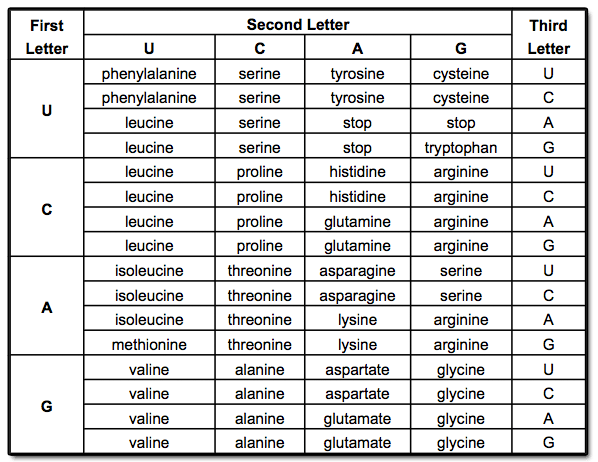
What is the correct amino acid sequence for the mRNA code AUGCCAGUAUGA
a)
Met-Pro-Ala-Val
b)
Met-Pro-Val
c)
Tyr-Gly-His
d)
Tyr-Gly-Arg-His
68.
Every three letters (example: ATC) in DNA codes for what??
a)
Amino Acid
b)
Nucleotide
c)
Lipid
d)
Carbohydrate
69.
One difference between DNA and RNA is that RNA....
a)
is double stranded
b)
contains the base Thymine
c)
contains the base Uracil
d)
contained the base Guanine
70.
The anti-codon
a)
contains a sequence the same as the codon
b)
contains a sequence complementary to the codon
c)
contains the base thymine
71.
tRNA is involved in
a)
carrying amino acids
b)
carrying ribosomes
c)
carrying glucose
d)
carrying lipids
72.
Amino acids are joined together in order to form
a)
DNA
b)
ribosomes
c)
proteins
d)
RNA
73.

The haploid number of human chromosomes is
a)
11
b)
12
c)
23
d)
46
74.
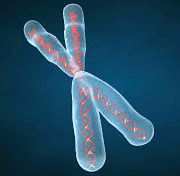
The diploid number of human chromosomes is
a)
23
b)
46
c)
92
75.
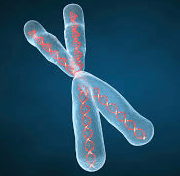
Each identical side of a chromosome is the
a)
centromere
b)
chromatin
c)
centriole
d)
chromatid
76.

When DNA is in its less coiled, "relaxed," state, between cell divisions, it is called
a)
autosomes
b)
chromatid
c)
chromatin
d)
centromere
77.
Autosomes are
a)
chromosomes found in autotrophs, only
b)
chromosomes that automatically correct all errors in the DNA
c)
chromosomes that determine traits other than sex
d)
chromosomes that determine the sex of the individual
78.

The structure that holds two chromosomes together until they separate for cell division is the
a)
chromatid
b)
chromatin
c)
centromere
d)
cytoplasm
79.
You are viewing a patients karyotype. You see 23 chromosomes total. There are no homologous chromosomes. Which cell are you viewing?
a)
Egg cell
b)
Zygote
c)
Skin cell
d)
White blood cell
80.
Crossing over helps promote
a)
male genotype
b)
genetic variation
c)
DNA replication
d)
mitosis
81.

A sperm contains
a)
Both an X and a Y chromosome
b)
Two X chromosomes
c)
An X OR a Y chromosome
d)
only a Y chromosome
82.
The cells produced via meiosis are called:
a)
sex cells
b)
somatic cells
c)
body cells
d)
skin cells
83.
This produces 2 identical cells.
a)
mitosis
b)
meiosis
84.

Meiosis makes sperm and egg cells. In humans, sperm and egg cells each have _____ chromosomes. Therefore a fertilized human egg cell (sperm and egg cell combined) would create a cell with _____ chromosomes.
a)
23, 46
b)
46, 23
c)
2, 4
d)
50, 100
85.

When an area of a chromatid is exchanged with the matching area on a chromatid of its homologous chromosome, _________________ occurs
a)
crossing over
b)
mutagenesis
c)
hybridization
d)
fertilization
86.
Chargaff's experiments showed that the amount of A, T, G and C is the same from species to species
a)
True
b)
False
87.
If a section of DNA has 13% thymine, then there is _____ adenine
a)
13%
b)
26%
c)
37%
d)
74%
88.
If there is 29% guanine in a section of DNA, then there is _____ thymine
a)
21%
b)
29%
c)
42%
d)
58%
89.
Who said, "The amount of A = the amount of T, and the amount of G = the amount of C"?
a)
Chargaff
b)
Avery
c)
Griffith
d)
Franklin
90.
The work of scientists including Griffin, Avery, Hershey & Chase and Franklin helped us to determine the __ are responsible for carrying genetic material.
a)
Amino Acids
b)
Proteins
c)
Nucleic Acids
d)
Carbohydrates
91.
From his work with mice and pneumonia-causing bacteria, Frederick Griffin coined the term
a)
Replication
b)
Transcription
c)
Transformation
d)
Translation
92.
By using radioactive isotopes, Hershey and Chase were able to conclude that __ is/are the carrier(s) of genetic information.
a)
nucleic acid
b)
Proteins
c)
Carbohydrates
d)
Lipids
93.
The work of Erwin Chargaff allowed Watson and Crick to determine the rules of...
a)
protein synthesis
b)
transcription
c)
hydrogen bonding
d)
nitrogen base pairing
94.
Rosalind Franklin's "Photo 51" allowed Watson and Crick to determine the ___ of DNA.
a)
Shape
b)
Backbone
c)
Nitrogen bases
d)
Hydrogen bonds
95.
Griffith discovered that
a)
DNA is different than RNA.
b)
adenine = thymine.
c)
bacteria can transfer DNA.
d)
DNA is the genetic molecule.
96.
How did Hershey and Chase's use of radiolabeled bacteriophages to study the genetic material validate Avery's research?
a)
It demonstrated conclusively that the genetic material is not protein.
b)
It showed that bacteriophages are not digested by bacterial enzymes.
c)
It proved that bacteria will take up phosphorus, but not sulfur.
d)
It confirmed that bacteriophages cannot inject radiolabeled DNA.
97.

Who was responsible for the experiment depicted by the image?
a)
Friedrich (Fritz) Miescher
b)
Hershey & Chase
c)
Frederick Griffith
d)
Oswald Avery, et. al.
98.

Who was responsible for the experiment depicted by the image?
a)
Friedrich (Fritz) Miescher
b)
Watson and Crick
c)
Frederick Griffith
d)
Rosalind Franklin
99.

Who was responsible for the experiment depicted by the image/data table?
a)
Oswald Avery, et. al.
b)
Watson and Crick
c)
Erwin Chargaff
d)
Frederick Griffith
100.

Who was responsible for the model shown?
a)
Oswald Avery, et. al.
b)
Watson and Crick
c)
Erwin Chargaff
d)
Linus Pauling
101.

Who was responsible for the experiment depicted by the image/data table?
a)
Oswald Avery, et. al.
b)
Watson and Crick
c)
Erwin Chargaff
d)
Rosalind Franklin
102.

Fruit fly body cells have 8 chromosomes. After mitosis, you would expect a resulting fruit fly daughter cell to have ...
a)
16 chromosomes.
b)
46 chromosomes.
c)
8 chromosomes.
d)
4 chromosomes.
103.
The process by which the nuclear material is divided equally between two new cells
a)
mitosis
b)
cancer
c)
spindle
d)
centromere
104.

Structure (b) is a ____.
a)
chromosome
b)
chromatid
c)
centromere
105.

Structure (a) is a ____.
a)
chromosome
b)
chromatid
c)
centromere
106.

Structure (c) is a ____.
a)
chromosome
b)
chromatid
c)
centromere
107.

Name the phase:
a)
Anaphase
b)
Telophase
c)
Metaphase
d)
Prophase
108.

Name the phase:
a)
Anaphase
b)
Telophase
c)
Metaphase
d)
Prophase
109.

What is the next phase of mitosis?
a)
Prophase
b)
Metaphase
c)
Anaphase
d)
Telophase
110.

Name the previous phase.
a)
Prophase
b)
Metaphase
c)
Anaphase
d)
Telophase
111.

Name the previous phase.
a)
Prophase
b)
Metaphase
c)
Anaphase
d)
Telophase
112.

Name the phase:
a)
Prophase
b)
Metaphase
c)
Anaphase
d)
Telophase
113.

The organelle that helps in cell division and produces spindle fibers.
a)
Chromosome
b)
Centriole
c)
Cytoplasm
d)
Chloroplast
114.
In order to obtain nutrients and oxygen quickly, a cell needs a large:
a)
Volume
b)
Surface area
c)
Density
d)
Mass
115.

Cancer cells typically form a mass of tissue called a:
a)
biopsy.
b)
carcinogen.
c)
tumor.
d)
allergy.
116.

What does it mean for a tumor to metastasize?
a)
mass
b)
spread
c)
to get better
d)
to repair cells
117.

What is cancer?
a)
The heart does not receive enough blood.
b)
Sudden disruption of blood flow to part of the brain.
c)
Blood filled weak spot.
d)
Uncontrolled growth and spread of abnormal cells.
118.
the uncontrolled division of cells that results in malignant growth
a)
tissues
b)
cancer
c)
mitosis
d)
anaphase
119.
Which of the following genotypes is homozygous recessive?
a)
RR
b)
Rr
c)
rr
d)
None of the Above
120.
Brown (B) is dominant over white (b). Which genotype is a purebred for brown fur?
a)
BB
b)
Bb
c)
bb
d)
All of the above
121.
Which of the following terms refers to the different possibilities of a gene?
a)
chromosome
b)
DNA
c)
Punnett Squares
d)
allele
122.
If something is heterozygous, it is also...
a)
purebred
b)
hybrid
c)
dominant
d)
recessive
123.
True/False: Different genotypes can code for the same phenotype.
a)
True
b)
False
124.

This image shows a...
a)
Punnett Square
b)
Phenotype
c)
Genotype
d)
Dominant allele
125.
What does a Punnett Square help you do?
a)
Determine the ratio of phenotypes
b)
Determine the ratio of genotypes
c)
Predict possible traits the offspring will have
d)
All of the above
126.
A phenotype is the...
a)
letter combination
b)
dominant gene
c)
recessive gene
d)
physical appearance
127.
Another word for homozygous is...
a)
purebred
b)
hybrid
c)
heterozygous
d)
dominant
128.
Recessive alleles are-
a)
capital
b)
lowercase
c)
both
d)
neither
129.
Tt is-
a)
homozygous dominant
b)
homozygous recessive
c)
heterozygous
d)
none of these
130.
Purple is dominant to white. A heterozygous purple flower is crossed with a white flower. What are the genotypes and phenotypes of the offspring?
a)
100% Pp (purple)
b)
50% Pp (purple); 50% pp (white)
c)
75% Pp (purple); 25% pp (white)
d)
25% PP, 50% Pp, 25% pp
75% purple, 25% white
75% purple, 25% white
131.
If a pea plant were homozygous recessive for height, how would its alleles be represented?
a)
TT
b)
Tt
c)
tt
d)
tT
132.

Which is the correct phenotype for this organism?
a)
BB
b)
blue
c)
green
d)
bb
133.

What is the genotype for this organism?
(E= 3 eyes, e= 1 eye)
(E= 3 eyes, e= 1 eye)
a)
EE
b)
Ee
c)
ee
d)
EE or Ee
134.

If green is dominant over purple, then what is the genotype for this individual?
a)
Purple
b)
Green
c)
GG
d)
gg
135.
B - black, b - brown. Two black mice mate and have some black and some brown mice. What is the genotype of the parents?
a)
BB x Bb
b)
BB x bb
c)
Bb x Bb
d)
Bb x bb
136.

What goes in box 1
a)
AABb
b)
AABB
c)
aabb
d)
AaBb
137.
What goes in box 2
a)
AABb
b)
AaBb
c)
aabb
d)
AaBB
138.
What goes in box 3
a)
Aabb
b)
AABB
c)
AAbb
d)
aaBb
139.
What goes in box 4
a)
AABb
b)
AABB
c)
AAbb
d)
AaBB
140.
Cross Two Homozygous plants
(RRYY x rryy)
R = round seeds, r = wrinkled seeds Y = yellow seeds, y = green seeds
What percent will have Round and Yellow seeds?
(RRYY x rryy)
R = round seeds, r = wrinkled seeds Y = yellow seeds, y = green seeds
What percent will have Round and Yellow seeds?
a)
0%
b)
25%
c)
50%
d)
100%
141.

What genotype is missing from this Punnett Square?
a)
RrYy
b)
RRYY
c)
rryy
d)
RrYY
142.

Based off this punnett square, what fraction of the offspring will have wrinkled, yellow seeds?
a)
9/16
b)
3/16
c)
1/16
d)
16/16
143.
Cross Two Homozygous plants
(RRYY x rryy)
R = round seeds, r = wrinkled seeds Y = yellow seeds, y = green seeds
What percent will have Round and Yellow seeds?
(RRYY x rryy)
R = round seeds, r = wrinkled seeds Y = yellow seeds, y = green seeds
What percent will have Round and Yellow seeds?
a)
0%
b)
25%
c)
50%
d)
100%
144.
What did Gregor Mendel use to discover the principles that rule heredity?
a)
Pea Plant
b)
Pigeons
c)
Pear trees
d)
Photosynthesis
145.
Before Mendel how did people think you got your traits
a)
equal from each parent
b)
more from the dad
c)
more from the mom
d)
from a stork
146.
What is a factor that is covered up by another trait?
a)
Recessive
b)
Dominant
147.

Who was the naturalist that traveled the world to study plants and animals?
a)
Albert Einstein
b)
Charles Darwin
c)
Charles Barkley
d)
Isaac Newton
148.

The gradual change in species over time is...
a)
Evolution
b)
Nucleotide
c)
Adaptation
d)
Natural Selection
149.

To adjust to a changing environment
a)
Mutation
b)
Adapt
150.

Darwin wrote that organisms with traits that are best suited to the environment will ________________
a)
increase in number
b)
become extinct
151.
When an organism completely dies out, it is called.....
a)
Adaption
b)
Extinction
c)
Fossilization
d)
Mutation
152.
Darwin referred to this as survival of the fittest. Over time, it results in changes in the inherited characteristics of a population because organisms with adaptations that make them fit for their environment will survive and reproduce better than those without favorable traits.
a)
Natural Selection
b)
Genetic Variation
c)
Survival of the Fittest
153.
Genetic differences between organisms of the same species
a)
Variation
b)
Adaptation
c)
Behavior
d)
Environment
154.
What is the advantage of having different shaped beaks?
a)
To look different from other species.
b)
To be able to eat the food readily available in the environment.
c)
To protect itself against predators.
d)
To protect itself against prey.
155.
The struggle for existence against other members of an organisms species is
a)
Competition
b)
Natural Selection
c)
gene flow
d)
genetic drift
156.

This animal is product of
a)
Natural Selection
b)
Selective Breeding
c)
Asexual Reproduction
d)
Bacteria
157.

This animal is an example of...
a)
Natural Selection
b)
Bacteria
c)
Asexual Reproduction
d)
Artificial Selection
158.

If a mouse population changes color from white to black over many generations due to their environment, what selection is taking place?
a)
Natural Selection
b)
Selective Breeding
c)
Artificial Selection
d)
Hydrogen and Helium
159.

The blue whale is an example of..
a)
Artificial Selection
b)
Natural Selection
c)
Selective Breeding
d)
Mutations
160.

This animal is a product of ...
a)
Natural Selection
b)
Artificial Selection
c)
Human Made
d)
Selective Breeding
100 %

