
 Worksheets
Biology 1: Final Review Test
Total questions: 156
Worksheet time: 1hrs 18mins
As a cell becomes larger, its
volume increases faster than its surface area.
surface area increases faster than its volume.
volume increases, but its surface area stays the same.
surface area stays the same, but its volume increases.
As a cell grows, it
places more demands on its DNA.
uses up food and oxygen more quickly.
has more trouble moving enough materials across its cell membrane.
all of the above
The speed with which wastes are produced by a cell depends on the cell's
ratio of surface area to volume.
environment.
volume.
surface area.
All of the following are problems that growth causes for cells EXCEPT
DNA overload.
excess oxygen.
obtaining enough food.
expelling wastes.
The process by which a cell divides into two daughter cells is called
cell division.
metaphase.
interphase.
mitosis.
Which of the following happens when a cell divides?
The cell's volume increases.
It becomes more difficult for the cell to get enough oxygen and nutrients.
The cell has DNA overload.
Each daughter cell receives its own copy of the parent cell's DNA.
When during the cell cycle are chromosomes visible?
Only during interphase
Only when they are being replicated
Only during cell division
Only during the G1 phase
Which of the following is a phase in the cell cycle?
G1 phase
G2 phase
M phase
all of the above
The cell cycle is the
series of events that cells go through as they grow and divide.
period of time between the birth and the death of a cell.
time from prophase until cytokinesis.
time it takes for one cell to undergo mitosis.
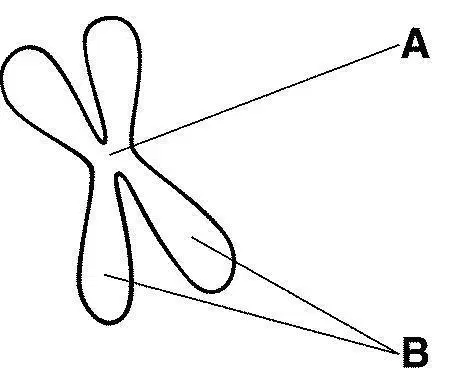
The structure labeled A in Figure 10-2 is called the
centromere.
centriole.
sister chromatid.
spindle.
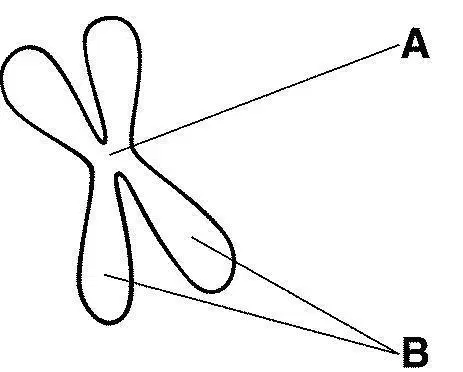
The structures labeled B in Figure 10-2 are called
centromeres.
centrioles.
sister chromatids.
spindles.
During which phase(s) of mitosis are structures like the one shown in Figure 10-2 visible?
Anaphase and prophrase
Prophase and metaphase
Metaphase only
Anaphase and interphase
Which of the following is a phase of mitosis?
Cytokinesis
Interphase
Prophase
S phase
The first phase of mitosis is called
prophase.
anaphase.
metaphase.
interphase.
During which phase of mitosis do the chromosomes line up along the middle of the dividing cell?
Prophase
Telophase
Metaphase
Anaphase
Which of the following represents the phases of mitosis in their proper sequence?
Prophase, metaphase, anaphase, telophase
Interphase, prophase, metaphase, anaphase, telophase
Interphase, prophase, metaphase, telophase
Prophase, metaphase, anaphase, telophase, cytokinesis
What is the role of the spindle during mitosis?
It helps separate the chromosomes.
It breaks down the nuclear membrane.
It duplicates the DNA.
It divides the cell in half.
The two main stages of cell division are called
mitosis and interphase.
synthesis and cytokinesis.
the M phase and the S phase.
cytokinesis and mitosis.
One difference between cell division in plant cells and in animals cells is that plant cells have
centrioles.
centromeres.
a cell plate.
chromatin.
During normal mitotic cell division, a parent cell having four chromosomes will produce two daughter cells, each containing
two chromosomes.
four chromosomes.
eight chromosomes.
sixteen chromosomes.
What happens when cells come into contact with other cells?
They divide more quickly.
They stop growing.
They produce cyclins.
They produce p53.
Which of the following is a factor that can stop normal cells from growing?
Contact with other cells
Growth factors
A cut in the skin
Cyclin that has been taken from a cell in mitosis
Cells grown in a petri dish tend to divide until they form a thin layer covering the bottom of the dish. If cells are removed from the middle of the dish, the cells bordering the open space will begin dividing until they have filled the empty space. What does this experiment show?
When cells come into contact with other cells, they stop growing.
The controls on cell growth and division can be turned on and off.
Cell division can be regulated by factors outside the cell.
All of the above
Which of the following explains why normal cells grown in a petri dish tend to stop growing once they have covered the bottom of the dish?
The cells lack cyclin.
The petri dish inhibits cell growth.
Contact with other cells stops cell growth.
Most cells grown in petri dishes have a defective p53.
When cytoplasm from a cell that is undergoing mitosis is injected into a cell that is in interphase, the second cell
stays in interphase.
enters mitosis.
stops making cyclin.
loses its p53.
In eukaryotic cells, the timing of the cell cycle is regulated by
the centrioles.
cyclins.
the spindle.
all of the above
Cyclins are a family of closely related proteins that
regulate the cell cycle.
produce p53.
cause cancer.
work to heal wounds.
Which of the following regulate(s) the cell cycle?
Growth factors
Cyclins
p53
all of the above
Cancer is a disorder in which some cells have lost the ability to control their
size.
spindle fibers.
growth rate.
surface rate.
Cancer cells form masses of cells called
tumors.
cyclins.
growth factors.
p53.
Gregor Mendel used pea plants to study
flowering.
gamete formation.
the inheritance of traits.
cross-pollination.
Offspring that result from crosses between true-breeding parents with different traits
are true-breeding.
make up the F2 generation.
make up the parental generation.
are called hybrids.
Gregor Mendel removed the male parts from the flowers of some plants in order to
prevent hybrids from forming.
prevent cross-pollination.
prevent self-pollination.
make controlled crosses between plants.
Gregor Mendel concluded that traits are
not inherited by offspring.
inherited through the passing of factors from parents to offspring.
determined by dominant factors only.
determined by recessive factors only.
The principle of dominance states that
all alleles are dominant.
all alleles are recessive.
some alleles are dominant and others are recessive.
alleles are neither dominant nor recessive.
When Gregor Mendel crossed true-breeding tall plants with true-breeding short plants, all the offspring were tall because
the allele for tall plants is recessive.
the allele for short plants is dominant.
the allele for tall plants is dominant.
they were true-breeding like their parents.
If a pea plant has a recessive allele for green peas, it will produce
green peas if it also has a dominant allele for yellow peas.
both green peas and yellow peas if it also has a dominant allele for yellow peas.
green peas if it does not also have a dominant allele for yellow peas.
yellow peas if it does not also have a dominant allele for green peas.
In the P generation, a tall plant was crossed with a short plant. Short plants reappeared in the F2 generation because
some of the F2 plants produced gametes that carried the allele for shortness.
the allele for shortness is dominant.
the allele for shortness and the allele for tallness segregated when the F1 plants produced gametes.
they inherited an allele for shortness from one parent and an allele for tallness from the other parent.
When you flip a coin, what is the probability that it will come up tails?
1/2
1/4
1/8
1
The principles of probability can be used to
predict the traits of the offspring produced by genetic crosses.
determine the actual outcomes of genetic crosses.
predict the traits of the parents used in genetic crosses.
decide which organisms are best to use in genetic crosses.
Organisms that have two identical alleles for a particular trait are said to be
hybrid.
homozygous.
heterozygous.
dominant.
A Punnett square shows all of the following EXCEPT
all possible results of a genetic cross.
the genotypes of the offspring.
the alleles in gametes of each parent.
the actual results of a genetic cross.
How many different allele combinations would be found in the gametes produced by a pea plant whose genotype was RrYY?
2
4
8
16
If a pea plant that is heterozygous for round, yellow peas (RrYy) is crossed with a pea plant that is homozygous for round peas but heterozygous for yellow peas (RRYy), how many different phenotypes are their offspring expected to show?
2
4
8
16
A cross of a red cow (RR) with a white bull (WW) produces all roan offspring (RRWW). This type of inheritance is known as
incomplete dominance.
polygenic inheritance.
codominance.
multiple alleles.
Variation in human skin color is a result of
incomplete dominance.
codominance.
polygenic traits.
multiple alleles.
Gregor Mendel's principles of genetics apply to
plants only.
animals only.
pea plants only.
all organisms.
The number of chromosomes in a gamete is represented by the symbol
Z.
X.
N.
Y.
If an organism's diploid number is 12, its haploid number is
12.
6.
24.
3.
Gametes are produced by the process of
mitosis.
meiosis.
crossing-over.
replication.
Chromosomes form tetrads during
prophase of meiosis I.
metaphase of meiosis I.
interphase.
anaphase of meiosis II.
Unlike mitosis, meiosis results in the formation of
diploid cells.
haploid cells.
2N daughter cells.
body cells.
Which of the following assort independently?
Chromosomes
Genes on the same chromosome
Multiple alleles
Codominant alleles
Gene maps are based on
the frequencies of crossing-over between genes.
independent assortment.
genetic diversity.
the number of genes in a cell.
If two genes are on the same chromosome and rarely assort independently,
crossing-over never occurs between the genes.
crossing-over always occurs between the genes.
the genes are probably located far apart from each other.
the genes are probably located close to each other.
When Gregor Mendel crossed a tall plant with a short plant, the F1 plants inherited
an allele for tallness from each parent.
an allele for tallness from the tall parent and an allele for shortness from the short parent.
an allele for shortness from each parent.
an allele from only the tall parent.
Avery's experiments showed that bacteria transformed by
RNA.
DNA.
proteins.
carbohydrates.
What did Griffith observe when he injected a mixture of heat-killed, disease causing bacteria and live harmless bacteria into mice?
The disease-causing bacteria change into harmless bacteria.
The mice developed pneumonia.
The harmless bacteria died.
The mice were unaffected.
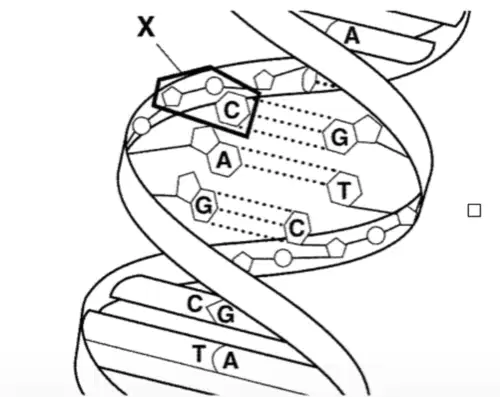
Figure 12-1 shows the structure of a(n)
DNA molecule.
amino acid.
RNA molecule.
protein.
Which of the following is a nucleotide found in DNA?
ribose + phosphate group + thymine
ribose + phosphate group + uracil
deoxyribose + phosphate group + uracil
deoxyribose + phosphate group + cytosine
Because of base pairing in DNA, the percentage of
adenine molecules in DNA is about equal to the percentage of guanine molecules.
pyrimidines in DNA is about equal to the percentage of purines.
purines in DNA is much greater than the percentage of pyrimidines.
cytosine molecules in DNA is much greater than the percentage of guanine molecules.
DNA is copied during a process called
replication.
translation.
transcription.
transformation.
DNA replication results in two DNA molecules,
each with two new strands.
one with two new strands and the other with two original strands.
each with one new strand and one original strand.
each with two original strands.
During DNA replication, a DNA strand that has the bases CTAGGT produces a strand with the bases
TCGAAC.
GATCCA.
AGCTTG.
GAUCCA.
In eukaryotes, DNA
is located in the nucleus.
floats freely in the cytoplasm.
is located in the ribosomes.
is circular.
RNA contains the sugar
ribose.
deoxyribose.
glucose.
lactose.
Unlike DNA, RNA contains
adenine.
uracil.
phosphate groups.
thymine.
How many main types of RNA are there?
1
3
hundreds
thousands
Which type(s) of RNA is (are) involved in protein synthesis?
transfer RNA only
messenger RNA only
ribosomal RNA and transfer RNA only
messenger RNA, ribosomal RNA, and transfer RNA
What is produced during transcription?
RNA molecules
DNA molecules
RNA polymerase
proteins
During transcription, an RNA molecule is formed
that is complementary to both strands of DNA.
that is identical to part of a single strand DNA.
that is double-stranded.
inside the nucleus.
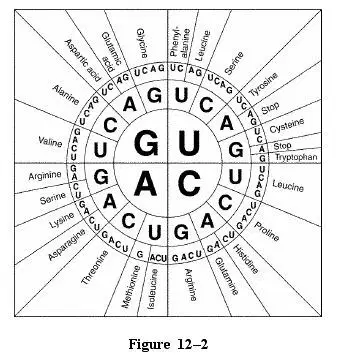
What does Figure 12-2 show?
Anticodons
The order in which amino acids are linked
The code for splicing mRNA
The genetic code
How many codons are needed to specify three amino acids?
3
6
9
12
What happens during the process of translation?
Messenger RNA is made from DNA.
The cell uses information from messenger RNA to produce proteins.
Transfer RNA is made from messenger RNA.
Copies of DNA molecules are made.
Genes contain instructions for assembling
purines.
nucleosomes.
proteins.
pyrimidines.
Which type of RNA functions as a blueprint of the genetic code?
rRNA
tRNA
mRNA
RNA polymerase
A mutation that involves a single nucleotide is called a(n)
chromosomal mutation.
inversion.
point mutation.
translocation.
Which of the following is NOT a gene mutation?
Inversion
Insertion
Deletion
Substitution
Which of the following is NEVER a frameshift mutation?
Substitution
Insertion
Deletion
Point mutation
A promoter is a
binding site for DNA polymerase.
binding site for RNA polymerase.
start signal for transcription.
stop signal for transcription.
Which of the following is NOT an example of biotechnology?
The use of mold to produce antibiotics.
The addition of a piece of human DNA into a bacterial cell.
The observation of a bacterial cell under a microscope.
The production of cloned mice for medical testing.
Why was the Human Genome Project not as successful in curing diseases as originally thought?
Many disease are caused by epigenetics rather than the DNA sequence itself.
They weren't able to sequence much of the human genome.
The information was restricted and not published to medical companies.
The technology wasn't available to sequence the full genome.
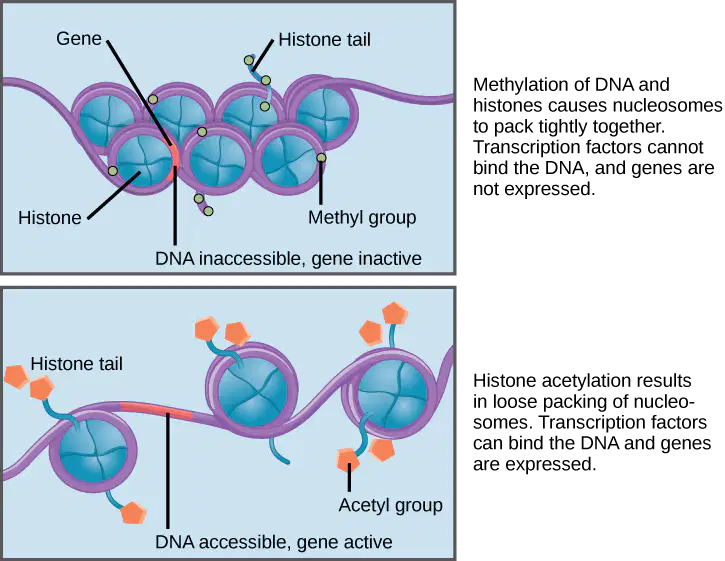
Of the two genes above, which one is able to be transcribed by the cell?
1. A
2. B
3. There's no way to tell.
4. Both A and B.
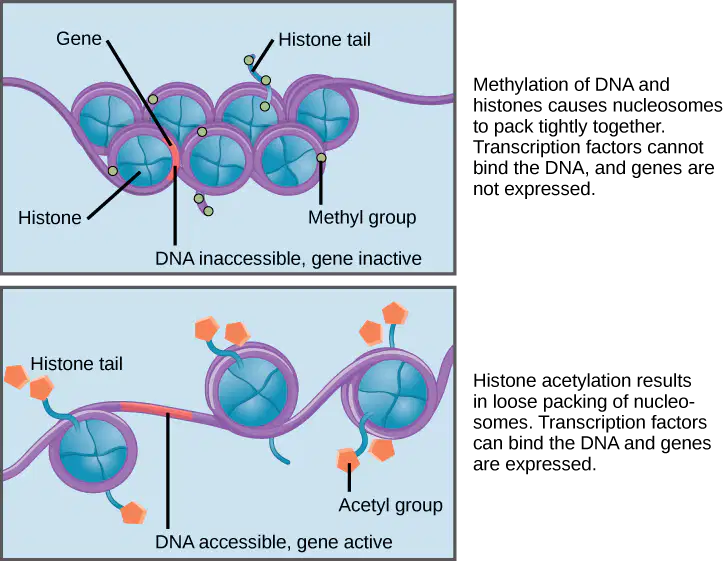
A diet high in folic acid during pregnancy helps to silence disease-causing genes in infants. Which of the images above shows the chromatin of a baby whose mother ingested a lot of folic acid?
A
B
There's no way to tell.
Both A and B.
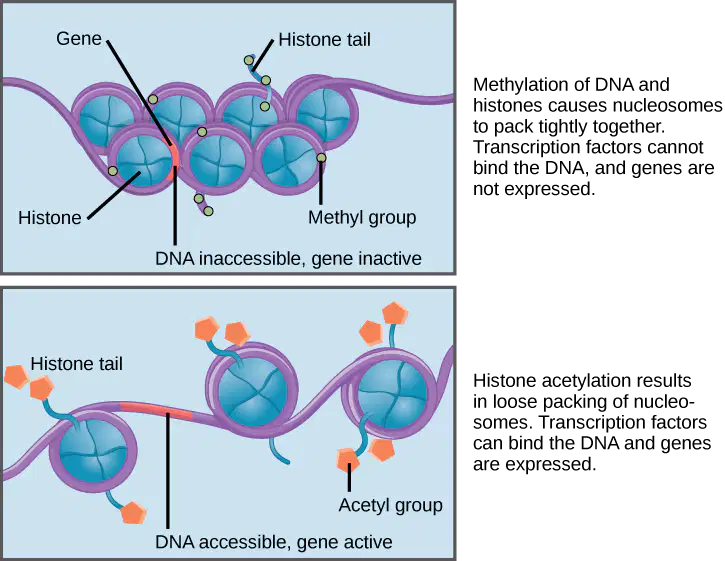
Which of the images above shows DNA that has methyl groups attached to it?
A
B
There's no way to tell.
Both A and B.
The Human Genome Project determined that only about 2% of our genome
codes for promoters and transcription factors.
has any known function.
codes for proteins.
can be sequenced.
A change in environmental conditions (like traveling to space) will most rapidly affect
your DNA sequence.
which genes are activated.
your DNA fingerprint.
your bacterial plasmids.
Restriction enzymes are able to
transcribe RNA back into DNA.
determine the sequence of a gene.
repair a mutated DNA sequence.
cut DNA at a specific point.
Bacteria naturally contain enzymes called restriction endonucleases that are able to
transcribe RNA back into DNA.
determine the sequence of a gene.
repair a mutated DNA sequence.
cut DNA at a specific point.
The chart below shows the length of DNA fragments (in numbers of base pairs) from a DNA finger print.
Length of fragment: 1) 100 bp, 2) 600 bp, 3) 400 bp, 4) 2,000 bp, 5) 800 bp
Which fragment would be the closest to the well (starting point) in the electrophoresis chamber?
1
2
3
4
5
Length of fragment: 1) 100 bp, 2) 600 bp, 3) 400 bp, 4) 2,000 bp, 5) 800 bp
Which of the following is the correct arrangement of these fragments in a DNA fingerprint? Note: The arrow shows the direction of DNA movement.
A
3, 5, 1, 4, and 2 going down
B
4, 5, 2, 3, and 1 going down
C
2, 4, 3, 1, and 2 going down
D
1, 3, 2, 5, and 4 going down
An electrophoresis chamber must be electrically charged because
that is how the DNA is cut apart.
the negatively charged DNA travels towards the positive end.
that is how the adenine and thymine are separated from the guanine and cytosine.
the positively charged DNA travels towards the negative end.
Which of the following is NOT true about STRs?
They vary widely from person to person.
They are a more efficient way than electrophoresis to find a DNA fingerprint.
They are part of non-coding regions in the human genome.
They can amplify the amounts of DNA in a sample.
Which of the is NOT a step in the PCR process?
Annealing
Primerization
Extension
Denaturation
All of the following are examples of methods for changing the genome of a population EXCEPT:
PCR
Selective breeding
CRISPR-Cas9
Genetic engineering with plasmids
You are working with a gene that causes bacteria to glow. You inserted this into a plasmid and added the engineered plasmids to the environment of existing bacteria. After a few days, you still see more bacteria, but none are glowing. What likely went wrong?
The gene was not correctly added into the plasmid.
The existing bacteria did not take up the plasmid.
The bacteria did not reproduce.
The gene was cut by a virus.
Recombinant DNA experiments use plasmids because
they already contain foreign DNA.
their genetic material can't be cut with restriction enzymes.
they are able to replicate inside the bacteria.
their DNA can be sequenced with electrophoresis.
What is the product of combining DNA from different species?
Recombinant DNA
A clone
Hybrid DNA
A plasmid
In which situation would CRISPR-Cas9 be helpful?
When selective breeding is too slow to cultivate the desired gene.
When a restriction enzyme isn't available to cut the DNA at the desired location.
When the target gene has already been sequenced.
All of the above are situations in which CRISPR-Cas9 would be helpful.
Put the following steps of the CRISPR-Cas9 process in order.
I. The cell tries to repair the DNA break, often causing mutations.
II. The guide RNA matches and binds to a particular sequence in the DNA strand.
III. The Cas9 protein makes a break in both strands of the DNA molecule.
III, I, II
II, III, I
I, II, III
III, II, I
Cloning is a process by which
undesirable genes may be eliminated.
many identical protein fragments are produced.
a virus and a bacterium are fused into one.
many identical cells may be produced.
A transgenic organism is one
whose genome has been altered by the addition of DNA from another species.
that has been mutated from one species into another.
that no longer has DNA in some of its cells.
that was birthed by a surrogate mother.
You are conducting cloning experiments with hamsters using somatic cell nuclear transfer (SCNT). A black hamster donates a somatic cell, a white hamster donates an egg cell, and a brown hamster is the surrogate mother. What color is the hamster baby?
Black
White
Brown
A mixture of black, white, and brown
During which situation would a transgenic organism be used?
To determine the type of virus infecting a patient.
An infertile couple that wants a baby.
Blood was found at a crime scene and needs to be matched to a suspect.
Bacteria transformed to produce a human protein.
Match the suspect DNA to the DNA found at the crime scene.
Suspect 1
Suspect 2
Suspect 3
Suspect 4
Match the DNA of the child to determine which person is the father.
Father 1
Father 2
Father 3
Cannot tell from sample.
How many of the dyes are made of a mixture of 2 or more dyes?
1
2
3
4
Darwin sailed on the HMS Beagle with what job?
Naturalist
Cook
Captain
Doctor
The COVID virus (SARS-CoV-2) formed a number of variants because
it spreads easily between individuals.
it could cause sever disease.
the original virus had a large number of variations.
Mutations arose when it reproduced.
Darwin bred pigeons with different variations in order to produce types that were quite different from each other. This is an example of:
Natural selection
Coevolution
Artificial selection
Homologous structures
Which of the following was NOT an observation made by Darwin from his voyage on the HMS Beagle?
Remains of ancient organisms were similar to present organisms, but not the same.
The genes of similar organisms showed many similarities.
Similar organisms showed variations within the same environment.
Similar-looking species could be found in different places.
In an eagle population, there is a variation of wingspan lengths. The eagles with longer wingspans can fly larger distances, allowing them to collect food more easily. Which of the following is true?
The eagles with longer wingspans were born with shorter wingspans but adapted to their environment.
Over time, the eagle population may show disruptive selection, favoring the longer wingspans.
Over time, there may be more individuals with longer wingspans in the population.
Both B and C are true.
Which of the following statements was NOT part of Darwin's theory?
Species can adapt their environments, forming other species.
Populations change over time.
Individuals compete to survive.
Individuals with the best fitness have a greater chance of survival.
Organisms that are well-suited for their environments are said to have high
allele frequency.
selection.
fitness.
variations.
If an antibiotic is able to destroy many types of bacteria, it is called
a mutated anitbiotic.
a viral antibiotic.
a broad-spectrum antibiotic.
a narrow-spectrum antibiotic.
A set of all the alleles within a population is called
a gene flow.
speciation.
genetic equilibrium.
a gene pool.
In the population above, what is the allele frequency for the dominant allele?
.3
.7
.5
.8
In the image above, a bacterial species with three different forms of a trait (black, white, gray) was exposed to infection by a virus. Which statement best describes what happened to the population after the virus?
Bacteria with a phenotype that resisted the virus increased in frequency.
Bacteria that were weakened by the virus mutated.
Bacteria with the dominant trait survived the virus.
Bacteria that were homozygous recessive survived the virus.
Hawaiian honeycreeper birds have different beak shapes. On one island, honeycreepers have long, curved beaks and on another island, they have short beaks. What is the best explanation for this difference?
The two types of birds separated by their beak type when migrating.
The birds had a common ancestor but adapted to different habitats.
Individual birds adapted to have different beak shapes.
The birds adapted due to selective mating.
A(n) __________ is a group of one species in a certain place and time.
population
genetic drift
gene pool
allele frequency
In the peppered moth study, scientists concluded that during the height of the Industrial Revolution, the moth population had experienced ________ selection that favored the _______ form.
artificial; dark
artificial; light
natural; dark
natural; light
The adaptions of the thorny acacia tree and the giraffe that eats from it is an example of
artificial selection
coevolution
analogous structures
homologous structures
Cheetahs have experienced several bottleneck events in their existence and now have very little genetic diversity within their populations. Which of the following is true?
This makes it harder for their populations to withstand environmental changes.
This makes them better adapted for their environment.
This means their population will never evolve.
This means random mating will not occur.
If a population has lower genetic diversity, which of the following is true?
This makes it harder for their populations to withstand environmental changes.
This makes them better adapted for their environment.
This means their population will never evolve.
This means random mating will not occur.
In the 9th grade class, 17% of the students have red hair. If this percentage continues to be 17% in future years, you could assume that
Red hair was a favorable trait for survival.
The population had experienced directional selection.
The population had experienced a founder effect.
The population was in genetic equilibrium.
The reason the allele frequencies changed in the previous question is due to the
Hardy-Weinberg Principle.
founder effect.
bottleneck effect.
behavioral isolation.
In a population of orangutans, arm length is determined by a polygenic trait. The distribution of the population for arm length is shown in the graph above. Which of the following is NOT true based on this graph?
The distribution is called a bell curve.
Point 1 shows the number of individuals with very long arms.
Point 2 shows the number of individuals with medium-length arms.
There are few individuals at points 1 and 3.
If female orangutans suddenly began favoring both short arms and long arms, but not mating with individuals with medium-length arms, this population may experience
directional selection
stabilizing selection
genetic equilibrium
disruptive selection
If a species of insect left the mainland and colonized a new island, on which island would you find the highest genetic diversity.
A large island far from the mainland.
A small island far from the mainland.
A large island close to the mainland.
A small island far from the mainland.
Which of these chordate characteristics exists as paired structures?
Tail
Notochord
Pharyngeal pouch
Nerve cord
In some chordates, pharyngeal pouches develop into
fins.
gills.
blood vessels.
vertebrae.
A vertebrae is any chordate that has a
backbone.
notochord.
hollow nerve cord.
tail that extends beyond the anus.
Which of the following statements about a vertebrae's skeleton is INCORRECT?
It supports and protects the body.
It is an endoskeleton.
It grows as the animal grows.
It is made entirely of nonliving material.
The two groups of nonvertebrate chordates are
tunicates and lancelets.
skates and rays.
frogs and toads.
lungfishes and coelacanths.
One difference between lancelets and tunicates is that adult lancelets have
a pharynx.
a head region.
jaws.
a backbone.
In which of the following ways does a larval tunicate resemble an adult tunicate?
Overall body shape
Method of moving from place to place
Method of feeding
Structure of notochord
Most fishes are characterized by each of the following EXCEPT
a cartilaginous skeleton.
scales.
paired fins.
gills.
In most fishes, the structures that are most important for obtaining oxygen from water are the
scales.
gills.
lungs.
vertebrae.
Vertebrae X has gills. To determine whether vertebrae X is a fish, it would be useful to know if it also has
a notochord.
pharyngeal pouches.
a spinal cord.
paired fins.
In fishes with gills, oxygen-rich water enters through the
mouth and leaves through the openings in the pharynx.
mouth and leaves through the bladder.
openings in the pharynx and leaves through the mouth.
openings in the pharynx and leaves through the anus.
Blood flows through the body of a fish in a
single-loop open circulatory system.
single-loop closed circulatory system.
double-loop open circulatory system.
double-loop closed circulatory system.
If a fish's olfactory bulbs were damaged, the fish probably would be unable to
coordinate its body movements.
recognize substances by their smell.
discriminate between light and dark objects.
detect vibrations in the water.
The organ that adjusts the buoyancy of many bony fishes is the
swim bladder.
cerebellum.
ventricle.
kidney.
Suppose a fish is swimming upstream in total darkness. Which of the following would be most likely to help the fish sense aquatic predators that approach it from behind?
Its well-developed eyes
Its chemoreceptors
Its lateral line system
Its bulbus arteriosus
Modern jawless fishes include
skates.
sharks.
lampreys.
lungfishes.
Which of the following is NOT a characteristic of most amphibians?
They live on land as adults.
They breathe with lungs as adults.
They have moist skin that contains mucus glands.
They have scales and claws.
Which feature distinguishes most fishes from most amphibians?
A vertebral column
Scales
Breathing with gills during at least part of the life cycle
Living in water during at least part of the life cycle
Most amphibians exist as
aquatic larvae that breathe with gills and as terrestrial adults that breathe using lungs and skin.
aquatic larvae that breathe using lungs and skin and as terrestrial adults that breathe with gills.
terrestrial larvae that breathe with gills and as aquatic adults that breathe using lungs and skin.
terrestrial larvae that breathe with gills and lungs and as aquatic adults that breathe using skin.
Adaptions that helped early amphibians live on land included all of the following EXCEPT
strong limb bones.
dry, scaly skin.
lungs and breathing tubes.
a bony rib cage.
Which of the following is NOT an amphibian adaption that provides support against the pull of gravity?
Strong bones in the limbs
Strong bones in the pelvic girdle
A bony cage around the internal organs
Lungs for breathing air
In a frog, the cavity through which digestive wastes, urine, and eggs or sperm leave the body is the
cloaca.
colon.
gallbladder.
pancreas.
Which chamber of an amphibian's heart contains blood with the highest oxygen concentration?
Ventricle
Right atrium
Left atrium
Conus arteriosus
The eggs of amphibians can dry out easily because they
are never encased in jelly.
do not have shells.
are usually laid on land.
are always fertilized externally.
A frog's tympanic membranes would be most useful for
enabling the frog to jump long distances.
filtering wastes from the frog's blood.
listening to the mating calls of other frogs.
keeping the frog's eyes from drying out on land.
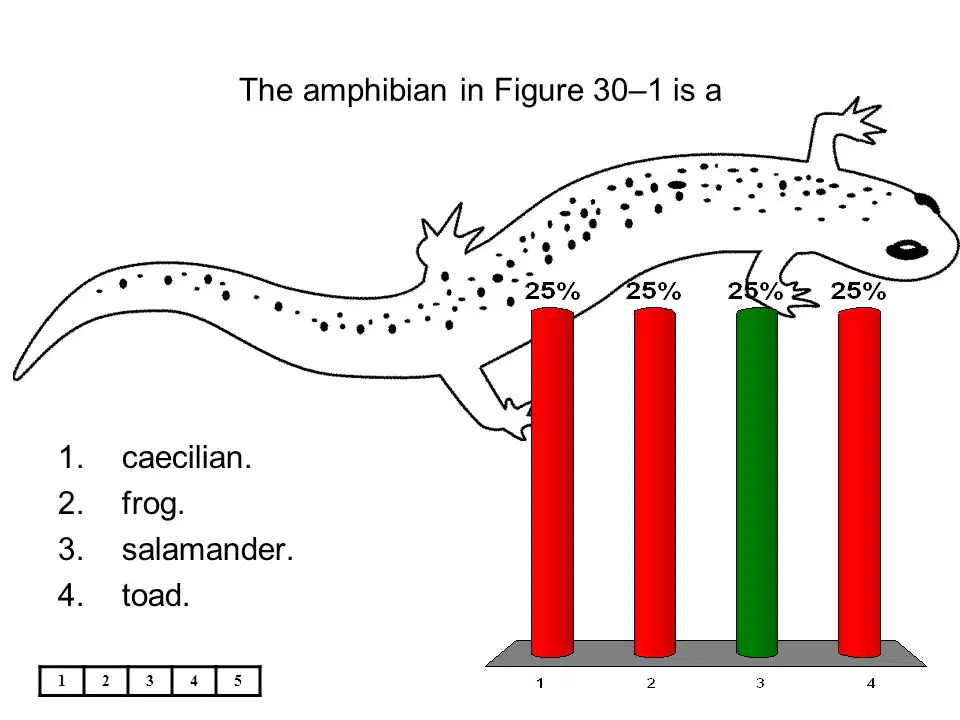
The amphibian in Figure 30-1 is a
caecilian.
frog.
salamander.
toad.
In which amphibian would you expect the pelvic girdle to be least well developed?
A caecilian
A salamander
A toad
A frog

