wayground logo

Free Printable Worksheets

Font size

S
M
L
XL
Worksheets

Unit 3 Test Review

Total questions: 163

Worksheet time: 2hrs 5mins

Name
Class
Date
1.
Which component is needed for clotting?
a)
white blood cells
b)
red blood cells
c)
platelets
d)
plasma
2.
Red blood cells are produced by the
a)
liver
b)
heart
c)
bone marrow
d)
pancreas
3.
How many copies of the sickle cell gene are needed for a person to have the disorder?
a)
0
b)
1
c)
2
d)
3
4.
A person with an infection would have a high ______ count.
a)
white blood cell
b)
red blood cell
c)
platelet
d)
plasma
5.
Sickle red blood cells have a decreased ability to carry 
a)
nutrients
b)
wastes
c)
oxygen
d)
proteins
6.
If someone has a low hematocrit count, then they have a reduced amount of what?
a)
plasma
b)
red blood cells
c)
white blood cells
d)
 platelets
7.

Which is NOT a symptom of sickle cell disease?

a)

shortness of breath

b)

pain and tissue damage

c)

increased infections

d)

neuropathy

8.
What is the name for the test shown that measures number of red blood cells?
a)
GTT test
b)
Insulin test
c)
Hematocrit test
d)
CBC differential
9.
Which blood component will increase when the body is fighting infection?
a)
red blood cells
b)
white blood cells
c)
platelets
d)
plasma
10.
These cells contain hemoglobin that carries oxygen:
a)
Erythropoietin
b)
Leukocytes
c)
Erythrocytes
d)
Thrombocytes
11.
condition in which the blood is deficient in red blood cells, hemoglobin, or in total volume
a)
anemia
b)
sickle cell
c)
hematocrit
d)
centrifugation
12.
Where are red & white blood cells created?
a)
plasma
b)
spleen
c)
bone marrow
d)
heart
13.
What medication was Anna taking to treat her sickle cell anemia?
a)
adderall
b)
levothyroxine
c)
herceptin
d)
hydroxyurea
14.
What is the hematocrit for the following test results: total volume = 8mm; RBC volume = 1.7mm
a)
25.2%
b)
15.4%
c)
21.25%
d)
18.75
15.
Does the patient with the following hematocrit results have anemia? total volume= 3.3; RBC volume= 1.5
a)
Yes
b)
No
16.

Which was not a treatment for Anna's sickle cell?

a)

IV

b)

exercises/physical therapy

c)

bone marrow transplant

d)

ultrasound

17.
Which of the following biomedical science professionals did NOT assisted Anna in her treatment of sickle cell anemia?
a)
hematologist
b)
orthopedist
c)
oncologist
d)
physical therapist
18.
These are responsible for clotting the blood:
a)
Erythrocytes
b)
Thrombocytes
c)
Leukocytes
d)
Erytropoietin
19.
Which component is needed to carry oxygen?
a)
white blood cells
b)
red blood cells
c)
platelets
d)
plasma
20.
Which component is needed to carry oxygen?
a)
white blood cells
b)
red blood cells
c)
platelets
d)
plasma
21.
Pale yellow fluid portion of whole blood that consists of water & its dissolved constituents
a)
Plasma
b)
Leukocytes
c)
Anemia
d)
Erythropoietin
22.

How many days do healthy red blood cells live?

a)

90-150

b)

90-120

c)

75-150

d)

75-120

23.
What is the name of the hormone that is produced in the kidneys that plays a role in making red blood cells?
a)
adenosine
b)
amylase
c)
homophiles
d)
erythropoietin
24.
What is the name of the machine that is used to separates the components of blood according to density?
a)
autoclave
b)
incubator
c)
centrifuge
d)
electroscope
25.
________ is a person trained to draw blood from patients for clinical analysis.
a)
Phlebotomist
b)
Chiropractor
c)
EMT 
d)
Physical Therapist
26.

Where are red & white blood cells broken down and recycled?

a)

plasma

b)

spleen

c)

bone marrow

d)

heart

27.

Which of these supplements can help sickle cell patients produce more red blood cells?

a)

folic acid

b)

Vitamin B12

c)

Vitamin C

d)

gingko biloba

28.

Which of these shows a sickle red blood cell?

a)
b)
c)
d)
29.

Leukocytes are also known as

a)

Red Blood Cells

b)

Sickle Cells

c)

Platelets

d)

White Blood Cells

30.

Thrombocytes are also known as

a)

Red Blood Cells

b)

Sickle Cells

c)

Platelets

d)

White Blood Cells

31.

Which sequence of DNA bases would pair with this partial strand

ATG TGA CAG

a)

ATG TGA CAG

b)

TAC ACT GTC

c)

GTA AGT GAC

d)

CAT TCA CTG

32.
Which of the following units are repeatedly joined together to form a strand of DNA?
a)
amino acids
b)
nucleotides
c)
fatty acids
d)
polysaccharides
33.
In a molecule of double-stranded DNA, the amount of Adenine present is always equal to the amount of
a)
cytosine
b)
guanine
c)
thymine
d)
uracil
34.
What determines the code, or information, of a DNA molecule?
a)
the shape (structure) of the nitrogen bases
b)
the order (sequence) of the nitrogen bases
c)
the color of the nitrogen bases
d)
the frequency (number) of nitrogen bases
35.
DNA codes for...
a)
cholesterol
b)
proteins
c)
fatty acids
d)
a sandwich
36.
Which process is shown?
a)
diffusion
b)
repiration
c)
recombination
d)
translation
37.
Which of the following is the blueprint for the production of RNA within a cell?
a)
DNA
b)
protein
c)
ATO
d)
carbohydrate
38.
When an extra base is inserted into the DNA sequence of a gene, the protein doesn't work. Which explains why?
a)
the base increases rate of translation
b)
the base causes DNA to be transcribed in opposite direction
c)
the inserted base causes the codons in the sequence to be incorrect for the desired protein
d)
the base signals enzymes to translate DNA rather than RNA
39.
The DNA sequence ATCAGCGCTGGC is part of a gene. How many amino acids are coded for by this message?
a)
4
b)
8
c)
12
d)
20
40.
What is the relationship between a protein, the cell, and DNA?
a)
DNA is produced by protein which is produced in the cell
b)
Protein is composed of DNA which is produced in the cell
c)
DNA controls the production of protein in the cell
d)
A cell is composed of DNA and protein
41.
Genetic info flows in one direction. Which best represents this flow?
a)
DNA-protein-RNA
b)
Protein-RNA-DNA
c)
RNA-protein-DNA
d)
DNA-RNA-protein
42.
The diagram shows the process of
a)
Transcription
b)
Translation
c)
Replication
d)
Mitosis
43.
Chargaff's rule dictates that...
A= Adenin, T= Thymine, G= Guanine, C= Cytosine
a)
A must bond to T and G to C
b)
T must bond to C and A to G
c)
A must bond to A and T to T
44.
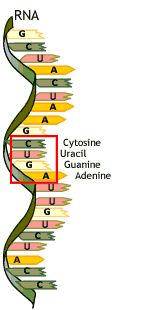
What is occurring in this picture?
a)
Translation
b)
DNA Replication
c)
Polymerase is unzipping the DNA
d)
Transcription
45.
Where does transcription take place?
a)
nucleus
b)
ribosome
c)
cytoplasm
d)
smooth ER
46.
The anticodon is located on 
a)
DNA
b)
mRNA
c)
tRNA
d)
rRNA
47.

In which part of the cell does this process take place

a)

at the ribosomes

b)

in the nucleus

c)

in food vacuoles

d)

on the chromosome

48.

What is structure V?

a)

amino acid

b)

codon

c)

gene

d)

DNA molecule

49.

Which of the structures are composed of RNA?

a)

II and IV

b)

I and V

c)

III and V

d)

III and IV

50.

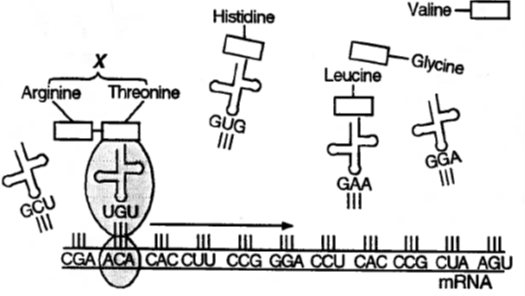
This process is

a)

monoploidy

b)

transcription

c)

replication

d)

translation

51.

What would the amino acid sequence be for TAGTGATTTAAT?

a)

met-asn-phe-his

b)

gly-arg-ser-pro

c)

ser-ala-glu-gly

d)

ile-thr-lys-leu

52.

Ribosomes are made of

a)

rRNA and mRNA

b)

protein and tRNA

c)

rRNA and protein

d)

tRNA and mRNA

53.

Messenger RNA is formed in the process of

a)

translation

b)

mutation

c)

replication

d)

transcription

54.

What would the corresponding DNA bases be?

a)

UCAG

b)

CUGA

c)

ACAG

d)

TCAG

55.

Which one of the following nucleotide pair bonds would be found in a DNA molecule?

a)

adenine-cytosine

b)

adenine-guanine

c)

cytosine-uracil

d)

guanine-cytosine

56.
Which of the following represents the maximum number of amino acids that could be incorporated into a polypeptide encoded by 21 nucleotides of messenger RNA?
a)
3
b)
7
c)
21
d)
42
57.
If a messenger RNA codon is UAC, which of the following would be the complementary anticodon triplet in the transfer RNA?
a)
ATG
b)
AUC
c)
AUG
d)
ATT
58.
Which RNA bases would pair with TACGAA in transcription
a)
AUGCUU
b)
ATGCTT
c)
GCATCC
d)
GCAUCC
59.
What is tRNA role during translation?
a)
To bring the amino acids to the ribosome
b)
Positioning the ribosome
c)
Carries the instructions on how to make a protein.
d)
None of the above
60.
Proteins are made of chains of______
a)
Nucleotides
b)
Monosaccharides
c)
amino acids
d)
Fatty acids
61.

Using the table what does the codon CUG code for?

a)

alanine

b)

Proline

c)

Leucine

d)

Methionine

62.

Using the codon identify the amino acid sequence:

AUG-GGC-ACC-UCA-UGA

a)

MET-GLU-VAL-TYR-STOP

b)

MET-GLY-THR-SER-STOP

c)

MET-SER-THR-GLY-STOP

d)

MET-LYS-ASN-STOP

63.

Using the codon identify the amino acid sequence:

AUG-CCA-GUA-GGG-UAA

a)

MET-HIS-ALA-GLY-STOP

b)

MET-PRO-GLY-VAL-STOP

c)

MET-PRO-VAL-GLY-STOP

d)

MET-THR-SER-ASP-STOP

64.
If a hydrophobic amino acid sequence is placed in water the amino acids will
a)
fold in half
b)
unfold
c)
bunch up
d)
spread out
65.

A hydrophilic amino acid does this when in water:

a)

moves toward the water on the outside of the protein

b)

moves away from the water to the inside of the protein

c)

moves towards negative amino acids

d)

moves toward positive amino acids

66.
What is the monomer of a protein?
a)
amino acid
b)
monosaccharide
c)
fatty acid
67.
Which is not a use or function of protein?
a)
forms enzymes and hormones
b)
forms transport channel in cell membrane
c)
forms structural proteins in the body
d)
quick energy
68.
Does the structure (shape) of a protein affect the function (what it does)?
a)
Yes
b)
No
69.

Normal-

GAG-CTC-GAC-AGA

Mutant

GAG CTC-CAC-AGA

a)

no mutation

b)

substitution

c)

insertion

d)

deletion

70.
Are all mutations bad?
a)
Yes
b)
No
71.
Any change in the sequence of DNA is...
a)
transgenic shift
b)
Single Genotype
c)
Monohybrid Trait
d)
Mutation
72.
Identify the DELETION mutation from the following DNA sequence: 
ATG CCA AAT
a)
ATG TCA AAT
b)
ATG CCT AAA T
c)
ATC CA  AT
d)
ATG CCA AAT
73.

Identify the SUBSTITUTION mutation from the following DNA sequence:

ATG CCA AAT

a)

ATG TCA AAT

b)

ATG CCT AAA T

c)

ATC CA AT

d)

ATG CCA AAT

74.
Original: ATC CAT
Mutation: ATC GCAT
What mutation occurred?
a)
deletion
b)
insertion
c)
silent
d)
transverse
75.

What process is happening in the diagram?

a)

transcription

b)

translation

c)

dna replication

d)

mitosis

76.
What is the location in the cell for transcription?
a)
nucleus
b)
cytoplasm
c)
ribosome
d)
mitochondria
77.

What is the location in the cell for translation?

a)

nucleus

b)

mitochondria in cytoplasm

c)

ribosome in cytoplasm

d)

chloroplast in cytoplasm

78.
What process is going on in this photo? 
a)
Transcription 
b)
Translation 
c)
Replication 
d)
All the above 
79.
The main function of tRNA is to...
a)
carry a message that, when translated, forms proteins
b)
form a portion of ribosomes
c)
string together complementary RNA and DNA strands
d)
bring amino acids from the cytoplasm to the ribosomes
80.
In RNA, Uracil pairs with ______. 
a)
cytosine
b)
adenine
c)
guanine
d)
thymine
81.

Which type of mutation occurs when there is an addition or removal of a base?

a)

missense mutation

b)

nonsense mutation

c)

frameshift mutation

d)

point mutation

82.

What type of mutation is shown in the diagram?

a)

Point mutation - missense

b)

Frameshift Mutation - deletion

c)

Frameshift Mutation - addition

d)

Point mutation - nonsense

83.

What type of mutation is this?

a)

Nonsense mutation

b)

Missense mutation

c)

Silent mutation

d)

Frameshift mutation

84.

Occurs when the DNA change does not alter the amino acid sequence of the polypeptide.

a)

Frameshift Mutation

b)

Insertion

c)

Missense mutation

d)

Silent Mutation

85.

The change in the second codon of DNA sequence from GAA to GAG does not affect the amino acid sequence. This is an example of ........................................

a)

Nonsense mutation

b)

Missense mutation

c)

Silent Mutation

d)

Frameshift Mutation

86.

Which of the following statement is NOT true?

a)

Point mutation involves a chemical change in just one base pair.

b)

Frameshift mutation occurs when there is an addition or removal of a base.

c)

Nonsense mutation occurs when the DNA change creates a stop codon that causes the translation to terminate early.

d)

Point mutation affect every codon beyond the point of mutation .

87.

Sickle cell disease is caused by a _____ mutation.

a)

substitution

b)

insertion

c)

deletion

d)

silent

88.
This image represents ________________
a)
Mitosis
b)
Meiosis
c)
Apoptosis
d)
Cellular Respiration
89.
In interphase what must happen for mitosis to take place?
a)
Translation
b)
DNA replication
c)
Transcription
d)
Synapsis
90.

Chromosomes contain ________________ that code for specific _______________________

a)

Genes, Traits

b)

Traits, Genes

c)

RNA, DNA

d)

rRNA, mRNA

91.
How many chromosomes are in a Human diploid cell?
a)
23
b)
46
c)
48
d)
28
92.
How many chromosomes are in a human haploid cell?
a)
23
b)
46
c)
22
d)
28
93.
Which genotype below represents a patient with Best disease. ( remember it is a dominant trait)
a)
bb
b)
Bb
94.
Which genotype represents a sickle cell carrier? (Remember it is recessive)
a)
SS
b)
ss
c)
Ss
95.

Which genotype represents a female with hemophilia? (Remember it is recessive and sex linked)

a)

XHXH

b)

XhXh

c)

XhY

d)

XHXh

96.

Which genotype represents a male with Hemophilia?(Remember it is recessive and sex linked)

a)

XHXH

b)

XhY

c)

XhXh

d)

XHY

97.
Which genotype represents a patient that suffers from sickle cell disease? (it is recessive)
a)
ss
b)
Ss
c)
SS
d)
sy
98.
The observable properties of an organism
a)
Allele
b)
Genotype
c)
Phenotype
d)
Gene
99.

The genetic constitution of an individual.

a)

Gene

b)

Genotype

c)

Phenotype

d)

Allele

100.
Any of the alternative forms of a gene that may occur at a given Locus
a)
gene
b)
Allele
c)
Genotype
d)
Phenotype
101.
A rare change in the genetic material, creating genetic diversity.
a)
Genotype
b)
Phenotype
c)
Mutation
d)
Gene
102.
The transmission of traits from ancestor to descendant
a)
Mutation
b)
Genotype
c)
Heredity
d)
Allele
103.
A discrete unit of hereditary information
a)
Genotype
b)
Allele
c)
Gene
d)
Phenotype
104.

This image shows what process?

a)

prophase 1

b)

interphase

c)

crossing over

d)

mitotic replication

105.
During which phase is the cytoplasm separated?
a)
Prophase
b)
Metaphase
c)
Cytokinesis
d)
Cytokenetic
106.
What was the first human cell used commercially?
a)
Stem Cells
b)
Pancreatic Cells
c)
HeLa Cells
d)
Brain Cells
107.
A _________ is an organized profile of a person's chromosomes
a)
Restriction Map
b)
Karyotype
c)
Chromosomal Optics
d)
Chromosomal Graph
108.
Chromosomes that have the same sequence of genes, that have the same structure, and that pair during meiosis.
a)
Sister Chromotids
b)
Homologous Chromosomes
c)
Sex Chromosomes
d)
Mutated Chromosomes
109.
The process that exchanges chromosome segments between homologous chromosomes during Meiosis I
a)
Duplication
b)
Translocation
c)
Segmentation Exchanges
d)
Crossing Over
110.
What is the name of the scientist that successfully cultured the first immortal human cell line?
a)
Gerald Wallace
b)
George Gey
c)
Gerald Gey
d)
George Wallace
111.
HeLa cells have been used to do all of the following except
a)
Develop the polio vaccine
b)
Cloning
c)
Testing cells in space
d)
Developing a cure for diabetes
112.

Can a Karyotype be used to diagnose down syndrome?

a)

Yes

b)

No

c)

Sometimes

113.

A type of mutation in which there are three instances of a particular chromosome, instead of the normal two.

a)

Monosomy

b)

Tetrisomy

c)

Pysomy

d)

Trisomy

114.
Identify the phase:
a)
Metaphase I
b)
Metaphase II
c)
Anaphase I
d)
Anaphase II
115.
Identify the phase.
a)
Metaphase I
b)
Metaphase II
c)
Anaphase I
d)
Anaphase II
116.
After meiosis II the daughter cells will contain ____ chromosomes if the original cell contained 78.
a)
78
b)
39
c)
23
d)
46
117.
In mitosis cells are genetically _______, but in meiosis cells are genetically ______.
a)
diverse, identical
b)
identical, diverse/different
118.
In sexual reproduction, chromosome reduction is necessary to ___.
a)
ensure that all offspring have the correct diploid number of chromosomes
b)
ensure that all offspring have the correct haploid number of chromosomes
c)
ensure that all daughter cells are identical
119.

Is this a normal human karyotype?

a)

YES

b)

NO

120.

Is this karyotype for a male or female?

a)

MALE

b)

FEMALE

121.
The process of crossing over occurs in what meiotic phase?
a)
anaphase 1
b)
prophase 1
c)
prophase 2
d)
telophase 1
122.

A cat has a total of 40 chromosomes in its body cells. How many in its sex cells?

a)

38

b)

20

c)

76

d)

10

123.
The chromosomes that pair up during meiosis, are called __________ chromosomes.  
a)
homozygous 
b)
asexual
c)
homologous
d)
genes
124.
An alternate form that a gene may have for a single trait; can be dominant or recessive.
a)
Allele
b)
Gene
c)
Karyotype
d)
chromosome
125.

A genetic trait is considered_______________ if it is expressed in a person who has only one copy of the gene associated with the trait.

a)

Recessive

b)

Heterozygous

c)

Homozygous

d)

Dominant

126.
A discrete unit of hereditary information consisting of a specific nucleotide sequence in DNA (or RNA, in some viruses).
a)
Chromosome
b)
Karyotype
c)
Gene
d)
Pedigree
127.
An organism's genetic makeup, or allele combinations
a)
Phenotype
b)
Genotype
c)
Traits
d)
Pungent Square
128.
Passing of traits from parents to offspring
a)
Heredity
b)
Genetics
c)
Genetic Engineering
d)
Gene Selection
129.
A diagram of a family tree showing the occurrence of heritable characters in parents and offspring over multiple generations.
a)
Punnett Square
b)
Pedigree Square
c)
Pedigree
d)
Punnett
130.

An organism's physical appearance or visible traits.

a)

Genotype

b)

Karyotype

c)

Chromosomes

d)

Phenotype

131.
A graphical way to show all the possible combinations of alleles if given the two parents' genotypes in order to predict what characteristics will occur in offspring.
a)
Punnett Square
b)
Pedigree
c)
Karyotype
d)
Sickle Cell
132.

A condition that appears only in individuals who have received two copies of a mutant gene, one copy from each parent.

a)

Dominant Trait

b)

Heterozygous Trait

c)

Recessive Trait

d)

Homozygous

133.
When a person has two identical alleles for a trait
a)
Polyzygous
b)
Cozygous
c)
Heterozygous
d)
Homozygous
134.
When a person has two different alleles for a trait
a)
Heterozygous
b)
Homozygous
c)
cozygous
d)
Polyzygous
135.

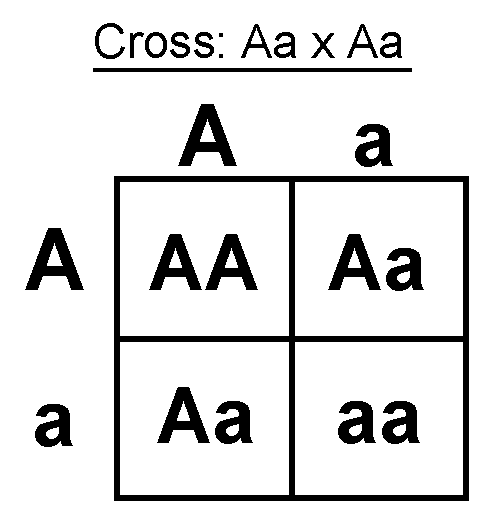
What percentage of offspring will be carriers?

a)

25%

b)

75%

c)

50%

d)

100%

136.

What percentage of these offspring will be homozygous dominant?

a)

25%

b)

50%

c)

75%

d)

0%

137.

What is the probability that the child will have sickle cell anemia?

a)

0%

b)

50%

c)

75%

d)

100%

138.
What is the probability that the child will be a carrier for sickle cell disease?
a)
25%
b)
50%
c)
75%
d)
100%
139.

Where is malaria most prevalent?

a)

Europe

b)

North America

c)

Africa

d)

Australia

140.
What organism plays a major role in transmitting malaria?
a)
bed bugs
b)
beetles
c)
bees
d)
mosquitos
141.
Carriers of sickle cell disease have a survival advantage against what?
a)
The Flu virus
b)
Hepatitis
c)
Diabetes
d)
Malaria
142.
An affected female and a carrier male had a child, what is the chance that the child has SCD? 
a)
0%
b)
50%
c)
25%
d)
100%
143.

What is the probability that the child will NOT be a carrier?

a)

25%

b)

50%

c)

75%

d)

100%

144.
What does allele frequency mean?
a)
The number of times an allele is NOT present in a population's gene pool.
b)
The wave-length of an allele's effect.
c)
The optimal wave-length of an allele
d)
The number of times an allele is present in a population's gene pool
145.
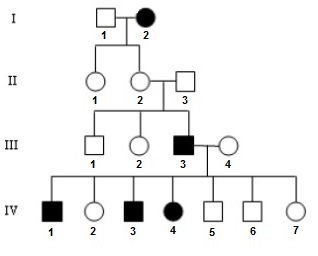
In the second generation-how many people are carriers of the trait?
a)
2
b)
3
c)
5
d)
6
146.
What is the phenotype of the offspring? (A-Brown hair; a-blond hair) 
a)
50 % Brown Hair and 50% Blond Hair 
b)
25 % Brown Hair and 75% Blond Hair 
c)
75 % Brown Hair and 25% Blond Hair 
d)
0% Brown Hair and 100% Blond Hair 
147.

Squidward has light blue skin, and his genotype for this trait is Bb. Which of the following would describe Squidward?

a)

Purebred

b)

Hybrid

c)

Homozygous

d)

Sex-linked

148.
What does a filled in square represent?
a)
Not affected Female
b)
Not affected Male
c)
Affected Male
d)
Affected Female
149.
How many generations are shown in this pedigree?
a)
1
b)
2
c)
3
d)
4
150.
How many kids did the mother and father from the first generation have?
a)
2
b)
4
c)
5
d)
6
151.
This pedigree represents the inheritance of hemophilia in this family. How many of the females have the hemophilia trait?
a)
8
b)
5
c)
2
d)
3
152.
What do half colored symbols represent?
a)
The individual is a carrier (heterozygous).
b)
The individual expresses the trait.
c)
The individual has both recessive alleles.
d)
The individual has both dominant alleles.
153.
What does an open circle represent?
a)
Not Affected Male
b)
Not Affected Female
c)
Affected Male
d)
Affected Female
154.
In the second generation-how many people are carriers of the trait?
a)
2
b)
3
c)
5
d)
6
155.
How many people in this whole pedigree have the trait/disease?
a)
2
b)
3
c)
4
d)
6
156.
How many females are in this pedigree?
a)
3
b)
4
c)
6
d)
7
157.
What is this?
a)
Pedigree
b)
Karyotype
c)
Venn diagram
d)
Punnett Square
158.
Which individual in the first generation is a carrier?
a)
The male
b)
The female
c)
individual 1
d)
None of the above
159.
B = brown fur  b = white fur
In the Punnett square, what is the probability for white fur
a)
0%
b)
25%
c)
50%
d)
75%
160.
In the Punnett square shown, what must the genotype of the missing parent be?
a)
BB
b)
Bb
c)
bb
d)
Tt
161.
B - black, b - brownTwo black mice mate and have some black and some brown mice.  What is the genotype of the parents?
a)
BB x Bb
b)
BB x bb
c)
Bb x Bb
d)
Bb x bb
162.
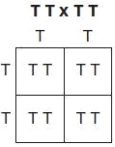
What ratio of the offspring from the cross shown will be homozygous recessive for the  trait of tallness
a)
0 in 4
b)
1 in 4
c)
2 in 4
d)
4 in 4
163.
What are the possible genotypes for this cross?
(Click the picture to see it without the text)

a)
TT = 25% Tt= 50% tt=25%
b)
all tall
c)
TT= 75% tt = 25%
d)
Tt = 100%