wayground logo

Free Printable Worksheets

Font size

S
M
L
XL
Worksheets

Year 11 mock

Total questions: 157

Worksheet time: 2hrs 37mins

Name
Class
Date
1.

What are the products of aerobic respiration?

a)

glucose and carbon dioxide

b)

glucose and water

c)

carbon dioxide and water

d)

oxygen and water

2.

Respiration is ....

a)

The movement of the diaphragm

b)

Breaking down starch to sugar

c)

Releasing energy from glucose

d)

Breathing

3.

What is this?

a)

a ribosome

b)

a nucleus

c)

a bacterium

d)

a mitochondrion

4.

Why is the inner membrane highly folded?

a)

so more nutrients can be absorbed into the blood

b)

so more anaerobic respiration can take place

c)

so more aerobic respiration can take place

d)

so more photosynthesis can take place

5.

Which of the following is NOT a use of the energy released in respiration

a)

breaking down large molecules into smaller ones

b)

muscle contraction

c)

active transport

d)

maintaining a steady body temperature

6.

True or false: cells need oxygen to release large amounts of energy

a)

True

b)

False

7.

True or false: anaerobic respiration releases energy faster than aerobic respiration

a)

True

b)

False

8.

What products are made during anaerobic respiration in yeast?

a)

Carbon dioxide and water

b)

Ethanol and water

c)

Ethanol and carbon dioxide

d)

Lactic acid and carbon dioxide

9.

Which of these observations would provide evidence for respiration in germinating beans?

a)

A decrease in temperature

b)

An increase in temperature

c)

A decrease in carbon dioxide concentration

d)

An increase in lactic acid

10.

Aerobic respiration is controlled by

a)

enzymes

b)

hormones

c)

nervous impulses

d)

ribosomes

11.
What process is the opposite of aerobic respiration?
a)
anaerobic respiration
b)
cellular respiration
c)
photosynthesis
d)
lactic acid fermentation
12.
A yeast is producing bubbles when it is placed in sugar water. What are the bubbles?
a)
acid
b)
carbon dioxide
c)
oxygen
d)
alcohol
13.
which kind of cells would have the most mitochondria?
a)
brain cells
b)
bone cells
c)
plant cells
d)
muscle cells
14.
What type of respiration requires oxygen?
a)
Aerobic
b)
Anaerobic
15.
What type of respiration does not require oxygen?
a)
Aerobic
b)
Anaerobic
16.
Which type of respiration is most efficient?
a)
Aerobic
b)
Anaerobic
17.
What is required to carry out fermentation or anaerobic respiration?
a)
glucose
b)
the absence of oxygen
c)
glucose and the abscense of oxygen
18.
Which equation shows the reaction for anaerobic respiration
a)
carbon dioxide + water --> glucose and oxygen
b)
glucose + Oxygen --> lactic acid and energy
c)
glucose + oxygen --> carbon dioxide and water and energy
d)
glucose --> lactic acid and energy
19.
Aerobic respiration is different from anaerobic respiration in that aerobic respiration needs...
a)
chlorophyll
b)
carbon dioxide
c)
glucose
d)
oxygen
20.

Cells in plant roots do not photosynthesise.


Give one reason why.

a)

They do not have any oxygen

b)

They do not have any carbon dioxide

c)

They do not have any light for photoynthesis

d)

The do not have any glucose for energy

21.

A student investigated the effect of light intensity on the rate of photosynthesis.


The diagram shows the apparatus the student used.

This is the method used.

1. Set up the apparatus as shown in the diagram above.

2. Place the lamp 10 cm from the pondweed.

3. Turn the lamp on and count the number of bubbles produced in one minute.

4. Repeat with the lamp at different distances from the pondweed.


Question

Complete the hypothesis for the student’s investigation.

‘As light intensity increases (a)  

22.

What was the independent variable in this investigation?

a)

Light Intensity

b)

Number of bubbles produced

c)

Temperature

d)

Time

23.

The graph shows the effect of the concentration of carbon dioxide on the rate of photosynthesis in tomato plants at 20 °C.


Question

What is the maximum rate of photosynthesis of the tomato plants shown in the graph?

(a)  

24.

A farmer plans to grow tomatoes in a large greenhouse.

The concentration of carbon dioxide in the atmosphere is 0.04%. The farmer adds carbon dioxide to the greenhouse so that its concentration is 0.08%.


Question

(i) Why does the farmer use 0.08% carbon dioxide?

a)

To increase the rate of growth of the tomato plants

b)

To increase the rate of respiration of the tomato plants

c)

To increase water uptake by the tomato plants

25.

Why does the farmer not use a concentration of carbon dioxide higher than 0.08%?


Tick 2 Correct answers

a)

Because it would cost more money than using 0.08%

b)

Because it would decrease the temperature of the greenhouse

c)

Because it would not increase the rate of photosynthesis of the

tomato plants any further

d)

Because it would increase water loss from the tomato plants

26.

Algae can photosynthesise.

Complete the word equation for photosynthesis.

water + ______1._________ --------> ________2._______ + oxygen

a)

1 Carbon Dioxide

b)

1 Glucose

c)

2 Carbon Dioxide

d)

2 Glucose

27.

A student investigated the effect of temperature on the rate of photosynthesis in pondweed.

The diagram shows the way the experiment was set up.


Question

The student needed to control some variables to make the investigation fair.

State two variables the student needed to control in this investigation.

(a)  

28.

A farmer grew tomato plants in a greenhouse.

The graph shows the effect of light intensity on the rate of photosynthesis in the tomato plants growing in the greenhouse.


Question

At which light intensity was light a limiting factor for photosynthesis?

a)

1

b)

4

c)

10

29.

What are the 3 reactants of photosynthesis? The reactants are the things needed for photosynthesis to occur.

a)

oxygen, glucose, sunlight

b)

sunlight, oxygen, water

c)

water, oxygen, carbon dioxide

d)

carbon dioxide, sunlight, water

30.

What is the tiny openings that let in the carbon dioxide needed for photosynthesis?

a)

stomata

b)

xylem

c)

phloem

d)

chloroplast

31.

How does water travel from the roots to the plan leaf? Name the structure that carries water.

a)

stomata

b)

phloem

c)

chloroplast

d)

xylem

32.

What are the 2 products of photosynthesis? The products are the things made in the process of photosynthesis.

a)

water, sunlight

b)

glucose, carbon dioxide

c)

oxygen, glucose

d)

sunlight, oxygen

33.

How does glucose travel in a producer (plant)? Name the structure.

a)

xylem

b)

phloem

c)

stomata

d)

chlorophyll

34.
Where does photosynthesis take place?
a)
The leaves.
b)
The roots.
c)
The branches.
d)
The kitchen.
35.

Which micro organisms cause communicable diseases?

a)

Pathogens

b)

Pathogerms

c)

Partitions

36.

_________ are diseases that can be transmitted from one person to another

a)

Non communicable diseases

b)

Communicable diseases

c)

Goiter

37.

What are two viral diseases that do have a vaccine?

a)

Measles and typhoid

b)

Measles and malaria

c)

Measles and chicken pox

38.
A doctor would most likely prescribe an antibiotic to treat what type of pathogen?
a)
Fungi
b)
Helminth
c)
Virus
d)
Bacteria
39.
Mosquitoes and Ticks are examples of organisms that can spread disease.  These types of organisms are refereed to as?
a)
Vectors
b)
Fungi
c)
Pathogens
40.
The ________ is the first line of defense.
a)
eyes
b)
stomach
c)
t-cells
d)
skin
41.
Cancer, Hypertension, and Asthma are examples of what types of disease?
a)
Non-communicable
b)
Communicable
42.
Athlete's foot is an example of this pathogen
a)
Bacteria
b)
Virus
c)
Fungus
d)
Protozoan
43.
Catch the disease by touching a contaminated object
a)
direct
b)
indirect
c)
fecal-oral
d)
vector borne
44.
Which of these causes lung cancer?
a)
smoking
b)
drinking alcohol
c)
exercise
d)
obesity
45.
Which of these is the main cause of type 2 diabetes
a)
smoking
b)
exercise
c)
obesity
d)
drinking alcohol
46.
Which of these causes liver disease
a)
exercise
b)
smoking
c)
drinking alcohol
d)
obesity
47.
A person is told they are at risk of a heart attack what would make their health better?
a)
Drinking alcohol
b)
Start smoking
c)
exercise
d)
eat lots of burgers
48.
Which of these is not a risk from smoking
a)
heart attack
b)
cancer
c)
stroke
d)
type 2 diabetes
49.
In type 2 diabetes your body does not produce the correct amount of....
a)
blood
b)
insulin
c)
brain cells
d)
liver cells
50.
Women should not smoke when they are pregnant because it will
a)
Make them sick
b)
damage the baby
c)
increase their blood oxygen
d)
cause type 2 diabetes
51.

The digestive juice being produced by the liver is called _____________.

a)

Glucose

b)

Glycogen

c)

Bile

d)

Fats

52.

Glucose that is stored in the liver is commonly called ______________.

a)

Glucose

b)

Glycogen

c)

Bile

d)

Fats

53.

Liver's primary function is to take away toxins out of the blood.

a)

True

b)

False

54.
What is metabolism
a)
The sum of all the reactions in a cell or the body of an organism
b)
The process of transferring glucose into energy 
c)
photosynthesis and respiration
d)
Transference of glucose to glycogen
55.
Which of the following is NOT a metabolic process in animals
a)
Respiration 
b)
Formation of lipid molecules
c)
The reactions of photosynthesis
d)
Breakdown of excess proteins 
56.
Why do athletes want to be able to use their muscles aerobically for as long as possible?
a)
Because it is a more efficient process
b)
So you don't get out of breath
c)
It stops your heart rate increasing
d)
Reduces water loss
57.
How can photosynthesis be related to cellular respiration?
a)
What's produced (made) by one is needed (the reactants) for the other
b)
They both produce the same products
c)
They both have the same reactants (need the same things)
d)
These 2 processes have nothing in common
58.
What is a clinical drug trial?
a)
Testing drugs before they're released to make sure they're safe and work
b)
Giving people medicine that will help improve their conditions
c)
Developing a drug and putting it on the market for immediate use
d)
Testing drugs in a clinic to see how effective they are
59.
Which of these is an example of a drug that wasn't tested properly and so resulted in harmful side effects?
a)
Paracetamol
b)
Statins
c)
Thalidomide
d)
Nicotine 
60.
What is a placebo?
a)
A second type of drug given to all people in a trial
b)
A 'dummy' pill given to all people in the trial
c)
A 'dummy' pill given to half of the people in the trial
d)
A drug that will probably harm the patients taking it 
61.
What is a double blind trial?
a)
The participants take the drug blindfolded
b)
When the scientist and the participants are unaware of whether they are taking the drug or placebo
c)
When the participants choose what they want to take without telling the scientist
d)
When the scientist knows who is taking the drug but the participants don't
62.
Why are clinical drug trials important?
a)
They can improve the health of patients
b)
To understand whether the drug causes any harmful side effects
c)
They help test the effectiveness of the drug 
d)
To test whether the drug works and if it causes any harmful side effects
63.
Why are double blind trials important?
a)
They make sure the results are fair and unbiased
b)
If the scientist knows who has taken the drug they will lie or change results to show it works
c)
They are the only type of clinical trials available 
d)
Patients might lie about any side effects they feel 
64.
Why are placebos so important?
a)
To help understand if the drug actually makes any real difference
b)
It is too expensive to give all the people who want to volunteer the drug 
c)
To save some people from the risk of harmful side effects 
65.
Which of these is most likely to be the reason a drug fails the FIRST stage of testing?
a)
The drug damages cells 
b)
Volunteers who took the drug felt too sick 
c)
The drug is too expensive to take to market 
d)
The drug isn't as effective as the treatment options that are already available
66.
What is a drug?
a)
An illegal substance that harms the body 
b)
A substance that modifies chemical reactions of the body
c)
A treatment for illness
67.
Which of these drugs would not be tested in a clinical trial?
a)
Antibiotics
b)
Cancer Drugs
c)
Alcohol
d)
Painkillers
68.

An unwanted physical or mental effect caused from using a drug is a

a)

Antagonism

b)

Synergism

c)

Drug Misuse

d)

Side effect

69.
What drug was originally extracted from the willow tree?
a)
Aspirin
b)
Paracetamol
c)
Ibuprofen
d)
None of them
70.
How did we originally get drugs?
a)
By extracting them from plants
b)
Synthesised from chemicals in labs
c)
None of the answers given
d)
Both of the answers given
71.
What is meant by the term efficacy?
a)
Whether or not a drug can easily kill infectious pathogens
b)
Whether or not a drug harms our body cells
c)
How much of a drug is needed to kill you
d)
How much of a drug is needed to be effective
72.
What is meant by the term dose?
a)
Whether or not a drug can easily kill infectious pathogens
b)
Whether or not a drug harms our body cells
c)
How much of a drug is needed to kill you
d)
How much of a drug is needed to be effective
73.
What is meant by the term toxicity?
a)
Whether or not a drug can easily kill infectious pathogens
b)
Whether or not a drug harms our body cells
c)
How much of a drug is needed to kill you
d)
How much of a drug is needed to be effective
74.
What is the role of white blood cells?
a)
To transport oxygen around the body
b)
To protect the body against pathogens
c)
To produce pain killers
d)
To aid the clotting of the blood 
75.
Why are clinical drug trials important?
a)
They can improve the health of patients
b)
To understand whether the drug causes any harmful side effects
c)
They help test the effectiveness of the drug 
d)
To test whether the drug works and if it causes any harmful side effects
76.

Why it is difficult to develop drugs that kill viruses?

a)

because drugs that kill viruses also damage the body’s tissues.

b)

because viruses mutate quickly

c)

because viruses are small

d)

because viruses cannot reproduce by themselves

77.

What are Monoclonal antibodies ?

a)

An antibody produced by the body.

b)

An antibody produced by a single clone of cells or cell line and consisting of identical antibody molecules.

c)

An antibody produced by a single clone of cells or cell line and consisting of many different antibody molecules.

d)

An antibody produced in a lab

78.

When monoclonal antibodies are being produced tumor cells and plasma cells are fused to make a

a)

Erythrocyte

b)

Phagocyte

c)

Hybridoma

d)

Plasma cell

79.

What are the uses of Monoclonal Antibodies?

a)

Treatment of cancer and other diseases

b)

Drug screening

c)

Home pregnancy tests

d)

All of the above

80.
What are antibodies made of?
a)
Carbohydrate
b)
Protein
c)
Polysacchiaride
d)
Lipid
81.
What is the first stage of producing monoclonal antibodies?
a)
Stimulating mouse lymphocytes to make an antibody
b)
collect spleen cells from a mouse
c)
Form hybridoma cells
d)
produce myeloma cells
82.

(a)   antibodies are antibodies artificially derived from a single B cell clone (i.e. identical specific antibodies)

83.

Typically, antibodies are located on the outer surfaces of bacteria, viruses, or parasites.

a)

True

b)

False

84.
Special proteins produced by the body to attack foreign invaders.
a)
antibodies
b)
antigen
85.
Vaccines contain weakened or dead parts of antigens. 
a)
True
b)
False
86.
Which best describes the relationship between antibodies and antigens?
a)
Antibodies are specific to one antigen
b)
Antigens are produced in response to antibodies
c)
One antibody can affect several different antigens
d)
Immunity develops when an antigen destroys an antibody.
87.

Which plant disease is shown here?

a)

Galls

b)

Rust

c)

Root Rot

d)

Tobacco Mosaic Virus

88.

Which plant disease is shown here?

a)

Rose Black Spot

b)

Chlorosis

c)

Tobacco Mosaic Virus

d)

Damping Off

89.

Which plant disease is shown here?

a)

Chlorosis

b)

Damping off

c)

Tobacco Mosaic Virus

d)

Black Spot

90.
What is the meaning of the term chlorosis? 
a)
Stunted growth
b)
Chlorophyll
c)
Yellowing of the plant
d)
Nitrate deficiency
91.

What is the result of nitrate deficiency in a plant

a)

Cellulose walls are strengthened

b)

Increased growth

c)

Yellowing of the leaves

d)

Stunted growth, older leave may go yellow

92.
What is the result of magnesium deficiency in a plant
a)
Cellulose walls are strengthened
b)
Increased growth
c)
Yellowing of the leaves
d)
Stunted growth
93.
Which of the following is a chemical plant defence?
a)
Producing antibacterial substances
b)
Thorns and spikes
c)
Layers of dead cells
d)
Mimicry
94.
Which of the following is a physical plant defence?
a)
Producing antibacterial substances
b)
Thorns and spikes
c)
Tough waxy cuticles
d)
Mimicry
95.
Which of the following is a mechanical plant defence?
a)
Producing antibodies
b)
Thorns and spikes
c)
Tough waxy cuticles
d)
Dead leaves
96.
Some plants have thorns - what type of defence mechanism is this?
a)
Physical
b)
Chemical
c)
Mechanical
97.

What is the result of Phosphorus deficiency in a plant

a)

Yellow leaves with dead brown spots

b)

Increased growth

c)

Yellowing of the leaves

d)

Purple leaves and poor root growth

98.

What is the result of Potassium ion deficiency in a plant

a)

Yellow leaves with dead brown spots

b)

Increased growth

c)

Strengthening of cell walls

d)

Purple leaves and poor root growth

99.

Diseases are caused by viruses, bacteria, fungi and which other group of pathogens?

a)

Malaria

b)

Protist

c)

Microorganisms

d)

Toxins

100.

Which is not a viral disease?

a)

HIV

b)

Tobacco mosaic

c)

Rose black spot

d)

Measles

101.

How is Salmonella spread?

a)

Bacteria in ingested food

b)

Viruses in ingested food

c)

Protist in ingested food

d)

Fungi in ingested food

102.

Which is not a symptom of gonorrhoea?

a)

Yellow discharge

b)

Green discharge

c)

Blood in urine

d)

Pain on urinating

103.

How is the spread of malaria reduced?

a)

Don't travel to warm countries

b)

Kill all the mosquitos

c)

Prevent mosquitos from breeding

d)

Use mosquito nets

104.

Why are cultures not incubated at body tempeature in the school laboratory?

a)

It is too hot for most microbes to grow

b)

It could lead to the growth of harmful microbes

c)

It is expensive to do

d)

It requires specialist equipment

105.
Bacteria ...
a)
are 10, 000 times smaller than viruses
b)
none of these options
c)
multiply every 20 minutes
d)
are only living once they enter a host cell
106.
Some pathogens are killed by...
a)
eating them
b)
stomache acid
c)
stomach acid
d)
cake
107.

A viral disease found in humans?

a)

Rose black spot

b)

Tobacco mosaic virus

c)

AIDS

d)

Malaria

108.

A pathogen that can be controlled by giving people vaccines.

a)

Malaria

b)

Salmonella

c)

Measles

d)

Gonorrhoea

109.

A pathogen that causes a yellow or green discharge from the vagina or penis.

a)

Malaria

b)

Salmonella

c)

Measles

d)

Gonorrhoea

110.

How can white blood cells help to prevent infections?

a)

Engulf/ingest pathogens

b)

Produce antibodies against pathogens

c)

Produce antitoxins

d)

All of these options

111.

What is the arrow pointing to?

a)

right atrium

b)

left atrium

c)

right ventricle

d)

left ventricle

112.

What is the arrow pointing to?

a)

right atrium

b)

left atrium

c)

right ventricle

d)

left ventricle

113.

What is the arrow pointing to?

a)

right atrium

b)

left atrium

c)

right ventricle

d)

left ventricle

114.

What is the arrow pointing to?

a)

right atrium

b)

left atrium

c)

right ventricle

d)

left ventricle

115.

What is the arrow pointing to?

a)

pulmonary artery

b)

myocardium

c)

pulmonary vein

d)

aorta

116.

What is the arrow pointing to?

a)

pulmonary artery

b)

myocardium

c)

pulmonary vein

d)

aorta

117.
These structures carry blood away from the heart.
a)
Blood cells
b)
Veins
c)
Capillaries
d)
Arteries
118.
The main purpose of Red Blood Cells is to 
a)
carry gases, wastes, and nutrients
b)
attack and destroy pathogens
c)
clot the blood
d)
digest food
119.
What part of blood carries hemoglobin?
a)
Red blood cells
b)
Plasma
c)
Platlets
d)
White blood cells
120.
What is the function of hemoglobin?
a)
to carry iron
b)
to carry wastes
c)
to carry oxygen
d)
to produce oxygen
121.
The extracellular matrix of blood is called
a)
plasma
b)
erythrocytes
c)
buffy coat
d)
lympocytes
122.

Human blood vessels are

a)

artries, capillaries, and atria

b)

ventricles, atria and pulmonary veins

c)

capillaries, artries, and veins

d)

veins, artries, and aorta

123.

The thickest and strongest blood vessel is the

a)

vein

b)

artery

c)

capillary

d)

both veins and capillaries

124.

The blood vessel that has the largest diameter is

a)

vein

b)

artery

c)

capillary

125.

The blood vessel that has valves at intervals...

a)

capillary

b)

artery

c)

vein

d)

none of the above

126.

Valves in veins

a)

support them

b)

protect them

c)

prevent the backward movement inside them

d)

provide them elesticity

127.

The substance that binds to an enzyme is called a?

a)

Polypeptide

b)

Co-enzyme

c)

Vitamin

d)

Substrate

128.

Changes in pH and temperature can ___________________ an enzyme which causes it to lose its shape and affects its function.

a)

puncture

b)

denature

c)

double

d)

delete

129.
Each enzyme only has 1 substrate that will fit its active site.  What is this called?
a)
reusablility
b)
denaturation
c)
specificity
d)
fragility
130.
Enzymes are...
a)
nucleic acids
b)
proteins
c)
lipids
d)
carbohydrates
131.
Where do substrates bind on an enzyme?
a)
voltage-gated channels
b)
surface receptor
c)
calcium channels
d)
active site
132.

What does the Gall Bladder store?

a)

Bile

b)

Fat

c)

Carbohydrates

d)

Insulin

133.

Where is Bile produced?

a)

Liver

b)

Stomach

c)

Pancreas

d)

Colon

134.

Most nutrient absorption occurs in the ________________ .

a)

mouth

b)

stomach

c)

large intestines

d)

small intestines

135.

Protein is broken down into ______________ before they are asborbed into the small intestines.

a)

fatty acids

b)

amino acids

c)

citric acid

d)

hydrochiloric

136.

____________ in the pancreatic and intestinal juice completes the digestion of fats.

a)

Amylase

b)

Renin

c)

Pepsin

d)

Lipase

137.

The villi provides a surface area for the absorption of nutrients into the bloodstream.

a)

True

b)

False

138.

Which of the following tests for starch?

a)

Iodine

b)

Benedict's

c)

Biuret

d)

Emulsion

139.

Which of the following tests for protein?

a)

Iodine

b)

Benedicts

c)

Biuret

d)

Emulsion

140.

Which of the following tests for glucose?

a)

Iodine

b)

Benedicts

c)

Biuret

d)

Emulsion

141.

When starch is present iodine turns...

a)

purple

b)

blue-black

c)

orange

d)

brick red

142.
When large amounts of glucose is present Benedicts turns...
a)
purple
b)
blue-black
c)
brick-red
d)
green
143.

A negative test for protein will cause Biuret to stay...

a)

brick red

b)

blue

c)

black

d)

orange

144.

A negative test for glucose will cause Benedicts to stay...

a)

brick red

b)

blue

c)

black

d)

orange

145.

What is a positive result for the lipid emulsion test?

a)

milky white colour

b)

clear

c)

yellow

d)

green

146.

In this experiment, you must put your test tubes into a hot water bath

a)

Benedict's Test

b)

Biurets Test

c)

Iodine Test

d)

Ethanol Emulsion Test

147.

The building blocks of lipids are

a)

Starches

b)

Fatty acids and Glycerol

c)

Sugars

d)

Amino Acids

148.

The building blocks of starch are

a)

glycerol

b)

amino acids

c)

sugars

d)

fatty acids

149.
If each division is 100 µm, what is the size of this organism?
a)
4 µm
b)
400 µm
c)
4,000 µm
d)
400 mm
150.
The ________ of the microscope would show you the SMALLEST field of view.
a)
low power objective
b)
medium power objective
c)
high power objective
d)
ocular
151.
What is diffusion?
a)
when molecules move 
b)
when molecules move from a high concentration to a low.
c)
no movement 
d)
molecules move everywhere
152.
Osmosis is the movement of _____ across a membrane.
a)
food
b)
energy
c)
oxygen
d)
water
153.
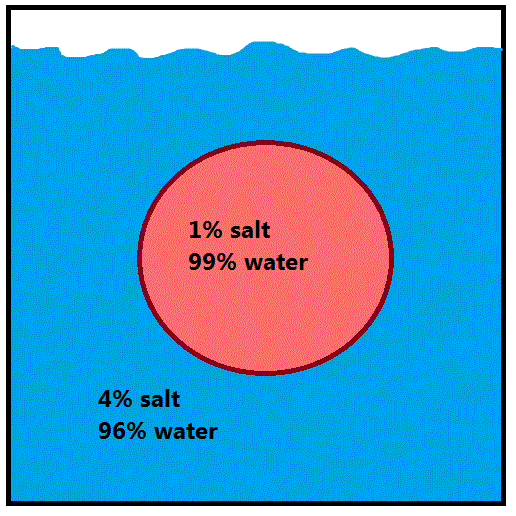
Where will the water go?
a)
Into the cell
b)
Out of the cell
c)
Equally in & out - it's isotonic
d)
There is no water
154.
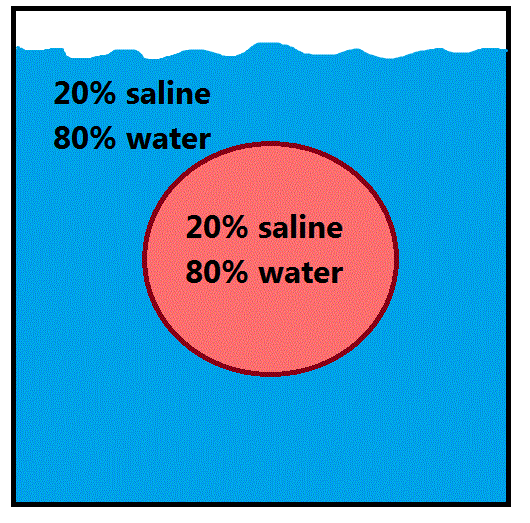
A blood cell is placed into the jar, as seen. Where will the water go?
a)
Into the cell
b)
Out of the cell
c)
Equally in & out - it's isotonic
d)
The water is a lie
155.
 If a cell containing 5% salt is placed into a glass of water with 20% salt, the water is _______ compared to the cell.
a)
hypertonic
b)
hypotonic
c)
isotonic
156.
This organelle turns the light energy into a simple sugar. 
a)
Mitochondria
b)
ER
c)
Chloroplast
d)
Nucleus
157.
This organelle makes proteins. 
a)
Cell membrane
b)
Nucleus
c)
Ribosome
d)
ER