
NEW
Font size
S
M
L
XL
 Worksheets
Diagnostic Test Motion
Total questions: 60
Worksheet time: 2hrs 38mins
Name
Class
Date
1.
What is speed?
a)
how far you go
b)
how much distance is covered over a period of time
c)
how fast you accelerate
d)
the change in the location of a object
2.
Total distance divided by total time is
a)
average speed
b)
constant speed
c)
instantaneous speed
d)
acceleration
3.
Shona cycles at an average speed of 8km/h. How far has she travelled if she cycles for 4 hours?
a)
55km
b)
32km
c)
43km
d)
32miles
4.
Which is correct?
a)
speed = distance x time
b)
speed = speed divided time
c)
speed = Distance divide time
d)
Speed = time x speed
5.
What is velocity?
a)
the quickness of an object
b)
the location of an object
c)
acceleration
d)
speed in a specific direction
6.
How many minutes in 1 hrs
a)
60 minutes
b)
100 minutes
c)
85 minutes
d)
50 minutes
7.
Can be measured in meters per second (m/s)
a)
Distance
b)
Time
c)
Speed
d)
Acceleration
8.
How far will a person go if they jog for 2 hours at a speed of 12 km/hr?
a)
6 km
b)
0.5 km
c)
10 km
d)
24 km
9.
What is a way to measure speed?
a)
miles/hour
b)
centimenters
c)
hours/kilometer
d)
kilometers
10.
If a cheetah runs 180 miles in 3 hours, what is its average speed?
a)
60 hours
b)
60 miles
c)
60 miles/hour
d)
60 miles/second/second
11.
What is a way to measure velocity
a)
miles per second
b)
meters per second
c)
meters per second squared
d)
seconds
12.
A runners races in the 100 meter dash. It takes her 10 seconds to finish. What is her average speed?
a)
10 m/s
b)
1000 m/s
c)
100 seconds
d)
10 seconds
13.
A place or object used for comparison to determine if another object is in motion is called a
a)
comparison point
b)
reference point
c)
point of view
d)
motion detector
14.
An object is _____ if its position changes relative to another object.
a)
in motion
b)
at reset
c)
a frame of refence
d)
magical
15.
Change in speed over a given period of time is
a)
velocity
b)
motion
c)
speed
d)
acceleration
16.
What is the equation to find speed?
a)
s=t/d
b)
s=d x t
c)
s=d/f
d)
s=d/t
17.
What is the SI unit for acceleration?
a)
m/s
b)
m
c)
m/s2
d)
s
18.
What is the SI unit for speed
a)
Km
b)
s
c)
m/s
d)
m/s2
19.

The formula:
? = D/T with direction
is used to find
? = D/T with direction
is used to find
a)
Velocity
b)
Speed
c)
Force
d)
Acceleration
20.

The graph represents
a)
no motion
b)
Constant velocity
c)
Acceleration
d)
negative acceleration
21.

The graph represents
a)
no motion
b)
constant velocity
c)
acceleration
d)
negative acceleration
22.
Find the velocity of a truck that travels 75 miles north in 2.5 hours.
a)
187.5 mph north
b)
30 mph north
c)
300 mph north
d)
200 mph north
23.
Find the velocity of a plane that traveled 3000 miles west in 5 hours.
a)
65 mph west
b)
6 mph west
c)
600 mph west
d)
6000 mph west
24.
How far will a person go if they jog for 2 hours at a speed of 12 km/hr?
a)
6 km
b)
0.5 km
c)
10 km
d)
24 km
25.
It took 3.5 hours for a train to travel the distance between two cities at a velocity of 120 miles/hr. How many miles lie between the two cities?
a)
34 miles
b)
420 miles
c)
120 miles
d)
360 miles
26.
g is defined as
a)
acceleration of all objects in motion
b)
acceleration of objects moving vertically
c)
acceleration of gravity
d)
none of the above
27.
Which of the following is a unit for acceleration?
a)
km/s
b)
m/s2
c)
mi/hr
d)
ft
28.

How far has the red runner gone in 3 seconds?
a)
40 yards
b)
10 yards
c)
30 yards
d)
20 yards
29.
What is Newton's First Law known as? The Law of
a)
Friction
b)
Mass
c)
Inertia
d)
Gravity
30.
Which has more Inertia? (so need more force to move)
a)
Truck
b)
Ant
c)
A cat
d)
A skateboard
31.
Which type of force(s) will cause a change in an object's motion?
a)
gravity
b)
zero net force
c)
balanced forces
d)
unbalanced forces
32.
What is the name for a push or pull?
a)
A movement
b)
A force
c)
Speed
d)
Density
33.
What is Newton's First Law
a)
F=ma
b)
Every action has an equal and opposite reaction
c)
An object at rest stays at rest, an object in motion stays in motion.
d)
Friction
34.
Which one needs a greater net force to move, a kilogram of feathers or a kilogram of iron?
a)
feathers
b)
iron
c)
same
d)
depends on their friction
35.
F=MA
An object of mass 10 kg is accelerated upward at 2 m/s2. What force is required?
An object of mass 10 kg is accelerated upward at 2 m/s2. What force is required?
a)
20 N
b)
2 N
c)
5 N
d)
0 N
36.
How many Laws does Newton have?
a)
4
b)
6
c)
1
d)
3
37.
What is the formula for force?
a)
F=M/A
b)
F=MA
c)
F=AX
d)
what is force?
38.
1000 kg is the...
a)
mass
b)
weight
c)
force
d)
acceleration
39.
20 N is the
a)
mass
b)
weight
c)
force
d)
acceleration
40.
45 m/s2 is the...
a)
Mass
b)
Force
c)
Acceleration
d)
weight
41.
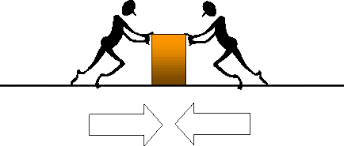
If an object is stationary (not moving) the forces acting upon it are _____________
a)
unbalanced
b)
weak
c)
balanced
d)
Hulk Smash!
42.
What is the unit of measurement for force?
a)
AMP
b)
Seconds
c)
Newtons
d)
Miles
43.
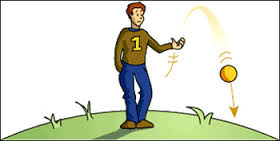
What is the attractive force that exists between all objects that have mass?
a)
Weight
b)
Mass
c)
Gravity
d)
Viscosity
44.

If these boys are pulling with the same amount of force. What will happen?
a)
The boy in blue will win.
b)
They will not move at all.
c)
The boy in red will win.
d)
Both will fall down.
45.
A force that slows or stops motion when objects rub together.
a)
Friction
b)
Push
c)
Pull
d)
Magnetism
46.
What pulls a ball back to earth?
a)
Gas
b)
Gravity
c)
Friction
d)
Molecules
47.
What is motion?
a)
It's like the ocean
b)
Any change in an animal or person's position.
c)
Motion is like acting
d)
Any change in an object or person's position.
48.
if you have balanced forces on a ball what happens
a)
It stays still
b)
Keeps going
c)
:(
d)
:)
49.

What is the net force?
a)
40 N left
b)
0 N Balalnced
c)
400 N right
d)
40 N right
50.
What is Newton's Third Law?
a)
Object in motion stays in motion and an object at rest stays at rest unless acted on by a outside force
b)
Force = mass x acceleration
c)
For every action there is an equal and opposite reaction
51.
According to Newton's second law, if you increase the force applied to an object :
a)
it accelerates more
b)
it doesn't move
c)
you get more inertia
d)
it decelerates
52.
Forces always act in equal and opposite pairs.
a)
Newton's 1st Law
b)
Newton's 2nd Law
c)
Newton's 3rd Law
d)
Newton's 4th Law
53.
An object at rest will _______ if no outside forces are applied.
a)
Stay at rest
b)
Increase Velocity
c)
Decrease Mass
54.
According to Newton’s first law of motion, a moving object that is not acted on by an unbalanced force will
a)
remain in motion.
b)
eventually come to a stop.
c)
change its momentum.
d)
accelerate.
55.
A person not wearing a seatbelt flies through a car window when someone slams on the breaks because the person’s body wants to remain in continuous motion even when the car stops.
a)
Newton's 1st Law
b)
Newton's 2nd Law
c)
Newton's 3rd Law
d)
None of them
56.
Who is the scientist who came up with the Laws of Motion?
a)
Sir Issac Newton
b)
The Greeks
c)
John Dalton
d)
Sir John Newt
57.
If you kicked a ball in space it would keep going because there is no gravity, friction, or air friction going against it. It will only stop moving in that direction if something comes into contact with it. This is an example of...
a)
Newton's First Law
b)
Newton's Second Law
c)
Newton's Third Law
58.
If you slide a hockey puck on ice, eventually it will stop because of the friction of the ice. This is an example of which Law of Motion.
a)
Newton's First Law
b)
Newton's Second Law
c)
Newton's Third Law
59.
What kind(s) of objects have inertia?
a)
all objects with mass
b)
only objects at rest
c)
only objects in motion
d)
only objects whose motion is being changed
60.
Which has more Inertia? (so need more force to move)
a)
Truck
b)
Ant
c)
A cat
d)
A skateboard
Reset

