
 Worksheets
Differential Calculus Bonanza
Total questions: 70
Worksheet time: 3hrs 2mins
Name
Class
Date
1.

Find the limit
a)
0
b)
5/2
c)
-4/3
d)
DNE
2.

Find the limit
a)
2
b)
infinity
c)
16
d)
negative infinity
3.

What is the limit?
a)
3
b)
-3
c)
Infinity
d)
DNE
4.

What is the limit of the function as x approaches -4 from the left?
a)
2
b)
-4
c)
DNE
d)
-2
5.
What is the derivative of xn?
a)
(n-1)xn
b)
nxn+1
c)
(n+1)xn-1
d)
nxn-1
6.
What is the derivative of tan(x)?
a)
-sec2(x)
b)
-csc2(x)
c)
sec2(x)
d)
csc2(x)
7.
What is the derivative of ex?
a)
xex-1
b)
xe
c)
ex
d)
ex-1
8.
What is the derivative of ln(x)?
a)
xln(x)
b)
1/x
c)
ex
d)
ln(x+1)
9.
Find the derivative of the given equation
f(x) = x3 + x2 + 3
f(x) = x3 + x2 + 3
a)
3x2 + 2x
b)
3x + 2x
c)
3x + 2x + 3
d)
x3 + x2
10.
What is the derivative of cos(x)?
a)
sin(x)
b)
-sin(x)
c)
cos(x)
d)
-cos(x)
11.

Find the limit as x approaches 3 from the left
a)
4
b)
3
c)
2
d)
DNE
12.

Find the domain of h(x):
a)
(-∞, +∞)
b)
(-∞, -2) U (-2, ∞)
c)
(2, ∞)
d)
[-2, ∞)
13.
For the function f(x) = -3x + 3 find f(0).
a)
0
b)
-3
c)
3
d)
-1
14.

What is the area of the rectangle?
a)
15 sq cm
b)
15 cm
c)
2
d)
16 cm
15.
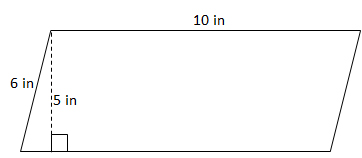
Find the area.
a)
60 in
b)
60 in2
c)
50 in
d)
50 in2
16.
What is the area of a triangle with a base of 9 cm and a height of 4 cm?
a)
8 cm squared
b)
6 cm squared
c)
36 cm squared
d)
18 cm squared
17.

Is this graph a function or not a function?
a)
Function
b)
Not a Function
18.
If a function has a derivative that is negative, what does that tell you?
a)
The function is increasing
b)
The function is decreasing
19.
If a function has a derivative that is positive, what does that tell you?
a)
The function is increasing
b)
The function is decreasing
20.
If a function has a second derivative that is positive, what does that tell you?
a)
The function is increasing
b)
The function is decreasing
c)
The function is concave up
d)
The function is concave down
21.
If a function has a second derivative that is negative, what does that tell you?
a)
The function is increasing
b)
The function is decreasing
c)
The function is concave up
d)
The function is concave down
22.
Does
y = -4x2
have a maximum or minimum value?
y = -4x2
have a maximum or minimum value?
a)
maximum
b)
minimum
c)
both
d)
neither
23.
If f '(x) >0, what is true about f(x)?
a)
it is concave up there
b)
it has an inflection point
c)
It's increasing
d)
it is concave down there
24.
If f '(x) <0, what is true about f(x)?
a)
it is concave up there
b)
it's decreasing
c)
It's increasing
d)
it is concave down there
25.
What will be true at an inflection point?
a)
f(x)=0
b)
f'(x)=0
c)
f ''(x)=0
d)
The function is undefined
26.
If you are looking at a sign chart, how do you find an inflection point?
a)
See where it goes from + to -
b)
See where it goes from + to +
c)
See where it goes from - to +
d)
give up
27.
What is the anti-derivative of y = -cos(x)
a)
-sin(x) +c
b)
sin(x)+c
c)
cos(x)+c
d)
-cos(x)+c
28.
What is the anti-derivative of y = ex?
a)
ex+c
b)
-ex+c
c)
ln(x) + c
d)
1/x + c
29.

Evaluate with a GC or Desmos.
a)
A
b)
B
c)
C
d)
D
30.
What is the anti-derivative of y = 3x3?
a)
3x^4/4+c
b)
x3+c
c)
9x2+c
d)
x2+c
31.
Slopes of parallel lines are...
a)
opposite reciprocals.
b)
opposites.
c)
identical.
d)
always 7.
32.
What is the y-intercept in the following equation: y=-4x-5
a)
(-4,0)
b)
(0,-4)
c)
(0,5)
d)
(0,-5)
33.
Slopes of perpendicular lines are...
a)
opposite reciprocals.
b)
opposites.
c)
identical.
d)
always 7.
34.
All of the x values or inputs are called what?
a)
Domain
b)
Range
c)
Relation
d)
Function
35.

What is the domain of the graph?
a)
x≤0
b)
x≥0
c)
All real numbers
d)
y≥0
36.

What is the range of the graph?
a)
x≤0
b)
y≥0
c)
y≤0
d)
All real numbers
37.
Evaluate using a GC or your orange sheet: tan(225°)
a)
-1
b)
√2
c)
2√3/3
d)
1
38.
Evaluate using a GC or your orange sheet: sin(π/6)
a)
1/2
b)
√2/2
c)
√3/2
d)
2
39.
What is the definition of function?
a)
Has inputs and outputs
b)
Every input has only ONE output
c)
Inputs have different outputs every time
d)
x-values and y-values
40.

Is this a function?
a)
Function
b)
Not a Function
41.

Which ordered pair below would prevent this table from being a function?
a)
(10, 10)
b)
(2, 4)
c)
(6, 1)
d)
(-2, 0)
42.

Find the indicated limit
a)
0
b)
∞
c)
- ∞
d)
DNE
43.

Evaluate this limit
a)
0
b)
0/0
c)
1/4
d)
DNE
44.
What is the average rate of change of
y = 2(3)x at [2, 4]?
y = 2(3)x at [2, 4]?
a)
72
b)
3
c)
36.8
d)
630
45.

Find the average rate of change from x=0 and x=3
a)
-3/4
b)
6
c)
3/4
d)
3
46.
f(x) = x^2 + 10 find slope at x = -2.
Hint: think of its derivative!
Hint: think of its derivative!
a)
14
b)
6
c)
-4
d)
4
47.
What is the derivative of tan y with respect to x? Note: this requires implicit differentiation
a)
sec y (dy/dx)
b)
sec2y (dy/dx)
c)
tan2y (dy/dx)
d)
sec2y
48.
Find the derivative of the given equation
f(x) = 7
f(x) = 7
a)
7
b)
0
c)
7x
d)
14
49.
Find the derivative of the given equation
f(x) = -4x
f(x) = -4x
a)
4
b)
x
c)
-4
d)
0
50.
Find the slope of the tangent line to
f(x) = -3x2-6x at x = 1.
f(x) = -3x2-6x at x = 1.
a)
m = 0
b)
f'(x) = -6x - 6
c)
f'(x) = 6x
d)
m = -12
51.

Which is the derivative of this graph?
a)
A
b)
B
c)
C
d)
D
52.
Find the derivative of:
sin(cos(2x-5))...chain rule here you come.
sin(cos(2x-5))...chain rule here you come.
a)
-2(sin2(2x-5))
b)
cos(cos(2x-5))(-sin(2x-5))(2)
c)
-(cos(2x-5))(sin(2x-5)
d)
2sinxcos(2x-5)
53.
What is the quotient rule for the derivative of
f = u/v?
f = u/v?
a)
f' = (vu' - uv')/v2
b)
f' = (uv' - vu')/v2
c)
f' = (vu' - uv')/u2
d)
f' = (uv' - vu')/u2
54.
What is the product rule for the derivative of
f = u⋅v?
f = u⋅v?
a)
f' = u'v + uv'
b)
f' = uv' - vu'
c)
f' = uv - v'u'
d)
f' = v'u' - vu
55.
Which if the following is not a correct notation for 'derivative?'
a)
f'(x)
b)
y'
c)
x'
d)
dy/dx
56.

Does this graph have a maximum or minimum value?
a)
maximum
b)
minimum
c)
neither
d)
both
57.

Where is the absolute extrema?
a)
max is 4 at x = 0
b)
max is 4 at x = 3
c)
max is 3 at x = 5
d)
No maximum
58.

Where is this decreasing?
a)
(-∞, -2.55) U (0, 2.55)
b)
(+∞, -6.25) U (36, -6.25)
c)
(-∞, ∞)
d)
(-∞, 0)
59.
What is x-value at which the function below has the same slope as the average rate of change over the indicated interval?
f(x) = x2 - 3x - 28, [-4,7]
f(x) = x2 - 3x - 28, [-4,7]
a)
1.5
b)
-1.5
c)
0.5
d)
-0.5
60.

Find the area inside this shape. Estimate using the graph paper
a)
36 sq. Un
b)
30 sq. Uni
c)
3
d)
30 unit
61.

Find the Area under the curve.
a)
-500 ⁄ 3 u2
b)
20 ⁄ 3 u2
c)
500 ⁄ 3 u2
d)
-20 ⁄ 3 u2
62.
Find the area under a curve defined by the equation 5x4+3x+7 between the x values 0 and 4.
a)
1200 u2
b)
1/12 u2
c)
1134 u2
d)
1076 u2
63.

What size is the subinterval partition in the following example?
a)
x=2
b)
y=1
c)
x=0.5
d)
y=5
64.

a)
176/3 u2
b)
104/3 u2
c)
80 u2
d)
152 u2
65.

a)
29/2 u2
b)
17/2 u2
c)
13/2 u2
d)
41/2 u2
66.
Which represents slope intercept form?
a)
y = mx + b
b)
y = b + mx
ax+ by = c
ax+ by = c
c)
x + y = b
d)
xy + b = 0
67.

Solve using a GC or Desmos
a)
pi/2
b)
0
c)
3pi/2
d)
-3pi/2
68.
Find the derivative of the given equation
f(x) = 1 - x2
f(x) = 1 - x2
a)
1 - 2x
b)
-2x
c)
-2
d)
-1
69.

Evaluate using NINT or Desmos
a)
-27 u2
b)
27 u2
c)
37 u2
d)
32 u2
70.

Use LRAM and 4 subintervals to estimate Area under the curve. Answers are in u2.
a)
A all of the above
b)
B I am not sure
c)
C say what?
d)
D none of the above
100 %

