
NEW
Font size
S
M
L
XL
 Worksheets
Unit 5 Review
Total questions: 47
Worksheet time: 3600secs
Name
Class
Date
1.
Where can the oldest layer be found?
a)
The top layer
b)
The middle layer
c)
They are all the same age
d)
The bottom layer
2.
In what kind of rock can fossils be found?
a)
Sedimentary Rocks
b)
Igneous Rocks
c)
Metamorphic Rocks
d)
Granite
3.

Which layer formed first?
a)
Rock Layer W
b)
Rock Layer X
c)
Rock Layer Y
d)
Rock Layer Z
4.
superposition: a principle which states that in ______________, _______________ sedimentary rock layers, the OLDEST layer is on the BOTTOM.
a)
disturbed, horizontal
b)
undisturbed, horizontal
c)
disturbed, vertical
d)
undisturbed, vertical
5.

this type of fossil is created during a process that preserved the delicate parts of plant leaves and insects
a)
amber
b)
petrified
c)
carbon film
d)
trace
6.
the trace or remains of an organism that lived a loooong time ago, often preserved in sediment
a)
half-life
b)
fossil
c)
geologic time-scale
d)
evolution
7.

this type of fossil is a mark or cavity made in sediment in the shape of a shell or other body
a)
cast
b)
trace
c)
petrified
d)
mold
8.
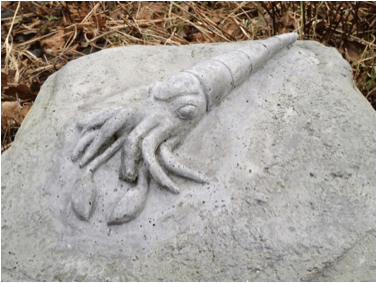
this type of fossil is a mold filled with sediment that creates a solid copy of an organism
a)
mold
b)
petrified
c)
cast
d)
trace
9.

this type of fossil provides evidence of the activities of ancient organisms; examples include marks left by footprints or tails
a)
mold
b)
carbon film
c)
trace
d)
cast
10.
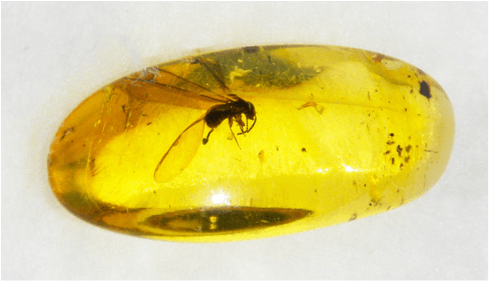
this material does an excellent job of preserving insect remains
a)
cast
b)
amber
c)
mold
d)
carbon film
11.
What is hardened tree sap called?
a)
coprolites
b)
index fossils
c)
gastroliths
d)
amber
12.
How do MOST fossils form?
a)
living things die and their remains are quickly buried by
sediments
b)
the hard parts of an organism dry out in the air
c)
the soft parts of an organism change to stone
d)
freezing preserves the remains of an organism
13.
Fossils of fish are found under land where cows now live. What does this tell you?
a)
the fish were dropped their by flying birds
b)
this land was once under the ocean
c)
farmers fed the fish to the cows
d)
fish used to live on land
14.
Why do bones and teeth remain as part of some fossils?
a)
they are white
b)
bones are large
c)
the parts are hard
d)
bones decay easily
15.

According to the law of superposition, the oldest fossils are found
a)
At the top of the rock layers
b)
Near the bottom of the rock layers
c)
In the middle of the rock layers
d)
Somewhat near the surface
16.
Which type of dating method can be used on rock layers by applying the Law of Superposition?
a)
relative dating
b)
absolute dating
c)
radioactive dating
d)
radiometric dating
17.

Which of the following is the oldest?
a)
Layer L
b)
Intrusion D
c)
Intrusion H
d)
Layer E
18.

Which of the following correctly lists the layers in order from oldest to youngest?
a)
A, B, C, D, E
b)
E, B, C, D, A
c)
E, D, C, B, A
d)
C, B, A, D, E
19.

What is the oldest layer in the outcrop?
a)
B
b)
C
c)
D
d)
E
20.

The rock formation labeled "P" is a(n)...
a)
fault
b)
intrusion
c)
inclusion
d)
unconformity
21.
States that if something cuts through rock layers, the layers must be older than the thing cutting through them.
a)
horizontality
b)
uniformitarianism
c)
superposition
d)
cross cutting
22.
States that rock layers on bottom are the oldest
a)
horizontality
b)
uniformitarianism
c)
superposition
d)
cross cutting
23.
States that all geological processes today that occurred in the past, happened in the same way.
a)
horizontality
b)
uniformitarianism
c)
superposition
d)
cross cutting
24.
The age of rock compared to the ages of rock layers
a)
unconformity
b)
relative age
c)
absolute age
d)
extrusion
25.
After the third half-life, how much of the sample is left?
a)
1/2
b)
1/3
c)
1/16
d)
1/8
26.
What is Half-life?
a)
The amount of time it takes for some of the nuclei in a sample of the isotope to decay
b)
The amount of time it takes for half the electrons in a sample of the isotope to decay
c)
The amount of time it takes for half the nuclei in a sample of the isotope to decay
d)
the amount of time it takes to double the nuclei in a sample of the isotope to decay
27.
The length of time required for half of the radioactive atoms in a sample to decay is its...
a)
era
b)
age
c)
half-life
d)
eon
28.
Relative dating of rock layers tells us that the deeper we dig, _______.
a)
the younger the rocks get
b)
the smellier the rocks get
c)
the harder the rocks get
d)
the older the rocks get
29.
This provides information about the history of life on earth and how organisms lived and evolved over time.
a)
fossil data
b)
fossil evidence
c)
fossil record
d)
remains of fossil
30.
The disappearance of a species.
a)
Evolution
b)
Extinction
c)
Migration
d)
Mutation
31.
Known as the age of the mammals?
a)
Mesozoic Era
b)
Holocene Epoch
c)
Cenozoic Era
d)
Cambrian
32.
The dinosaurs and reptiles were dominant in which Era?
a)
Precambrian
b)
Mesozoic
c)
Paleozoic
d)
Cenozoic
33.

What occurred during the Paleozoic Era?
a)
a great number of organisms evolved
b)
mammals evolved
c)
reptiles spread widely
34.
Paleozoic, Mesozoic & Cenozoic are all
a)
Epochs
b)
Eras
c)
Periods
d)
Eons
35.
Which type of dating method can be used on rock layers by applying the Law of Superposition?
a)
relative dating
b)
absolute dating
c)
radioactive dating
d)
radiometric dating
36.
Which division on the geologic time scale is the shortest?
a)
epoch
b)
era
c)
eon
d)
period
37.
Which is the most recent era of time- the one that we are currently in?
a)
Mesozoic
b)
Paleozoic
c)
Cenozoic
d)
Precambrian
38.
Why are advantageous traits more likely to be passed onto offspring?
a)
Because they are more likely to survive and reproduce.
b)
Because they come from dominant alleles.
c)
Because they come from recessive alleles.
d)
Because the trait is an acquired phenotype.
39.
Where did most of the life live during the paleozoic era?
a)
Land
b)
Water
c)
Air
d)
None. There was no life in the paleozoic era.
40.
How old do Paleontologists believe the Earth is?
a)
2015 years old
b)
3.6 billion years old
c)
4.6 billion years old
d)
4.6 million years old
41.
The time span that lasted the longest was the...
a)
Precambrian
b)
Paleozoic
c)
Mesozoic
d)
Cenozoic
42.
The Era with the largest extinction we know of is the...
a)
Mesozoic era
b)
Precambrian era
c)
Paleozoic era
d)
Cenozoic era
43.
The Era when humans first appeared was...
a)
Cenozoic
b)
Mesozoic
c)
Paleozoic
d)
Precambrian
44.
During which era did the earliest dinosaurs appear?
a)
Cenozoic
b)
Paleozoic
c)
Mesozoic
d)
Precambrian
45.
What type of animal lived only during the Mesozoic Era?
a)
Mammals
b)
Birds and Mammals
c)
Dinosaurs
d)
All of them
46.
How log ago did the dinosaurs become extinct?
a)
4.6 billion years ago
b)
3.5 billion yeats ago
c)
65 million years ago
d)
3 million years ago
47.
When is the test?
a)
Monday
b)
Tuesday
c)
Wednesday
d)
This weekend - it's a take home test
Reset

