
 Worksheets
Unit 7 AP Bio review
Total questions: 59
Worksheet time: 1hrs 13mins
Name
Class
Date
1.

If a bacteria is called coccus, its shape is:
a)
Spiral
b)
Oval
c)
Round
d)
Prokaryote
2.
An organism that has genetic material not contained in a nucleus is called a:
a)
prokaryote
b)
eukaryote
c)
protist
d)
Virus
3.

For a virus to multiply it needs to enter a cell and have its ___ take over the cell functions
a)
Proteins
b)
Amino acids
c)
Genetic material
d)
Ribosomes
4.
A substance that is introduced into the body to stimulate the production of chemicals that destroy specific viruses is called a:
a)
disease
b)
virus
c)
vaccine
d)
rabies
5.
What do viruses need to reproduce?
a)
they need genetic material
b)
They need a host cell
c)
They need bacteria
d)
They need insulin
6.
Reasons that viruses are considered to be nonliving is because
a)
They are not cellular
b)
They cannot reproduce on their own
c)
They cannot make proteins
d)
all of the above
7.
A(n) _____ is a virus that enters a bacterial cell.
a)
endospore
b)
decomposer
c)
plasmid
d)
bacteriophage
8.
When a virus invades a living cell, its _______
takes over the cell's functions.
takes over the cell's functions.
a)
outer coat
b)
genetic material
c)
core
d)
cytoplasm
9.
Antibiotics kill viruses
a)
True
b)
False
10.
A tiny non-living particle that invades and then multiplies inside of a living cell is called a:
a)
vaccine
b)
virus
c)
bacteriophage
11.
How could you describe the size of a virus?
a)
Smaller than bacteria
b)
Larger than a parasite
c)
About the size of a dime
d)
Smaller than a proton
12.
What happens in the lytic cyle?
a)
Virus goes in and leaves the host cell
b)
Virus quickly kills the host cell
c)
Virus sleeps inside of the host cell
d)
Virus stay dormant for a long time
13.
What happens in the lysogenic cycle?
a)
Virus goes in and leaves the host cell
b)
Virus quickly kills the host cell
c)
Virus inject the nucleic acid into the host cell, and the nucleic acid integrates into the host cell DNA, and stay dormant for a long time
d)
Bacteria injects DNA into a host cell
14.
The lytic cycle takes the longest out of the two viral reproductive cycles.
a)
True
b)
False
15.

What process is this?
a)
phagocytosis
b)
lytic cycle
c)
lysogenic cycle
d)
formation of antibodies
16.
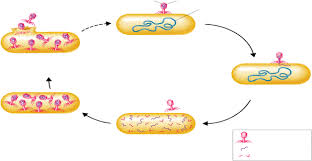
What is shown here?
a)
Lysogenic Cycle
b)
Lytic Cycle
c)
Binary Fission
d)
Conjugation
17.

Host DNA is compromised and viral DNA takes over in which phase?
a)
1
b)
2
c)
4
d)
5
18.

The lysing of a cell occurs in which phase?
a)
1
b)
2
c)
4
d)
5
19.
What happens after attachment?
a)
Attachment
b)
Entry
c)
Replication
d)
Assembly
20.
What happens before virus assembly during the lytic cycle?
a)
Attachment
b)
Entry
c)
Replication
d)
Lysis
21.
What is the 1st step of virus infection?
a)
Entry
b)
Attachment
c)
Replication
d)
Assembly
22.
Influenza infects a cell and causes it to lyse immediately. Which type of virus is influenza?
a)
Lytic
b)
Lysogenic
c)
Bacterial
d)
None of the above
23.
HIV is an example of which type of virus?
a)
Lysogenic
b)
Bacterial
c)
Lytic
d)
None of the above
24.
Viruses are made up of
a)
Nucleus, membrane
b)
Capsid, nucleus
c)
Capsid, nucleic acid
d)
Mitochondria, nucleus
25.
During the process of gel electrophoresis, molecules are separated as they are pulled by an electric current through a molecular filter. Which best describes how molecules are separated?
a)
precisely by both size and charge
b)
approximately by size and charge
c)
by size only
d)
by charge only
26.
Why do the fragments of DNA in gel electrophoresis travel away from the negative electrode?
a)
DNA is negatively charged
b)
DNA is positively charged
c)
the agarose gel in negatively charged
d)
the agarose gel is positively charged
27.
Which is the primary purpose of using restriction enzymes in gel elctrophoresis?
a)
It allows the strands of DNA to be cut into various lengths for testing
b)
It restricts the number of base pairs that can be tested in a sample
c)
It makes the testing simpler by moving the strands into the gel faster
d)
It charges the DNA strands
28.
What type of macromolecule are restriction enzymes?
a)
nucleic acid
b)
carbohydrate
c)
protein
d)
lipid
29.
A method of separating DNA fragments according to their size and charge using an electric current passed through a gel containing the samples a
a)
Chromosome
b)
DNA Probe
c)
Electrophoresis
d)
Restriction Enzyme
30.
A special protein that targets a specific base sequence and cuts DNA into smaller fragments a. Gene c. DNA Probe b. Exon d. Restriction Enzyme
a)
Gene
b)
DNA Probe
c)
Exon
d)
Restriction Enzyme
31.
Pattern of DNA fragments obtained by examining a person’s unique sequence of DNA base pairs
a)
Chromosome
b)
DNA Probe
c)
DNA Fingerprint
d)
Electrophoresis
32.
How do scientists cut DNA into smaller strands?
a)
restriction enzymes
b)
scissors
c)
ligase
d)
agarose
33.
Which model of base pairing is correct?
a)
A=T and C=G
b)
A=T=C=G
c)
A+T and G+C
d)
A=G and T=C
34.
True or False. The total amount of DNA in a cell is known as genome?
a)
True
b)
False
35.
Most human cells have how many chromosomes
a)
23
b)
24
c)
46
d)
48
36.

DNA cutting "scissors" are
a)
Bacteriophages
b)
Restriction Enzymes
c)
DNA Enzymes
d)
Plasmids
37.
Which process separates DNA fragments by their size and movement speed?
a)
PCR
b)
Gel Electrophoresis
c)
Blotting
d)
Cloning
38.
GMO stands for
a)
Genetically modified organism
b)
Genetically made organism
c)
Generically made organ
d)
Generically modified organism
39.
What gender has an X and a Y chromosome?
a)
male
b)
female
c)
transgender
d)
all of the above
40.

Based on these results whose blood was found in the blood stain at the crime scene?
a)
Bob
b)
Sue
c)
John
d)
Lisa
41.

Which of the following best describes a DNA molecule?
a)
double helix
b)
contains ribose
c)
made of amino acids
d)
contains Uracil
42.
Where is DNA found in the body?
a)
Cells nucleus
b)
Heart
c)
Cartilage
d)
Muscle
43.
What was the Human Genome Project specifically trying to find?
a)
the nucleotide sequences
b)
polymerase chains
c)
a single nucleotide
d)
forms of resistant DNA
44.
Identify the gene mutation:
NORMAL
AAA-GCA-TTA-CGC
MUTANT
AAA-CCA-TTA-CGC
NORMAL
AAA-GCA-TTA-CGC
MUTANT
AAA-CCA-TTA-CGC
a)
insertion
b)
deletion
c)
insertion frameshift
d)
subsitution
45.
Identify the gene mutation:
Normal
AGC-TTA-CGT-AAA
Mutant
ACT-TAC-GTA-AA
Normal
AGC-TTA-CGT-AAA
Mutant
ACT-TAC-GTA-AA
a)
insertion frameshift
b)
deletion frameshift
c)
insertion
d)
nonsense
46.
Identify the gene mutation:
Normal-
GAG-CTC-GAC-AGA
Mutant
GAG CTC-CAC-AGA
Normal-
GAG-CTC-GAC-AGA
Mutant
GAG CTC-CAC-AGA
a)
no mutation
b)
substitution
c)
insertion
d)
deletion
47.

Identify the chromosomal mutation
a)
Deletion
b)
Duplication
c)
Inversion
d)
Translocation
48.

Identify the chromosomal mutation
a)
Deletion
b)
Duplication
c)
Inversion
d)
Translocation
49.
The function of _____ is to transport amino acids in the cytoplasm to the ribosome.
a)
rRNA
b)
tRNA
c)
mRNA
d)
DNA
50.
In proteins, the amino acid order is determined by
a)
nitrogenous bases in RNA
b)
random placement
c)
nitrogenous bases in DNA
d)
there is no order
51.
What is the mRNA strand that would result from the DNA template strand CCTA?
a)
GGAT
b)
CCAT
c)
GGAU
d)
CCAU
55.

which process is shown?
a)
diffusion
b)
repiration
c)
recombination
d)
translation
53.
The end product of translation is what?
a)
amino acid
b)
protein
c)
sugar
d)
lipid
54.
The anticodon is found on what structure?
a)
mRNA
b)
tRNA
c)
rRNA
d)
DNA
55.
which process is shown?
a)
diffusion
b)
repiration
c)
recombination
d)
translation
56.
What molecules do both DNA and RNA contain?
a)
uracil
b)
nucleotides
c)
thymine
d)
deoxyribose
57.
The DNA sequence ATCAGCGCTGGC is part of a gene. how many amino acids are coded for by this message?
a)
4
b)
8
c)
12
d)
20
58.
DNA sequence is ACAGTGC. How would this be coded on mRNA?
a)
TGTCACG
b)
UGUCACG
c)
GUGACAU
d)
CACUGUA
59.

The principle shown in the image is called what?
a)
Transcription
b)
The Central Dogma
c)
Translation
d)
The Principle of Proteins
100 %

