
 Worksheets
Classification of Living Things
Total questions: 80
Worksheet time: 48mins
Name
Class
Date
1.
The scientific name for an organism includes which taxa?
a)
class and family
b)
genus and species
c)
domain and kingdom
d)
kingdom and phylum
2.
A tool used by a taxonomist to identify an unknown organism is known as a __________.
a)
dichotomous key
b)
binomial nomenclature
c)
scientific name
d)
binomial key
3.
The science of classifying and naming organisms is ______________.
a)
evolution
b)
taxonomy
c)
grouping
d)
scientific names
4.

An illustration and a dichotomous key are given. What is the correct classification for this organism?
a)
Class Insecta
b)
Order Amblygygi
c)
Order Araneae
d)
Order Scorpiones
5.
Who first proposed binomial nomenclature as a way of classifying organisms?
a)
Carolus Linnaeus
b)
Aristotle
c)
Charles Darwin
d)
Louis Pasteur
6.

The 8 levels of classification, from most broad to most specific are ...
a)
Domain, Genus, Family, Order, Class, Phylum, Kingdom, Species
b)
Domain, Species, Kingdom, Genus, Phylum, Family, Class, Order
c)
Domain, Kingdom, Phylum, Class, Order, Family, Genus, Species
d)
Order, Kingdom, Species, Domain, Phylum, Family, Class, Genus
7.
The taxon with the largest amount of organisms grouped together...
a)
Species
b)
Phylum
c)
Kingdom
d)
Domain
8.
Which of the following is not true when comparing scientific and common names?
a)
Scientific names vary from place to place.
b)
Common names can vary from place to place.
c)
Scientific names are written in Latin.
d)
Common names can inaccurately describe the organism and be confusing.
9.
Smallest taxonomic group with many similar characteristics...
a)
domain
b)
kingdom
c)
species
d)
class
10.

A student discovers an arachnid with a segmented abdomen, long legs, and a tail with no stinger. The student uses the dichotomous key below to identify it. Which arachnid has the student found?
a)
Whip Scorpion
b)
Wind Scorpion
c)
Daddy long legs
d)
Scorpion
11.

What is the most primitive organism shown on the cladogram?
a)
chimp
b)
perch
c)
hagfish
d)
salamander
12.

Which organisms pictured on the cladogram have hair?
a)
prosimians only
b)
prosimians and humans
c)
humans only
d)
prosimians and birds
13.

Which group(s) of organisms do not have vertebrae?
a)
lampreys and lancelets
b)
lampreys and tuna
c)
lancelets only
d)
salamanders, tuna, and lampreys
14.

Which organism in the table shown is most closely related to the common dolphin?
a)
human
b)
killer whale
c)
giant kelp
d)
bat star
15.

Which organism in the table is least closely related to the chimpanzee?
a)
human
b)
grey wolf
c)
tiger snake
d)
monarch butterfly
16.
Name the kingdom being described:
multi-cellular; eukaryotic; cell membrane but no cell wall; ingestive heterotroph
multi-cellular; eukaryotic; cell membrane but no cell wall; ingestive heterotroph
a)
plants
b)
animals
c)
protists
d)
fungus
17.
Name the kingdom being described:
multi-cellular; eukaryotic; absorptive heterotroph; no chloroplasts; has a cell wall made of chitin; has vegetative and reproductive mycelium
multi-cellular; eukaryotic; absorptive heterotroph; no chloroplasts; has a cell wall made of chitin; has vegetative and reproductive mycelium
a)
fungus
b)
protist
c)
plant
d)
animals
18.
What "rules" do you follow when writing a scientific name?
a)
capitalize the first word
b)
lower case the 2nd word
c)
underline both words
d)
all of these must be used
19.
Taxonomy is the science of :
a)
taxing things
b)
naming and classifying things
c)
killing & stuffing things you put on your wall
20.
True or false: Seaweed and algae are both classified in the plant kingdom.
a)
True, they are both plants.
b)
False, they are not both plants.
21.
Name the kingdom being described: mostly unicellular; all are eukaryotic; all have a cell membrane but only a few have a cell wall; some are autotrophic and cause red tides; one category includes the protozoans like amoebas and paramecium; some include slime molds.
a)
fungus
b)
plant
c)
protist
d)
bacteria
22.
Name the kingdom being described:
multi-cellular; eukaryotic; cell wall of cellulose; comes in 2 basic types called vascular and non-vascular; examples are gymnosperms and angiosperms
multi-cellular; eukaryotic; cell wall of cellulose; comes in 2 basic types called vascular and non-vascular; examples are gymnosperms and angiosperms
a)
plants
b)
animals
c)
protists
d)
fungus
23.
A(n) ____________ cell does not have a nuclear membrane to protect/separate the DNA from the rest of the contents of the cell.
a)
prokaryotic
b)
eukaryotic
c)
diatomaceous
24.
A(n) __________ cell has a nuclear membrane around its DNA to protect the chromosomes
a)
prokaryotic
b)
eukaryotic
c)
archaea
25.
If you saw a unicellular, prokaryotic organism in a salty brine pool or on an ice sheet in Antarctica or near a deep sea ocean vent, you would be looking at:
a)
fungi
b)
protist
c)
archaebacteria
d)
eubacteria
26.
Which kingdom is being described?
unicellular; true nucleus; animal-like (based on how they move); plant-like (based on colors); forms Red Tides; fungal-like live in cool, dark, damp places
unicellular; true nucleus; animal-like (based on how they move); plant-like (based on colors); forms Red Tides; fungal-like live in cool, dark, damp places
a)
Fungi
b)
Animalia
c)
Plantae
d)
Protista
27.
Which kingdom is being described: prokaryotic, unicellular, can give you a sore throat; helps make food like cheese or pickles
a)
Protista
b)
Animalia
c)
Archaebacteria
d)
Eubacteria
28.
Which of the following is NOT a reason to use Latin for scientific names?
a)
dead/does not change
b)
world-wide/universal
c)
it sounds technical and professional
29.
Which set of words use the proper terms to write a scientific name? (NOTE: all should be underlined)
a)
Kingdom phylum
b)
KINGDOM PHYLUM
c)
Genus species
d)
Genus Species
30.
When classifying organisms, besides the number of cells (unicellular vs. multicellular), scientists look at the following things:
a)
type of cell (prokaryotic vs eukaryotic)
b)
type of cell boundary (membrane vs wall)
c)
how it gets it food (producer vs consumer)
d)
all of these are correct
31.
The smallest functional and structural unit of all living organisms is:
a)
atom
b)
cell
c)
nucleus
d)
brain
32.
Any living things is called:
a)
organism
b)
animal
c)
cell
d)
plant
33.
An organism that consists of a single cell is called?
a)
multicellular
b)
unicellular
c)
autotroph
d)
heterotroph
34.
An example of an unicellular organism would be:
a)
monkey
b)
bacteria
c)
spider
d)
human
35.
An organism made up of more than one cell would be called:
a)
multicellular
b)
unicellular
c)
heterotroph
d)
autotroph
36.
An organism that CANNOT make its own food and must consume other living things:
a)
heterotroph
b)
multicellular
c)
unicellular
d)
autotroph
37.
An organism that CAN make its own food is called:
a)
heterotroph
b)
unicellular
c)
autotroph
d)
multicellular
38.

Which trait do only humans have, according to the cladogram?
a)
jaws
b)
mammary glands & hair
c)
terrestrial during all life stages
d)
bipedal & opposable thumbs
39.
What is this?
Canis
Canis
a)
genus and species
b)
genus
c)
species
d)
class
40.
What is this?
Panthera tigris
Panthera tigris
a)
genus and species
b)
genus
c)
species
d)
phylum
41.
What is this?
familiaris
familiaris
a)
genus and species
b)
genus
c)
species
d)
kingdom
42.

Who is the closest relative to the birds?
a)
crocodiles
b)
sharks
c)
fish
d)
amphibians
43.
Who is the closest relative to the sharks?
a)
crocodiles
b)
sharks
c)
ray-finned fish
d)
amphibians
44.

The scientific name for water bear is Hypsibius dujardini. What is its genus?
a)
Hypsibius
b)
dujardini
c)
water
d)
tardigrade
45.

The scientific name for water bear is Hypsibius dujardini. What is its species?
a)
Hypsibius
b)
dujardini
c)
water
d)
tardigrade
46.

What is the name of bird Z?
a)
Certhidea
b)
Geospiza
c)
Camarhynchus
d)
Platyspiza
47.

Which 2 organisms would be able to reproduce and produce fertile offspring?
a)
2 organisms in the same class
b)
2 organisms in the same family
c)
2 organisms in the same genus
d)
2 organisms in the same species
48.

Which Kingdom is the image apart of?
a)
Bacteria
b)
Plantae
c)
Protista
d)
Fungi
49.
This word means to become more complex structurally.
a)
Growth
b)
Stimulus
c)
Response
d)
Development
50.
This word means any change in an organism's surroundings causing it to change.
a)
Growth
b)
Stimulus
c)
Response
d)
Development
51.
This word means becomes larger in size.
a)
Growth
b)
Stimulus
c)
Response
d)
Development
52.
This word means the reaction to a stimulus.
a)
Growth
b)
Stimulus
c)
Response
d)
Development
53.
Scientists who group organisms are called ________________.
a)
Taxonomy
b)
Monera
c)
Plant
d)
Taxonomists
54.
This kingdom's characteristics consists of autotrophs and multi cellular.
a)
Taxonomy
b)
Monera
c)
Plant
d)
Taxonomists
55.
This kingdom's organisms fall into three categories known as mushrooms, yeasts, and molds.
a)
Fungi
b)
Monera
c)
Plant
d)
Animal
56.
What is Cilia?
a)
A tail like structure that help protist move
b)
Hair like fibers that help protist move
c)
A place where spores are kept
d)
A fake foot that help protist move
57.
What is Flagella?
a)
A tail like structure that help protist move
b)
Hair like fibers that help protist move
c)
A place where spores are kept
d)
A fake foot that help protist move
58.
What is a pseudopod?
a)
A tail like structure that help protist move
b)
Hair like fibers that help protist move
c)
A place where spores are kept
d)
A fake foot that help protist move
59.

Which of these is a characteristic shared between Fungi and Plantae?
a)
Heterotrophic
b)
Mobile
c)
Prokaryotic
d)
Multicellular
60.
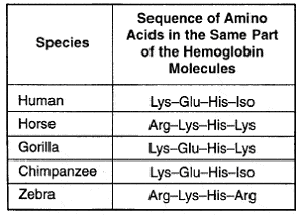
You look at two species and see very similar amino acid sequences. What does this likely tell you?
a)
These are the same animal.
b)
These animals have a common ancestor.
c)
These animals are not likely related.
d)
These animals are likely becoming one species.
61.
Why do scientists classify living things?
a)
to help keep information about organisms
b)
to make it easy to find information about an unknown species
c)
to communicate clearly with other scientists about organisms
d)
all of the above
62.

A goldfish's scientific name is Carassius auratus. What would a scientist in Germany call a goldfish?
a)
Goldfisch
b)
Carassius auratus
c)
Schnell fishy
d)
How should I know, I don't speak German
63.
Archaebacteria and Eubacteria are the only living organisms that do not have
a)
flagella
b)
cytoplasm
c)
a cell wall
d)
a nucleus
64.

What kingdom?
a)
Plantae
b)
Fungi
c)
Animalia
d)
Protista
65.

What kingdom?
a)
Plantae
b)
Fungi
c)
Animalia
d)
Protista
66.

What kingdom?
a)
Plantae
b)
Fungi
c)
Animalia
d)
Protista
67.

What kingdom?
a)
Plantae
b)
Fungi
c)
Animalia
d)
Protista
68.

What kingdom?
a)
Archaebacteria
b)
Eubacteria
c)
Animalia
d)
Protista
69.

What kingdom?
a)
Plantae
b)
Fungi
c)
Animalia
d)
Protista
70.

What kingdom?
a)
Plantae
b)
Fungi
c)
Animalia
d)
Protista
71.

Name this bacteria shape
a)
coccus
b)
bacillus
c)
spirillum
72.

Name this bacteria shape
a)
coccus
b)
spirillum
c)
bacillus
73.

All bacteria are harmful to humans
a)
True
b)
False
74.

Bacteria are only found in dirty places
a)
True
b)
False
75.

What are these images?
a)
Shapes of viruses
b)
Shapes of bacteria
c)
Shapes of protists
d)
Shapes of fungi
76.

This one-celled organism swims by moving its hair-like cilia.
a)
Paramecium
b)
Amoeba
c)
Euglena
77.
All of the following are examples of fungi except one. Which of the following is NOT a type of fungus?
a)
yeast
b)
mold
c)
mushroom
d)
algae
78.
__________ are fungi that that produce the gas that makes bread rise.
a)
Mushrooms
b)
Athletes' foot
c)
Blue Cheese
d)
Yeast
79.
What is true of all plants?
a)
eukaryotic
b)
prokaryotic
80.
What is true of all plants
a)
multicellular
b)
unicellular
100 %

