
 Worksheets
Chapter 10 Practice-Test tomorrow
Total questions: 62
Worksheet time: 1hrs 14mins
Name
Class
Date
1.

In a molecule of double-stranded DNA, the amount of Adenine present is always equal to the amount of
a)
cytosine
b)
guanine
c)
thymine
d)
uracil
2.
Which statement BEST describes the primary function of DNA replication?
a)
To ensure daughter cells have a complete copy of DNA.
b)
To prevent mutations from occurring in cells.
c)
To allow prokaryotic cells to undergo meiosis.
d)
To provide genetic variation within specific organisms.
3.
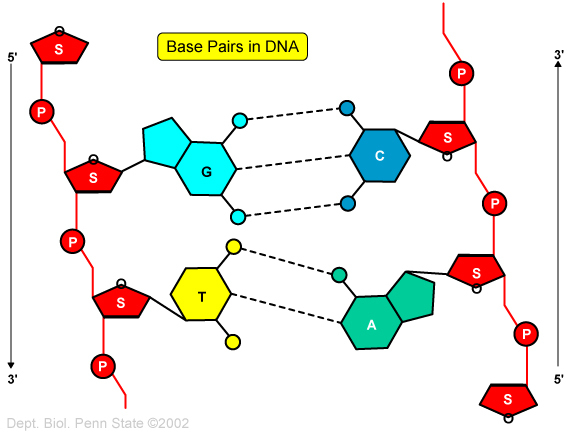
Nitrogenous bases are joined by which type of bond?
a)
polar bonds
b)
ionic bonds
c)
covalent bonds
d)
hydrogen bonds
4.
Which 2 molecules form the sides (backbone) of the DNA ladder?
a)
deoxyribose sugar and adenine
b)
deoxyribose sugar and a hydrogen bond
c)
deoxyribose sugar and the nucleus
d)
deoxyribose sugar and phosphate
5.
Which of the following units are repeatedly joined together to form a strand of DNA?
a)
amino acids
b)
nucleotides
c)
fatty acids
d)
polysaccharides
6.
What is the correct complementary strand for the following DNA?ATCGAG
a)
TACGAG
b)
ATCGAG
c)
TAGCTG
d)
TAGCTC
7.
The two strands of DNA run in opposite directions. They are said to be:
a)
Antiparallel
b)
Complementary
c)
Anti-directional
d)
Weird
8.
This team discovered that genes are made of DNA, not protein.
a)
Beadle & Tatum
b)
Hershey & Chase
c)
Watson & Crick
d)
Venter & Collins
9.
This scientist's X-ray photographs of DNA helped identify its helical structure.
a)
Rosalind Franklin
b)
Gregor Mendel
c)
Francis Crick
d)
Thomas Hunt Morgan
10.

Who was responsible for the model shown?
a)
Oswald Avery, et. al.
b)
Watson and Crick
c)
Erwin Chargaff
d)
Linus Pauling
11.
Scientist Griffith mixed dead, virulent, pneumonia-causing bacteria with living, harm-less bacteria. The harmless bacteria than infected mice with pneumonia. This experiment showed the process of....
a)
replication
b)
transcription
c)
transformation
d)
virulination
12.
Scientist Griffith mixed dead, virulent, pneumonia-causing bacteria with living, harm-less bacteria. The harmless bacteria than infected mice with pneumonia. This experiment showed the process of....
a)
replication
b)
transcription
c)
transformation
d)
virulination
13.
The work of scientists including Griffin, Avery, Hershey & Chase and Franklin helped us to determine the __ are responsible for carrying genetic material.
a)
Amino Acids
b)
Proteins
c)
Nucleic Acids
d)
Carbohydrates
14.
The process of one bacteria changing its phenotype due to the uptake of DNA from a different bacteria is called
a)
replication
b)
transformation
c)
protein synthesis
d)
DNA polymerase
15.
The process of copying DNA prior to cell division is called
a)
replication
b)
transformation
c)
protein synthesis
d)
DNA polymerase
16.
DNA replication results in two DNA molecules
a)
each with two new strands
b)
each with two original strands
c)
one with two new strands and the other with two original strands
d)
each with one new strand and one original strand
17.

monomer of nucleic acid; consisting of a sugar, phosphate, and nitrogen base
a)
nucleotide
b)
guanine
c)
deoxyribose
d)
DNA
18.
Which of these is a function of DNA?
a)
Replicate Cells
b)
Provides Energy
c)
Store Genetic Information
d)
Maintain Homeostasis
19.

Who was responsible for the experiment depicted by the image/data table?
a)
Oswald Avery, et. al.
b)
Watson and Crick
c)
Erwin Chargaff
d)
Frederick Griffith
20.

Who was responsible for the experiment depicted by the image?
a)
Friedrich (Fritz) Miescher
b)
Hershey & Chase
c)
Frederick Griffith
d)
Oswald Avery, et. al.
21.
Hershey & Chase used radioactive _______ to label the DNA core of the bacteriophage.
a)
Phosphorus
b)
Nitrogen
c)
Carbon
d)
Sulfur
22.
When Hershey and Chase radioactively labeled the DNA of the bacteriophage, they found radioactive phosphorous _____.
a)
in the bacterial cells
b)
in the liquid medium
c)
Both A & B
23.
Hershey & Chase's experiments depending upon the presence of _______ distinguishes proteins from DNA.
a)
Carbon
b)
Nitrogen
c)
Sulfur
d)
Oxygen
24.
X-ray diffraction photographs by Wilkins and Franklin suggested that
a)
DNA and proteins have the same basic structure.
b)
DNA molecules are arranged as a tightly coiled helix.
c)
DNA and RNA are the same molecules.
d)
DNA is composed of either purines or pyrimidines, but not both.
25.
The amount of guanine in an organism always equals the amount of
a)
protein.
b)
thymine.
c)
adenine.
d)
cytosine.
26.
Adenine binds with _________molecules and cytosine with ___________molecules.
a)
guanine; thymine
b)
thymine; guanine
c)
cytosine; adenine
d)
None of them bind with anything
27.
The two areas on either end of the bacterial DNA molecule where the double helix separates are called _______________.
a)
bubbles.
b)
helixes.
c)
replication forks.
d)
chromosomes.
28.
The enzyme that puts the fragments of DNA created on the lagging strand together is called
a)
DNA polymerase
b)
RNA primase
c)
ligase
d)
helicase
29.
Chargaff observed that:
a)
the amount of adenine in an organism always equaled the amount of guanine.
b)
the amount of adenine in an organism always equaled the amount of thymine.
c)
the amount of adenine in an organism always equaled the amount of cytosine.
d)
the amount of stars in the sky was relative to his mood.
30.
DNA nucleotides contain the five-carbon sugar
a)
ribose.
b)
deoxyribose.
c)
phosphate.
d)
nitrogenous base.
31.
This is a DNA strand. Which is the mRNA strand that would be made through transcription?
TACGAA
TACGAA
a)
AUGCUU
b)
ATGCTT
c)
GCATCC
d)
GCAUCC
32.
Where does transcription take place?
a)
in the nucleus
b)
outside the nucleus in the cytoplasm
c)
on a ribosome
33.
Where does replication take place?
a)
inside the nucleus
b)
outside the nucleus in the cytoplasm
c)
on a ribosome
34.
_______ is made during transcription and ________ is made during translation.
a)
mRNA / a protein
b)
a protein / mRNA
c)
Ribosome / Nucleus
d)
mRNA / tRNA
35.
What type of bonds are forming during translation?
a)
Peptide bonds
b)
Hydrogen bonds
c)
Acid bonds
36.
How many amino acids are coded for by this sequence of nucleotides:
ATG GGA ACT CCA
ATG GGA ACT CCA
a)
4
b)
2
c)
6
d)
12
37.

Which process does this picture show?
a)
Transcription
b)
Translation
c)
Replication
38.
The job of tRNA is to
a)
carry amino acids to the ribisomes
b)
carry ribisomes to the ER
c)
carry glucose to mitochondria
d)
carry mRNA out of the nucleus
39.
One difference between DNA and RNA is that....
a)
Only RNA has the base Uracil
b)
only RNA contains the base Thymine
c)
only RNA contains the base Cytocine
d)
only RNA contained the base Guanine
40.
In comparison to a DNA strand, a
a)
mRNA strand is shorter and single stranded
b)
mRNA strand is longer and single stranded
c)
mRNA strand is shorter and double stranded
d)
mRNA strand is longer and double stranded
41.

What process is being shown here?
a)
Replication
b)
Translation
c)
Transcription
42.

What amino acid is represented by the codon UUA?
a)
Phenylalanine
b)
Tyrosine
c)
Leucine
d)
Stop codon
43.

What amino acid is represented by the codon CAG?
a)
Aspartic Acid
b)
Histidine
c)
Glutamine
d)
Methionine
44.
Which is the mRNA molecule that would be transcribed from this DNA template:
TGGCAAGTACGT
TGGCAAGTACGT
a)
ACCGTTCATGCA
b)
UGGCAAGUACGU
c)
UCCGUUCUUGCU
d)
ACCGUUCAUGCA
45.

What is the correct amino acid sequence for the mRNA code AUGCCAGUAUGA
a)
Met-Pro-Ala-Val
b)
Met-Pro-Val
c)
Tyr-Gly-His
d)
Tyr-Gly-Arg-His
46.
In DNA replication, which enzyme is responsible for creating the replication fork by breaking hydrogen bonds?
a)
helicase
b)
RNA polymerase
c)
ligase
d)
DNA polymerase
47.
Okazaki fragments are a result of _________.
a)
Semiconservative replication
b)
Discontinuous replication
c)
DNA Polymerase
d)
Single Stranded Binding Proteins
48.
The _________ contains __________.
a)
Leading Strand / Okazaki Fragments
b)
Lagging Strand / Okazaki Fragments
c)
Leading Strand / Topoisomerase
d)
Lagging Strand / dispersive replication
49.
Nucleotide pairing is always
a)
purine and purine
b)
pyrimidine and pyrimidine
c)
purine and pyrimidine
d)
none of the above-pairing is random
50.
Enzyme that unwinds the DNA
a)
ligase
b)
DNA Polymerase
c)
primase
d)
helicase
51.
Seals the Okazaki fragments together
a)
DNA Polymerase
b)
ligase
c)
helicase
d)
primase
52.

The table shows the results of measuring the percentages of the four bases in the DNA of several different organisms. Some of the values are missing from the table. Based on Chargaff’s rule, the percentages of guanine bases in chicken DNA should be approximately what?
a)
28.8%
b)
19.9%
c)
21.5%
d)
13.4%
53.

In the drawing, what chemical is adding base pairs to the strand?
a)
DNA polymerase
b)
nucleosomes
c)
histonase
d)
chromatinase
54.
Which is larger guanine or cytosine
a)
guanine because it's a purine
b)
guanine because it's a pyrimidine
c)
cytosine because it's a purine
d)
cytosine because its a pyrimidine
55.
what makes up the handrails of a DNA ladder
a)
the nitrogen bases
b)
the nucleotides
c)
phosphate and sugar
d)
only sugar
56.
Who took a picture of DNA that helped determine it's shape?
a)
Watson
b)
Crick
c)
Franklin
d)
Chargaff
57.
Which of the following is not part of a nucleotide?
a)
deoxyribose sugar
b)
lipid
c)
phosphate
d)
nitrogen base
58.
If a DNA molecule is 18% Guanine which of the following is correct
a)
18% cytosine, 32% adenine, 32% thymine
b)
32% cytosine, 18% adenine, 32% thymine
c)
18% cytosine, 64% adenine, 64% thymine
d)
32% cytosine, 32% adenine, 18% thymine
59.

Base 1 (you have to ask yourself a couple of logical questions here...don't guess or memorize because the problem you will see might be different) is
a)
A
b)
G
c)
C
d)
T
60.
Base 2 (you have to ask yourself a couple of logical questions here...don't guess or memorize because the problem you will see might be different) is
a)
A
b)
G
c)
C
d)
T
61.
Base 3 (you have to ask yourself a couple of logical questions here...don't guess or memorize because the problem you will see might be different) is
a)
A
b)
G
c)
C
d)
T
62.
Base 4 (you have to ask yourself a couple of logical questions here...don't guess or memorize because the problem you will see might be different) is
a)
A
b)
G
c)
C
d)
T
100 %

