
 Worksheets
Q-3 Mini 1 Test Review-MJ
Total questions: 46
Worksheet time: 1hrs 5mins
Name
Class
Date
1.
This particle is found in the nucleus and has no charge
a)
Neutron
b)
Proton
c)
Electron
2.
This particle is found in the nucleus and has a positive charge
a)
Electron
b)
Proton
c)
Neutron
3.
This contains most of the mass of an atom
a)
Electron Cloud
b)
Nucleus
c)
Electron
4.
This is the simplest of all atoms and contains only one proton and one electron
a)
Oxygen
b)
Hydrogen
c)
Water
5.

What scientist is best known for his "Plum Pudding" model of the atom?
a)
J.J. Tomson
b)
Ernest Rutherford
c)
John Dalton
d)
Democritus
6.

What contribution did John Dalton make to atomic theory?
a)
He discovered that every atom was positively charged.
b)
He discovered that every element consisted of one type of atom.
c)
He discovered that atoms have a nucleus.
d)
He discovered that atoms could be divided into smaller parts.
7.

Place the following scientists in order, from earliest to latest:
A) Ernest Rutherford
B) J.J. Thomson
C) John Dalton
A) Ernest Rutherford
B) J.J. Thomson
C) John Dalton
a)
B,C,A
b)
C,A,B
c)
A,C,B
d)
C,B,A
8.

J.J. Thomson provided evidence that an atom...
a)
is the smallest particle of matter
b)
contains negatively charged particles
c)
has an overall negative charge
d)
has an overall positive charge
9.
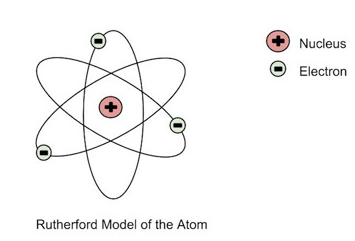
Rutherford's gold foil experiment provided evidence that...
a)
negative and positive charges are spread evenly throughout the atom.
b)
alpha particles have a positive charge.
c)
gold is not a dense as previously thought.
d)
there is a dense positively charged nucleus at the center of an atom.
10.
An atom's overall charge is ________.
a)
positive
b)
depends
c)
neutral
d)
negative
11.
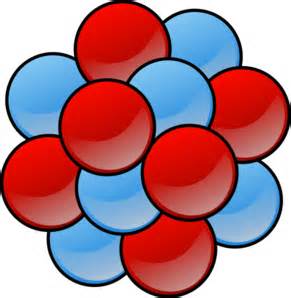
What does the nucleus of an atom contain?
a)
Electrons and neutrons
b)
Protons and neutrons
c)
Neutrinos and positrons
d)
DNA and RN
12.

Who came up with this model of an atom?
a)
J.J. Thompson
b)
Ernest Rutherford
c)
Neils Bohr
d)
James Chadwick
13.
True or False: The majority of an atom is made up of empty space
a)
True
b)
False
14.
Contributes basically no mass to an atom.
a)
protons
b)
neutrons
c)
electrons
d)
protons and neutrons
15.
Neon has an atomic number of 10 and an atomic mass of 20.180. How many protons, electrons, and neutrons will it have?
a)
P=10 E=10 N=11
b)
P=5 E=5 N=10
c)
P=10 E=10 N=10
d)
P=10 E=5 N=5
16.
The atomic number for Oxygen is 8, so
a)
there are 8 protons in the atom
b)
the atomic mass is less than 8
c)
the mass of the atom is 8
d)
the atom is decaying
17.

What element is pictured?
a)
Hydorgen
b)
Boron
c)
Beryllium
d)
Arsenic
18.
The word "atom" comes from a Greek word that means
a)
Invisible
b)
Indivisible
c)
Undivided
19.
What are the two types of charge in an atom?
a)
Positive and Negative
b)
Neutral and Negative
c)
Positive and Neutral
20.
The first person to ever talk about an atom was
a)
Democritus
b)
Rutherford
c)
Dalton
21.

How many protons does the following element have?
a)
11
b)
23
c)
12
22.

How many electrons does the following element have?
a)
11
b)
12
c)
23
23.
The atomic number tells you what?
a)
number of electrons
b)
number of protons
c)
number of neutrons
d)
both electrons and protons in an atom.
24.
Which group of the periodic table is composed of inert (not reactive) gases?
a)
alkali metals
b)
alkaline earth metals
c)
halogens
d)
noble gases
25.
Elements which are shiny, conduct electricity and heat are called
a)
metal
b)
nonmetal
c)
metalloid
d)
nonexistent
26.
Which element is not a metal?
a)
Mg
b)
Re
c)
Al
d)
B
27.

The atoms along the staircase are called
a)
metals
b)
nonmetals
c)
metalloids
d)
noble gases
28.
Why is water NOT on the periodic table?
a)
It is naturally occuring
b)
It is a compound, not an element
c)
It exists as a solid, a liquid, and a gas
d)
Its chemical formula doesn't fit
29.
_______ are the ROWS on the periodic table.
a)
Families
b)
Groups
c)
Periods
d)
Elements
30.
Atoms with similar properties are most likely located...
a)
in the same period.
b)
in the same group.
c)
in different periods.
d)
to the right and left of each other.
31.
What is the element symbol for boron?
a)
B
b)
Bo
c)
Bn
d)
W
32.
Good conductor of heat
a)
Metal
b)
Nonmetal
33.
Which of the following is not a property of metals?
a)
brittle
b)
malleable
c)
shiny
d)
conduct heat and electricity
34.

The blue atoms are called
a)
metals
b)
nonmetals
c)
metalloids
d)
noble gases
35.
Elements which are considered semiconductors are
a)
metal
b)
nonmetal
c)
metalloid
d)
nonexistent
36.
Calcium is most like which of the following?
a)
Barium
b)
Potassium
c)
Cesium
d)
Nitrogen
37.

What section is the least reactive?
a)
yellow
b)
red
c)
dark blue
d)
orange
38.
The family in the periodic table that contains the most reactive metals is the_______
a)
Alkaline Earth Metals
b)
Transition Metals
c)
Alkali Metals
d)
Other Metals
39.

Which of these is the electron?
a)
A
b)
B
c)
C
d)
D
40.

B and C are found in the ______ of an atom.
a)
Energy levels
b)
Space
c)
Nucleus
d)
Outside
41.

Mr Negative here is better known as? His charge is negative.
a)
Protron
b)
Neutron
c)
Electron
d)
Neceus
42.

Mr Green here is neutral and is better known as a_________.
a)
Proton
b)
Neutron
c)
Electron
d)
Pea
43.

Which number here is my atomic number?
a)
5
b)
10.811
44.

In order for me to find the number of neutrons, I must round the atomic mass and then do what?
a)
atomic number-atomic mass
b)
atomic number x atomic mass
c)
atomic mass + atomic number
d)
atomic mass - atomic number
45.

Which of these is the proton.
a)
A
b)
B
c)
C
d)
None
46.

Label the following:
grey=
blue=
yellow=
grey=
blue=
yellow=
a)
Gas, Solid, Liquid
b)
Metal, Metalloid, Nonmetal
c)
Metal, Nonmetal, Metalloid
100 %

