
NEW
Font size
S
M
L
XL
 Worksheets
Classification, Bacteria, and Kingdoms Review
Total questions: 53
Worksheet time: 36mins
Name
Class
Date
1.
Which of the following organisms are LEAST closely related?
a)
organisms that share a domain
b)
organisms that share a family
c)
organisms that share a genus
d)
organisms that share a species
2.
The scientific name for an organism is made from the:
a)
class and family name
b)
genus and species name
c)
domain and kingdom name
d)
kingdom and phylum name
3.
Which kingdom contains members who are prokaryotic?
a)
Archaebacteria and Eubacteria
b)
Archaebacteria and Protista
c)
Eubacteria and Animalia
d)
Eubacteria and Fungi
4.
Members of this kingdom live in unusual conditions such as deep ocean trenches or volcanoes
a)
Eubacteria
b)
Protista
c)
Fungi
d)
Archaebacteria
5.
Molds, yeast, and mushroom belong to kingdom:
a)
Eubacteria
b)
Archaebacteria
c)
Protista
d)
Fungi
6.
Tool used by a taxonomist to identify an unknown organism is a:
a)
dichotomous key
b)
binomial nomenclature
c)
scientific name
d)
binomial key
7.

The 8 levels of classification, most broad to most specific.
a)
Domain, Genus, Family, Order, Class, Phylum, Kingdom, Species
b)
Domain, Species, Kingdom, Genus, Phylum, Family, Class, Order
c)
Domain, Kingdom, Phylum, Class, Order, Family, Genus, Species
d)
Order, Kingdom, Species, Domain, Phylum, Family, Class, Genus
8.
Members of this kingdom are multicellular and heterotrophic
a)
Plantae
b)
Protista
c)
Animalia
d)
Achaebacteria
9.
Term given to describe the 2 name naming system is:
a)
dichotmous key
b)
binomial nomenclature
c)
2 scientific names
d)
binomial key
10.
Who first proposed binomial nomenclature as a way of classifying organisms?
a)
Carl Linnaeus
b)
Gregory Mendel
c)
Charles Darwin
d)
Henry Groseclose
11.
Cells that do not have a true nucleus are called....
a)
eukaryote
b)
prokaryote
c)
unicellular
d)
multicellular
12.
Cells that have a true nucleus are called....
a)
eukaryotes
b)
prokaryotes
c)
unicellular
d)
multicellular
13.

An illustration and a dichotomous key are given. What is the correct classification for this organism?
a)
Class Insecta
b)
Order Amblygygi
c)
Order Araneae
d)
Order Scorpiones
14.

Which is the most specific classification level?
a)
Domain
b)
Kingdom
c)
Genus
d)
Species
15.
Which level of classification (taxon) comes after kingdom?
a)
order
b)
family
c)
phylum
d)
species
16.
The science of classifying organisms is ...
a)
biology
b)
ecology
c)
cladistics
d)
taxonomy
17.
A new species of animal is discovered and must be classified. Which would be the most important thing to study to determine its classification?
a)
what it eats
b)
where it lives
c)
how old it is
d)
its skeletal structure
18.
A branching diagram that represents the proposed evolutionary history of a species or group.
a)
Cladogram
b)
Taxon/Taxa
c)
Classificaiton
d)
Node
19.

What kingdom is mostly multicellular and makes its own food?
a)
plant
b)
animal
c)
fungi
d)
bacteria
20.

What kingdom is mostly unicellular and has the most diversity?
a)
animal
b)
fungi
c)
protist
d)
bacteria
21.

What kingdom is mostly made of decomposers?
a)
plant
b)
animal
c)
fungi
d)
protist
22.
Why do scientists classify organisms?
a)
It helps identify relationships between organisms.
b)
It requires them to clearly identify key characteristics of each organism.
c)
It avoids confusion.
d)
All of the choices are correct.
23.
Small organisms that can be both autotrophic or heterotrophic. May be multicellular or single celled.
a)
protists
b)
plants
c)
animals
d)
fungi
24.
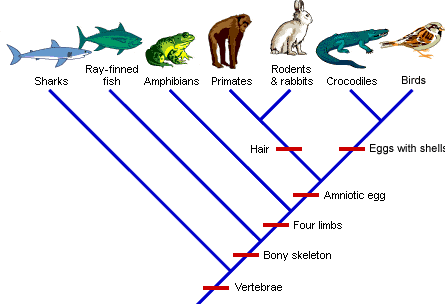
According to this cladogram, sharks are MOST closely related to which organism?
a)
Amphibians
b)
Ray finned fish
c)
Crocodiles
d)
Birds
25.
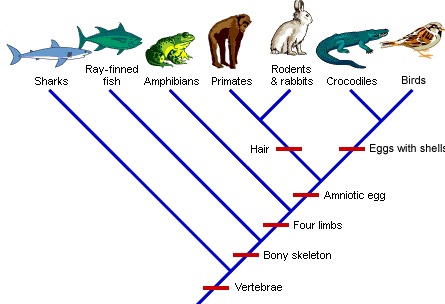
Which two orgainsms have hair?
a)
Sharks & Ray Finned Fish
b)
Primates & Rodents
c)
Birds & Crocodiles
d)
Rabbits & Birds
26.
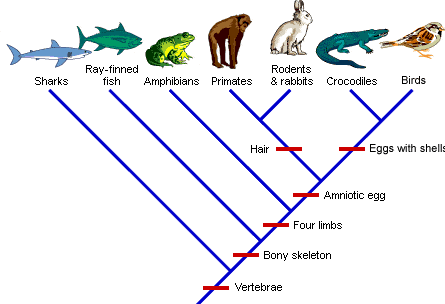
According to this cladogram, birds are LEAST related to:
a)
Amphibians
b)
Sharks
c)
Ray Finned Fish
d)
Crocodiles
27.
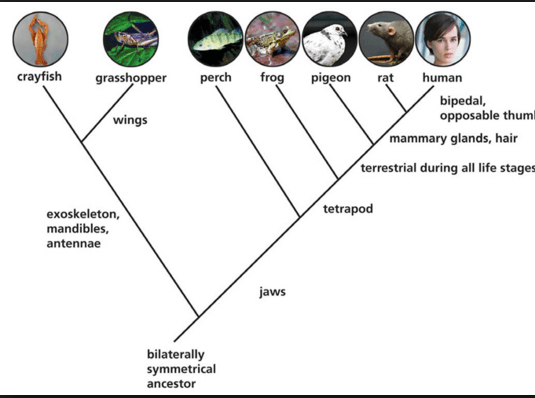
According to the cladogram, which organism is most distantly related to the human?
a)
crayfish
b)
grasshopper
c)
perch
d)
frog
28.
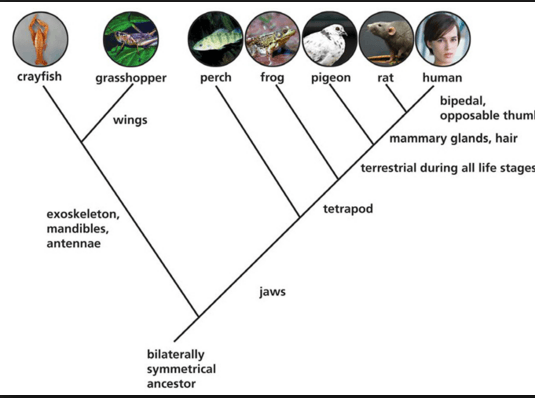
Which trait do only humans have, according to the cladogram?
a)
jaws
b)
mammary glands & hair
c)
terrestrial during all life stages
d)
bipedal & opposable thumbs
29.
You look at two species and see very similar DNA. What does this likely tell you?
a)
These are the same animal.
b)
These animals have a common ancestor.
c)
These animals are not likely related.
d)
These animals are likely becoming one species.
30.
An inherited characteristic that increases an organisms ability to survive and reproduce in its specific environment is called a(n)
a)
vestigial structure
b)
speciation
c)
analogous structure
d)
adaptation
31.
Cladograms are constructed by grouping organisms together based on their____________ characteristics.
a)
shared
b)
different
c)
similar
d)
opposite
32.

What genus does Bird X belong to?
a)
Certhidea
b)
Geospiza
c)
Camarhynchus
d)
Platyspiza
33.
A virus needs a host cell in order to
a)
obtain nutrients
b)
make oxygen
c)
replicate
d)
grow
34.

Name this bacteria shape
a)
coccus
b)
spirillum
c)
bacillus
35.

Name this bacteria shape
a)
bacillus
b)
coccus
c)
spirillum
36.

Name this bacteria shape
a)
coccus
b)
bacillus
c)
spirillum
37.
Bacteria that help break down dead material in the environment are called
a)
vaccines
b)
decomposers
c)
oats
38.
A disease causing organism
a)
pathogen
b)
poison
c)
vaccine
39.
The name of a bacteria can be described by its shape
a)
False
b)
True
40.
All bacteria are
a)
unicellular
b)
multicellular
c)
eukaryotic
41.
Bacteria help you digest food.
a)
True
b)
False
42.
All bacteria are harmful to humans
a)
True
b)
False
43.
Antibiotics kill viruses
a)
True
b)
False
44.
When a virus invades a living cell, its _______
takes over the cell's functions.
takes over the cell's functions.
a)
outer coat
b)
genetic material
c)
core
d)
cytoplasm
45.
What part of a virus is the protein capsule that houses the genetic material (DNA/RNA)?
a)
tail
b)
nucleus
c)
capsid
d)
glycoprotein
46.
Which viral life cycle allows viral genetic material to lay dormant while the host cell reproduces?
a)
lytic
b)
mitosis
c)
lysogenic
d)
S phase
47.
What do viruses need to reproduce?
a)
they need genetic material
b)
They need a host cell
c)
They need bacteria
d)
They need insulin
48.
What happens in the lytic cyle?
a)
Virus goes in and leaves the host cell
b)
Virus quickly kills the host cell
c)
Virus sleeps inside of the host cell
d)
Virus stay dormant for a long time
49.

How does this protist move?
a)
Pseudopods
b)
Cilia
c)
Flagellum
50.

How does this protist move?
a)
Flagellum
b)
Cilia
c)
Pseudopods
51.

A protist that cannot make its own food is called what?
a)
Autotroph
b)
Heterotroph
52.

Fine hairs that allow protist to move is called what?
a)
Pseudopods
b)
Euglena
c)
Flagella
d)
Cilia
53.
What type of cells are protists?
a)
Prokaryotic
b)
Eukaryoitc
Reset

