
 Worksheets
Genetics
Total questions: 90
Worksheet time: 3hrs 51mins
Name
Class
Date
1.
What does heterozygous mean?
a)
An organism that has the same genes for a trait (TT or tt)
b)
An organism that has different genes for a trait (Tt)
c)
When neither gene is fully dominant; offspring is a mixture of both
d)
the different forms of a trait (hair color--> brown, blonde, red
2.
If a heterozygous tall pea plant is crossed with a short pea plant, what are the possible genotypes of the future offspring?
a)
100% Tt
b)
50% Tt, 50% tt
c)
75%Tt, 25%tt
d)
25%TT, 50%Tt, 25%tt
3.

This is an example of what?
a)
Complete dominance
b)
Incomplete dominance
c)
Codominance
d)
None of the above
4.

Two brown eyed parents (Bb) have a baby. What is the chance the baby is blue eyed?
a)
0 %
b)
25%
c)
50%
d)
75%
5.

Which process and type of resulting cells are represented?
a)
mitosis, gametes
b)
mitosis, body cells
c)
meiosis, gametes
d)
meiosis, body cells
6.
Which of the following cell types is formed by meiosis?
a)
muscle cells
b)
skin cells
c)
sperm cells
d)
blood cells
7.

Which best describes the process shown?
a)
mutation in which the DNA content of the gene is ltered
b)
segregation of sister chromatids
c)
condensation and segregation of the alleles
d)
crossing-over which alleles are exchanged
8.
What is one advantage of sexual reproduction?
a)
offspring are identical to parents
b)
offspring are resistant to viruses
c)
offspring are born live, rather thna from eggs
d)
offspring inherit a wider variety of genetic information
9.

The sex of an offspring is determined by ______________________.
a)
the mother
b)
the father
c)
the mother and the father
d)
by the environment
10.

Red/green color blindness is a recessive trait. A woman who is a carrier for this allele marries a normal-vision male. What is the probability that they will have a child who is color blind?
a)
1/4
b)
1/2
c)
3/4
d)
1
11.
What is a phenotype?
a)
The expression of a trait; what you see.
b)
refers to the genetic makeup of an individual
c)
An organism that has the same genes for a trait (ex. TT or tt)
d)
the passing of traits from parent to offspring
12.
The inherited combination of alleles is known as the offspring's
a)
heredity
b)
phenotype
c)
genotype
d)
redigree
13.
True/False: Different genotypes can code for the same phenotype.
a)
True
b)
False
14.
What does a Punnett Square help you do?
a)
Determine the ratio of phenotypes
b)
Determine the ratio of genotypes
c)
Predict possible traits the offspring will have
d)
All of the above
15.
Another word for homozygous is...
a)
purebred
b)
hybrid
c)
heterozygous
d)
dominant
16.
A woman with blood genotype I(A)i marries a man with blood genotype I(B)i. What is the probability that they would have a child with type O blood?
a)
1/1
b)
1/2
c)
1/3
d)
1/4
17.
A person with type O blood marries a person with type AB blood. Possible blood genotypes of their children are
a)
I(A)i and I(B)I(B)
b)
I(B)I(B) and I(A)I(A)
c)
I(A)i and I(B)i
d)
I(A)I(B) and ii
18.
In screech owls, red feathers are dominant over gray feathers. If two heterozygous red-feathered owls are mated, what percentage of their offspring would be expected to have red feathers?
a)
25%
b)
50%
c)
75%
d)
100%
19.

In a pedigree, what shape represents a male?
a)
circle
b)
square
c)
triangle
d)
diamond
20.
What gender has an X and a Y chromosome?
a)
male
b)
female
c)
transgender
d)
all of the above
21.
Which of the following genotypes is homozygous dominant?
a)
A
b)
Aa
c)
AA
d)
aa
22.
Which of the following genotypes is heterozygous?
a)
Bb
b)
BB
c)
bb
d)
B
23.

T - tall and t = short
In the punnett square below, what belongs in the missing square
In the punnett square below, what belongs in the missing square
a)
tt
b)
Tt
c)
Bb
d)
TT
24.

He is known as the father of modern day genetics.
a)
Gregory Mendel
b)
Greg Mendel
c)
Gregor Mendel
d)
Grace Mendel
25.
What characteristic would a child not inherit from parents?
a)
freckles
b)
eye color
c)
hair style
d)
dimples
26.
A single piece of coiled DNA found in the cells; contains genes that encode traits.
a)
gene
b)
chromosome
c)
trait
d)
DNA
27.
An allele whose trait always shows up in the organism when the allele is present.
a)
recessive allele
b)
dominant allele
c)
hidden allele
d)
present allele
28.
the passing of genetic traits from parent to offspring.
a)
heredity
b)
trait
c)
gene
d)
allele
29.
An allele whose trait only shows up when no dominant allele is present.
a)
hidden allele
b)
dominant allele
c)
recessive allele
d)
present allele
30.
A human usually has _____ total chromosomes.
a)
6
b)
22
c)
4
d)
46
31.
The nitrogen base adenine is always paired with the nitrogen base ____________.
a)
cytosine
b)
guanine
c)
thymine
d)
nitrogen
32.
The nitrogen base guanine is always paired up with the nitrogen base ________________.
a)
thymine
b)
guanine
c)
cytosine
d)
adenine
33.

Colorblindness is a recessive, X chromosome sex-link disorder. Cross the parents to figure out which percentage of their offspring will be colorblind.
a)
25%
b)
0%
c)
75%
d)
50%
34.

Two heterozygous parents produce offspring. What is the probability of the HETEROZYGOUS GENOTYPE appearing in the offspring generation?
a)
75%
b)
25%
c)
50%
d)
100%
35.
What is another way of saying "purebred"?
a)
homozygous
b)
dominant
c)
recessive
d)
heterozygous
36.
Which of the following is NOT a nitrogen base in DNA?
a)
adenine
b)
cytosine
c)
guanine
d)
uracil
37.
The gene for cystic fibrosis is a recessive trait. this disorder causes the body to secrete large amounts of mucus that can damage the body. If 1 out of 20 people is a carrier of this disorder, why are only 1 of 1,600 babies born with cystic fibrosis?
a)
the offspring inherit mutations randomly
b)
The dominant trait will most likely express itself.
c)
In order for a recessive gene to be expressed both alleles must be recessive
d)
Law of independent assortment is in effect
38.
each pair of alleles segregates independently during the formation of the egg or sperm
a)
Principle of segregation
b)
Principle of independent assortment
c)
Law of recessiveness
d)
Law of dominance
39.

Color blindness is a sex-linked recessive trait (c) carried on the X chromosome. Using the pedigree with the key provided, what is the genotype of person II-4?
a)
XCXc
b)
XCXC or XCXc
c)
XcXc
d)
Not enough information to determine
40.
Color blindness is a recessive trait that is sex-linked. A female child is born color blind. Assuming there were no mutations, what are the likely genotypes of her father and mother?
a)
XcY, XCXc
b)
XCY, XCXc
c)
XCY, XcXc
d)
XcY, XCXC
41.
Segment of DNA on a chromosome that contains instructions for protein synthesis and controls a particular inherited trait
a)
Gene
b)
Pedigree
c)
Punnett Square
d)
Dominant
42.
A chart or “family tree” that tracks which members of a family have a particular trait
a)
Gene
b)
Pedigree
c)
Punnett Square
d)
Dominant
43.
Any permanent change in a gene or chromosome of a cell; may be beneficial, harmful, or have little effect on an organism
a)
Homozygous
b)
Selective Breeding
c)
Mutation
d)
Carrier
44.
Process by which humans cross organisms to produce offspring with certain desirable traits
a)
Homozygous
b)
Selective Breeding
c)
Mutation
d)
Carrier
45.
A test in which amniotic fluid is drawn from the amniotic sac through the mother's abdomen. It can detect chromosomal abnormalities or chemical problems.
a)
Chorionic Villi Sampling
b)
Ultrasound
c)
Amniocentesis
d)
Pelvic exam
46.
Which of the following conditions results in mucus lining the lungs, liver, and digestive tract?
a)
cystic fibrosis
b)
sickle cell anemia
c)
Tay-Saachs
d)
Hunington's
47.
What part of the body does Tay-Sachs the disease affect?
a)
Brain
b)
Brain & Spinal Cord
c)
Spinal Cord
d)
Circulatory System
48.
How does a child get Tay-Sachs?
a)
Bacteria Infection
b)
Both mom & dad have to be carriers of the gene
c)
Unknown
d)
Mom has allergies
49.
Over the past few thousand years, humans have helped to bring about changes in many plant and animal species in order to make them more useful. Examples include strong workhorses, hunting dogs, large-eared corn, beautiful flower varieties using the process of
a)
Mitosis
b)
Natural selection
c)
Cloning
d)
Selective breeding
50.
For those individuals who have an allergic reaction to cats, a company in Los Angeles promises relief. They offer a new line of cats genetically modified to eliminate or reduce their allergy-causing properties. The development of this new line of cats most likely involved
a)
manipulating the DNA of cats
b)
changing the behavior of cats
c)
altering the reproductive rate of cats
d)
using natural selection to produce a new variety of cat
51.
In an individual with sickle-cell anemia, which cells are abnormally shaped?
a)
Bone cells
b)
Skin cells
c)
Red blood cells
d)
White blood cells
52.
A sudden change in the DNA of a chromosome can usually be passed on to future generations if the change occurs in a
a)
Brain cell
b)
Sex cell
c)
Liver cell
d)
Skin cell
53.
Which statement best describes chromosomal mutations?
a)
They only involve changes in the chromosome number
b)
They only involve changes in the chromosome structure
c)
They involve changes in the chromosome number or the chromosome structure
d)
They never involve changes in the chromosome number or the chromosome structure
54.
The failure of homologous chromosomes to separate from each other is known as
a)
crossing over
b)
disjunction
c)
nondisjunction
d)
synapsis
55.
A characteristic of mutations is that they usuallu
a)
are caused only by the events of mitosis
b)
do not occur at random
c)
result in a different genetic sequences
d)
occur to meet the needs of a species
56.
In certain plants, each cell contains double the normal chromosome number. These 4n cells are an example of the condition known as
a)
replication
b)
diploidy
c)
polyploidy
d)
disjunction
57.
Photograph of chromosomes grouped in ordered pairs
a)
pedigree
b)
Punnett Square
c)
Venn Diagram
d)
Karyotype
58.

Which genetic abnormality is shown in this karyotype?
a)
Partial Addition
b)
Partial Deletion
c)
Trisonomy 21
d)
Monosomy
59.
What mutation has occurred here?
T-G-A-C-C-A
T-G-A-G-C-A
T-G-A-C-C-A
T-G-A-G-C-A
a)
Substitution
b)
Deletion
c)
Insertion
d)
Frameshift
60.
DNA molecule segment is : TTACGCAAG
The mutated DNA segment is TTCGCAAG. This is an example of ___ mutation.
The mutated DNA segment is TTCGCAAG. This is an example of ___ mutation.
a)
Substitution
b)
Deletion
c)
Insertion
d)
Inversion
61.
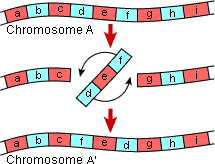
What type of chromosomal mutation is this?
a)
Translocation
b)
Inversion
c)
Deletion
d)
Duplication
62.

illustration shows.
a)
sickle cell
b)
hemophilia
c)
turner's
d)
tay-sachs.
63.
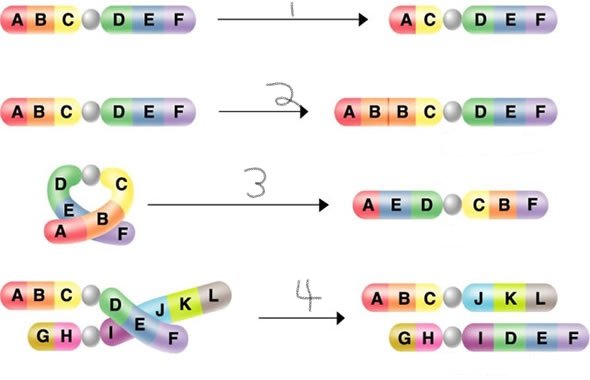
Which of these is the correct order for the chromosome mutations in the image (from top to bottom)?
a)
(1) duplication, (2) inversion, (3) substitution, (4) translocation
b)
(1) deletion, (2) duplication, (3) inversion, (4) translocation
c)
(1) deletion, (2) insertion, (3) translocation, (4) inversio
d)
(1) substitution, (2) duplication, (3) translocation, (4) inversion
64.
the creation of genetically identical organisms
a)
Bioremediation
b)
Cloning
c)
Gene Therapy
d)
Tissue Culturing
65.
Using biotechnology to change the genetic makeup of an organism is called
a)
Tissue Culturing
b)
Biotechnology
c)
Cloning
d)
Genetic Engineering
66.
Examples of environmental mutagens include:
a)
Chemicals
b)
Radiation
c)
Viruses
d)
All of these
67.
Bacteria containing DNA from a foreign donor
a)
plasmid
b)
restriction enzymes
c)
recombinant DNA
d)
transgenic bacteria
68.
molecular scissors that "cut' DNA
a)
plasmid
b)
restriction enzymes
c)
recombinant DNA
d)
gene
69.
simple ring of DNA from prokaryotes
a)
plasmid
b)
restriction enzymes
c)
recombinant DNA
d)
gene
70.
Any change or mistake in DNA replication can cause a ________
a)
cancer cell
b)
virus
c)
disease
d)
mutation
71.
A molecule containing DNA from two different organisms is called
a)
a plasmid.
b)
a polyploid.
c)
a hybrid organism.
d)
recombinant DNA.
72.
Genetic engineering has been used to produce
a)
medicines.
b)
food animals.
c)
improved crops.
d)
all of these.
73.
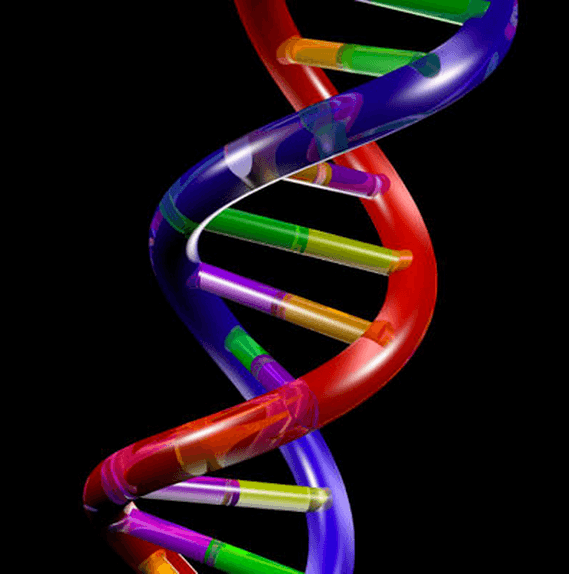
What determines the code, or information, of a DNA molecule?
a)
the shape (structure) of the nitrogen bases
b)
the order (sequence) of the nitrogen bases
c)
the color of the nitrogen bases
d)
the frequency (number) of nitrogen bases
74.
Which of the following best describes a DNA molecule?
a)
double helix
b)
contains ribose
c)
made of amino acids
d)
contains Uracil
75.

What amino acid is represented by the codon UUA?
a)
Phenylalanine
b)
Tyrosine
c)
Leucine
d)
Stop codon
76.
The process of using an mRNA to make a protein is called
a)
Replication
b)
Transcription
c)
Translation
d)
Cell Division
77.
Transcription takes place in the
a)
cytoplasm
b)
chloroplast
c)
nucleus
d)
mitochondria
78.
The process of making an mRNA strand from a DNA template is called
a)
Replication
b)
Transcription
c)
Translation
d)
Protein Synthesis
79.
ATTTGAGCC- Original
ATTGAGCC - Mutated
The example above is an example of a
ATTGAGCC - Mutated
The example above is an example of a
a)
Insertion- Frameshift
b)
Deletion- Substitution
c)
Deletion -Frameshift
d)
All of the above
80.
Diploid Cells are represented by
a)
2n
b)
n
c)
4n
d)
1/2 n
81.
The chromosomes that pair up during meiosis, are called __________ chromosomes.
a)
homozygous
b)
asexual
c)
homologous
d)
genes
82.
How many daughter cells are produced at the end of meiosis?
a)
1
b)
2
c)
3
d)
4
83.
If a cell has an abnormal number of chromosomes, usually from meiosis, what is this considered? Choose the best answer.
a)
Chromosome mutation
b)
Nondisjunction
c)
Sex-linked mutation
d)
Inversion
84.

When an area of a chromatid is exchanged with the matching area on a chromatid of its homologous chromosome, _________________ occurs
a)
crossing over
b)
mutagenesis
c)
hybridization
d)
fertilization
85.
What kind of cells are made in MEIOSIS?
a)
Haploid Gametes
b)
Diploid Somatic Cells
c)
Skin Cells
d)
Liver Cells
86.

Chromosomes are found in the ____________ of the cell
a)
Chloroplast
b)
Nucleus
c)
Cytoplasm
d)
Mitochondria
87.
__________________ is a tool for tracing through generations of family members.
a)
Pedigree
b)
Probability
c)
Purebred
d)
Punnett Square
88.
During Asexual Reproduction the offspring are__________?
a)
Formed by two parents
b)
Contain no genetic material from the father
c)
Are identical to their parent.
89.
Creating a new plant from an piece existing plant is known as
a)
Vegetative Propigation
b)
Budding
c)
Fission
d)
Sexual Reproduction
90.
The following reproduce sexually except-
a)
Dogs
b)
Horses
c)
People
d)
Bacteria
100 %

