
 Worksheets
Chapter 20 Bacteria/Virus
Total questions: 58
Worksheet time: 45mins
Name
Class
Date
1.
Bacteria are prokaryotes which means they
a)
have a nucleus on their capsule
b)
do not contain a nucleus
c)
can live in environments with and without oxygen
d)
contain membrane bound organelles
2.

Name this bacteria shape
a)
coccus
b)
spirillum
c)
bacillus
3.

Name this bacteria shape
a)
bacillus
b)
coccus
c)
spirillum
4.
The outer covering of a bacteria cell is called the
a)
flagella
b)
cytoplasm
c)
cell wall
5.
Bacteria that help break down dead material in the environment are called
a)
vaccines
b)
decomposers
c)
oats
6.
A disease causing organism
a)
pathogen
b)
poison
c)
vaccine
7.
Strep throat is caused by
a)
bacteria
b)
virus
8.
The flu is caused by
a)
bacteria
b)
virus
9.
Live bacteria are found in milk, cheese and yogurt
a)
True
b)
False
10.
The name of a bacteria can be described by its shape
a)
False
b)
True
11.
How do bacteria move?
a)
flagella
b)
cilia
c)
they don't
12.
If a bacterial shape is described as being "strepto" smart patients know the bacteria is growing in a
a)
clump
b)
cluster
c)
chain
13.
All bacteria are
a)
unicellular
b)
multicellular
c)
eukaryotic
14.

Bacteria help you digest food.
a)
True
b)
False
15.

All bacteria are harmful to humans
a)
True
b)
False
16.

Bacilli bacteria are what shape?
a)
spiral
b)
rod
c)
round
17.
Bacteria are smaller then viruses.
a)
True
b)
False
18.
Penicillin is called a/an ________________?
a)
antibody
b)
antibiotic
c)
vaccine
d)
enzyme
19.
Process by which bacteria reproduce asexually
a)
binary fission
b)
transduction
c)
transformation
20.
a cell with no nucleus is called
a)
virus
b)
prokaryote
c)
endospore
d)
bacillus
21.
A bacterium, virus, or protist that causes disease is called a ____.
a)
bioremediation
b)
antibiotic
c)
pathogen
d)
a retrovirus
22.
Which of the structures is NOT found in bacteria?
a)
ribosome
b)
cell membrane
c)
cytoplasm
d)
nuclear membrane
23.
A bacterial infection may be treated with antibiotics, but a virus cannot
a)
True
b)
False
24.
Which disease is not caused by bacteria?
a)
Strep throat
b)
Pneumonia
c)
Food poisoning
d)
Influenza (the Flu)
25.
A ___ is made by using pieces of deactivated viruses or dead pathogens.
a)
Flagella
b)
Vaccine
c)
Spore
d)
Antibodies
26.
Which part of a bacteria cell wall "holds" the stain?
a)
plasma membrane
b)
fimbriae
c)
peptidoglycan
d)
pilus
27.
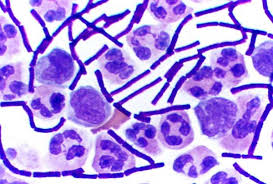
These bacteria are
a)
gram positive
b)
gram negative
c)
nonliving
d)
viral
28.
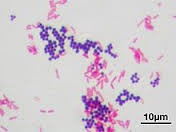
These bacteria are
a)
nonliving
b)
gram positive
c)
gram negative
d)
gram positive and gram negative
29.
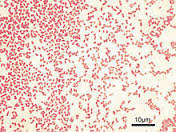
These bacteria are
a)
gram positive and negative
b)
gram positive
c)
gram negative
d)
viral
30.

?
a)
streptococcus
b)
staphlococcus
c)
diplococcus
d)
none of these
31.

?
a)
streptococcus
b)
staphlococcus
c)
diplococcus
d)
none of these
32.

?
a)
streptococcus
b)
staphlococcus
c)
diplococcus
d)
none of these are correct
33.
Which is applied first in gram staining?
a)
alcohol
b)
grams iodine
c)
crystal violet
d)
safranin
34.
Which is applied last in gram staining?
a)
alcohol
b)
crystal violet
c)
safranin
d)
grams iodine
35.

What part of the phage is the DNA?
a)
A
b)
B
c)
C
d)
D
36.
How does a virus cause a person to develop the common cold?
a)
invades the host cell to reproduce
b)
removes energy from the host cell
c)
produces toxins in the host cell
d)
protects the host cell from bacteria
37.

A(n) _____ is a virus that enters a bacterial cell.
a)
endospore
b)
decomposer
c)
plasmid
d)
bacteriophage
38.
When a virus invades a living cell, its _______
takes over the cell's functions.
takes over the cell's functions.
a)
outer coat
b)
genetic material
c)
core
d)
cytoplasm
39.
What part of a virus is the protein capsule that houses the genetic material (DNA/RNA)?
a)
tail
b)
nucleus
c)
capsid
d)
glycoprotein
40.
What do viruses need to reproduce?
a)
they need genetic material
b)
They need a host cell
c)
They need bacteria
d)
They need insulin
41.
What happens in the lysogenic cycle?
a)
Virus goes in and leaves the host cell
b)
Virus quickly kills the host cell
c)
Virus inject the nucleic acid into the host cell, and the nucleic acid integrates into the host cell DNA, and stay dormant for a long time
d)
Bacteria injects DNA into a host cell
42.
What happens in the lytic cyle?
a)
Virus goes in and leaves the host cell
b)
Virus quickly kills the host cell
c)
Virus sleeps inside of the host cell
d)
Virus stay dormant for a long time
43.
What helps prevent viral diseases?
a)
Vaccines
b)
Antibiotics
c)
Herbal tea
d)
Gene Therapy
44.
What is the 1st step of virus infection?
a)
Entry
b)
Attachment
c)
Replication
d)
Assembly
45.
Viruses are made up of
a)
Nucleus, membrane
b)
Capsid, nucleus
c)
Capsid, nucleic acid
d)
Mitochondria, nucleus
46.

What is the main function of the projections on the surface of a virus?
a)
They aid in respiration
b)
They help the virus grow
c)
They help the virus invade its host by attaching to specific sites on the host
d)
They help the virus digest food molecules
47.
Viruses are...
a)
prokaryotic
b)
eukaryotic
c)
non-living
d)
endospores
48.
Which can be treated with antibiotics?
a)
Virus
b)
Bacteria
c)
Mutagen
d)
Parasite
49.
Reasons that viruses are considered to be nonliving is because
a)
They are not cellular
b)
They cannot reproduce on their own
c)
They cannot make proteins
d)
all of the above
50.
The HIV virus, which contain RNA instead of DNA, is classified as a retrovirus. Which of the following BEST describes how retroviruses work?
a)
They prevent the host from creating RNA during protein synthesis.
b)
Their genetic material is copied backwards from RNA to DNA.
c)
They only infect cells in the tissues of the lungs.
d)
Their genetic material is copied normally from DNA to RNA.
51.
nonliving particle that can reproduce within a living cell
a)
endospore
b)
virus
c)
vacuole
d)
nucleus
52.
enzyme injected into host cell which copies viral RNA into DNA
a)
polymerase
b)
lactase
c)
helicase
d)
reverse transcriptase
53.
Virus is latin for
a)
disease
b)
illness
c)
bacteria
d)
poison
54.

Which type of cell?
a)
Prokaryote
b)
Eukaryote
c)
Virus
d)
Plasmid
55.
How does the DNA of a bacteriophage enter a host cell?
a)
injection
b)
endocytosis
c)
conjugation
d)
binary fission
56.
The outside of a virus is called a capsid and is made up of
a)
cytoplasm
b)
protein
c)
carbohydrates
d)
lipids
57.
What do viruses and bacteria have in common?
a)
ribosomes
b)
cell wall
c)
plasma membrane
d)
genetic material
58.
Which type of cell contains all organisms that have a nucleus?
a)
Virus
b)
Prokaryotes
c)
Eukaryotes
d)
Protista
100 %

