
 Worksheets
Cells and Heredity
Total questions: 55
Worksheet time: 37mins
Name
Class
Date
1.
What is photosynthesis?
a)
The process in which humans eat their food
b)
When a photographer takes a photo.
c)
To get your pictures from the photo lab.
d)
The process in which plants make their food.
2.
Which statement about photosynthesis is correct?
a)
Plants get the energy they need for photosynthesis from water.
b)
Plants get the energy they need for photosynthesis from soil.
c)
Plants get the energy they need for photosynthesis from sunlight.
d)
Plants do not require energy to perform photosynthesis.
3.
Why is photosynthesis and respiration important to the environment?
a)
They make plants
b)
They keep the oxygen and carbon dioxide in the air consistant
c)
They use up harmful UV radiation from the sun
d)
They increase carbon dioxide and oxygen in the air
4.
Which of the following best describes the arrangement of a DNA molecule?
a)
a line
b)
a ladder
c)
a fat "X"
d)
a circle
5.
The uncontrollable cell division in the human body can lead to this?
a)
heart disease
b)
diabetes
c)
Cystic Fibrosis
d)
Cancer
6.
Uncontrolled cell growth is called___.
a)
Mitosis
b)
DNA Replication
c)
Cancer
d)
Radiation
7.
Little holes or openings in the leaves of plants that allow for gases such as carbon dioxide to enter are called:
a)
mouths
b)
stomata
c)
stomachs
d)
veins
8.
The photosynthetic pigment that absorbs light during photosynthesis and gives plants its green color is called:
a)
chloroplast
b)
chlorophyll
c)
cytoplasm
d)
chlorine
9.
Little holes or openings in the leaves of plants that allow for gases such as carbon dioxide to enter are called:
a)
mouths
b)
stomata
c)
stomachs
d)
veins
10.
What is a series of events a cell goes through as they grow and divide?
a)
Cell Division
b)
Cell Cycle
c)
Cytokinesis
d)
Mitosis
11.
How sharp or clear an image is refers to it's
a)
Sharpness
b)
Brightness
c)
Resolution
12.
Provides support and protection for the cell while also controlling the movement of materials in and out of the cell.
a)
Cell Membrane
b)
Nucleus
c)
Ribosomes
d)
Vacuole
13.
The control center of the cell.
a)
Nucleus
b)
Nuclear Membrane
c)
Chloroplasts
d)
Golgi Aparatus
14.
Cells in many-celled organisms are often different from each other.
a)
True
b)
False
15.
All organic compounds contain Carbon.
a)
True
b)
False
16.
When particles move from areas of high concentration to areas less concentrated, this has taken place.
a)
diffusion
b)
mitosis
c)
endocytosis
d)
photosynthesis
17.
What process occurs when WATER diffuses across a membrane?
a)
endocytosis
b)
mitosis
c)
osmosis
d)
nuclear fission
18.

Diffusion is the movement of molecules from
a)
an area of equilibrium to an area of high concentration.
b)
an area of low concentration to an area of high concentration.
c)
an area of high concentration to an area of high concentration.
d)
an area of high concentration to an area of low concentration.
19.

Which of the following is a job of the cell membrane?
a)
Regulates which materials enter and leave the cell.
b)
Breaks apart lipids, carbohydrates, and proteins from foods.
c)
Stores water, salt, proteins, and carbohydrates.
d)
Keeps the cell wall in place.
20.
The diffusion of water across a membrane is called
a)
equilibrium.
b)
osmosis.
c)
facilitated diffusion.
d)
active transport.
21.

Cells sometimes use energy to transport materials across the cell membrane. This is called
a)
photosynthesis
b)
osmosis
c)
cellular respiration
d)
active transport
22.

Passive transport requires no
a)
concentration gradients
b)
osmosis
c)
motion
d)
energy
23.
What is the purpose of an enzyme?
a)
give permission for the reaction
b)
raise activation energy
c)
speed up reactions
d)
control how many reactions occur
24.
Protects the cell from the outside environment. (Only Plants)
a)
Cell Membrane
b)
Chloroplasts
c)
Cell Wall
d)
Vacuoles
25.
How are starches made?
a)
Sugar Molecules combine with one another to form large molecules
b)
Lipids create starch compounds
c)
They aren't made
d)
Mashed Potatoes?
26.
compounds are chemically bonded together
a)
False
b)
true
c)
I don't know?
27.
A compound consists of two or more elements bound together.
a)
True
b)
False
28.
The traits of an organism are passed to its offspring on small coded strands of DNA material called
a)
meiosis
b)
recessive traits
c)
genes
d)
heredity
29.
Which of the following genotypes is homozygous dominant?
a)
A
b)
Aa
c)
AA
d)
aa
30.
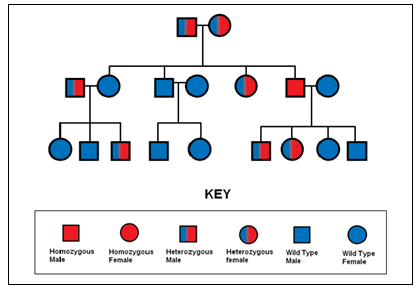
In a pedigree, what shape represents a male?
a)
circle
b)
square
c)
triangle
d)
diamond
31.
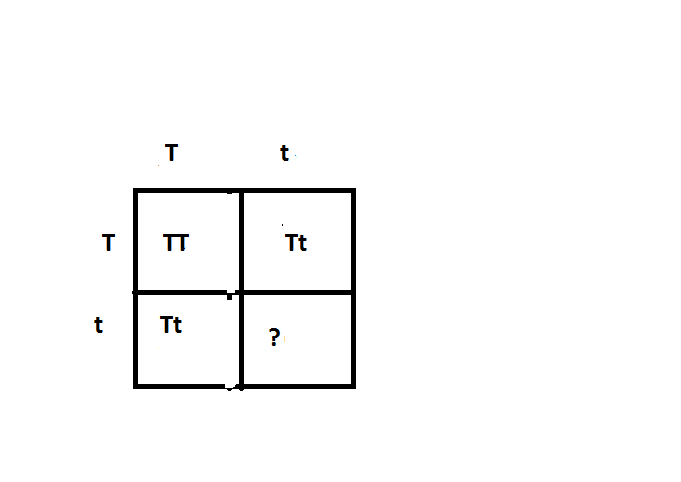
T - tall and t = short
In the punnett square below, what belongs in the missing square
In the punnett square below, what belongs in the missing square
a)
tt
b)
Tt
c)
Bb
d)
TT
32.

B = brown fur b = white fur
In the punnett square, what is the probability for white fur?
In the punnett square, what is the probability for white fur?
a)
0%
b)
25%
c)
50%
d)
75%
33.
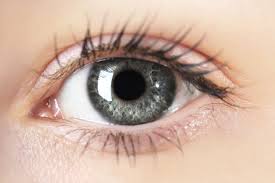
What you see, or the physical appearance.
a)
Genotype
b)
Phenotype
c)
Homozygous
d)
Heterozygous
34.
Which of the following is a phenotype?
a)
Aa
b)
red hair
c)
heterozygous
d)
DNA
35.
AA is an example of
a)
homozygous dominant
b)
homozygous recessive
c)
heterozygous
d)
none of these
36.
Which of the following is a genotype?
a)
long hair
b)
blue eyes
c)
Gg
d)
tall
37.
Which of the following is a phenotype?
a)
AA
b)
AB
c)
black fur
d)
Tt
38.
An organism's genetic make-up:
a)
phenotype
b)
genotype
c)
dominant
d)
recessive
39.
Any change in the sequence of DNA is...
a)
transgenic shift
b)
Single Genotype
c)
Monohybrid Trait
d)
Mutation
40.
Are all mutations bad?
a)
Yes
b)
No
41.

illustration shows.
a)
sickle cell
b)
hemophilia
c)
turner's
d)
tay-sachs.
42.
XX is
a)
Male
b)
Female
43.
XY is
a)
Male
b)
Female
44.
What does the prefix homo- in homozygous mean?
a)
same
b)
different
c)
dating
d)
humans
45.
What does the prefix hetero- in heterozygous mean?
a)
same
b)
different
c)
dating
d)
human
46.
What is the definition of phenotype?
a)
The physical expression of a trait
b)
The genetic combination of alleles
c)
A gene on the DNA strand
47.
What is the definition of genotype?
a)
The physical expression of a trait
b)
The genetic combination of alleles
c)
the genes on a DNA strand
48.
One form of a gene is called_______________
a)
a DNA
b)
a Phenotype
c)
a trait
d)
an allele
49.
Which of the following will only show if two alleles are present?
a)
a dominant trait
b)
a recessive trait
50.
What does a Punnett Square help you do?
a)
Determine the ratio of phenotypes
b)
Determine the ratio of genotypes
c)
Predict possible traits the offspring will have
d)
All of the above
51.
Cystic fibrosis is a genetic disorder in which the body produces abnormally thick ______ in the lungs and intestines?
a)
Skin
b)
Muscle
c)
Blood
d)
Mucus
52.
Which of the following is a carrier of the recessive trait?
a)
TT
b)
Tt
c)
tt
d)
TTt
53.
A clone is an organism that has exactly the same genes as the organism from which it was produced?
a)
True
b)
False
54.
To keep a dog breed the same as it already is, a breeder selects and mates dogs that have the same or similar sets of alleles. This breeding is an example of
a)
cloning.
b)
individual selection.
c)
inbreeding.
d)
crossbreeding.
55.
Which of the following statements about the characteristics of organisms is correct?
a)
Genes alone determine the characteristics or organisms
b)
A combination of genes and the environment determine the characteristics of organisms.
c)
organisms have the same characteristics as their parents
d)
Environment alone determines the characteristics of organisms
100 %

