
NEW
Font size
S
M
L
XL
 Worksheets
Unit 8: Emerging as a Modern Nation
Total questions: 41
Worksheet time: 24mins
Name
Class
Date
1.
What New Deal program gives you a monthly pension when you turn 65?
a)
Social Security
b)
TVA
c)
Medicare
d)
FDIC
2.
During the Great Depression, many people did lose their homes because they couldn't pay for them. They either had to live with family members or in makeshift "houses" made out of cardboard or whatever they could find. These were called "Hoovervilles" or ________________.
a)
shanty towns
b)
neighborhoods
c)
Hoover Wagons
d)
clubs
3.
The U.S. senator from Louisiana who was known as the "Kingfish".
a)
Francis Townsend
b)
Charles Coughlin
c)
Huey Long
d)
Tom Joad
4.
His program to help the poor during the Great Depression was known as the "Share the Wealth" program.
a)
Herbert Hoover
b)
Franklin D. Roosevelt
c)
Clark Gable
d)
Huey Long
5.
■subsidized farmers
a)
TVA
b)
CCC
c)
AAA
d)
WPA
6.
–regulate the stock market & prevent another stock market crash
a)
ACC
b)
SEC
c)
TVA
d)
CCC
7.
–created dams in 7 states to provide cheap hydroelectric power & create jobs
a)
CCC
b)
TVA
c)
WPA
d)
SEC
8.
Harlem is a neighborhood in
a)
New York City
b)
New Orleans
c)
New Jersey
d)
Africa
9.
Which was NOT a LONG-TERM cause of the Great Depression?
a)
Buying stock on margin
b)
Stock market crash (Black Tuesday)
c)
too much production and consumer spending
d)
Laisezz-faire economic policies
10.
The Great Depression began in
a)
1925
b)
1929
c)
1932
d)
1940
11.
What effect did the Dust Bowl storms have on the Great Depression?
a)
Many farmers were forced to leave the Great Plains.
b)
Unemployment decreased gradually.
c)
Many homes long the Mississippi River were flooded.
d)
Hoover was re-elected as president.
12.
One of the most famous American poets of all-time, he infused jazz and blues rhythms into much of his work.
a)
Duke Ellington
b)
Cab Calloway
c)
Louis Armstrong
d)
Langston Hughes
13.
He led the United Negro Improvement Association and helped promote a sense of black pride.
a)
Marcus Garvy
b)
Alain Locke
c)
James Weldon Johnson
d)
Langston Hughes
14.
Which of these statements is true of the 1932 presidential election?
a)
Franklin Roosevelt won in a landslide.
b)
Hoover lost by a narrow margin.
c)
Huey Long ran a strong third-party campaign.
d)
Roosevelt won a third term.
15.
What innovation did Henry Ford use to boost the automotive industry?
a)
Interchangeable Parts
b)
The Assembly Line
c)
The Seaplane
d)
Washing Machine
16.
What were the most popular types of music in the 1920’s.
a)
Rap
b)
Classical
c)
Jazz and Blues
d)
Country
17.
Who was the first pilot to fly a trans atlantic flight?
a)
Marcus Garvey
b)
Henry Ford
c)
Charles Lindeburgh
d)
Herbert Hoover
18.
The most direct result of the 18th Amendment(Prohibition) was that ________
a)
people were mostly in support of the amendment.
b)
organized crime in America increased
c)
organized crime in America decreased
d)
people stopped drinking alchohol
19.
The Scopes Monkey Trial of 1925 had to do with teaching of Fundamentalism and ______.
a)
school
b)
Evolution
c)
life
d)
religion
20.
During the 1920s people's lives changed because they began listening to the what?
a)
mass media
b)
movies
c)
radio
d)
music
21.
These two Italian immigrants were wrongly convicted of murdering a man in the 1920’s. The evidence that had been collected by police did not support convicting these two men, and the evidence actually pointed away from the two. What were the names of these two men?
a)
Sacco and Vanzetti
b)
Mario and Luigi
c)
O'Reilly and Sansom
d)
Lenin and De Gaulle
22.
These hate group gained traction in the 1920’s, even though they had been around since right after the Civil War. They are notorious for hating people who are of different races, or from different countries. What is the name of this hate group?
a)
NAACP
b)
War Hawks
c)
KKK
d)
Nazis
23.

Many believe this author captured the spirit of the "Roaring Twenties" with his novel Titled The Great Gatsby.
a)
Paul Lawrence Dunbar
b)
F. Scott Fitzgerald
c)
Ernest Hemingway
d)
Louis Armstrong
24.

_______________ were young women who rebelled against traditional ways of thinking and acting.
a)
Expatriates
b)
Jazzers
c)
Flappers
d)
Scats
25.
This man was a political leader in the Black community during the Harlem Renaissance who wanted Black Americans to be proud of themselves, see the beauty of themselves, and stay separate from White people.
a)
Marcus Garvey
b)
Calvin Coolidge
c)
Duke Ellington
d)
Langston Hughes
26.
Both Warren Harding and Calvin Coolidge
a)
believed in a laissez faire approach to the economy and government
b)
believed government intervention was important to a successful economy.
c)
were anarchists
d)
had administrations riddled with scandal.
27.

What was Prohibition?
a)
A complete ban on the sale of food
b)
A complete ban on the sale of clothes
c)
A complete ban on the sale of alcohol
d)
A complete ban on the sale of cars
28.
The 1920s were characterized by
a)
Economic depression
b)
Wars
c)
Economic Prosperity
d)
none of the above
29.
Prohibition of alcohol. Which amendment is this?
a)
15th
b)
18th
c)
22nd
d)
24th
30.

What was created to "protect American jobs"?
a)
Federal Reserve
b)
Stocks
c)
Tariffs
d)
International Trade
31.
FDR addressed the American public in weekly broadcasts known as:
a)
FDR Hour
b)
Hangin' With Franklin
c)
Fireside Chats
d)
Around the Fire
32.
Who was the President of the United States when the Stock Market crashed?
a)
Franklin D. Roosevelt
b)
Herbert Hoover
c)
Woodrow Wilson
d)
Theodore Roosevelt
33.
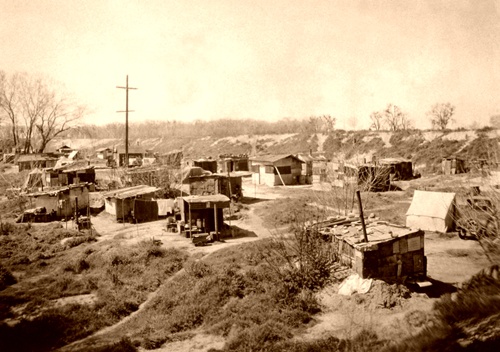
What was the main reason for the emergence of “Hoovervilles” like the one shown in the photograph?
a)
Many Americans had lost jobs during the Great Depression.
b)
Thousands of homes had been destroyed by the effects of the Dust Bowl.
c)
Housing projects could not keep up with the demand for homes needed by the poor.
d)
Preparations for World War I had created a shortage of building materials.
34.
During the 1930s, poor land management and severe drought conditions across parts of the Midwest resulted in the
a)
formation of the United States Department of Agriculture
b)
creation of wheat surpluses
c)
growth of the Populist movement
d)
development of Dust Bowl conditions on the Great Plains
35.
A major difference between the philosophies of President Herbert Hoover and President Franklin D. Roosevelt in responding to the Great Depression is that Roosevelt
a)
wanted to rely on private charities to provide assistance
b)
stressed the need for individual rugged individualism
c)
supported direct relief to people out of work
d)
thought the government should not be involved in economic reform
36.
As part of the New Deal, the Securities and Exchange Commission (SEC) and the Federal Deposit Insurance Corporation (FDIC) were created to
a)
allow for a quick recovery of stock prices
b)
provide direct loans to businesses
c)
protect individual investors from stock fraud and bank failure
d)
allow banks and companies to invest in the stock market
37.
An advocate of President Franklin D. Roosevelt’s farm policy would have likely supported which economic strategy?
a)
Reducing agricultural output to increase product values
b)
Utilizing minimum wage laws to stimulate farm productivity
c)
Allowing market forces to operate freely to achieve stabilization
d)
Increasing agricultural production to ensure an affordable food supply
38.
The Civilian Conservation Corps (CCC) and the Works Progress Administration (WPA) were both New Deal programs developed to address the problem of
a)
excessive stock market speculation
b)
high unemployment
c)
increased use of credit
d)
limited income of senior citizens
39.
The TVA is significant because it hired people to
a)
deliver food to the poverty-stricken Dust Bowl residents
b)
build dams and generators that provided electricity
c)
work on farms to help stabilize agriculture
d)
publish important facts about businesses
40.
Which of the following was a major cause of the Great Depression?
a)
overproduction and underconsumption
b)
a decrease in the supply of consumer goods
c)
an increase in demand for imported products
d)
an increase in the price of wheat on the world market
41.
Which of the following is a characteristic of daily life in the 1920s?
a)
Many Americans lost all of their money in the Stock Market crash.
b)
Many Americans did not have jobs and there were failed banks and businesses.
c)
Many Americans experienced an economic boom, furthered by new technologies.
d)
All Americans experienced an economic boom, furthered by new technologies.
Reset

