Wayground logo

Free Printable Worksheets

Font size

S
M
L
XL
Worksheets

VUS 3rd Nine Weeks Review 2020

Total questions: 54

Worksheet time: 45mins

Name
Class
Date
1.
Which president played a role in the completion of the Panama Canal?
a)
William Taft
b)
Woodrow Wilson
c)
Teddy Roosevelt
d)
Franklin Roosevelt
2.
Which Latin American country was annexed following the Spanish American War?
a)
Cuba
b)
Puerto Rico
c)
Panama
d)
Hawaii
3.
Which policy urged all foreigners in China to obey Chinese law, and encouraged fair competition?
a)
14 Points
b)
Open Door Policy
c)
Big Stick Policy
d)
Treaty of Versailles
4.
World War I started in Europe in 1914.  For three years, the United States stayed...
a)
Neutral
b)
with Britain and fought
c)
with Germany and fought
5.
What was Wilson's plan to end all wars in the world?
a)
14 Points
b)
Treaty of Versailles
c)
Open Door Policy
d)
Big Stick Policy
6.
What was the tipping point in WWI and led to the defeat of the Germans?
a)
US Entering the war
b)
New technologies were found
c)
Germany ran out of money
d)
US leaving the war
7.
Overspeculation, expansion of credit, and banks running out of money lead to what event?
a)
Dust Bowl
b)
Flappers
c)
Stock Market Crash
d)
WWII
8.
"...the only thing we have to fear is fear itself..."
a)
Woodrow Wilson
b)
Teddy Roosevelt
c)
FDR
d)
Truman
9.
Germany bombing Great Britain is called the -
a)
Stalingrad
b)
Battle of Great Britain
c)
Pearl Harbor
d)
Midway
10.
How did the war start in Europe in 1939?
a)
D-day invasion
b)
Germany over runs France
c)
Soviets invade Germany
d)
Germany invades Poland
11.
Which battle in Europe kept Hitler from getting the oils fields in Russia?
a)
Stalingrad
b)
D-day
c)
El Alamein
d)
Trafalgar 
12.
The liberation of western Europe started after which invasion?
a)
Paris
b)
D-Day
c)
Battle of Britain
d)
Stalingrad
13.
Which US president made the decision to drop the atomic bombs on Nagasaki and Hiroshima?
a)
Wilson
b)
FDR
c)
Truman
d)
Teddy Roosevel
14.
American POW's suffered brutal treatment after the surrender of the Phillippines, known as the...
a)
Bataan Death March
b)
Hiroshima
c)
Iwo Jima
d)
Midway
15.
Germany's plan and system for eliminating the Jews, gypsies and other "undesirables" was known as...
a)
The Final Answer
b)
genocide
c)
Holocaust
16.
Which convention attempted to ensure humane treatment of prisoners of war...
a)
Geneva
b)
Paris
c)
Stalingrad
d)
El Alamein
17.
What was the nickname given to women who entered the workforce during WWII?
a)
Rosie
b)
Sandy
c)
Willomenia
d)
Frannie
18.
Japanese Americans were moved to these to prevent them from "spying" and/or working with Japan during WWII.
a)
Concentration Camps
b)
Internment Camps
c)
Work Camps
d)
CCC
19.
Which country, following WWII, was partitioned and divided among other countries?
a)
Britain
b)
France
c)
Germany
d)
Russia
20.
What organization was created following WWII to help prevent future wars?
a)
League of Nations
b)
United Nations
21.
This was the name for the set of programs put in place by FDR to help the depression era economy.
a)
fireside chat
b)
bank holiday
c)
New Deal
d)
packing the court
22.
This New Deal reform program insured checking and savings accounts. 
a)
Civilian Conservation Corps
b)
Fair Labor Standards Act
c)
Federal Deposits Insurance Corporation
d)
Social Security Act
23.
Which New Deal program employed young men to work on various projects to improve the country?
a)
Social Security Act
b)
Fair labor Standards Act
c)
Rural Electrification Act
d)
Civilian Conservation Corps
24.
Which New Deal program set aside savings through taxes for unemployment, the disabled or retirement? 
a)
Federal Deposits Insurance Corporation
b)
Social Security Act 
c)
Agricultural Adjustment Act
d)
Civilian Conservation Corps
25.

Can you recall what the 18th amendment is

a)

Made it illegal to make or sell alcohol

b)

Gave women the right to vote

c)

Led to a decrease in crime

d)

Gave African Americans the right to vote

26.

During the 1920s, controversies concerning national Prohibition and the behavior of “flappers” were all signs of disagreement over…

a)

The return to normalcy

b)

Changing culture and lifestyles

c)

Causes of the Great Depression

d)

The benefits of new technology

27.

Young women in the 1920s who declared their independence from traditional values were known as __________________________.

a)

Fads

b)

Actresses

c)

Flappers

d)

Beyonce

28.
Which music genre was created in the 20s?
a)
Bluegrass
b)
Jazz
c)
Hip Hop
d)
R&B
29.
This event was the movement of African American from the South, Northward in search of a better life
a)
Great Migration
b)
Manifest Destiny
c)
Reconstruction
d)
Homestead Act
30.
Who was the leader of the American Federation of Labor? (Labor Union)
a)
Samuel Gombers
b)
Eugene Debs
c)
John Sherman
d)
Woodrow Wilson
31.
In State governments, all the following are used except:
a)
Referendum
b)
Initiative
c)
Recall
d)
Urbanization
32.
Causes of the Progressive Movement include dangerous working conditions – (all of the following) except:
a)
Child labor
b)
Long hours
c)
High wages
d)
No job security
33.

In which court case did the Supreme Court rule that "separate but equal" did not violate the 14th amendment, upholding the "Jim Crow" Laws?

a)

Marbury v. Madison

b)

McCulloch v. Maryland

c)

Gibbons v. Ogden

d)

Plessy v. Ferguson

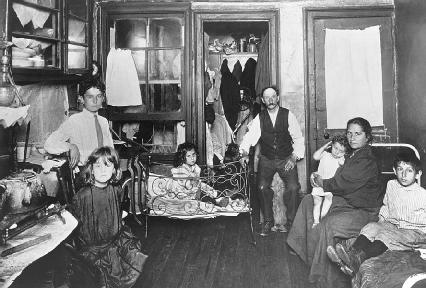
34.
The photo demonstrates one of the problems with
a)
overcrowding urban tenements.
b)
labor union activism in urban areas.
c)
the overproduction of consumer goods.
d)
the growth of political machines.
35.

Between Civil War & WWI the US transformed into what kind of economy?

a)

Communist

b)

Egalitarian

c)

Industrial

d)

Agricultural

36.

After reconstruction, many southern state governments passed _______________ laws that separated races

a)

KKK

b)

Rustic

c)

Jim Crow

d)

White Privilege

37.

What means government should interfere the LEAST amount possible in the economy?

a)

Laissez-faire

b)

Liberalism

c)

Conservatism

d)

Socialism

38.

Who was the oil tycoon?

a)

Andrew Carnegie

b)

John Rockefeller

c)

Cornelius Vanderbilt

d)

JP Morgan

39.

Who was the financial tycoon?

a)

JP Morgan

b)

John Rockefeller

c)

Cornelius Vanderbilt

d)

Andrew Carnegie

40.

Who was the steel tycoon?

a)

Cornelius Vanderbilt

b)

JP Morgan

c)

John Rockefeller

d)

Andrew Carnegie

41.

Who perfected the assembly line?

a)

Henry Bessemer

b)

Alexander Graham Bell

c)

Henry Ford

d)

Thomas Edison

42.

Who believed the way to equality was through vocational and economic success?

a)

WEB Dubois

b)

Ida B. Wells

c)

Malcolm X

d)

Booker T. Washington

43.

Who believed education was meaningless without equality and helped start the NAACP?

a)

WEB DuBois

b)

Booker T. Washington

c)

Martin Luther King Jr.

d)

Ida B. Wells

44.

What prevents any business structure that restrains trade (monopolies)?

a)

Proclamation of 1763

b)

The 19th Amendment

c)

Sherman Anti-Trust Act

d)

Clayton Anti-Trust Act

45.

In Buck v. Bell (1927), the United States Supreme Court upheld a VA statute for the sterilization of people considered genetically unfit.

a)

True

b)

False

46.

The ____ Amendment is the prohibition amendment and it was repealed by the ____ Amendment

a)

19th & 21st

b)

18th & 21st

c)

21st & 23rd

d)

18th & 19th

47.

Americans who supported a weak federal government and called for a Bill of Rights were known as -

a)

Federalists

b)

Anti-Federalist

c)

Tories

d)

Neutrals

48.

What were the supporters of a strong national government called?

a)

Federalists

b)

Anti-Federalists

c)

Tories

d)

Neutrals

49.

What was our first form of government made by leaders that feared a powerful government like England's?

a)

Articles of Confederation

b)

The Constitution

c)

The Declaration of Independence

d)

The Bill of Rights

50.

The Federalists advocated for a strong _____________ government & echoed the thoughts of modern day Democrats/Liberals

a)

Central

b)

National

c)

Federal

d)

State

51.

Important legal precedents established by the Marshall Court helped the judicial branch become an _______________ branch of government

a)

Adequate

b)

Equal

c)

Inhumane

52.

The doctrine of judicial review was set forth in what court decision?

a)

Gibbons v. Ogden

b)

McCulloch v. Maryland

c)

Marbury v. Madison

53.

What political party was led by John Adams and Alexander Hamilton and believed in a strong national government?

a)

Federalists

b)

Democratic - Republicans

c)

Whigs

d)

Know - Nothings

54.

Who was the leader of the Democratic - Republicans that believed in a weak national government and an agricultural economy?

a)

George Washington

b)

Thomas Jefferson

c)

John Adams

d)

Alexander Hamilton