
 Worksheets
evolution by natural selection (the Living Environment)
Total questions: 58
Worksheet time: 1hrs 7mins
Name
Class
Date
1.
Evidence that best supports the theory of biological evolution was obtained from the:
a)
analysis of food chains and food webs
b)
comparison of the number of cells in organisms
c)
study of fossil records
d)
investigation of environmental niches
2.

Some evolutionary pathways are represented in the diagram below. An inference that can be made from information in the diagram is that
a)
species E evolved from species G
b)
species A was probably much larger than all the other species
c)
species J is adapted to the existing environment
d)
species C is a direct descendant of species I
3.
Certain antibacterial soaps kill 99% of the bacteria present on hands. Constant use of these soaps could be harmful over time because:
a)
the soap stimulates skin cell division
b)
large populations of pathogens are beneficial to the hands
c)
microbes prevent viral diseases
d)
more pathogens may be resistant to the soap
4.
Some variation must be present in a population in order for natural selection to take place. These variations arise from mutations in the DNA and:
a)
sorting of chromosomes during sexual reproduction
b)
combining of chromosomes during organ development
c)
removal of chromosomes during selective breeding
d)
changing of chromosomes during cloning
5.
In a population of birds, the percentage of individuals having a certain gene changes from 20% to 60% over the span of several hundred years. This situation will most likely affect the rate of:
a)
biological evolution
b)
asexual reproduction
c)
ecological succession
d)
gene mutation
6.
In a certain species of insect, some individuals have flattened white disks on their bodies that protrude and interlock, resembling an orchid flower. This adaptation provides the insect with a better opportunity to capture its prey. If environmental conditions remain unchanged, it is most likely that, in future generations, the proportion of the population with this adaptation will:
a)
increase, only
b)
decrease, only
c)
increase, then decrease
d)
decrease, then increase
7.
The fossil record of ancient life forms provides scientific evidence of:
a)
direct harvesting
b)
gene manipulation
c)
evolutionary changes
d)
selective breeding
8.
Many years ago, a scientist grew pea plants that produced wrinkled peas. The peas from these plants produced new plants that also produced wrinkled peas. The scientist concluded that something in the parent plants was being transmitted to the next generation. This discovery is now known as:
a)
genetic engineering
b)
gene splicing
c)
biological evolution
d)
heredity
9.
In the past, humans developed varieties of dogs, such as the German shepherd and the bearded collie, using:
a)
natural selection of favorable traits
b)
mutations present only in body cells
c)
recombination of genes during mitosis
d)
selective breeding for particular traits
10.

The diagram below represents an evolutionary tree. Which statement best describes species E?
a)
Species D is an ancestor of species E.
b)
Species E had greater success due to patterns of behavior.
c)
Through natural selection, species E produced increased survival mechanisms.
d)
Species E had insufficient adaptive characteristics for survival in a changing environment.
11.

Which finches would be most like the ancestral finch?
a)
large tree finches
b)
cactus finches
c)
warbler finches
d)
large ground finches
12.

Present-day cactus finches are a type of:
a)
ground finch
b)
ancestral finch
c)
warbler finch
d)
tree finch
13.
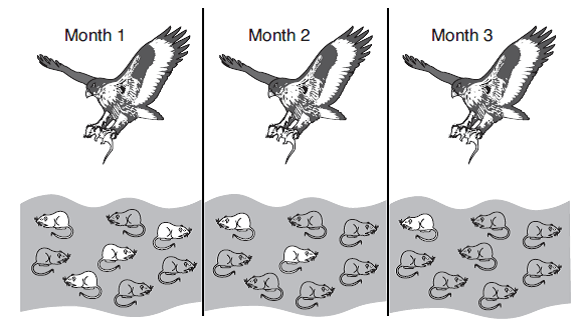
The diagram below represents the same field of mice hunted by a hawk over a period of three months. The overall changes in the population of mice can be explained best by:
a)
reproduction
b)
natural selection
c)
mouse extinction
d)
succession
14.
The Galapagos pink land iguana, Conolophus marthae (C. marthae), is native to only one of the Galapagos Islands. Its entire range is currently limited to Wolf Volcano on Isabella Island. The iguana was first discovered on this island in 1986. Genetic studies of the animal began sometime later, and it was identified as a species separate from other iguana populations on the Galapagos in 2009. Its population might have been as high as 100 in 1986, but now there might be as few as 10 of the animals left alive. Other evidence indicates that this species could have diverged from another line of iguanas about 5.7 million years ago. After that, the other line of iguanas diverged into two other species, C. pallidus and C. subcristatus.
In the future, the current population of about ten pink land iguanas will probably:
In the future, the current population of about ten pink land iguanas will probably:
a)
migrate to new islands in the Galapagos in order to survive
b)
soon become extinct, because they have little genetic diversity
c)
soon become extinct, because they have too much genetic diversity
d)
undergo evolution by natural selection and survive
15.

The Galapagos pink land iguana, Conolophus marthae (C. marthae), is native to only one of the Galapagos Islands. Its entire range is currently limited to Wolf Volcano on Isabella Island. The iguana was first discovered on this island in 1986. Genetic studies of the animal began sometime later, and it was identified as a species separate from other iguana populations on the Galapagos in 2009. Its population might have been as high as 100 in 1986, but now there might be as few as 10 of the animals left alive. Other evidence indicates that this species could have diverged from another line of iguanas about 5.7 million years ago. After that, the other line of iguanas diverged into two other species, C. pallidus and C. subcristatus.
Which evolutionary tree best represents the information about the pink land iguana provided in the passage?
Which evolutionary tree best represents the information about the pink land iguana provided in the passage?
a)
1
b)
2
c)
3
d)
4
16.
The Galapagos pink land iguana, Conolophus marthae (C. marthae), is native to only one of the Galapagos Islands. Its entire range is currently limited to Wolf Volcano on Isabella Island. The iguana was first discovered on this island in 1986. Genetic studies of the animal began sometime later, and it was identified as a species separate from other iguana populations on the Galapagos in 2009. Its population might have been as high as 100 in 1986, but now there might be as few as 10 of the animals left alive. Other evidence indicates that this species could have diverged from another line of iguanas about 5.7 million years ago. After that, the other line of iguanas diverged into two other species, C. pallidus and C. subcristatus.
The testing that revealed that these iguanas are a separate species from the other iguanas present in the Galapagos most likely included:
The testing that revealed that these iguanas are a separate species from the other iguanas present in the Galapagos most likely included:
a)
the use of paper chromatography
b)
DNA analysis
c)
cloning studies
d)
genetic engineering
17.
What is a change in an organism that allows for it to survive in its environment?
a)
homologous
b)
vestigial
c)
variation
d)
adaptation
18.
When all of the organisms of a species have died it is called
a)
evolution
b)
extinction
c)
adaptation
d)
natural selection
19.
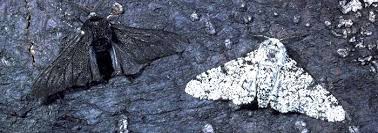
Predict which moth would increase in population
a)
light
b)
dark
20.

Which layer is the oldest?
a)
1
b)
2
c)
3
d)
4
21.
When the DNA of an organism is altered it is referred to as…
a)
Mutation
b)
Gene Flow
c)
Genetic Drift
d)
Sexual Selection
22.

Darwin wrote that organisms with traits that are best suited to the environment will ________________
a)
increase in number
b)
become extinct
23.
Which of the following is NOT an example of natural selection?
a)
People selectively breeding hamsters.
b)
Insect populations developing resistance to certain pesticides.
c)
Bacteria becoming resistant to antibiotics.
d)
Male birds of certain species developing colorful feathers to attract female mates.
24.

Which species’ DNA is most similar to the DNA of the toothed whale?
a)
Hippopotamus
b)
Baleen Whale
c)
Grazing Mammals
d)
Camels
25.
Which term refers to the process by which individuals that are better suited to the environment survive and reproduce therefore passing down their genes to their offspring?
a)
Evolution
b)
Variation
c)
Artificial Selection
d)
Natural Selection
26.
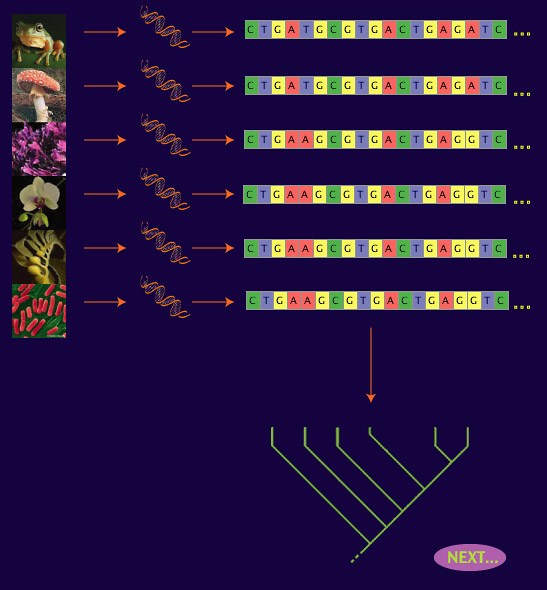
Two organisms that are closely related would have
a)
very similar DNA sequence
b)
exactly the same DNA sequences
c)
no proteins in common
d)
completely different DNA sequence
27.
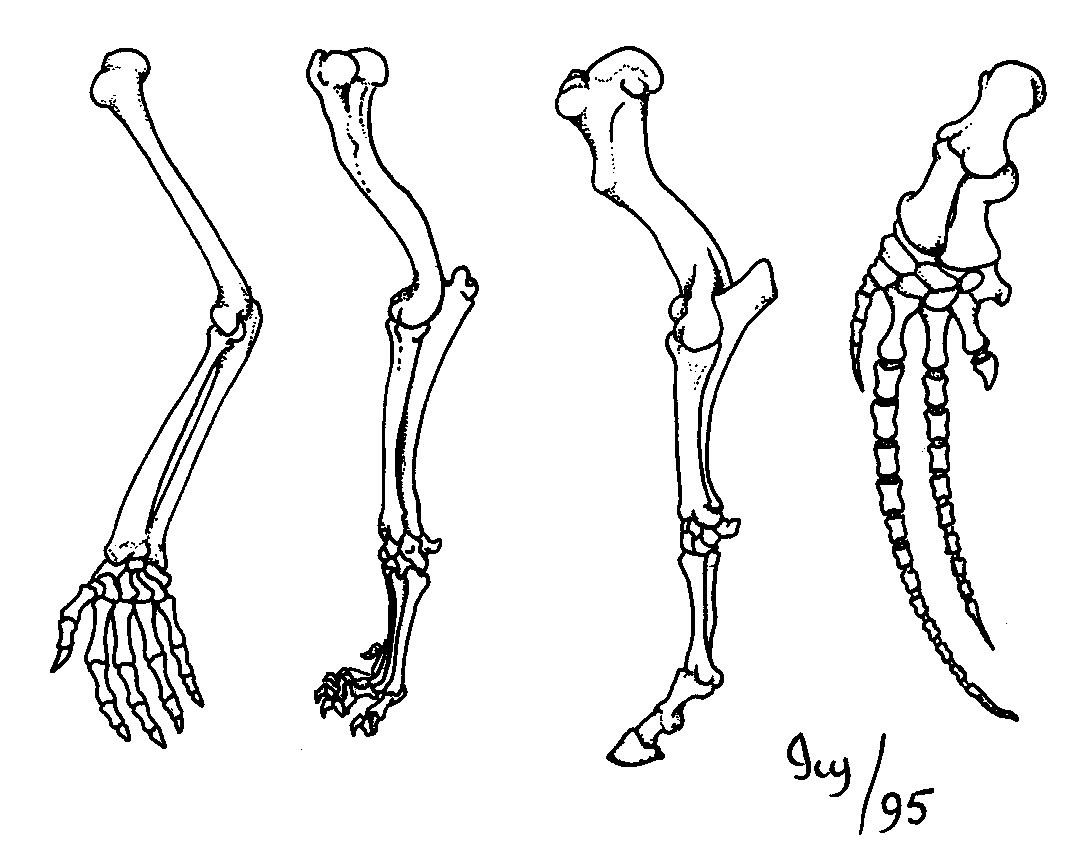
Structures with the same parts have different functions; suggests that organisms share a common ancestry
a)
vestigial structures
b)
homologous structures
c)
adaptive radiation
d)
fossil
28.
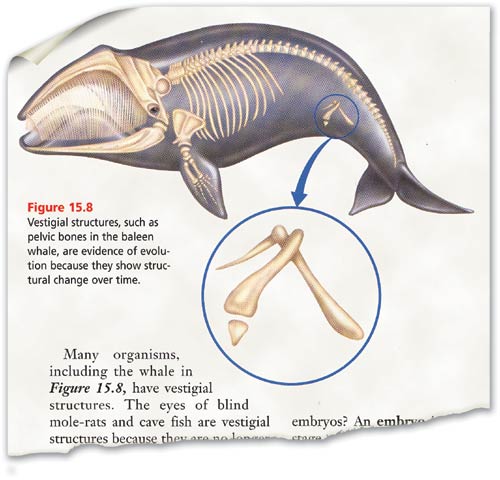
Which of the following is an example of a vestigial structure?
a)
the wings of a red-tailed hawk
b)
the hind limbs of a house cat
c)
the fins of sharks
d)
the tailbone of a human
29.
The ability of an organism to survive and reproduce in its specific environment
a)
diversity.
b)
evolution
c)
adaptation
d)
fitness
30.

The diagram shows fossils in different rock layers. Which of these statements about the age of these fossils is most likely correct?
a)
Fossil A and C are the same age
b)
Fossil B is older than fossil C
c)
Fossils A is older than fossil B
d)
Fossil D is older than fossil C
31.

Which of the following is a term for a group of similar organisms that can reproduce fertile offspring?
a)
individual
b)
population
c)
species
d)
fossil
32.
Why are advantageous traits more likely to be passed onto offspring?
a)
Because they are more likely to survive and reproduce.
b)
Because they come from dominant alleles.
c)
Because they come from recessive alleles.
d)
Because the trait is an acquired phenotype.
33.
What eventually happens to a species when the environment changes and the organisms do not adapt? (1) (2) (3) (4)
a)
classification
b)
extinction
c)
development
d)
regulation
34.
Which process is a cause of variation in a species?
a)
metamorphosis
b)
cellular respiration
c)
sexual reproduction
d)
regulation
35.
Which process allows for the evolution of finches over time?
a)
natural selection
b)
asexual reproduction
c)
selective breeding
d)
ecological succession
36.
The theory of Evolution by Natural Selection states that
a)
species that are extinct have no biological relationship to living species
b)
different animal species always interbreed to form new and different species
c)
species change over time, sometimes developing into new species
d)
the environment of Earth is constant over time
37.
Evolution can occur at different rates; however, for evolution to occur, there must be:
a)
variations within a species
b)
extinction of the species
c)
asexual reproduction
d)
no change in the genes of an organism
38.

Two organisms that are closely related would have
a)
very similar DNA sequence
b)
exactly the same DNA sequences
c)
no proteins in common
d)
completely different DNA sequence
39.
Embryos of chickens, fish and humans look very similar. They all have folds known as gill pouches in the neck region. What may this suggest?
a)
they all formed in the ocean
b)
they all evolved from a common ancestor
c)
they are all going extinct
40.

Some organisms that share a common ancestor have features that have different functions, but similar structures. These are known as
a)
vestigial structures
b)
analogous structures
c)
homologous structures
d)
fossil structures
41.
The diagram shows fossils in different rock layers. Which of these statements about the age of these fossils is most likely correct?
a)
Fossil A and C are the same age
b)
Fossil B is older than fossil C
c)
Fossils A is older than fossil B
d)
Fossil D is older than fossil C
42.

What is this an example of?
a)
diversity of species
b)
variation
c)
vestigial structures
d)
DNA studies
43.
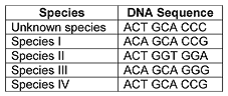
According to this data, the unknown bacterial species is most closely related to:
a)
Species I
b)
Species II
c)
Species III
d)
Species IV
44.

Comparing human hemoglobin of chimpanzees, horses, kangaroos, and chickens, reveal that humans have the fewest amino acid differences with
a)
Kangaroos
b)
Horses
c)
chickens
d)
chimpanzees
45.
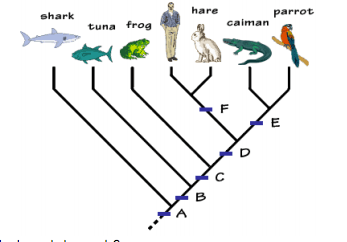
On the cladogram, which organism is the closest relative of the human?
a)
Frog
b)
Hare
c)
Caiman
d)
Parrot
46.
Survival of at least a few members of a population after a major environmental change is most dependent on
a)
the population having an individual that is adapted to the original environment
b)
the population having an individual that is adapted to great changes in the temperature in its environment
c)
variations in many different traits in many individuals in the population
d)
no variations in the color of the fur, skin, or feathers of the individuals in the population
47.
The theory of evolution states that
a)
species that are extinct have no biological relationship to living species
b)
different animal species always interbreed to form new and different species
c)
species change over time, sometimes developing into new species
d)
the environment of Earth is constant over time
48.
Evolution can occur at different rates; however, for evolution to occur, there must be
a)
variations within a species
b)
extinction of the species
c)
asexual reproduction
d)
no change in the genes of an organism
49.
Natural selection is best described as
a)
a change in an organism in response to a need of that organism
b)
a process of nearly constant improvement that leads to an organism that is nearly perfect
c)
differences in survival rates as a result of different inherited characteristics
d)
) inheritance of characteristics acquired during the life of an organism
50.
Which statement best describes a situation where competition occurs in an ecosystem?
a)
A deer outruns an attacking wolf
b)
A deer, during the winter, consumes tree bark.
c)
A deer and a rabbit consume grass in a field
d)
A deer and a rabbit are both startled by a hawk flying overhead.
51.
Fossils provide evidence that
a)
life on Earth millions of years ago was more complex than life is today
b)
the changes that will occur in species in the future are easy to predict
c)
many species of organisms that lived long ago are now extinct
d)
most species of organisms that lived long ago are exactly the same today
52.
Plant species X lives in a hot, dry environment. Slowly, over hundreds of years, the climate becomes wetter. Fungi attack species X and cause the population of species X to decrease. However, plant species X could survive if the plants
a)
try to mutate quickly and synthesize new proteins
b)
are watered often and fertilized with extra nutrients
c)
can adapt to the new conditions by mating with the fungus
d)
have a few members of the population that are fungus-resistant
53.
Many animals have developed courtship behaviors. Males will often dance, swim, or sing in a particular way to attract a female. Males who are more successful at the courtship behavior will have a greater chance of having more offspring. This behavior is a result of
a)
natural selection
b)
genetic engineering
c)
asexual reproduction
d)
gene manipulation
54.
Which occurrence represents an example of evolution?
a)
Exposure to radiation reduces the rate of mutation in leaf cells.
b)
A mutation in a liver cell causes a person to produce an enzyme that is less efficient.
c)
Cells in a zygote eventually change into bone cells or skin cells.
d)
Some antibiotics are almost useless, because pathogens have developed a resistance to these antibiotics.
55.
Potato farmers in Ireland during the mid 1800s all grew the same type of potato. The potato plants were all produced as clones of one another. When a fungus infected the crop, all of the potatoes were destroyed. The reason why all the potato plants died (instead of evolving a resistance) is that they:
a)
had little genetic variability
b)
had increased biodiversity
c)
were the product of fertilization
d)
were the result of biotechnology
56.
The corn we eat today is larger and has more kernels than the corn people first grew thousands of years ago. Which process is most likely responsible for the changes that have occurred?
a)
mitosis
b)
succession
c)
direct harvesting
d)
selective breeding
57.
Over time, data that support the successful evolution of a species would include observations that describe
a)
an increase in the genetic changes occurring in body cells
b)
a decrease in the genetic variety carried in sex cells
c)
an increase in the proportion of offspring that have favorable characteristics
d)
a decrease in the proportion of the population that has beneficial traits
58.
Caffeine is a compound found in the seeds of many different plants, such as coffee beans, cola nuts, and cacao beans (the source of chocolate). The presence of this chemical in all three types of plants suggests that these plants
a)
inherited identical mutations
b)
share a common ancestry
c)
were exposed to the same type of radiation in the past
d)
were cloned from a caffeine plant
100 %

