
 Worksheets
Mid Term Practice
Total questions: 105
Worksheet time: 2hrs 20mins
Name
Class
Date
1.
A scientist is planning to carry out an experiment on the affect of temperature on bacteria growth. Which would NOT be an appropriate first step?
a)
Doing research in a library about bacteria
b)
Having discussions with other scientists
c)
Completing a data table with expected results
d)
Looking at past experiments
2.

This step should be done more than once to ensure accurate results
a)
Conduct an experiment
b)
Ask a question
c)
Record data
d)
Clean up after your investigation
3.

What is the volume of Object X?
a)
10.0 cm3
b)
15.0 cm3
c)
20.0 cm3
d)
25.0 cm3
4.

I have two objects with the same volume but different masses. Which object will be more dense?
a)
The object with less weight.
b)
The object with more weight.
c)
The object with more mass.
d)
The object with less mass.
5.
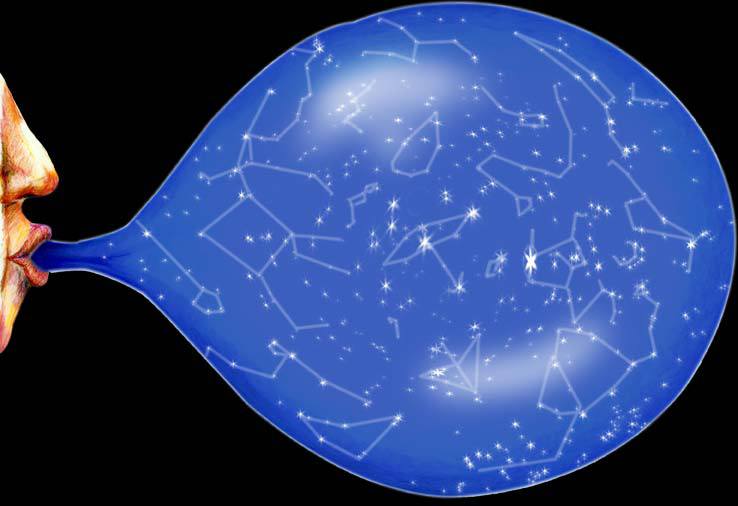
What does the Big Bang theory suggest?
a)
The universe was just there
b)
The Milky Way is the only solar system
c)
The universe is continually expanding
d)
The universe is collapsing in toward a single point
6.
Our solar system began as a -
a)
nebula
b)
quasar
c)
prototype
d)
neutron star
7.
How old is our universe?
a)
13.8 thousand years
b)
13.8 million years
c)
13.8 billion years
d)
13.8 trillion years
8.

What type of galaxy is this?
a)
Spiral
b)
Elliptical
c)
Irregular
d)
Irrational
9.
Our Galaxy is called the
a)
M38
b)
Milky Way Galaxy
c)
Andromeda Galaxy
d)
Pinwheel Galaxy
10.

What is the best title for this picture?
a)
Birth of a Star
b)
Birth of a Universe
c)
Life Cycle of a Low Mass Star
d)
Life Cycle of a High Mass Star
11.

Which one shows the correct location of the Sun in the Milky Way galaxy?
a)
A
b)
B
c)
C
d)
none of the above
12.
Which of the following is the largest?
a)
star
b)
universe
c)
cluter
d)
galaxy
13.

Which layer is between outer core and the crust?
a)
inner core
b)
mantle
c)
ocean
14.

Which number shows the Earth at the summer solstice (Northern hemisphere)?
a)
1
b)
2
c)
3
d)
4
15.
Which number shows the Earth at the winter solstice (Northern hemisphere)?
a)
1
b)
2
c)
3
d)
4
16.
Why does the moon appear bigger than the planets and stars?
a)
The moon is closer than the planets.
b)
The moon is larger than the planets.
17.

Why is the moon bright in the night sky?
a)
The moon is made of burning gasses.
b)
The moon reflects light from the Earth.
c)
There is a source of light inside of the moon.
d)
The moon reflects light from the Sun.
18.

From one full moon to the next full moon, it take _______ days. (this a lunar month)
a)
10
b)
15
c)
29.5
d)
99
19.

Which Apollo Mission was the first one to make it to the surface of the moon?
a)
Apollo 7
b)
Apollo 11
c)
Apollo 13
20.

What is this image an example of?
a)
lunar eclipse
b)
waning crescent
c)
solar eclipse
d)
waxing crescent
21.

What is the phase of this moon?
a)
Third Quarter
b)
Waning Crescent
c)
First Quarter
d)
Waning Gibbous
22.

What is the phase of the moon in the picture?
a)
New Moon
b)
Third Quarter
c)
First Quarter
d)
Waxing Gibbous
23.
Which direction does the Earth revolve around the Sun?
a)
Left / Counter clockwise
b)
Right / Clockwise
24.
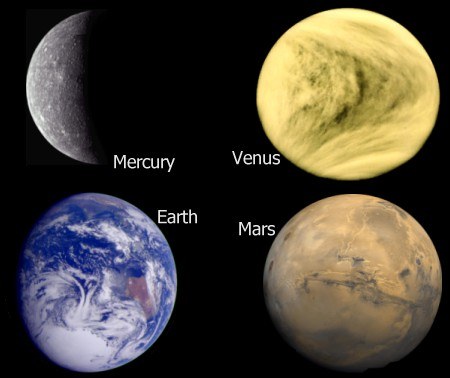
Earth and the other planets closest to the Sun are made mostly of _______
a)
gas
b)
metal
c)
water
d)
rock
25.
Where is the asteroid belt found?
a)
between earth and mars
b)
Between Uranus and Neptune
c)
Between Mercury and Venus
d)
Between Mars and Jupiter
26.
Why does Earth have different seasons?
a)
because of the distance between Earth and the sun
b)
because of the speed of Earth as it rotates on its axis
c)
because of the amount of light blocked by the moon on its axis
d)
because of the tilt of Earth on its axis as it moves around the sun
27.

a pattern of stars that form an imaginary picture or design in the sky
a)
Orbit
b)
Rotate
c)
constellation
d)
Milky Way
28.

Earth's ________ on its axis causes day and night.
a)
rotation
b)
revolution
c)
phase
d)
comet
29.

An ice ball that has a very long elliptical orbit is called a _________.
a)
phase
b)
asteroid
c)
axis
d)
comet
30.
A[n] ___________ tide occurs when the sun, Earth, and the moon are nearly in a line.
a)
spring
b)
high
c)
low
d)
neap
31.

At which position would the moon be during a neap tide?
a)
1
b)
2
c)
3
d)
4
32.

What is the profile view to Topographic Map #1?
a)
A
b)
B
c)
C
d)
D
33.

A mountaineer is planning an expedition. He wants to follow the easiest possible path, which means he needs to find the most gentle slope up the mountain. Which route should the mountaineer choose?
a)
Route A
b)
Route B
c)
Route C
d)
Route D
34.

What is the most likely elevation of the mountain peak? (Contour interval is 100 m)
a)
1550 meters
b)
1652 meters
c)
1500 meters
d)
1700 meters
35.

The following image shows what mineral property?
a)
Hardness
b)
Streak
c)
Cleavage
d)
Density
36.
How light reflects off of a mineral is called the mineral's
a)
luster
b)
streak
c)
cleavage
d)
fracture
37.

What mineral is used for pencils?
a)
Graphite
b)
Galena
c)
Magnetite
d)
Quartz
38.

What mineral is salt?
a)
quartz
b)
sulfur
c)
halite
d)
calcite
39.
How do you determine the density of a mineral?
a)
D=M/V
b)
D=V/M
c)
D=M x V
d)
D= V x M
40.
Rubbing a mineral on a streak plate determines the color of the mineral's _____________
a)
Surface
b)
Interior
c)
Powder
d)
Crystals
41.

Using this scale, which mineral can scratch fluorite?
a)
Talc
b)
Gypsum
c)
Apatite
d)
Calcite
42.
Which type of rock results from melting and cooling of magma?
a)
Igneous
b)
Metamorphic
c)
Sedimentary
d)
Extrusive
43.
Which type of rock forms from extreme heat and pressure?
a)
Igneous
b)
Sedimentary
c)
Organic
d)
Metamorphic
44.
Coal is an example of a _______ sedimentary rock.
a)
Chemical
b)
Organic
c)
Clastic
d)
Intrusive
45.

This rock was formed when magma cooled very slowly inside the Earth. What specific type of rock is it?
a)
Intrusive Igneous Rock
b)
Extrusive Igneous Rock
c)
Foliated Metamorphic Rock
d)
Clastic Sedimentary Rock
46.

This rock formed when lava cooled very quickly on Earth's surface. What specific type of rock is it?
a)
Extrusive Igneous Rock
b)
Intrusive Igneous Rock
c)
Non-Foliated Metamorphic Rock
d)
Biochemical Sedimentary Rock
47.
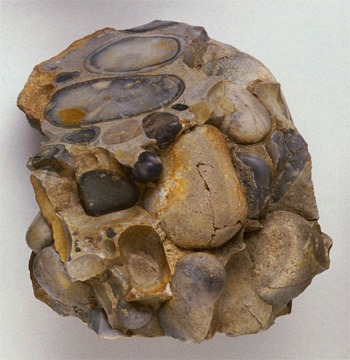
This rock was formed by smaller pieces of rock that settled at the bottom of a lake millions of years ago. What type of rock is this?
a)
Sedimentary
b)
Igneous
c)
Metamorphic
48.

The process when rocks break into smaller pieces due to exposure to natural elements is called
a)
erosion
b)
weathering
c)
sediments
49.

Each rock type can follow only one pathway of the rock cycle.
a)
True
b)
False
50.

Which stage does the #3 show in the diagram?
a)
condensation
b)
evaporation
c)
precipitation
d)
run off
51.

What is A?
a)
Evaporation
b)
Condensation
c)
Precipitation
d)
Runoff
52.

What is D?
a)
Evaporation
b)
Condensation
c)
Precipitation
d)
Runoff
53.

A meander is best described as ...
a)
A straight section of the river.
b)
A winding section of a lake.
c)
A section of the river that joins another river.
d)
A winding section of a river.
54.

When the bends of a Meander get close enough they can join, creating a new river path. What is left is called ...
a)
An oxback lake
b)
An oxen lake
c)
An oxcart lake
d)
An oxbow lake
55.
The water cycle includes ...
a)
Evaporation, Condensation, Transportation, Precipitation.
b)
Evaporation, Condensation, Transpiration, Precipitation.
c)
Evaporation, Erosion, Transpiration, Precipitation.
d)
Evaporation, Erosion, Transportation, Precipitation.
56.
Which is NOT a main watershed system in VA?
a)
Chesapeake Bay
b)
Pacific Ocean
c)
Gulf of Mexico
d)
Albemarle Sound
57.
Which is the largest estuary in the US?
a)
Delaware Bay
b)
Albemarle Sound
c)
Gulf of Mexico
d)
Chesapeake Bay
58.

Which watershed do we live in?
a)
York
b)
James
c)
Roanoke
d)
Potomac Shenandoah
59.

Which Virginia province is shown on the map?
a)
Coastal Plain
b)
Piedmont
c)
Valley and Ridge
d)
Blue Ridge
60.
What is the fossil fuel found in the Appalachian Plateau Province?
a)
Coal
b)
Oil
c)
Natural Gas
d)
Uranium
61.
Which province is known for its "rolling hills?"
a)
Piedmont
b)
Blue Ridge
c)
Valley & Ridge
d)
Appalachian Plateau
62.
Which province is known for its karst topography?
a)
Piedmont
b)
Coastal Plain
c)
Valley & Ridge
d)
Blue Ridge
63.
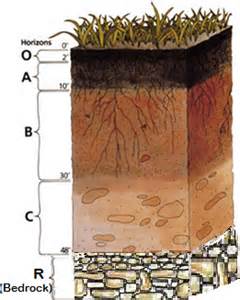
Which horizon is made up of partially weathered rocks?
a)
Horizon A
b)
Horizon B
c)
Horizon C
d)
Horizon D or R
64.
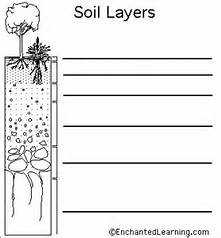
Which horizon contains clay, silt, minerals, and a little humus?
a)
Horizon A
b)
Horizon B
c)
Horizon C
d)
Horizon D or R
65.

The outside layer of the earth is called ______________________.
a)
core
b)
crust
c)
mantle
d)
outer core
66.

The huge pieces of the earth's crust are called ____________________________.
a)
crust
b)
plates
c)
directions
d)
seismos
67.
Which travels fastest, always being the first detected by seismic stations?
a)
P waves
b)
S waves
68.
An instrument that detects and measures earthquakes is a
a)
seismogram
b)
focus seismic map
c)
focus
d)
seismograph
69.

What does the image represent?
a)
Triangulation
b)
Seismograph
c)
Seismogram
d)
Seismic Waves
70.
What are the three main types of volcanoes?
a)
extinct, active, dormant
b)
cinder cone, composite, shield
71.
A sleeping volcano is called what?
a)
active
b)
dormant
c)
extinct
72.
A dead volcano is called what?
a)
active
b)
dormant
c)
extinct
73.

Stratovolcanoes can be described as...
a)
Very large with gentle slopes and eruptions of low viscosity magma
b)
Large with steep slopes and violent eruptions of very viscous magma
c)
Small and clustered in groups with steep slopes and firey eruptions that occur only once
74.

Which types of magma contains the least amount of SiO2
a)
rhyolitic
b)
andesitic
c)
felsic
d)
basaltic
75.

An area of deep cracks that forms between two tectonic plates that are pulling away from each other
a)
rift zone
b)
crater
c)
caldera
d)
vent
76.

What type of fault is the San Andreas?
a)
Convergent
b)
Transform
c)
Optimus Prime
d)
Divergent
77.

The magnitude of an earthquake is measured on a seismograph noting the recordings on the seismogram using this:
a)
Mercalli Scale
b)
Richter Scale
c)
Moment Magnitude Scale
d)
Triple Beam Scale
78.
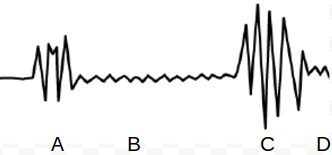
Where are the P-waves located on this seismogram?
a)
A
b)
B
c)
C
d)
D
79.

This forms from a depression left by a glacier and fills with water. (and the water is there for the entire year)
a)
Moraine
b)
Prairie pothole
c)
Kettle Lake
d)
Fiord
80.
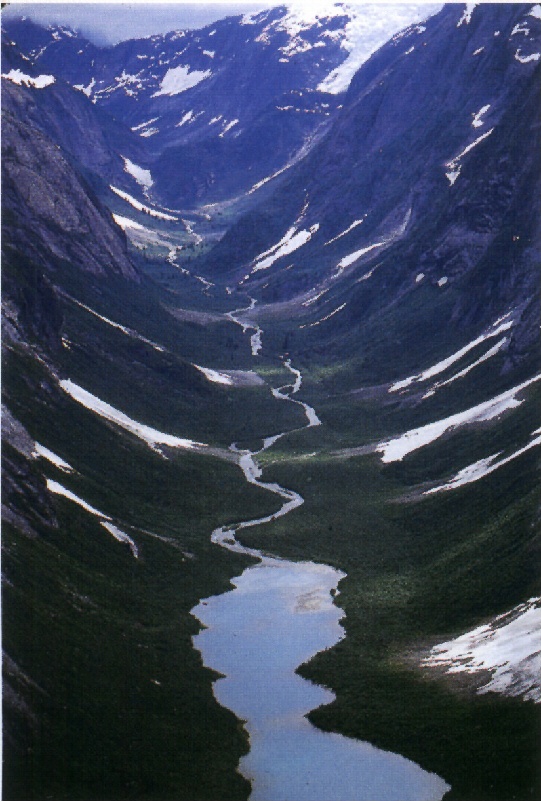
A _____ glacier carves a V-shaped valley into a U-shaped valley.
a)
Valley
b)
Continental
c)
Mountain
d)
Plain
81.
S Waves can move through which of the following?
a)
Gas
b)
Liquid
c)
Solid
d)
All of these
82.
Frank has an eraser. It has a mass of 4g, and a volume of 2cm3. What is its density?
a)
8 g/cm3
b)
2 g/cm3
c)
1/2 g/cm3
d)
24 g/cm3
83.
Impermeable materials...
a)
have an abundance of pores.
b)
let water in.
c)
have little to no pores.
84.

Well sorted soil...
a)
has low porosity
b)
has low pore space
c)
has high porosity
d)
means water will move through slowly
85.

Base your answer to the following question on the diagram, which represents samples of soil and bedrock at Earth’s surface. The arrows represent possible infiltration of rainwater Which sample probably has the greatest porosity?
a)
Granite bedrock
b)
Pebble-and-sand soil
c)
Pebble soil
d)
Conglomerate bedrock
86.

Water can infiltrate loose soil when the soil is...
a)
saturated and permeable
b)
saturated and impermeable
c)
unsaturated and permeable
d)
unsaturated and impermeable
87.

Which well(s) discharge water from a confined aquifer?
a)
1 and 2
b)
1 only
c)
4 and 5
d)
3 and 5
88.
What is the name of the area of groundwater where it is saturated?
a)
Zone of Saturation
b)
Unsaturated Zone
c)
Water Table
d)
Wells
89.

The land area that supplies water to a river system is called a
a)
water table
b)
trailer
c)
house
d)
watershed
90.

At which two locations in this stream is deposition normally dominant over erosion?
a)
A and D
b)
B and E
c)
C and E
d)
D and C
91.

The type of formation shown is at the southern end of the Mississippi river. What is it called?
a)
coastal erosion
b)
a delta
c)
a loess
d)
sand dunes
92.
Which of these is not formed by wave erosion?
a)
Moraine
b)
headlands
c)
sea cave
d)
sea arch
93.
The energy from the sun is created by a process called:
a)
nuclear fission
b)
nuclear fusion
c)
nuclear reaction
d)
nuclear core
94.
What causes day and night?
a)
The sun rises and sets
b)
The Earth rotating on its axis
c)
The Earth revolves around the sun
d)
The tilt of the Earth
95.
As the Earth travels around the sun, this tilt causes different areas of the Earth’s surface to get different amounts of daylight at different times of the year. The angle of the Sun’s rays to the surface also causes areas to have more or less of the Sun’s energy. This causes the ________.
a)
months
b)
day and night
c)
seasons
d)
years
96.
an If-Then Statement that makes a prediction about the outcome
a)
Materials
b)
Hypothesis
c)
Procedure
d)
purpose
97.

What type of stress causes these folds?
a)
compression
b)
shearing
c)
tension
98.

a)
normal fault
b)
reverse fault
c)
strike-slip fault
99.

Stress that stretches rock so that it becomes thinner in the middle!
a)
tension
b)
compression
c)
sheear
d)
rubber-binder
100.

Who is the person credited with developing the theory of continental drift?
a)
Harry Hess
b)
Galileo
c)
Alfred Wegener
d)
Newton
101.

What island is the oldest?
a)
A
b)
B
c)
E
d)
D
102.

What is occuring at C?
a)
rift valley
b)
subduction zone
c)
volano
d)
mid-ocean ridge
103.
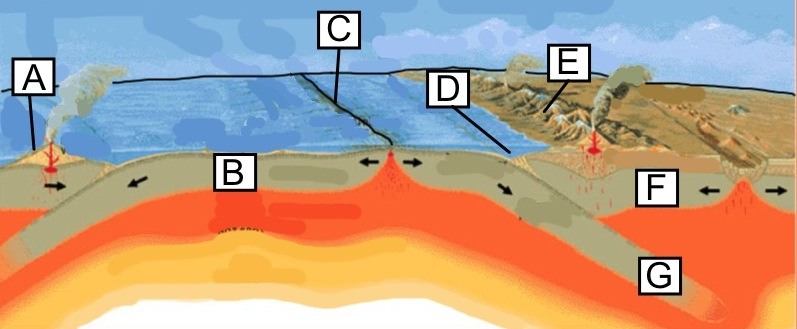
What type of crust is B?
a)
oceanic
b)
continental
104.
What type of crust is B?
a)
oceanic
b)
continental
105.

What is occurring at E?
a)
rift valley
b)
mountains
c)
trench
d)
mid-ocean ridge
100 %

