
 Worksheets
2018 Spring Exam
Total questions: 100
Worksheet time: 2hrs 2mins
Name
Class
Date
1.
Which one needs a greater net force to move, a kilogram of feathers or a kilogram of iron?
a)
feathers
b)
iron
c)
same
d)
depends on their friction
2.

When a cannon fires a cannonball we observe Newton's third law. Which force is the reaction force?
a)
The cannon moving forward
b)
The cannonball moving forward
c)
The cannon moving backward
d)
The cannonball moving backward
3.
The tendency of an object to stay in motion or at rest is called
a)
velocity
b)
acceleration
c)
speed
d)
inertia
4.

Which one of Newton’s Laws of Motion best explains why the dishes do not move when the table cloth is removed?
a)
Newton's 1st Law
b)
Newton's 2nd Law
c)
Newton's 3rd Law
d)
Newton's Law of Biology
5.
What is the difference between mass and weight?
a)
mass is how much matter is in an object, and weight is the gravitational pull on that object
b)
mass and weight are the same
c)
weight affects how much mass is in an object
d)
weight is determined by how many atoms make up an object
6.

How is the teapot being heated?
a)
condensation
b)
conduction
c)
convection
d)
radiation
7.

How is the cat being heated?
a)
condensation
b)
conduction
c)
convection
d)
radiation
8.

Heat always moves from an object of __________ temperature to an object of _________ temperature.
a)
moderate, high
b)
higher, lower
c)
lower, higher
d)
zero, high
9.
Which method of energy transfer does not involve movement of matter?
a)
convection
b)
conduction
c)
radiation
d)
None of the above
10.
Which statement correctly compares the difference between conduction and convection in common classroom settings?
a)
Conduction can only occur in solids and gases, while convection can occur in both liquids and gases
b)
Convection can only occur in solids, while conduction can occur in both liquids and gases
c)
Conduction can only occur in liquids and gases, while convection can occur in solids, liquids, and gases
d)
Convection can only occur in liquids and gases, while conduction can occur in solids, liquids, and gases
∆t=76
∆t=76
11.
_______________ describes how much energy is required to raise an object's temperature.
a)
Conduction
b)
Convection
c)
Specific Heat
d)
Radiation
12.
A cold-blooded reptile basks on a warm rock in the sun. Its body is warmed by
a)
Radiation
b)
Conduction
c)
Convection
d)
Both (a) and (b)
13.

A group of friends gather around a fire to stay warm.
a)
conduction
b)
convection
c)
radiation
14.
Which of the following substances is the best conductor of transferring energy as heat?
a)
Carbon dioxide gas
b)
Water
c)
Iron
d)
Rubber
15.
The faster an object moves, the ________ kinetic energy it has.
a)
more
b)
less
c)
none of the above
d)
all of the above
16.
Why does warm air rise and cool air sink?
a)
Warm air is less dense than cooler air.
b)
Warm air is more dense than cooler air.
c)
Warm air weighs less than cooler air.
d)
Warm air weighs more than cooler air.
17.
When standing near a fire you feel the warmth of the flame due to __________.
a)
Conduction
b)
Convection
c)
Radiation
d)
Insulatiuon
18.
What method of heat transfer occurs through direct contact between solids, liquids, or gases?
a)
Conduction
b)
Convection
c)
Radiation
d)
Insulation
19.
An increase in what factor will affect the kinetic energy of an object or atom/molecule?
a)
Its mass
b)
Its velocity
c)
Mass or velocity will affect the KE of a particle or object
20.
What kind of heat transfer can travel without matter?
a)
Conduction
b)
Convection
c)
Radiation
d)
Condensation
21.
When thermal energy is added to a substance, the substance's particles move:
a)
More rapidly at an increased distance from each other
b)
More rapidly with less distance between each other
c)
More slowly with a greater distance between each other
d)
More slowly with a reduced distance be
22.
Thermal energy always moves from ___________ to __________.
a)
Hot to Hot
b)
Cold to hot
c)
Warmer to cooler
d)
Cooler to warmer
23.
____________ is the ability to cause change.
a)
Energy
b)
Force
c)
Friction
d)
Motion
24.
Energy due to motion is ____________ energy.
a)
Potential
b)
Energy
c)
Kinetic
d)
Friction
25.
Stored energy due to position.
a)
energy
b)
gravitational potential energy
c)
potential energy
d)
chemical potential energy
26.
Energy stored in food and fuels
a)
potential energy
b)
gravitational potential energy
c)
kinetic energy
d)
chemical potential energy
27.
Energy stored by the things above Earth.
a)
energy
b)
gravitational potential energy
c)
kinetic energy
d)
elastic potential energy
28.
Energy stored by things that stretch.
a)
elastic potential energy
b)
energy
c)
potential energy
d)
kinetic energy
29.
The amount of kinetic energy a moving object has depends on its ___________________ and its _____________________.
a)
acceleration/inertia
b)
mass/velocity
c)
feelings/heat
d)
velocity/time
30.
The sun gives off what two forms of energy?
a)
Light/radiant
b)
Heat/Energy
c)
Potential Energy/Kinetic Energy
d)
Photosynthesis/Chemical potential
31.
An electric blanket warms you on a cold evening. How did energy change form?
a)
magic
b)
electrical to thermal
c)
chemical to thermal
d)
thermal to electrical
32.
A pile of logs is burned for a campfire. How did energy change form?
a)
chemical to light/thermal
b)
electrical to thermal
c)
potential to kinetic energy
d)
mechanical to electrical
33.
You eat an orange during half-time during a soccer game. How did energy change?
a)
chemical to mechanical/electrical (nervous system)
b)
chemical to light/thermal
c)
light to thermal
d)
potential to kinetic energy
34.
Total amount of kinetic energy and potential energy in a system.
a)
Potential Energy
b)
Kinetic Energy
c)
Law of Conservation of Energy
d)
Mechanical Energy
35.
Energy may change form, but it cannot be created or destroyed under ordinary conditions.
a)
Law of Conservation of Energy
b)
Law of Order
c)
Law of Conforming Energy
d)
Law of Potential to Kinetic Energy
36.

A battery converts what type of energy to another?
a)
sound to kinetic
b)
light to heat
c)
mechanical to electrical
d)
chemical to electrical
37.
On a roller coaster, where is maximum potential energy?
a)
At the bottom of a big hill
b)
When going around a corner
c)
When going upside down
d)
At the top of a big hill
38.

As a pendulum swings from its highest to lowest position, what happens to its kinetic and potential energy?
a)
Both the potential energy and kinetic energy decrease
b)
The potential energy decreases while the kinetic energy increases
c)
The kinetic energy decreases while the potential energy increases
d)
Bothe the potential energy and kinetic energy increase
39.
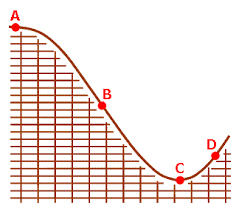
At which point(s) on the roller coaster is the kinetic energy at its maximum?
a)
A
b)
B
c)
C
d)
D
40.
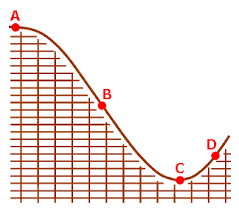
At which point(s) on the roller coaster is the gravitational potential energy at its maximum?
a)
A
b)
B
c)
C
d)
D
41.

At what position does the pendulum have the greatest gravitational potential energy?
a)
Position D
b)
Position C
c)
Position B
42.
At what position does the pendulum have the greatest kinetic energy?
a)
Position D
b)
Position C
c)
Position B
43.

Which character has the greatest gravitational potential energy?
a)
Character A
b)
Character B
c)
Character C
d)
Character D
44.

Which skier has the greatest kinetic energy?
a)
Skier A
b)
Skier B
c)
Skier C
d)
Skier D
45.
Calculate the kinetic energy of a 2 kg rock that rolls down the hill with a velocity of 8 m/s.
a)
64 Joules
b)
16 Joules
c)
128 Joules
d)
8 Joules
46.
A cinder block is sitting on a platform 20 m high. It has a mass of 8 kg. Calculate the potential energy of the cinder block.
a)
1,568 Joules
b)
160 Joules
c)
3 Joules
d)
28 Joules
47.
A girl on a motorbike passes by at a speed of 15 m/s. Her mass is 40 kg. What is her kinetic energy?
a)
300 Joules
b)
600 Joules
c)
950 Joules
d)
4500 Joules
48.
High energy waves have a ____.
a)
high frequency
b)
low frequency
c)
small amplitude
d)
big wavelength
49.
Sound travels fastest through
a)
solids
b)
liquids
c)
gases
d)
empty space
50.
Waves that require a medium are called
a)
mechanical waves
b)
transverse waves
c)
light waves
d)
gamma rays
51.
Which of these CANNOT travel in empty space?
a)
electromagnetic waves
b)
mechanical
52.
When they say there is a perpendicular nature to a mechanical wave they mean
a)
disturbance of particles is up/down while flow of energy right/left, longitudinal
b)
disturbance of particles right/left while flow of energy up/down, transverse
c)
disturbance of particles right/left while flow of energy right/left, tranverse
d)
disturbance of particles up/down while flow of energy right/left, transverse
53.
When they say there is a parallel nature to a mechanical wave they mean
a)
disturbance of particles is up/down while flow of energy right/left, longitudinal
b)
disturbance of particles right/left while flow of energy up/down, transverse
c)
disturbance of particles right/left while flow of energy right/left, longitudinal
d)
disturbance of particles up/down while flow of energy right/left, transverse
54.

What kind of wave is pictured below?
a)
compressional wave
b)
transverse wave
c)
sound wave
d)
mechanical wave
55.
What do we call the bottom of a transverse wave?
a)
crest
b)
trough
c)
wavelength
d)
amplitude
56.
What do we call the top of the wave?
a)
crest
b)
trough
c)
amplitude
d)
frequency
57.
What kind of wave moves at right angles to the direction of the wave?
a)
compressional waves
b)
mechanical waves
c)
transverse waves
d)
ultraviolet rays
58.
What do we call the part of a compressional wave that is squeezed together?
a)
compression
b)
rarefaction
c)
crest
d)
trough
59.
What do we call the part of a compressional wave that is spread a part?
a)
compression
b)
rarefaction
c)
crest
d)
trough
60.
What is a repeating disturbance or vibration that transfers or moves energy from place to place?
a)
Medium
b)
Wave
c)
Compression
d)
Rarefaction
61.

Which letter represents wavelength?
a)
A
b)
B
c)
C
d)
D
62.

Which letter represents the wave crest?
a)
A
b)
B
c)
C
d)
D
63.

Which letter represents the wave trough?
a)
A
b)
B
c)
C
d)
D
64.

Which letter represents amplitude?
a)
A
b)
B
c)
C
d)
D
65.

Which wave has a greater frequency?
a)
A
b)
B
66.
What is the number of wavelengths that pass a point each second called?
a)
speed
b)
frequency
c)
amplitude
d)
medium
67.

Which wave in the diagram below appears to have the lower frequency?
a)
Wave A
b)
Wave B
c)
They have the same frequency
d)
Only amplitudes are shown
68.

Which wave in the diagram below appears to have the higher amplitude?
a)
Wave A
b)
Wave B
c)
They both have the same amplitude
d)
The waves only show frequency
69.
Which of these electromagnetic waves can we see?
a)
radio
b)
x-ray
c)
microwave
d)
visible light
70.
The number of wavelengths that pass a point each second
a)
frequency
b)
wavelength
c)
pitch
d)
amplitude
71.
Which material would not let light waves through?
a)
transparent
b)
transmissive
c)
translucent
d)
opaque
72.
A reflected sound wave
a)
frequency
b)
pitch
c)
echo
d)
rarefaction
73.
What happens when white light is made to pass through a prism?
a)
The white light is blocked inside the prism.
b)
The white light is reflected back by the prism.
c)
The white light separates into light of different colors
d)
The white light comes out the prism with increased rightness
74.
What are the three primary colours of light?
a)
red, green, blue
b)
red, yellow, blue
c)
yellow, magenta, cyan
d)
red, yellow, green
75.
The law of reflection states:
a)
the normal is at a right angle to the mirror
b)
incident rays are brighter than reflected rays
c)
the angle of incidence is equal to the angle of reflection
d)
only smooth, shiny surfaces reflect light
76.
The normal or norm is:
a)
an imaginary line at right angles to a reflecting surface
b)
where light enters and leaves a mirror during reflections
c)
at the same angle as the reflected ray of light
d)
always the same for all flat surfaces
77.

The unit of frequency is ___.
a)
meters
b)
nanometers (nm)
c)
m/s
d)
Hertz
78.

When a light ray travels from air to water it is bent. This process is called ____.
a)
reflection.
b)
refraction.
c)
diffraction
d)
infraction
79.

Constructive interference results in ____.
a)
larger amplitude.
b)
larger frequency.
c)
lower amplitude.
d)
lower wavelength
80.
The number of waves that pass a given point in a certain amount of time.
a)
Frequency
b)
Lens
c)
Wavelength
d)
Rays
81.
What happens when light hits a mirror?
a)
it makes a color
b)
it reflects
c)
it makes a rainbow
d)
it passes through
82.
The interaction between two waves that meet is called
a)
reflection
b)
refraction
c)
diffraction
d)
interference
83.
Another name for light bending is ....
a)
Reflaction
b)
Absorbing
c)
Refraction
d)
mirror
84.
Electromagnetic waves with the longest wavelengths are
a)
gamma rays
b)
x-rays
c)
infrared waves
d)
radio waves
85.
Which of the following does NOT belong in the electromagnetic spectrum:
a)
X-ray
b)
sound wave
c)
ultra violet rays
d)
microwaves
86.

_____________________light is the only type of EM wave detected by the human eye.
a)
Red
b)
Gamma
c)
Microwave
d)
Visible
87.

Wavelengths on the right side of the Electromagnetic spectrum are ______________.
a)
short
b)
long
c)
average
88.

_______ carry the greatest amount of energy.
a)
x-rays
b)
gamma rays
c)
infrared rays
d)
visible light
89.
Select the correct order of waves on the Electromagnetic Spectrum
a)
Radio, Micro, Infra, Visible, Ultra, X-ray, Gamma
b)
Gamma, X-ray, Ultra, Vis, Infra, Micro, Radio
c)
Vis, Micro, Infra, Ultra, X-ray, Gamma, Radio
d)
Micro, Radio, Vis, Infra, Ultra, X-ray, Gamma
90.

Which letter shows reflection?
a)
Pathway A
b)
Pathway B
c)
Pathway C
d)
Pathway D
91.

What is this image an example of?
a)
Reflection
b)
Diffusion
c)
Refraction
92.

Primary colors of light can combine to make
a)
black light
b)
white light
c)
primary pigments
d)
ultraviolet light
93.

The Law of Reflection:
The angle of incidence is _________ the angle of reflection
The angle of incidence is _________ the angle of reflection
a)
bigger than
b)
the same as
c)
smaller than
94.

_____ is a lens that is thicker in the middle and can make an object appear larger.
a)
prism
b)
convex lens
c)
concave lens
d)
mirror
95.

______ is a lens that is thicker on its edges and makes an object appear smaller?
a)
mirror
b)
convex lens
c)
concave lens
d)
prism
96.

Which is the angle of incident?
a)
Angle 1
b)
Angle 2
97.
When the crests of one wave overlap the crests of another wave or waves, this occurs.
a)
A. diffraction
b)
B. destructive
interference
c)
C. constructive
interference
d)
D. resonant
frequencies
98.
When two waves combine to form a new wave with a smaller amplitude, it is called
a)
Refraction
b)
Constructive Interference
c)
Resonance
d)
Destructive Interference
99.
When two waves combine to form a new wave with a larger amplitude, it is called
a)
Diffraction
b)
Destructive Interference
c)
Resonance
d)
Constructive Interference
100.

If two overlapping waves are in-phase, the resultant wave will have ______ compared to the two waves.
a)
Greater amplitude
b)
Greater frequency
c)
Greater wavelength
d)
Greater wave speed
100 %

