
 Worksheets
Semester Review
Total questions: 100
Worksheet time: 1hrs 23mins
Name
Class
Date
1.
Why are approved eye protection devices (such as goggles) are worn in the lab?
a)
A. To improve your vision
b)
B. To make you look like a bug
c)
C. To give you headaches
d)
D. To protect eyes around chemicals, heat, or glassware
2.
If a lab fire erupts, immediately:
a)
A. Notify (or tell) your teacher
b)
B. Run and scream
c)
C. Throw water at the fire
d)
D. Open the windows
3.
You are working in the lab using glassware. Your partner drops a glass beaker and it shatters. A piece of glass gets in his eyes. What should he have been wearing?
a)
A. Gloves
b)
B. Sun glasses
c)
C. Safety Goggles
d)
D. A lab aporn
4.
You are in lab and your partner accidentally gets their hair stuck in a triple beam balance. What should have your partner done?
a)
A. Worn a hat in class
b)
B. Skipped class
c)
C. Got a hair cut
d)
D. Tied/pulled their hair back
5.
If you have been injured in the lab, what should you do first?
a)
A. Apply the first aid yourself
b)
B. Go to doctor after school in a few hours
c)
C Tell your science teacher immediately
d)
D. Not tell anyone
6.
All of the x values or inputs are called what?
a)
Domain
b)
Range
c)
Relation
d)
Function
7.
Type of graph that compares item quantities.
a)
pie graph
b)
table
c)
bar and column graph
d)
line graph
8.
Type of graph that shows changes in quantities over time and distance.
a)
line graph
b)
pie graph
c)
table
d)
bar and column graph
9.
The horizontal axis; usually for categories.
a)
X-axis
b)
grids
c)
legend
d)
Y-axis
10.
The vertical axis; usually for values.
a)
X-axis
b)
grids
c)
Y-axis
d)
legend
11.
Variable - A placeholder for a piece of information that can change.
a)
True
b)
False
12.
The things that are kept the same to ensure the results are due to the experiment is called..
a)
Control
b)
Constant
c)
Independent Variable
d)
Dependent Variable
13.
The variable the is changed on purpose is..
a)
Constant
b)
Control
c)
Independent Variable
d)
Dependent Variable
14.
The variable that is being tested, counted, or measured and is responding to the independent variable is known as
a)
Control
b)
Constant
c)
Independent Variable
d)
Dependent Variable
15.
Its one of the independent variables that is use for comparison, does not get any change, original or plain variable.
a)
Constant
b)
Control
c)
Independent Variable
d)
Dependent Variable
16.
The rate at which velocity changes is called
a)
speed
b)
direction
c)
acceleration
d)
motion
17.
Speed equals distance divided by
a)
time
b)
velocity
c)
size
d)
motion
18.
When an object’s distance from another object is changing,
a)
it is in motion.
b)
it is speeding.
c)
it is accelerating.
d)
it is moving at a high velocity.
19.
A place or object used for comparison to determine if something is in motion is called
a)
a position
b)
a reference point
c)
a constant
d)
velocity
20.
The moon accelerates because it is
a)
in a vacuum in space.
b)
continuously changing direction.
c)
a very large sphere.
d)
constantly increasing its speed of orbit.
21.
A change in an object's position relative to a reference point is called ____________ .
a)
speed
b)
velocity
c)
motion
d)
acceleration
22.
If you increase the amount of space between two objects, the force of gravity...
a)
increases
b)
decreases
c)
stays the same
23.
If you decrease the mass of an object, the force of gravity...
a)
increases
b)
decreases
c)
stays the same
24.
Friction occurs because the surface of objects are very smooth at the molecular level.
a)
True
b)
False
25.
Which of the following is not a type of friction?
a)
static
b)
stickiness
c)
sliding
d)
fluid
26.
Friction occurs because the surface of objects are very smooth at the molecular level.
a)
True
b)
False
27.
T/F: Fluid friction between an object and air is called air resistance.
a)
True
b)
False
28.
The force that opposes motion is ________.
a)
a balanced force
b)
an unbalanced force
c)
an accelerating force
d)
friction
29.
The unit of force is ______.*
a)
grams
b)
liters
c)
newtons
d)
kilograms
30.
Gravitational force exerted on an object
a)
mass
b)
weight
c)
gravity
d)
force
31.
Attractive force that exists between all object that have mass.
a)
mass
b)
weight
c)
gravity
d)
friction
32.
Amount of matter in an object
a)
weight
b)
force
c)
mass
d)
colume
33.
Mass is measured in ___________.
a)
grams
b)
newtons
c)
joules
d)
mililiters
34.
Two factors effecting the magnitude of the force of gravity between 2 objects are...
a)
mass and distance
b)
mass and matter
c)
distance and weight
d)
weight and mass
35.
Gravity attracts all objects towards one another.
a)
False
b)
True
c)
It depends
36.
Any object with mass has gravity.
a)
True
b)
Sometimes
c)
False
d)
Never
37.
Friction is a force that acts in an ___________ direction of movement.
a)
similar
b)
opposite
c)
parallel
d)
west
38.
Friction is a force that acts in a(n) ___________ direction relative to a moving object.
a)
similar
b)
opposite
c)
parallel
d)
perpendicular
39.
What does friction tend to produce?
a)
light
b)
sound
c)
heat
d)
gravity
40.
What is the unit that measures force?
a)
Weight
b)
Net force
c)
Newton
d)
Kilogram
41.
How would the absence of friction affect a marble traveling on a long, straight path?
a)
The marble’s speed would decrease.
b)
The marble’s speed would increase.
c)
The marble would stop immediately.
d)
The marble would remain at a constant speed.
42.
Two factors effecting the magnitude of the force of gravity between 2 objects are...
a)
mass and distance
b)
mass and volume
c)
distance and weight
d)
weight and mass
43.
An object is falling but it is not accelerating. What do you know?
a)
Gravity is stronger than air resistance.
b)
Air resistance is stronger than gravity.
c)
Air resistance is equal to gravity.
d)
The forces of air resistance and gravity are unbalanced.
44.
The tendency of an object at rest to stay at rest unless it is acted upon by a force is called ___________________
a)
inertia
b)
motion
c)
gravity
d)
lubricant
45.
Which could be an example of a balanced force?
a)
An asteroid moving at a constant speed through space
b)
A car accelerating from a stop sign
c)
A box of dishes falling from a counter
d)
A rocket taking off
46.
Which could be an example of an unbalanced force?
a)
A plate sitting on a dining table
b)
A ball at the top of a hill that is not moving
c)
Earth orbiting the Sun
d)
A baseball that has been thrown to home plate.
47.

A ____________ is a push or a pull on an object.
a)
friction
b)
force
c)
magnet
d)
gravity
48.
What will cause an object to move?
a)
Applied forces
b)
Balanced forces
c)
Unbalanced forces
49.
A push or pull that causes a change in motion
a)
Friction
b)
Gravity
c)
Force
d)
Mass
50.

"For every action, there is an equal and opposite reaction."
a)
Newton's 1st Law
b)
Newton's 2nd Law
c)
Newton's 3rd Law
d)
Newton's 4th Law
51.

Force = Mass x Acceleration
a)
Newton's 1st Law
b)
Newton's 2nd Law
c)
Newton's 3rd Law
d)
Newton's 4th Law
52.

"An object in motion (or at rest) will to stay in motion (or at rest) until an outside force acts upon it."
a)
Newton's 1st Law
b)
Newton's 2nd Law
c)
Newton's 3rd Law
d)
Newton's 4th Law
53.

The tendency of an object to resist changes in its motion is...
a)
inertia
b)
force
c)
acceleration
d)
velocity
54.
A Newton is a unit of...
a)
force
b)
inertia
c)
acceleration
d)
velocity
55.

Which best explains why we are able to accelerate forward when starting to run?
a)
As one leg moves backward, it provides an equal and opposite force for the other foot to move forward.
b)
No acceleration takes place. Runners are always at a fixed velocity.
c)
The striking foot pushes backward against the ground. The friction with the ground provides an equal and opposite force forward.
d)
The runner's upper body quickly leans forward, causing the entire body to begin accelerating forward
56.

This is a __________wave
a)
transverse
b)
longitudinal
c)
surface
d)
all of the above
57.

This is a __________wave
a)
transverse
b)
longitudinal
c)
surface
d)
all of the above
58.

This is a __________wave
a)
transverse
b)
longitudinal
c)
surface
d)
all of the above
59.
The distance from any point on a wave to an identical point on the next wave
a)
A. frequency
b)
B. wavelength
c)
C. wave speed
d)
D. amplitude
60.
A wave that is an oscillation of matter, and therefore transfers energy through a medium.
a)
mechanical wave
b)
medium
c)
surface wave
61.
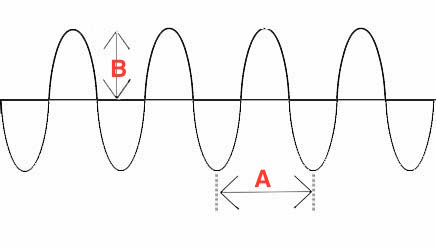
What property of this wave is represented by the letter "A"
a)
amplitude
b)
crest
c)
trough
d)
wavelength
62.
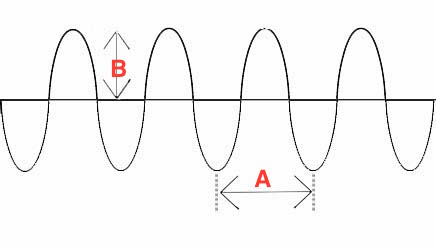
What property of the wave is represented by the letter "B"?
a)
amplitude
b)
crest
c)
trough
d)
wavelength
63.
The highest point on a wave is:
a)
the crest
b)
the trough
c)
the top
d)
the coast
64.
The lowest point on a wave is the:
a)
Amplitude
b)
Crest
c)
Trough
d)
Wavelength
65.
A mechanical wave cannot travel through...
a)
a vacuum(empty space).
b)
water.
c)
air.
d)
glass.
66.
The number of wavelengths that pass a point each per second is:
a)
frequency
b)
period
c)
longitudinal
d)
transverse wave
67.
What does it mean to refract?
a)
bounce off
b)
to bend
c)
curve outward
d)
reflect
68.
What happens when light hits a mirror?
a)
it makes a color
b)
it reflects
c)
it makes a rainbow
d)
it passes through
69.
A wave that does not require a medium
a)
A. electromagnetic wave.
b)
B. surface
wave
c)
C. medium
d)
D. transverse
wave
70.
When the crests of one wave overlap the crests of another wave or waves, this occurs.
a)
A. diffraction
b)
B. destructive
interference
c)
C. constructive
interference
d)
D. resonant
frequencies
71.
As wavelength decreases in the electromagnetic spectrum the frequency _____.
a)
decreases
b)
stays the same
c)
increases
d)
doubles
72.
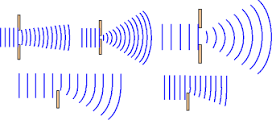
What is showing?
a)
Diffraction
b)
Interference
c)
refraction
73.
True or false: as you move along the spectrum, left to right, the wavelengths decrease in size (get smaller)
a)
true
b)
false
c)
Other
74.
Which has the SHORTEST wavelength and, therefore, the highest frequency/most energy
a)
Radio waves
b)
Ultraviolet Rays
c)
Gamma Rays
d)
X-rays
75.
What is the electromagnetic spectrum?
a)
the range of wavelengths or frequencies over which elctromagnetic radiation extends.
b)
A type of wave
c)
wave properties
76.
How are electromagnetic waves different from other waves?
a)
They have very short wavelengths
b)
They transmit energy instead of matter
c)
They can travel through a vacuum
d)
They can change direction by reflection
77.
An object that blocks all of the light from passing through is...
a)
transparent
b)
clear
c)
opaque
d)
translucent
78.
This type of object lets some light through, but not all. It is not easy to see through this type of material.
a)
transparent
b)
translucent
c)
co-parent
d)
opaque
79.
A block of wood is opaque.
a)
true
b)
false
80.
If an object allows most all light to pass through it then it is...
a)
transparent
b)
opaque
c)
translucent
d)
cold
81.

Identify if the material is transparent, translucent, or opaque.
a)
Transparent
b)
Translucent
c)
Absords
d)
Opaque
82.

Identify if the material is transparent, translucent, or opaque.
a)
Transparent
b)
Translucent
c)
Opaque
d)
Absorbs
83.

Identify if the material is transparent, translucent, or opaque.
a)
Translucent
b)
Opaque
c)
Transparent
84.
A mixture of cyan and yellow paints gives ________ paint.
a)
Green
b)
Red
c)
Black
d)
Blue
85.
Adding red and green spotlights gives us what color?
a)
Cyan
b)
Yellow
c)
Blue
d)
Magenta
86.
Suppose that two flashlight beams are shone on a white screen, one through a pane of blue glass and the other through a pane of green glass. What color appears on the screen where the beams overlap?
a)
Yellow
b)
Green
c)
Cyan
d)
Magenta
87.
Where does light come from in the natural world?
a)
photons released when electrons fall from high to low orbital
b)
light does not occur in the natural world
c)
all light originates from the Sun in our entire universe
88.
The worst thing you can do for the health of a green-leafed plant is to illuminate it with only
a)
red light
b)
green light
c)
blue light
d)
all are equally bad
89.
Why do we see a GREEN leaf?
a)
because humans color it that color
b)
because it absorbs green and reflects all the other colors
c)
it absorbs every color except for green
90.
What are the primary colors?
a)
Red and Green
b)
Yellow, Red, and Blue
c)
Purple and Blue
d)
Light Blue and Blue
91.
The part of the eye that is made up of rods and cones and absorbs light is the
a)
Retina
b)
Iris
c)
Pupil
d)
Optic nerve
92.

An object appears red because it
a)
reflects light waves of all colors
b)
reflects light waves of red
c)
absorbs light waves of red
d)
transmits light waves of all colors
93.
Regulates the amount of light entering the eye and gives the eye its color.
a)
Iris
b)
Lens
c)
Pupil
d)
Retina
94.
Pupil
a)
Focuses light
b)
Clear tissue that covers the front of the eye
c)
Opening through which light enters the eye
d)
Layer of receptor cells
95.
The clear tissue that covers the front of the eye.
a)
Lens
b)
Pupil
c)
Iris
d)
Cornea
96.

What is letter B
a)
Optic nerve
b)
Lens
c)
Cornea
d)
Retina
97.
This part of the eye carries the message from your eye to the part of your brain that controls vision.
a)
cornea
b)
lens
c)
optic nerve
d)
retina
98.
The pupil is
a)
The adjustable opening in the center of the eye through which light enters
b)
light reflected off objects
c)
a light sensistive inner surface container receptor rods and cones
d)
near the cochlea
99.
What allows us to see objects near and far?
a)
Pupil
b)
Lens
c)
Iris
d)
Sclera
100.
This part of the eye sends messages to the brain
a)
rods
b)
retina
c)
optic nerve
d)
cones
100 %

