
 Worksheets
SUPER EPIC BEFORE SPRING BREAK LIFE SCIENCE QUIZIZZ
Total questions: 208
Worksheet time: 3hrs 19mins
Name
Class
Date
1.
What is CMS's address?
a)
716 Belvoir
b)
716 Germantown
c)
761 Belvoir
d)
761 Germantown
2.

Which plant parts are the tubes that carry water throughout the plant? (These were dyed red in our celery.)
a)
xylem
b)
phloem
c)
roots
d)
leaves
3.

Which plant part is responsible for reproduction?
a)
flower
b)
roots
c)
stem
d)
leaves
4.
What is true of all plants?
a)
consumer
b)
decomposer
c)
producer
5.
What is true of all plants?
a)
multicellular
b)
unicellular
6.

A fruit is a genius way for plants to help disperse the __________ of the plant!
a)
cones
b)
fruit
c)
spores
d)
seeds
7.

What do these plants use for reproduction?
a)
seeds
b)
spores
8.

What is a plant's ovary?
a)
the female structure of the flower that becomes a fruit
b)
the female structure of the flower that accepts the pollen
c)
the male structure of the flower that produces pollen
d)
another name for the stem of the plant
9.

Gases enter and exit a leaf through the what? (These were the green structures on the leaves of our creeping heart plant!)
a)
vascular tissue
b)
mouth hole
c)
stomata
d)
cell wall
10.
What kind of cells do plants have?
a)
prokaryotic
b)
eukaryotic
11.
Some plants reproduce __________ using sperm and egg (creating more diverse offspring), while other plants reproduce __________ (creating identical offspring).
a)
sexually, asexually
b)
asexually, sexually
12.
How do the nervous and muscular systems interact?
a)
When a muscle is stimulated, a signal is sent to the brain and the brain sends a message back to the muscles to react
b)
When a muscle is stimulated, a signal is sent to the skeleton and the bones move the muscles
c)
When a nerve is stimulated, a signal is sent to the muscles and they move the bones
d)
The nervous system has no control over the muscular system
13.
What is the body system that sends and recieves electrical signals from the brain?
a)
Skeletal System
b)
Nervous System
c)
Muscular System
d)
Digestive System
14.
What system controls voluntary and involuntary life functions?
a)
Nervous System
b)
Skeletal System
c)
Digestive System
d)
Respiratory System
15.
Why is the blood that flows from the lungs to the heart bright red?
a)
It has oxygen in it
b)
It has carbon dioxide in it
c)
It has food coloring in it
d)
It has waste in it
16.
Which body system transports oxygen and nutrients through out the body?
a)
Muscular System
b)
Nervous System
c)
Digestive System
d)
Circulatory System
17.
What system breaks food down into energy for the body?
a)
Stomach
b)
Digestive System
c)
Respiratory system
d)
Lungs
18.
What system receives oxygen and gets rid of carbon dioxide?
a)
Heart
b)
Muscular System
c)
Veins
d)
Respiratory System
19.
Which of the following is in the correct order from smallest to largest?
a)
tissue-organ-system-cell
b)
cell-organ-tissue-system
c)
System-tissue-cell-organ
d)
cell-tissue-organ-system
20.
How does the cardiovascular system and the respiratory system work together?
a)
The cardiovascular system transports oxygen around the body while the repiratory system gives the body oxygen
b)
The cardiovascular system makes cells while the respiratory system moves them where they are suppose to go.
c)
The cardiovascular system allows the body to have energy while the repiratory system makes cells
d)
The cardiovascular system transports nutrients around the body while the respiratory system brings oxygen into the body
21.
The main function of the respiratory system is to do what?
a)
Circulate nutrient rich blood to the body
b)
To absorb nutrients into the body
c)
To exchange gasses between the blood and the environment.
d)
To relay information to the body for life support
22.
What organ absorbs the majority of nutrients?
a)
Large Intestines
b)
Small Intestines
c)
Stomach
d)
Liver
23.
What blood vessels go away from the heart?
a)
Arteries
b)
Capillaries
c)
Veins
d)
Heart
24.
What blood vessels bring blood back to the heart?
a)
Arteries
b)
Veins
c)
Capillaries
d)
Heart
25.
Where does mechanical and chemical breakdown start in the digestive system?
a)
stomach
b)
liver
c)
small intestines
d)
mouth/teeth
26.

Saliva is a fluid that helps with food digestion.
a)
True
b)
False
27.
Cardiac muscles are found in the walls of organs such as the stomach, intestines, blood vessels, and bladder.
a)
True
b)
False
28.
What system does the muscular system work with to move the body?
a)
Skeletal
b)
Digestive
c)
Respiratory
d)
Circulatory
29.
The Integumentary system is what system?
a)
Digestive system
b)
Muscular system
c)
Skin system
d)
Respiratory system
30.
What is the main function of the heart?
a)
To exchange gasses with the blood and the environment
b)
To filter out impurities and eliminate waste
c)
To digest food mechanically and chemically
d)
To pump blood through the body
31.
What is the main function of the circulatory system?
a)
Circulate nutrient rich blood to the body
b)
To absorb nutrients into the body
c)
To exchange gasses between the blood and the environment.
d)
To relay information to the body for life support
32.
in which blood vessels are nutrients and wastes exchanged in the blood?
a)
Arteries
b)
Veins
c)
Capillaries
d)
Heart
33.
Tissues join together to form:
a)
cells
b)
organs
c)
organ systems
d)
organisms
34.
What is a group of similar cells that work together?
a)
Tissue
b)
Organ
c)
Cell group
d)
Organ system
35.
The maintenance of a stable internal environment is called....
a)
homestasis
b)
regulation
c)
control
d)
balance
36.
What is the correct order of organization
a)
cells->tissue->organs->organ systems-> organism
b)
tissue->cells->organs->organ systems-> organism
c)
organs->organ systems-> organism->cells->tissue
d)
cells->tissue->organs->organism->organ system
37.
An example of tissue is
a)
muscle
b)
blood
c)
stomach
d)
brain
38.
An example of an organ is
a)
epithelial
b)
circulatory
c)
tissue
d)
stomach
39.
An example of an organ system is
a)
brain
b)
lungs
c)
integumentary
d)
bladder
40.
What is mechanical digestion?
a)
food is crushed and broke down in the mouth
b)
enzymes break down food in the stomach
c)
food is crushed and broke down in the small interstine
d)
enzymes break down food in the mouth
41.
How does the circulatory and digestive systems work together?
a)
The digestive system provides oxygen to circulatory system which then transports it throughout body.
b)
The circulatory system brings food to the digestive system to be broken down.
c)
The digestive system breaks down food and the circulatory system transports the nutrients throughout the body.
d)
These systems do not work together.
42.

What is #1 pointing to?
a)
ovary
b)
petal
c)
stigma
d)
stamen
43.

What is #8 pointing to?
a)
petal
b)
stamen
c)
pistil
d)
ovary
44.
The male part of the flower is known as the _____.
a)
stamen
b)
pistil
c)
ovary
d)
petal
45.
The female part of the flower is known as the ____.
a)
stamen
b)
anther
c)
filament
d)
pistil
46.
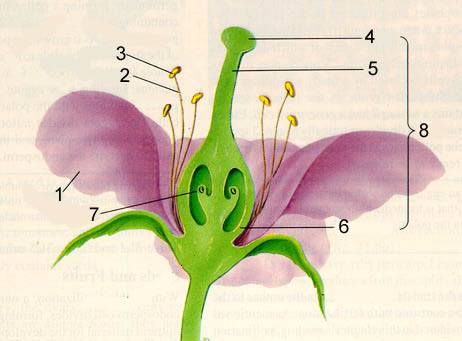
What is #2 pointing to?
a)
anther
b)
filament
c)
ovary
d)
style
47.

What is #3 pointing to?
a)
stigma
b)
filament
c)
ovary
d)
anther
48.
In what part of the flower does fertilization take place?
a)
anther
b)
stigma
c)
ovary
d)
filament
49.

What is #7 pointing to?
a)
anther
b)
ovary
c)
ovule
d)
petal
50.

What is #6 pointing to?
a)
stigma
b)
style
c)
ovary
d)
petal
51.

What is #5 pointing to?
a)
anther
b)
filament
c)
stigma
d)
style
52.
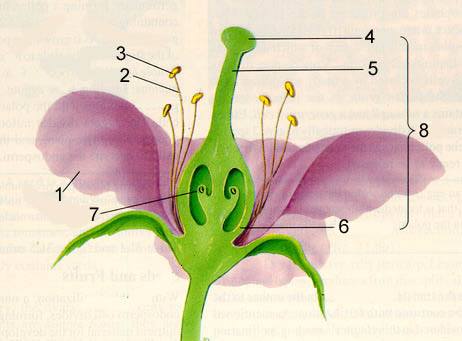
What is #4 pointing to?
a)
anther
b)
style
c)
stigma
d)
ovary
53.
Where is pollen made?
a)
ovary
b)
petal
c)
pistil
d)
anther
54.
What is the sticky part of the flower that catches pollen?
a)
style
b)
stigma
c)
ovary
d)
petal
55.
What part of the flower will turn into a fruit?
a)
petal
b)
ovary
c)
ovule
d)
stamen
56.
What part of the flower will turn into a seed?
a)
ovary
b)
anther
c)
ovule
d)
filament
57.
All scientists agree that viruses are living
a)
True
b)
False
58.
Viruses are...
a)
prokaryotic
b)
eukaryotic
c)
Neither, they don't have cells
d)
endospores
59.
Viruses can reproduce on their own
a)
False
b)
True
60.
Reasons that viruses are considered to be nonliving is because
a)
They are not made of cells
b)
They cannot reproduce on their own
c)
They do not exchange gases
d)
all of the above
61.
What do viruses need to reproduce?
a)
they need genetic material
b)
They need a host cell
c)
They need bacteria
d)
They need insulin
62.
Viruses are cells.
a)
True
b)
False
63.
Which of the following occurs after a virus attaches to a host cell in the viral reproduction process?
a)
The host cell dies
b)
The virus dies
c)
The virus inserts its genetic information into the host cell
d)
copies of the virus are immediately released from the host
64.
Which of the following is not caused by a virus?
a)
influenza
b)
Measles
c)
AIDS
d)
MRSA
65.
After a virus inserts its genetic material, what sometimes happens to the host cell?
a)
It explodes
b)
It becomes a virus cell
c)
Nothing ever happens
d)
All of these
66.
Viruses can eliminate waste
a)
True
b)
False
67.
Viruses use energy
a)
True
b)
False
68.
Viruses grow and develop
a)
True
b)
False
69.
Viruses are classified in the Domain Bacteria
a)
True
b)
False
70.

If viruses aren't made of cells, then what are they made of?
a)
bravery
b)
A protein shell
c)
eggs
d)
DNA
71.

A bacteriophage is a virus that infects
a)
other viruses
b)
bacteria
c)
humans
d)
birds
72.

Viruses can only infect cells that
a)
look yummy
b)
have complementary surface proteins
c)
have the same DNA sequence
d)
have the same overall shape
73.
Solar energy is a type of
a)
potential energy
b)
kinetic energy
74.
The energy stored in food is
a)
chemical
b)
mechanical
c)
gravitational
d)
kinetic
75.

This is a picture of
a)
a unicorn
b)
DNA
c)
RNA
d)
a virus
76.
Cells work in teams to form
a)
organs
b)
organ systems
c)
tissues
d)
organisms
77.
Which plant structure helps it to collect energy from the sun?
a)
cell membrane
b)
cell wall
c)
cytoplasm
d)
chloroplasts
78.
Which plant cell structure helps to give it structure and support?
a)
cell wall
b)
large vacuole
c)
chloroplast
d)
chlorophyll
79.
Which metric unit is often used when viewing microscopic specimens
a)
micrometer
b)
kilometer
c)
milligram
d)
centiliter
80.
Once we breathe ____________ into our lungs, it goes to the heart, which pumps it out into the blood vessels.
a)
oxygen
b)
carbon dioxide
81.
Cell organelles are like tiny little ____________.
a)
cells
b)
tissues
c)
organs
d)
organ systems
82.
All cells are either considered plant cells or animal cells
a)
true
b)
false
83.
Describe the offspring made from sexual reproduction
a)
The offspring are exactly like one of the parents
b)
The offspring is a combination of both parents
c)
The offspring are not like either of their parents. They got their DNA from someone else.
d)
THe offspring will be like the dad.
84.
Describe the offspring made from asexual reproduction
a)
It will be a little similar to the parent
b)
It will be exactly like the parent
c)
It will be very different from the parent
d)
It will be a mixture of both parents
85.
Which of the following is NOT a gamete?
a)
egg
b)
sperm
c)
skin cell
d)
all of the above are gametes
86.
If a regular body cell had 30 chromosomes, how many chromosomes would be found in the ZYGOTE?
a)
30
b)
60
c)
15
d)
cannot tell
87.
The process of a sperm cell joining the egg cell is called...
a)
zygote
b)
gamete
c)
fertilization
d)
cellular respiration
88.
Once the zygote is created, what process will be used to make more cells to GROW the organism?
a)
mitosis
b)
meiosis
c)
fertilization
d)
cellular respiration
89.
The diploid number is 90, so that means the haploid number is
a)
90
b)
180
c)
45
d)
60
90.
Meiosis is the process of cell division for making more...
a)
somatic (body cells)
b)
egg and sperm cells
c)
skin cells
d)
brain cells
91.
If a human cell has 46 chromosomes, how many chromosomes are found in each cell at the end of mitosis?
a)
23
b)
92
c)
46
d)
varies
92.
If a human cell has 46 chromosomes, how many chromosomes are in each cell at the end of meiosis?
a)
23
b)
46
c)
92
d)
varies
93.
How many cells are produced at the end of mitosis?
a)
2
b)
4
c)
46
d)
23
94.
How many cells are produced at the end of meiosis?
a)
2
b)
4
c)
46
d)
23
95.
If a regular BODY (somatic) cell had 30 chromosomes, how many chromosomes would be found in the GAMETES?
a)
30
b)
15
c)
10
d)
60
96.
What is the pigment in chloroplasts that performs photosynthesis?
a)
Chlorosynthesis
b)
Chlorophyll
c)
ADP
d)
Electron Transport
97.
Which of the following is an example of a HETEROTROPH?
a)
Grass
b)
Algae
c)
Lemon Tree
d)
Bear
98.
What is the main chemical compound that stores and releases energy?
a)
ATP
b)
Cytoplasm
c)
PTP
d)
Oxygen
99.
Which of the following is an example of an AUTOTROPH?
a)
Appletree
b)
Dog
c)
Mushroom
d)
Human
100.
Which of the following is an example of a HETEROTROPH?
a)
Grass
b)
Algae
c)
Lemon Tree
d)
Bear
101.
What is the ultimate ORIGINAL source of energy for living things
a)
Sugar
b)
Sun
c)
Moon
d)
Carbon Dioxide
102.
Which organisms perform Photosynthesis?
a)
Only Autotrophs
b)
Only Heterotrophs
c)
Autotrophs and Heterotrophs
103.
What process occurs when light energy is captured in autotrophs and converted into sugar?
a)
Photosynthesis
b)
Cellular Respiration
104.
Which organelle performs CELLULAR RESPIRATION?
a)
Chloroplast
b)
Mitochondria
105.
Which of the following is the correct equation for CELLULAR RESPIRATION?
a)
Sugar + O2 --> CO2 + H2O + ATP
b)
ATP + O2 --> CO2 + H2O + sugar
c)
Sugar + CO2 --> O2 + H2O + ATP
d)
Sugar + H2O + O2 --> CO2 + O2 + ATP
106.
Which of the following is the correct equation for PHOTOSYNTHESIS?
a)
CO2 + light + H2O --> O2 + Sugar
b)
CO2 + sugar + H2O --> O2 + light
c)
O2 + light + H2O --> CO2 + Sugar
d)
CO2 + O2 + H2O --> Light+ Sugar
107.

Which is NOT part of the cell theory?
a)
"All living organisms are made of cells."
b)
"All cells must possess a nucleus containing DNA."
c)
"Cells are the basic unit of all living organisms."
d)
"New cells only come from pre-existing cells."
108.

What is the function of #9?
a)
convert solar energy into chemical energy
b)
convert chemical energy from food into ATP
c)
break down waste using enzymes
d)
store food, water, or waste
109.

Which cell part do all prokaryotes possess?
a)
Nucleus
b)
Ribosomes
c)
Endoplasmic Reticulum
d)
Lysosomes
110.

What product does #1 manufacture?
a)
ATP
b)
lipids
c)
proteins
d)
ribosomes
111.

Which of the following is absent from an animal cell?
a)
one large, central vacuole
b)
cytoskeleton
c)
lysosomes
d)
mitochondria
112.

What type of cell is featured in the background picture?
a)
animal cell
b)
plant cell
c)
eukaryote
d)
prokaryote
113.

Which of the following characteristics identifies this as a plant cell?
a)
Mitochondria
b)
Cell Wall
c)
Multiple, small vacuoles
d)
Nucleus
114.

The cell membrane contains two layers of...
a)
phospholipids
b)
proteins
c)
carbohydrate chains
d)
lipophosphates
115.

What type of transport occurs when you dry off with a towel?
a)
Diffusion
b)
Osmosis
c)
Active Transport
d)
Facilitated Diffusion
116.

What type of transport occurs when food coloring mixes into water?
a)
Diffusion
b)
Osmosis
c)
Active Transport
d)
Facilitated Diffusion
117.

What type of transport requires the aid of carrier or channel proteins?
a)
Diffusion
b)
Osmosis
c)
Active Transpor
d)
Facilitated Diffusion
118.

What type of transport uses ATP to pump molecules against the concentration gradient?
a)
Diffusion
b)
Osmosis
c)
Active Transport
d)
Facilitated Diffusion
119.

The amoeba's action
a)
Phagocytosis
b)
Pinocytosis
120.

The amoeba's action
a)
Endocytosis
b)
Exocytosis
121.

The solution on the right side of the tube before diffusion.
a)
Hypertonic
b)
Hypotonic
c)
Isotonic
d)
Equilibrium!
122.

The solutions on both sides of the tube after diffusion
a)
Hypertonic
b)
Hypotonic
c)
Isotonic
d)
Equilibrium!
123.
Which organelle is DNA usually found in?
a)
cell membrane
b)
vacuole
c)
chloroplast
d)
nucleus
124.
What are the 4 nitrogen bases?
a)
adenine, thymine, cytoplasm, and guanine
b)
adenine, thymine cytosine, and guanine
c)
adenine, thymine, cytosine, and gylcerol
d)
adenine, thymine, cytosine, and glucose
125.

Why is DNA important?
a)
it is very small and very complicated
b)
it's in everything
c)
it serves as the blueprint for traits of all living things
d)
because we eat it every day for energy
126.
Guanine bonds with ______________.
a)
Adenine
b)
Guanine
c)
Cytosine
d)
Thymine
127.
Adenine bonds with ______________.
a)
Guanine
b)
Thymine
c)
Cytosine
d)
Adenine
128.
What molecules do both DNA and RNA contain?
a)
uracil
b)
nucleotides
c)
thymine
d)
deoxyribose
129.

Which of the following best describes a DNA molecule?
a)
double helix
b)
contains ribose
c)
made of amino acids
d)
contains Uracil
130.
Protists are classified by how they obtain?
a)
Food
b)
Mates
c)
Oxygen
d)
Their habitat
131.
True or False...protists are a very diversified kingdom.
a)
True
b)
False
132.
There are three main categories of protists: animal like, plantlike, and _________ like ?
a)
bacteria
b)
fungus
c)
virus
d)
slime
133.
Slime and water molds belong to which class of protists?
a)
Animal like
b)
Plant like
c)
Fungus like
d)
Sporozoans
134.
What structure is used for movement?
a)
ribosomes
b)
cytoplasm
c)
flagella
135.
What type of cell is bacteria?
a)
eukaryotic
b)
prokaryotic
c)
multicellular
136.
Which shape is round/spherical?
a)
cocci
b)
bacilli
c)
spirilla
137.
Which shape is spiral?
a)
cocci
b)
bacilli
c)
spirilla
138.
Which shape is rod?
a)
cocci
b)
bacilli
c)
spirilla
139.
Binary fisssion is a type of __________ reproduction ?
a)
asexual
b)
sexual
140.
Who is CMS's principal?
a)
Mr. Fahler
b)
Mrs. Collice
c)
Mr. Chang
141.
Who is the 7-Red team science teacher?
a)
Mrs. Ames
b)
Mr. Rickert
c)
Mrs. Litz
d)
Mrs. Quinn
142.
Who is the 7-Orange team science teacher?
a)
Mrs. Ames
b)
Mr. Rickert
c)
Mrs. Litz
d)
Mrs. Quinn
143.
Who is the 7-Green team science teacher?
a)
Mrs. Ames
b)
Mr. Rickert
c)
Mrs. Litz
d)
Mrs. Quinn
144.
Who is the 7-Blue team science teacher?
a)
Mrs. Ames
b)
Mr. Rickert
c)
Mrs. Litz
d)
Mrs. Quinn
145.

How many individuals are there in the 3rd generation?
a)
2
b)
3
c)
4
d)
6
146.

In the second generation-how many people are carriers of the trait?
a)
2
b)
3
c)
5
d)
6
147.

a)
Not Affected Male
b)
Not Affected Female
c)
Affected Male
d)
Affected Female
148.

a)
Not affected Female
b)
Not affected Male
c)
Affected Male
d)
Affected Female
149.

Which individual in the first generation is a carrier?
a)
The male
b)
The female
c)
individual 1
d)
None of the above
150.
Gives the cell a rigid, box-like shape; outside of the cell membrane; in plants.
a)
cytoplasm
b)
chromatin
c)
cell wall
d)
cell membrane
151.
Sac within the cytoplasm that is full of fluid; plants have one large; stores food, water, etc.
a)
vacuole
b)
cell wall
c)
lysosome
d)
ribosome
152.
Consists of a jellylike substance that contains many organelles.
a)
ribosomes
b)
cytoplasm
c)
chloroplasts
d)
cell wall
153.
Which organelle uses energy from sunlight to make sugar?
a)
mitochondria
b)
nucleus
c)
chloroplasts
d)
vacuoles
154.
Humans have ________ pairs of chromosomes.
a)
21
b)
23
c)
46
d)
None of the above
155.
Before cells can divide, what must be copied?
a)
mitochondria
b)
cytoplasm
c)
DNA
d)
Cell Wall
156.
The cell spends most of it's life in ________________.
a)
mitosis
b)
cytokinesis
c)
Interphase
d)
None of the above
157.

The structure labeled A is a(n)
a)
chromatid
b)
centriole
c)
centromere
d)
chromophere
158.

The structures labeled B are
a)
centrioles
b)
chromatids
c)
centromeres
d)
chromopheres
159.
When an animal cell goes through cytokinesis,__________
a)
a cell plate forms dividing the 2 new nuclei.
b)
the cell membrane pinches off the 2 new cells.
c)
4 new cells are formed.
d)
None of the above
160.
A human cell has 46 chromosomes before mitotic division. How many chromosomes will the daughter cells after mitosis.
a)
12
b)
23
c)
46
d)
92
161.

Microscope
a)
Tool to help you see objects that are far away
b)
Tool to make objects appear much larger
162.

This symbol represents what rule
a)
Will be using electricity
b)
Substance is flammable
c)
Substance is safe to eat
d)
Substance is toxic
163.

Telescope
a)
Tool to help you see objects that are far away
b)
You can see larger objects with it
164.
What tool do we use to measure mass?
a)
graduated cylinder
b)
beaker
c)
ruler
d)
balance
165.
What tool do we use to measure length?
a)
graduated cylinder
b)
beaker
c)
ruler
d)
balance
166.
The process of gathering information
a)
analyzing
b)
hypothesizing
c)
inferring
d)
observation
167.
What is the most important thing to remember when setting up a science experiment?
a)
You can change several things in the test.
b)
You can not change anything in the test.
c)
The way you set up the experiment does not really matter.
d)
You can only change ONE thing.
168.
One form of a gene is called_______________
a)
a DNA
b)
a Phenotype
c)
a trait
d)
an allele
169.
What is the definition of genotype?
a)
The physical expression of a trait
b)
The genetic combination of alleles
c)
the genes on a DNA strand
170.
What is the definition of phenotype?
a)
The physical expression of a trait
b)
The genetic combination of alleles
c)
A gene on the DNA strand
171.
the condensed form of DNA is called________________
a)
an allele
b)
a gene
c)
a chromosome
d)
a phenotype
172.
Where, in the eukaryotic cell, is DNA located?
a)
ribosomes
b)
nucleus
c)
E.R.
d)
cytoplasm
173.
Which of the following will only show if two alleles are present?
a)
a dominant trait
b)
a recessive trait
174.
Which of the following genotypes would be considered heterozygous?
a)
BB
b)
gg
c)
Ff
d)
TT
175.
Which of the following is a phenotype?
a)
Bb
b)
Black fur
176.

What is the percentage of offspring that have green pods?
a)
100%
b)
75%
c)
50%
d)
25%
177.

What percentage of the offspring in the punnett square are shown as a hybrid?
a)
100%
b)
75%
c)
50%
d)
25%
178.

What is the phenotype of the heterozygous parent in the punnett square?
a)
green
b)
yellow
c)
hybrid
d)
purebred
179.
Which of the following genotypes is a purebred?
a)
Bb
b)
Gg
c)
bb
d)
Dd
180.
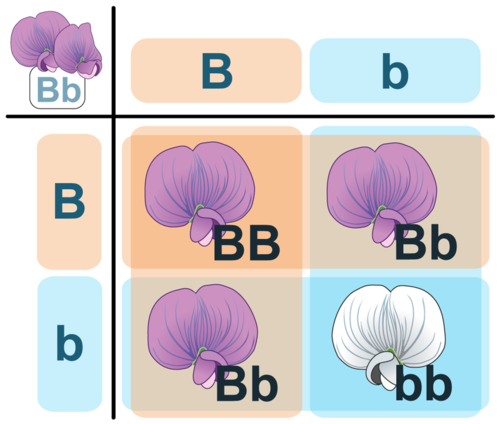
In this punnett square, which is the dominant trait?
The B stands for bud.
The B stands for bud.
a)
purple flower bud
b)
white flower bud
c)
dominant
d)
recessive
181.
Who first proposed binomial nomenclature as a way of classifying organisms?
a)
Carolus Linnaeus
b)
Carl's Jr.
c)
Charles Darwin
d)
Henry Groseclose
182.

What is a dichotomous key used for in science?
a)
To organize biomes
b)
Identify organisms
c)
Identify bacteria only
d)
None of these
183.

A dichotomous key for trees is provided. Hikers found a tree that has large brown cones and single sharp needles. What species of tree have the hikers found?
a)
Juniper
b)
Pine
c)
Spruce
d)
Fir
184.
What is the study of classification called?
a)
Taxonomy
b)
Geology
c)
Anatomy
d)
Geometry
185.
What are the three domains?
a)
Green, Blue, Red
b)
Autotrophic, Heterotrophic, Both
c)
Archea, Eukarya, Bacteria
d)
Marine Organism, Land Organism, or Both
186.
What is the most specific level of classification?
a)
Family
b)
Domain
c)
Species
d)
Carolus Linnaeus
187.

This domain is characterized by ancient bacteria that can live in extreme environments, such as hot springs.
a)
Archaea
b)
Bacteria
c)
Eukarya
d)
Prokarya
188.

Which kingdom would this organism belong to?
a)
Plantae
b)
Archaebacteria
c)
Protista
d)
Animalia
189.

Which kingdom do humans belong to?
a)
Plantae
b)
Fungi
c)
Animalia
d)
Protista
190.

This organism is found in a normal environment. What domain/kingdom does it belong to?
a)
Bacteria
b)
Protista
c)
Archaea
d)
Fungi
191.
Organisms that are classified as autotrophic are able to-
a)
be seen with the human eye
b)
move
c)
reproduce
d)
make their own food
192.
The broadest or most general taxonomic classification of living organisms is organized by --
a)
Kingdom
b)
Domain
c)
Species
d)
Organisms
193.
This domain contains organisms that have a true nucleus in each of their cells. This domain breaks down into four kingdoms.
a)
Animalia
b)
Archaea
c)
Bacteria
d)
Eukarya
194.
This kingdom includes nongreen, nonmoving eukaryotic organisms that break down substances outside their bodies and absorb the nutrients.
a)
Archaea
b)
Plantae
c)
Bacteria
d)
Fungi
195.
This kingdom includes mostly single-celled or simple multicellular organisms.
a)
Protista
b)
Eubacteria
c)
Archaebacteria
d)
Fungi
196.
This kingdom includes complex, multicellular organisms that are usually green, have cell walls, and make sugar by photosynthesis
a)
fungi
b)
bacteria
c)
plantae
d)
archaea
197.
All of the following have a nucleus except...
a)
Bacteria
b)
Animalia
c)
Plantae
d)
Protista
198.
Which kingdom is autotrophic AND has a cell wall?
a)
Bacteria
b)
Fungi
c)
Plantae
d)
Protista
199.
Tigers, Jellyfish, Gorillas and Sponges are all part of kingdom _______.
a)
Animalia
b)
Plantae
c)
Fungi
d)
Bacteria
200.
How many cells do bacteria have?
a)
1
b)
2
c)
3
d)
millions
201.
Research question: does the distance a person kicks a soccer ball effect how well they will do on their math test. What is the dependent variable?
a)
How far they kick the soccer ball
b)
who the person is
c)
how well they do on the math test
d)
Type of soccer ball.
202.
When experimenting with the growth of a plant, a scientist uses three (of the same type of) plants, two different fertilizers, equal light, and equal water. What type of variable is the fertilizer?
a)
Dependent
b)
Independent
c)
Control
d)
Compound
203.
Research Question: Does the type of gasoline put in a car effect how fast the car can drive. What is the independent variable?
a)
Type of gasoline
b)
which car the gas is put into
c)
how fast the car can drive
d)
how much gas is put into the car
204.
An experiment is performed on plants to see how different liquids affect plant growth. Each plant in the experiment is given a different liquid; water, apple juice, or milk. Each plant has the same amount of soil, sunlight, and listens to the same music. In this investigation, what is the dependent variable?
a)
Type of plant
b)
Water, apple juice, milk
c)
Plant growth
d)
Color of the plant's leaves
205.
The summary at the end of an experiment that explains the results is called...
a)
conclusion.
b)
procedures.
c)
materials.
d)
responding variable.
206.
Why do scientist use the scientific method?
a)
To make sure they get credit for their discoveries.
b)
To make sure their results are valid and can be performed by other scientists.
c)
So that other scientist don't get mad at them
207.
The variable being measured is called...
a)
Manipulated/independent
b)
Responding/dependent
c)
Controlled group
d)
controls
208.
How many variables should you test at a time?
a)
4
b)
2
c)
1
d)
3
100 %

