
 Worksheets
Unit 5: Evolution
Total questions: 56
Worksheet time: 1hrs 22mins
Name
Class
Date
1.

The difference in the physical traits of an individual from those of other individuals in a group is called a(n)
a)
change
b)
adaption
c)
species
d)
variation
2.

What did Charles Darwin observe in finch populations of the Galapagos Islands off the coast of South America?
a)
different species on different islands
b)
all species on one of the islands
c)
identical species on all the islands
d)
the same species as North America
3.
Which of the following is a fossil?
a)
a plant that has recently died
b)
a group of organisms that can reproduce
c)
a structure or organ that no longer functions
d)
a trace of an organisms that existed in the past
4.
In natural selection, the selecting agent is the
a)
humans
b)
mutations
c)
breeders
d)
environment
5.

A bird in a population that can easily outcompete other birds for food and that can produce many offspring has a high
a)
life expectancy
b)
mutation rate
c)
fitness
d)
adaptability
6.

Which of the folllowing is an exammple of a vestigial structure?
a)
the wings of a red-tailed hawk
b)
the hind limbs of a house cat
c)
the fins of sharks
d)
the wings of an ostrich
7.
What is suggested by the similarity of early embryos of different species of vertebrates? (i.e. humans, turtles, fish, chickens, salamanders, rabbits, etc.)
a)
no evolutionary relationships between the groups
b)
convergent evolution
c)
similar structures with different functions
d)
evolution from a distant common ancestor
8.
Some organisms that share a common ancestor have features that have different functions, but similar structures. These are known as
a)
vestigial structures
b)
analogous structures
c)
homologous structures
d)
fossil structures
9.
Two organisms that are closely related would have
a)
very similar DNA sequence
b)
exactly the same DNA sequences
c)
no proteins in common
d)
completely different RNA sequence
10.

The measure of how common a particular allele occurs in a population is known as a(n)
a)
gene pool
b)
allele frequency
c)
mutation rate
d)
phenotype
11.

Genetic variation can arise from a random change in the DNA of a gene. This change is called a(n)
a)
mutation
b)
gene flow
c)
gene pool
d)
allele
12.
When organisms move from one population to another there is an increases genetic variation. This is known as
a)
genetic drift
b)
sexual selection
c)
bottleneck effect
d)
gene flow
13.
Mutations are important because they bring about
a)
death of the organism in which they develop
b)
genetic variation needed for a population to evolve
c)
benefits for the individual, not for the population
d)
Hardey-Weinberg equilibrium within a population
14.
An earthquake causes an ocean channel to open and separate an island into two. The species on each side of the island are now undergoing
a)
geographic isolation
b)
behavioral isolation
c)
directional selection
d)
temporal isolation
15.
What kind of isolation occurs when two populations of birds have different courtship dances?
a)
geographic
b)
sexual
c)
temporal
d)
behavioral
16.
Asexual reproduction produces offspring with
a)
half of a single parent's genes
b)
the same genes as the parent
c)
a mix of genes from two parents
d)
lots of genetic variation
17.
Acacia trees have hollow thorns and pores at the base of their leaves that secrete nectar. Ants live inside the thorns and drink the nectar provided by the tree while also defending the plant from herbivores. The two species benefit from their corresponding adaptations and have evolved in response to one another. This is known as
a)
convergent evolution
b)
co-evolution
c)
divergent evolution
d)
speciation
18.
What is the process in which humans breed organisms for certain traits? (Examples include: Cattle, Dogs, Crops)
a)
natural selection
b)
coevolution
c)
artificial selection
d)
convergent evolution
19.
Identify the type of isolation that occurs when the timing of reproduction is different between two populations?
a)
geographic
b)
temporal
c)
behavioral
d)
selective
20.

Which of the following is a term for a group of similar organisms that can reproduce and have fertile offspring?
a)
individual
b)
population
c)
species
d)
fossil
21.
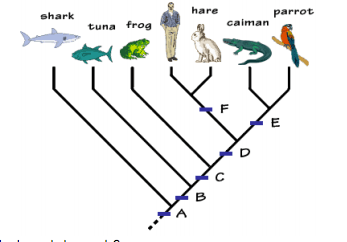
On the cladogram, which organism is the closest relative of the human?
a)
Frog
b)
Hare
c)
Caiman
d)
Parrot
22.
The concept of gene flow is demonstrated when a cow is driven off from its herd, joins another herd, and reproduces. When the cow contributes to the gene pool of the new herd, which of these will most likely increase?
a)
Environmental fitness
b)
Reproductive mutations
c)
Natural selection
d)
Genetic variation
23.
Genetic drift is a process that causes...
a)
The genetic makeup of an entire population to disappear
b)
The genetic makeup of an entire population to be altered due to chance events
c)
Organisms to better adapt to their environment
d)
Organisms to have the same DNA as their parents
24.
All genes present in a population is called:
a)
Genetic Drift
b)
Gene Flow
c)
Gene Pool
25.

The hypothesis that evolution of a species occurs in periods of rapid change separated by periods of little or no change is called
a)
divergence
b)
gradualism
c)
punctuated equilibrium
d)
isolation
26.

The hypothesis that evolution of a species occurs gradually over time at a slow and constant process is known as
a)
speciation
b)
punctuated equilibrium
c)
gradualism
d)
microevolution
27.

According to this cladogram, birds are LEAST related to -
a)
Amphibians
b)
Sharks
c)
Ray Finned Fish
d)
Crocodiles
28.

Which trait do only humans have, according to the cladogram?
a)
jaws
b)
mammary glands & hair
c)
terrestrial during all life stages
d)
opposable thumbs
29.

If an organism has a vestigial structure, that structure likely once had a function in a(n)
a)
close relative
b)
early ancestor
c)
unrelated organism
d)
embryological stage
30.
Who is the father of evolution?
a)
Darwin
b)
Mendel
c)
Newton
d)
Einstein
31.
What is another name for natural selection?
a)
survival of the smartest
b)
survival of the fastest
c)
survival of the biggest
d)
survival of the fittest
32.
When all of the organisms of a species have died it is called
a)
evolution
b)
extinction
c)
adaptation
d)
natural selection
33.
What is the study of organisms at the early stages of development?
a)
Biochemical/Molecular Evidence
b)
Comparative Embryology
c)
Homologous Structures (Comparative Anatomy)
d)
Fossil Record
34.
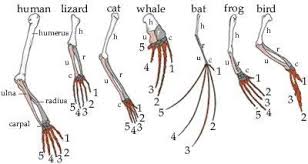
What is the image an example of?
a)
vestigial structures
b)
comparative embryology
c)
homologous structures (comparative anatomy)
d)
fossil record
35.
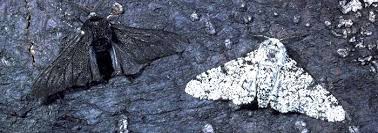
Based on the image, predict which moth variation would increase in population due to adaptation
a)
light
b)
dark
36.

Darwin wrote that organisms with traits that are best suited to the environment will ________________
a)
increase in number
b)
become extinct
37.
Which term refers to the process by which individuals that are better suited to the environment survive and reproduce therefore passing down their genes to their offspring?
a)
Evolution
b)
Variation
c)
Adaptation
d)
Natural Selection
38.

The Asian shore crab invaded parts of the eastern coast of the United States about 15 years ago. The Asian shore crab preys on blue mussels. In the time since the Asian shore crab arrived, the average shell thickness of the blue mussel population has increased. Which of the following is the most likely reason that this increase in shell thickness has occurred?
a)
Blue mussels with thick shells attract more crabs that mussels without thick shells.
b)
Blue mussels with thick shells grow in larger colonies than mussels without thick shells.
c)
Blue mussels with thick shells catch more food per day than mussels without thick shells.
d)
Blue mussels with thick shells survive and reproduce more successfully than mussels without thick shells.
39.

Which of the following statements gives the most likely explanation for the presence of two very similar species of squirrels living on opposite sides of the Grand Canyon?
a)
One squirrel traveled across the canyon and started a new population on the other side.
b)
One squirrel traveled across the canyon and interbred with a different population on the other side.
c)
Members of one single squirrel species were geographically separated by the formation of the canyon.
d)
Members of two different squirrel species migrated from two different places to opposite sides of the canyon.
40.

What type of selection is shown? (Hint: Intermediate is selected for and BOTH extremes are selected against)
a)
Directional
b)
Stabilizing
c)
Disruptive
d)
Bidrectional
41.

What type of natural selection is this? (Hint: one extreme is selected for)
a)
Disruptive Selection
b)
Directional Selection
c)
Stabilizing Selection
d)
Normalizing Selection
42.
If finches with large beaks and finches with small beaks increase in a population while finches with average sized beaks decreases, which pattern of natural selection has occurred?
a)
Directional selection
b)
Disruptive selection
c)
Stabilizing selection
d)
Normalizing selection
43.
What is something that explains why a phenomenon happens?
a)
Hypothesis
b)
Theory
c)
Law
d)
Conclusion
44.
Any inherited trait that gives an organism an advantage in its environment is called ___.
a)
a mutation
b)
an adaptation
c)
evolution
d)
natural selection
45.
This scientist stated that by using or not using a certain body part, organisms could change in their lifetime and that the trait gained would be passed down to their offspring.
a)
James Hutton
b)
Charles Lyell
c)
Jean-Baptiste Lamarck
d)
Thomas Malthus
46.
Which of the following is the definition for speciation?
a)
an inherited or learned trait that increases an organism’s chance of survival in its environment
b)
the evolutionary process through which new species emerge
c)
a process by which organisms that are better adapted to their environment tend to survive, reproduce, increase in number, and pass their traits on to succeeding generations
d)
a process by which one of the extreme variations of a trait is favored
47.
Which of the following is the last step in the creation of a new species and the occurrence of speciation?
a)
geographic isolation
b)
reproductive isolation
c)
temporal isolation
d)
behavioral isolation
48.

What does the picture represent?
a)
Founder Effect
b)
Mutations
c)
Bottleneck effect
d)
Gene Flow
49.

What does the image represent?
a)
Founder effect
b)
Bottleneck effect
c)
Mutation
d)
Natural Selection
50.
One species of flower blooms in the spring, the other in the fall. They can not interbreed because of
a)
Behavioral isolation
b)
Temporal isolation
c)
Mechanical isolation
d)
Reproductive isolation
51.
A few deer wander out of their native woods into a completely new park where no deer had ever been before. They go on to create an entirely new population. This chance event is best described as
a)
Genetic Drift
b)
Natural Selection
c)
Non-random mating
d)
Mutation
52.
Fossils form in which type of rock?
a)
sedimentary
b)
igneous
c)
metamorphic
53.
By which method have scientists determined that the Earth is about 4.5 billion years old?
a)
plate tectonics
b)
relative dating
c)
radiometric dating
d)
law of superposition
54.
Which is a process that allows scientists to compare rock layers with others in a sequence to determine their age?
a)
Absolute Dating
b)
Relative Dating
c)
Radiometric Dating
55.
The theory of Endosymbiosis explains
a)
The origin of eukaryotes
b)
How species develop
c)
How bacteria live
d)
Why cells rely on one another
56.
This 1953 experiment was designed to test the hypothesis that lightning supplied the energy needed to turn atmospheric gases into organic molecules such as amino acids. Therefore, explaining the beginnings of life on Earth. What is the name of this experiment?
a)
Endosymbiosis
b)
Millery-Urey
c)
Meteorite
d)
Lipid-Membrane
100 %

