
 Worksheets
basics chemistry review
Total questions: 140
Worksheet time: 3hrs 36mins
Name
Class
Date
1.
what does S stand for?
a)
salt
b)
sodium
c)
sulfur
d)
spit
2.
C stands for?
a)
cat
b)
calcium
c)
carbon
d)
crypton
3.
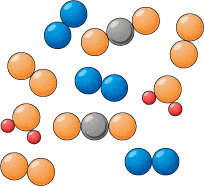
These are found on the Periodic Table.
a)
elements
b)
mixtures
c)
compounds
4.
The four organic compounds found in living things are?
a)
Carbohydrates, Lipids, Nucleic Acids, and Oxygen
b)
Carbohydrates, Lipids, Proteins, and Carbon
c)
Carbohydrates, Lipids, Proteins, Nucleic Acids
d)
Carbon, Lipids, Proteins, Nucleic Acids
5.
P stands for
a)
Phosphorus
b)
Potassium
c)
Possum
6.
N stands for
a)
Nickel
b)
Nitrogen
c)
Ninja
7.

What is the atomic number of carbon?
a)
6
b)
12
c)
12.011
8.

What is the atomic mass of carbon?
a)
6
b)
12
9.

How many electrons would be in an atom of fluorine?
a)
9
b)
18
c)
18.998
d)
10
10.
Which of the following represents a chemical change?
a)
tearing paper in half
b)
melting ice into water
c)
roasting a marshmallow
d)
chopping wood
11.
What is the smallest particle of mattter?
a)
element
b)
atom
c)
molecule
d)
compound
12.
If I have a block of wood with a density of 0.5 g/cm3 and I cut it in half, the density of one of the halves of wood would now be. . .
a)
0.25 g/cm3
b)
1.0 g/cm3
c)
0.5 g/cm3
d)
5.0 g/cm3
13.
Matter which has no definite shape or volume is known as a
a)
solid
b)
liquid
c)
gas
14.
All of the following are examples of matter except
a)
a table
b)
light
c)
Mrs. Piscitelli
d)
oxygen
15.
The periodic table of elements is organized by
a)
atomic mass
b)
number of electrons
c)
atomic number
d)
number of neutrons
16.
Which of the following is a mixture
a)
Carbon
b)
Water
c)
Air
d)
Sugar
17.
Which one of the following is a compound?
a)
Mercury (Hg)
b)
Lemonade
c)
Vinegar (CH3COOH)
d)
Air
18.

How many neutrons would be in an atom of Fluorine?
a)
9
b)
10
c)
19
d)
18.998
19.
The most basic building block of matter (smallest part of an element) is called a(n) __________.
a)
Product
b)
Reactant
c)
Atom
d)
Molecule
20.
A(n) _____ is a unique substance that forms when two or more elements combine chemically.
a)
element
b)
compound
c)
mixture
d)
all of the above
21.
The properties of compounds are ______________________ the elements that form them.
a)
the same as
b)
more intense than
c)
different from
d)
less visible than
22.
Examples of mixtures include ______________.
a)
lemonade
b)
salad dressing
c)
salt water
d)
all of these
23.
The components of a mixture ______________________ when they combine.
a)
keep physical properties
b)
form chemical bonds
c)
have new chemical properties
d)
all of these
24.
Components of mixtures can be __________ by physical processes.
a)
chemically combined
b)
separated
c)
purified
d)
none of these
25.
A substance that undergoes a(n) _____ change becomes a new kind of substance.
a)
large
b)
physical
c)
chemical
d)
state of matter
26.
_____Mg + _____P4 → _____Mg3P2 [choose the balanced answer]
a)
3Mg + P4 ---> 3Mg3P2
b)
5Mg + 2P4 ---> 5Mg3P2
c)
6Mg + P4 ---> 2Mg3P2
d)
6Mg + 2P4 ---> 2Mg3P2
27.
The substances on the left of the yields arrow that start a chemical reaction are called _____.
a)
reactants
b)
products
c)
reactors
d)
ingredients
28.
The substances on the right side of the yields arrow that are produced in a chemical reaction are called _____.
a)
reactants
b)
products
c)
reactors
d)
ingredients
29.
A chemical reaction like 2H2 + O2 --> 2H2O is represented by a chemical _____.
a)
math problem
b)
equation
c)
recipe
d)
explosion
30.
Endothermic reactions absorbs more energy to break bonds, so endothermic reactions cause (a) ______________.
a)
decrease in temperature
b)
increase in temperature
c)
no change in
31.
Which of the following causes an exothermic reaction:
a)
Alka-seltzer in water (feels cold)
b)
Calcium chloride in water (feels hot)
c)
Vinegar on pennies (no change in temperature)
d)
Ice melting
32.
In a __________ atoms are closely spaced and may vibrate in position but do not change locations.
a)
solid
b)
liquid
c)
gas
d)
plasma
33.
Chemical equations must be balanced because they describe how chemical reactions obey the principle of __________.
a)
activation
b)
decomposition
c)
mass coefficients
d)
conservation of mass
34.
According to the law of conservation of mass, if 5 grams of Oxygen completely reacted with 10 grams of Hydrogen, how many grams of water should be produced?
a)
5g
b)
10g
c)
15g
d)
20g
35.
What is the atomic number for an element with three protons?
a)
2
b)
1
c)
3
d)
6
36.

How many protons are in this element?
a)
79
b)
196
c)
117
d)
Cannot be determined
37.
In the compound 2H2, The "2" means:
a)
there are "2" many molecues
b)
there are two moles or molecues of H2; it is the coefficient
38.
Water has a chemical change when it
a)
is decomposed (broken down) into hydrogen gas and oxygen gas
b)
boils into water vapor
c)
freezes into solid ice
39.
What is a neutralization reaction?
a)
A chemical reaction involving an acid and a base.
b)
A chemical reaction involving water and glucose
c)
a chemical reaction involving vinegar and lemon juice
40.
Is the following equation balanced or unbalanced ?
Al + O2 --> Al2O3
Al + O2 --> Al2O3
a)
Balanced
b)
Unbalanced
41.
At the end of chemical reactions, what is the total mass of the reactants compared to the total mass of the products?
a)
the product is doubled
b)
the product is half the mass of the reactants
c)
the mass is the same
d)
the mass changes depending on the reaction
42.
Why is the following chemical equation not balanced?
H2 + O2 --> H2O
H2 + O2 --> H2O
a)
each side of the equation has a different number of oxygen atoms
b)
each side of the equation has a different number of hydrogen atoms
c)
each side has the same mass
43.
A chemical change is different than a physical change because in a chemical change
a)
Chemicals are used
b)
Molecules do not physically touch
c)
A new substance is formed and in a physical change no new substance is formed
d)
The change can be seen but in a physical change it cannot
44.
What type of reaction is illustrated below?
FeS + Hal --> H2S + FeCl
FeS + Hal --> H2S + FeCl
a)
synthesis
b)
decomposition
c)
single replacement
d)
double replacement
45.
What type of reaction is illustrated below?
2HI --> H2 + I2
2HI --> H2 + I2
a)
synthesis
b)
decomposition
c)
single replacement
d)
double replacement
46.

Which of the following compounds does NOT have ionic bonds?
a)
LiF
b)
NaCl
c)
CO2
d)
MgF2
47.

What is the group number for elements that have a stable number of electrons in their outer energy level?
a)
18 (noble gases)
b)
17 (halogens)
c)
2 (alkaline earth metals)
d)
1 (alkali metals)
48.

When K+ and I- combine, a(n) _________ bond results.
a)
covalent
b)
ionic
c)
metallic
d)
polyatomic
49.

Which statement is true of ionic compounds?
a)
They are electrically neutral when dissolved in water
b)
They are good conductors as solids
c)
They are formed of metals and nonmetals bonded together
d)
They are made by sharing electrons
50.

In the process of ionic bonding, ions come together because
a)
opposite charges repel
b)
positive and negative ions attract
c)
salt is magnetic
d)
like charges attract each other
51.
How many dots are shown in the electron dot diagram for oxygen, element number 8?
a)
one
b)
six
c)
eight
d)
two
52.
The maximum number of electrons in the second energy level of an atom is ____.
a)
two
b)
four
c)
eight
d)
ten
53.

According to this pH strip, the tested material most likely is __________.
a)
pickle juice
b)
a soda
c)
a cleaning product
d)
water
54.
An atom which loses or gains an electron is called a(an) ____________?
a)
proton
b)
isotope
c)
ion
d)
molecule
55.

When the pH of a substance becomes more acidic the number on the pH scale
a)
decreases
b)
increases
c)
triples
d)
stays the same
56.

What kind of compound rarely dissolves in water?
a)
Ionic Compounds
b)
Covalent Compounds
c)
Acids
d)
Bases
57.

_______________ compounds share electrons.
a)
ionic
b)
covalent
c)
metallic
d)
acidic
58.

What type of compounds are brittle and generally have a high melting point?
a)
ionic compounds
b)
covalent compounds
c)
acids
d)
bases
59.

What is made when an acid neutralizes a base?
a)
Water
b)
Salt
c)
Water and Salt
d)
None of the above
60.
What type of hydrocarbon has double and triple bonds between carbon atoms?
a)
saturated
b)
unsaturated
c)
aromatic
d)
neutral
61.
Heat flows from _______ to ______ objects
a)
cooler to warmer
b)
warmer to warmer
c)
warmer to cooler
d)
cooler to cooler
62.
Heat is measured in
a)
joules
b)
grams
c)
degrees celcius
63.
q stands for which variable
a)
heat
b)
mass
c)
specific heat
d)
change in temperature
64.
For the formula:
Q= m c ∆T
The units for specific heat are:
Q= m c ∆T
The units for specific heat are:
a)
g /J C
b)
°C/g J
c)
kJ/g
d)
J/g°C
65.
Which has a highest specific heat?
a)
water
b)
sand
c)
concrete
d)
glass
66.
A person warming themselves from a fire is
a)
endothermic
b)
exothermic
67.
Most of the nonmetals on the periodic table are located...
a)
on the left side
b)
at the bottom
c)
on the right side
d)
in the middle
68.
Why is water NOT on the periodic table?
a)
It is naturally occuring
b)
It is a compound, not an element
c)
It exists as a solid, a liquid, and a gas
d)
Its chemical formula doesn't fit
69.
_______ are the ROWS on the periodic table.
a)
Families
b)
Groups
c)
Periods
d)
Elements
70.
________ are the COLUMNS on the periodic table and are organized by similar properties.
a)
Classifications
b)
Groups
c)
Periods
d)
Elements
71.
Atoms with similar properties are most likely located...
a)
in the same period.
b)
in the same group.
c)
in different periods.
d)
to the right and left of each other.
72.
If an atom had the same properties as fluorine (F), it would probably be located in
a)
period 1.
b)
period 2.
c)
group 2.
d)
group 17.
73.
As you move from left to right across the periodic table, the atomic number increases.
a)
True
b)
False
74.
Most of the elements on the periodic table are classified as "metal".
a)
True
b)
False
75.
The word "periodic" in periodic table refers to...
a)
a regular, repeating pattern
b)
organization of elements
c)
columns of elements
d)
increasing numbers of protons
76.
Which has the greater EN:
N or C?
N or C?
a)
C
b)
N
77.
Put these in increasing order:
F, N, B
F, N, B
a)
B < N < F
b)
B < F < N
c)
N < F < B
d)
F < N < B
78.
What kind of bond do you have: K and Br
a)
Non-polar covalent
b)
Polar covalent
c)
ionic
d)
James Bond
79.
What kind of bond do you have: H and H
a)
Non-polar covalent
b)
Polar covalent
c)
ionic
d)
James Bond
80.
What kind of bond do you have: F and Cl
a)
Non-polar covalent
b)
Polar covalent
c)
ionic
d)
James Bond
81.
Which orbital block corresponds to transition metals in the periodic table?
a)
s
b)
p
c)
d
d)
f
82.
The element bromine is a -
a)
Period 3 alkali metal.
b)
Period 4 halogen.
c)
Period 3 noble gas.
d)
Period 4 transition metal.
83.
Which two elements are most likely ductile?
a)
C and P
b)
Zn and N
c)
Ag and Au
d)
Si and Ne
84.
A highly reactive group 17 element.
a)
halogen
b)
metalloid
c)
noble gas
d)
alkali metal
85.
An element that has physical and chemical properties of both metals and nonmetals.
a)
transition element
b)
transition metal
c)
metalloid
d)
alkaline earth metal
86.
An extremely unreactive group 18 element.
a)
halogen
b)
alkali metal
c)
noble gas
d)
alkaline earth metal
87.
group 1 elements, except for hydrogen; they are reactive and usually exist as compounds with other elements
a)
alkaline earth metals
b)
alkali metals
c)
metal
d)
transition metal
88.
indicates the relative ability of an element's atoms to attract electrons in a chemical bond
a)
ionization energy
b)
periodic law
c)
representative elements
d)
electronegativity
89.
states that atoms lose, gain, or share electrons in order to acquire the stable electron configuration of a noble gas
a)
periodic law
b)
ion
c)
octet rule
d)
period
90.
states that when the elements are arranged by increasing atomic number, there is a periodic repetition of their chemical and physical properties
a)
periodic law
b)
octet rule
c)
ionization energy
d)
electronegativity
91.
Which element has an atomic number 20
a)
Oxygen
b)
Hydrogen
c)
Potassium
d)
Calcium
92.
Ripping a piece of paper in half is a ___________
a)
Physical property
b)
Physical change
c)
Chemical Change
d)
Chemical Property
93.
Which type of element is a poor conductor of heat and electricity
a)
Metals
b)
Nonmetals
c)
Metalloids
94.
What substance is oxidized in the following reaction?
4Fe + 3O2 --> 2Fe2O3
4Fe + 3O2 --> 2Fe2O3
a)
Iron
b)
Fluorine
c)
Oxygen
95.
Is calcium oxidized or reduced in the following reaction?
2CaO--> 2Ca + O2
2CaO--> 2Ca + O2
a)
Oxidized
b)
Reduced
96.
Na + Cl2 --> NaCl is what type of reaction?
a)
Synthesis
b)
Decomposition
c)
Single replacement
d)
Double replacement
97.
Cu + AgNO3 --> Cu(NO3)2 + Ag is what type of reaction?
a)
synthesis
b)
decomposition
c)
single replacement
d)
double replacement
98.
a catalyst increases the rate of a reaction by
a)
increasing activation energy
b)
decreasing activation energy
c)
decreasing energy of the products
d)
decreasing energy of the reactants
99.
According to Le Chatlier's Principle, decreasing the temperature favors the
a)
endothermic reaction
b)
exothermic reaction
100.
Predict this reaction, Ca + 2HCl --> ?
a)
4CaCl3 + H2
b)
no reaction
c)
CaH2 + Cl
d)
CaCl2 + H2
101.
A chemical reaction that involves a gain/loss of electrons is called:
a)
Double Replacement
b)
Neutralization
c)
Oxidation-Reduction
d)
Hydrolysis
102.
Identify the reaction type:
C2H5OH(l) + O2(g) --> CO2(g) + H2O(g)
C2H5OH(l) + O2(g) --> CO2(g) + H2O(g)
a)
Double displacement
b)
Synthesis
c)
Acid base
d)
Combustion
103.
What is the oxidation number of N in NO2-1?
a)
-3
b)
+4
c)
-2
d)
+3
104.
Which substance is reduced in the following reaction?
NaOH + Li --> LiOH + Na
NaOH + Li --> LiOH + Na
a)
Li
b)
Na
c)
O
d)
H
105.

Which letter corresponds to the activation energy of the forward reaction?
a)
A
b)
B
c)
C
d)
D
106.
Which compound has the smallest molar mass?
a)
CO
b)
CO2
c)
H2O
d)
H2O2
107.
Avogadro's number of representative particles is equal to one_____.
a)
kilogram
b)
gram
c)
kelvin
d)
mole
108.
What is the molar mass of AuCl3?
a)
96 g
b)
130 g
c)
232.5 g
d)
303.3 g
109.
What is the reason why oil and water don't mix?
a)
Oil is too heavy to mix with water
b)
Water can only mix with polar molecules
c)
Water can only mix with non-polar molecules
d)
Oil is too light to mix with water
110.
Use the molarity formula to calculate the molarity of a solution containing 0.75 moles of LiCl and 0.25 L.
M = moles of solute/ Liters of solution
M = moles of solute/ Liters of solution
a)
3 M
b)
3 mol
c)
0.33 M
d)
0.33 mol
111.

If 60 g of Pb(NO3)2 are dissolved in 100 g H2O at 20°C, is the solution saturated, unsaturated ,or supersaturated?
a)
Saturated
b)
Unsaturated
c)
Supersaturated
112.
What happens to the freezing point of a solvent when a solute is added to it?
a)
The freezing point increases
b)
The freezing point decreases
c)
The freezing point doesn't change
113.
If an electrical current can run through a solution, it is said to contain
a)
magic
b)
non-electrolytes
c)
electrolytes
d)
electricity
114.
How many neutrons does uranium-235 have?
a)
238
b)
92
c)
146
d)
143
115.
Isotopes have the same number of protons, but a different number of ________________.
a)
Quarks
b)
Electrons
c)
Neutrons
d)
Photons
116.
Which of the following is an example of a diatomic molecule?
a)
CaCl2
b)
Mg
c)
O2
d)
NaCl
117.
When an atom loses a valence electron, it becomes a(n) _____________ ion.
a)
positive
b)
negative
c)
neutral
d)
polyatomic
118.
Which of the following elements must be present in any organic compound?
a)
Carbon
b)
Oxygen
c)
Potassium
d)
Hydrogen
119.
During the process of fractional distillation, the petroleum compounds are separated according to the difference in their _______________.
a)
boiling point
b)
density
c)
unsaturation
d)
mass
120.

a)
Alkane
b)
Alkene
c)
Alkyne
121.
Hydrocarbons are compounds that contain
a)
Carbon, only
b)
Carbon and Hydrogen, only
c)
Carbon, Oxygen, and Hydrogen, only
d)
Carbon, Oxygen, Hydrogen, and Nitrogen, only
122.

what kind of molecule is this?
a)
alkane
b)
alkene
c)
alkyne
d)
cycloalkane
123.
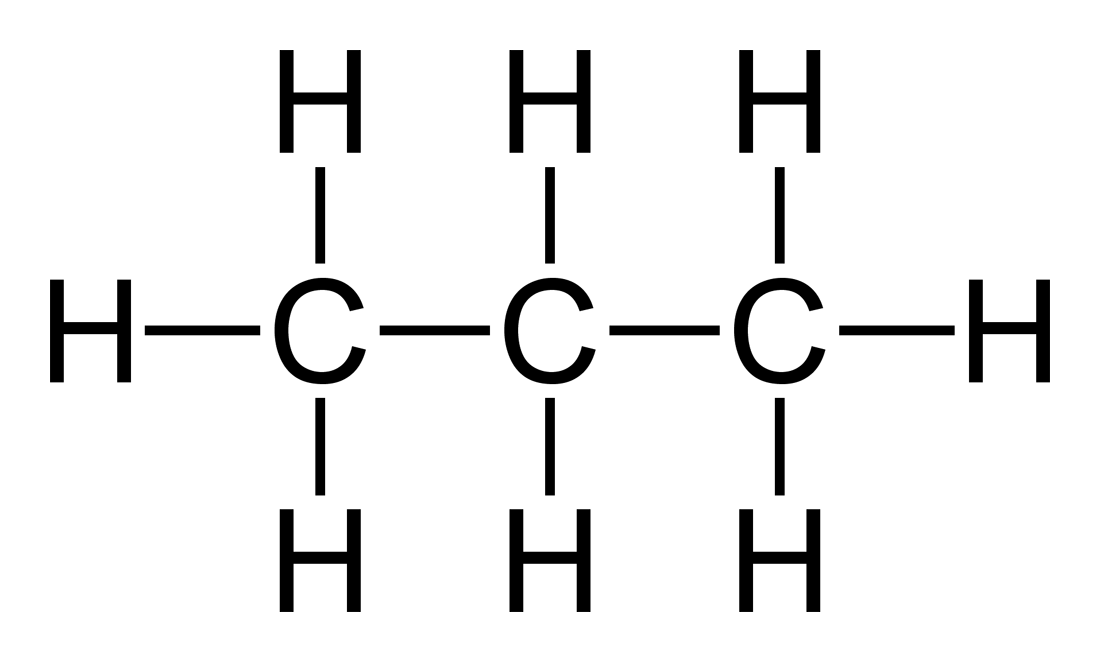
Name this alkane
a)
Methane
b)
Ethane
c)
Propane
d)
Butane
124.
When the temperature of a solvent is increased, the time it takes for the solute to dissolve is decreased because
a)
water molecules have more energy and strike the surface of solute more frequently.
b)
solute molecules transfer their energy to the solvent which causes the solute to dissolve more quickly.
c)
the ions in the solute strike the water molecules as they vibrate
d)
the water molecules lose energy to the solute
125.
What property of water molecules causes surface tension and cohesion?
a)
Covalent bonds
b)
Bent shape
c)
All non-metal atoms
d)
Polarity
126.

Br = 2.8
C = 2.5
C = 2.5
a)
non-polar
b)
polar
<---
<---
c)
polar
--->
--->
127.

a)
non-polar
b)
polar
--->
--->
c)
polar
<---
<---
d)
polar
polar, pointing straight down
polar, pointing straight down
128.

Balloons can be twisted into shapes because
a)
the force exerted changes the number of particles
b)
the volume of a gas is constant
c)
particles of gas can be compressed
129.
When you increase your depth under water, the water pressure on your body
a)
increases
b)
decreases
c)
stays the same
130.
What type of relationship do pressure and volume have?
a)
direct
b)
inverse
c)
they are unrelated
d)
symbiotic
131.

If a balloon is cooled what will happen to the volume?
a)
Volume will increase
b)
Volume will decrease
c)
Volume will not change
132.
How many significant figures does the following number have: 0.002040
a)
6
b)
4
c)
3
d)
2
133.
How many significant figures does the following number have: 0.998005
a)
9
b)
10
c)
6
d)
5
134.
How many significant figures does the following number have: 100.3
a)
4
b)
3
c)
5
d)
2
135.
Which of the following is the correct formula for magnesium and chlorine?
a)
Mg2Cl
b)
MgCl
c)
MgCl2
d)
Mg2Cl2
136.
find the formula potassium hydroxide
a)
KH
b)
KOH
c)
K2OH
d)
K(OH)2
137.
iron(II) oxide
a)
FeO
b)
FeO2
c)
Fe2O
d)
Fe2O2
138.
Use the equation 2 Al + 3 Cl2 ---> 2 AlCl3. If 2 moles of aluminum and 2 moles of chlorine are reacted, identify the limiting reactant.
a)
AlCl3
b)
Cl2
c)
Al
139.
When does a chemical reaction stop?
a)
When the lab is finished
b)
When the excess reactant is used up
c)
When the limiting reactant is used up
d)
Chemical reactions never stop
140.
How many grams of CuSO4 do you need to get exactly Avogadro's number?
a)
159.61 g
b)
111.6 moles
c)
63.55 g
d)
159.61 moles
100 %

