
 Worksheets
Grade 7 Science Revision 2
Total questions: 86
Worksheet time: 1hrs 7mins
Name
Class
Date
1.
What are the products of photosynthesis?
a)
water and carbon dioxide
b)
oxygen and glucose
c)
oxygen and carbon dioxide
d)
oxygen and water
2.
What molecule absorbs sunlight for photosynthesis?
a)
chloroplast
b)
thylakoid
c)
grana
d)
chlorophyll
3.
Which statement about photosynthesis is correct?
a)
Plants get the energy they need for photosynthesis from water.
b)
Plants get the energy they need for photosynthesis from soil.
c)
Plants get the energy they need for photosynthesis from sunlight.
d)
Plants do not require energy to perform photosynthesis.
4.
The raw materials or reactants of photosynthesis are
a)
sugar and water.
b)
sugar and oxygen.
c)
carbon dioxide and water.
d)
carbon dioxide and oxygen.
5.
The main source of energy for all life comes from ____.
a)
the Earth
b)
the moon
c)
the sun
d)
the food we eat/make
6.
Why do we eat food?
a)
to provide energy/fuel
b)
to eliminate waste products
c)
to prevent diseases
d)
to kill pathogens
7.
Where does cellular respiration take place in the cell?
a)
Cell Membrane
b)
Nucleus
c)
Mitochondria
d)
Vacuole
8.
Where does photosynthesis occur?
a)
mitochondria
b)
stomata
c)
xylem
d)
chloroplast
9.
Which of the following is the correct equation for PHOTOSYNTHESIS?
a)
6CO2 + 6H2O --> 6O2 + C6H12O6
b)
6CO2 + C6H12O6 + 6H2O --> O2
c)
6O2 + 6H2O --> 6CO2 + C6H12O6
d)
C6H12O6 + 6O2 ---> 6H2O + 6CO2
10.

When you breathe, your lungs take in ___ and remove ___.
a)
air/oxygen
b)
oxygen/carbon dioxide
c)
carbon dioxide/waste
d)
waste/air
11.

The two main branches from the trachea (one to each lung)
a)
bronchi
b)
alveoli
c)
capillaries
d)
bronchioles
12.

The air sacs that are covered with capillaries where gas exchange takes place
a)
bronchi
b)
lungs
c)
oxygen
d)
alveoli
13.

What is the function of the bronchi?
a)
Transport air from nose to lungs
b)
Transport air from trachea to lungs
c)
Transport air from lungs to alveoli
d)
Transport air from alveoli to blood
14.

What is the main function of the respiratory system?
a)
to provide oxygen and remove carbon dioxide from the body
b)
to bring oxygen to the body
c)
to break down food and absorb nutrients
d)
to remove oxygen from the body and deliver carbon dioxide
15.

Within the lungs, the exchange of oxygen and carbon dioxide occurs between the ___ and the capillaries.
a)
trachea
b)
bronchi
c)
alveoli
d)
diaphragm
16.

Name the organ label # 6.
a)
alveoli
b)
bronchi
c)
trachea
d)
lungs
17.

What is tube that is also known as your wind pipe?
a)
esophogus
b)
bronchi
c)
trachea
d)
alveoli
18.
___ in cigarette smoke is the greatest contributor to lung cancer.
a)
Hydrogen
b)
Nicotine
c)
Oxygen
d)
Tar
19.
The respiratory system is a group of _____ and _____.
a)
Muscles and tendons
b)
Veins and bones
c)
Tissues and organs
d)
Cartilage and skin
20.
What is the main organ of the respiratory system?
a)
Trachea
b)
Lungs
c)
Brochi
d)
Alveoli
21.
The larynx is also known as the...
a)
Voice box
b)
Passage to the lungs
c)
Long vein
d)
Airway
22.
Which of the following metals is not attacked by the environment
a)
Copper
b)
Gold
23.
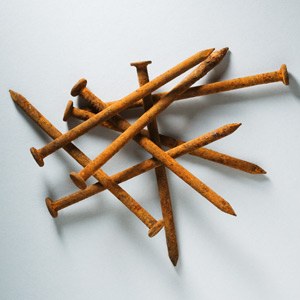
Is this an example of corrosion?
a)
Yes
b)
No
24.
What is oxidation?
a)
A reaction involving oxygen
b)
A reaction involving non-metals
25.
Which of the following is a factor that affects the rate of corrosion?
a)
Impurities in the metal
b)
Abrasives on the surface of the metal
c)
Presence of chemical salts
d)
Using galvanised steel
26.
The chemical compound of water is
a)
HO
b)
H2O
c)
H3O
d)
HO2
27.
Pure water has a
a)
Neutral pH
b)
Negative pH
c)
Positive pH
d)
Both B and C
28.

What two elements make up water?
a)
Helium and oxygen
b)
Hydrogen and oxygen
c)
helium and carbon
d)
oxygen and carbon
29.
The main source of energy for all life comes from ____.
a)
the Earth
b)
the moon
c)
the sun
d)
the food we eat/make
30.
Element is a
a)
pure substance
b)
compound
c)
mixture
d)
molecule
31.
Element:Fe
a)
Gold
b)
Flourine
c)
Phosphorus
d)
Iron
32.
Which of the following is not a compound?
a)
HCl
b)
Cl
c)
NaCl
d)
CO2
33.

What does the C represent?
a)
atomic mass
b)
atomic number
c)
element name
d)
chemical symbol
34.
Is water an element or a compound?
a)
Element
b)
Compound
35.
The properties of the elements that make up a compound are usually very similar to the compound itself.
a)
True
b)
False
36.
A compound consists of two or more elements bound together.
a)
True
b)
False
37.

Which of the following elements is required in an organic compound?
a)
nitrogen
b)
oxygen
c)
carbon
d)
sodium
38.
A _____________ is a substance that is made of 2 or more elements that are chemically combined.
a)
atom
b)
cell
c)
element
d)
compound
39.
How many elements are represented in the compound?
Na2CO3
Na2CO3
a)
1
b)
2
c)
3
d)
4
40.

A substance made by mixing other substances together and being able to then separate is the definition of a
a)
Combination
b)
Solution
c)
Mixture
41.
The atoms in a molecule are held together by
a)
gravitational attraction
b)
chemical bonds
c)
frictional forces
d)
physical bonds
42.
Which is the chemical name for the compound MgCl2?
a)
magnesium chloride
b)
magnesium carbonate
c)
manganese carbonate
d)
manganese dioxide
43.
Which is the chemical name for the compound CO2?
a)
carbon trioxide
b)
carbon monoxide
c)
carbon dioxide
44.
The difference between elements and compounds is that...
a)
elements can be separated by physical means and compounds cannot.
b)
elements cannot be separated by physical means and compounds can.
c)
elements contain only one kind of atom and compounds contain more than one kind of atom.
d)
elements contain more than one kind of atom and compounds contain only one kind of atom.
45.
What is this element...Au
a)
Iron
b)
Titanium
c)
Gold
d)
Flourine
46.
Smoking is the largest cause of preventable death in Australia
a)
True
b)
False
47.
Nicotine causes narrowing of the arteries adding extra load to the heart
a)
True
b)
False
48.
What is Passive Smoking?
a)
The term used to describe those who smoke inside.
b)
The term used to describe the action of children whose parents smoke.
c)
The term to describe the effect of smoking outside where fresh air can clear toxins.
d)
ØThe term used to describe the effect of tobacco smoke on people who do not smoke themselves but are subjected to the smoke of those who do.
49.
Smoking during pregnancy can lead to miscarriage, stillbirth or death
a)
True
b)
False
50.
Babies of smokers are often smaller.
a)
True
b)
False
51.
How many years does smoking take off a smokers life?
a)
1-5
b)
10-20
c)
20-25
d)
5-9
52.
Thick, sticky, dark fluid when tobacco burns is called
a)
Nicotine
b)
Ammonia
c)
Tar
d)
Cilia
53.
The "main" ingredient in tobacco that causes the addiction is
a)
THC
b)
Ethanol
c)
Nicotine
d)
Cocaine
54.
What is the biggest cause of lung cancer?
a)
Smoking
b)
Second-hand smoke
c)
Eating unhealthy foods
d)
Not exercising
55.

This is an example of magnets...
a)
attracting to each other.
b)
repelling each other.
56.

The strongest part of a magnet is...
a)
the bars.
b)
the force field.
c)
the poles.
d)
the middle.
57.

Are the magnetic field lines in the picture correct?
a)
Yes, because they point from north to south.
b)
No, because they point from north to south (they're supposed to go the other way).
c)
Yes, because the North pole is on the left in all pictures.
d)
No, because the North pole is on the left in all pictures (it's supposed to be on the right).
58.

This is an example of magnets...
a)
attracting to each other.
b)
repelling each other.
59.
Magnetism is a type of ____________
a)
force
b)
book
c)
plant
d)
animal
60.
The force of magnetism is stronger when magnets are ________________
a)
cold
b)
round
c)
closer together
d)
farther apart
61.
Are ALL metals magnetic?
a)
Yes
b)
No
62.
Region around a magnet in which magnetic force can act.
a)
Magnetic field
b)
Magnetic force
c)
Domain
d)
Perimeter
63.
There are several modern uses of magnets. Magnets allow high speed trains to ______________________ above the track. They go faster because without touching the tracks there is no friction to slow them down.
a)
collide
b)
levitate
c)
attract
d)
repair
64.

True or False: The Earth is a giant magnet
a)
True
b)
False
65.
A ___________ is an arrangement of elements in columns
a)
columns
b)
rows
c)
periodic table
d)
electron shell
66.
Each column in the periodic table is called a
a)
period
b)
group
c)
cluster
d)
unit
67.
The atomic number tells you what?
a)
number of electrons
b)
number of protons
c)
number of neutrons
d)
both electrons and protons in an atom.
68.
Which group of the periodic table is composed of inert (not reactive) gases?
a)
alkali metals
b)
alkaline earth metals
c)
halogens
d)
noble gases
69.
Elements which are shiny, conduct electricity and heat are called
a)
metal
b)
nonmetal
c)
metalloid
d)
nonexistent
70.
Which element is not a metal?
a)
H
b)
Re
c)
Al
d)
B
71.
The family in the periodic table that contains the most reactive metals is the_______
a)
Alkaline Earth Metals
b)
Transition Metals
c)
Alkali Metals
d)
Other Metals
72.
Particles in an atom's nucleus that are neutral and have no charge are
a)
megatrons.
b)
electrons.
c)
neutrons.
d)
protons.
73.
A negatively charged particle that moves around the nucleus is a(n)
a)
proton
b)
neutron
c)
electron
d)
quark
74.

The atomic number of this pictured element is
a)
28
b)
58.6934
c)
Ni
d)
Nickel
75.
Elements which are shiny, conduct electricity and heat are called
a)
metal
b)
nonmetal
c)
metalloid
d)
nonexistent
76.
How many electrons do atoms need to be stable?
a)
1
b)
2
c)
6
d)
8
77.
An isotope is the same element with a different number of...? (4.3)
a)
Protons
b)
Neutrons
c)
Electrons
78.

what does the 6 represent?
a)
Atomic mass
b)
atomic number
c)
chemical symbol
d)
element name
79.
The simplest substance is..?
a)
Carbon
b)
An element
c)
Water
d)
A simple compound
80.
20. A wave interaction that happens when two or more waves overlap and the resulting wave has a greater amplitude is called
a)
constructive interference
b)
absorption.
c)
refraction.
d)
reflection.
81.
14. The layer of cells on the inside back surface of the eye is called the
a)
cornea.
b)
retina.
c)
optic nerve.
d)
iris.
82.
13. The opening in the middle of the eye is called
a)
pupil.
b)
iris.
c)
cornea.
d)
retina.
83.
12. The colored part of the eye that contracts and expands is called
a)
cornea.
b)
cone
.
.
c)
iris.
d)
optic nerve.
84.
11. Special cells that react to light and can distinguish black, white, and grey are called
a)
retinas.
b)
cones.
c)
lenses.
d)
rods.
85.
9. Special cells that respond only to color are called
a)
cones.
b)
rods.
c)
corneas.
d)
pupils.
86.
3. The color of an opaque object is determined by the
a)
colors of light that are reflected.
b)
colors of light that are transmitted.
c)
colors of light that diffracted.
d)
colors of light that are refracted.
100 %

