
 Worksheets
Science!!
Total questions: 129
Worksheet time: 2hrs 58mins
Name
Class
Date
1.
A dog gives birth to 5 puppies. What percentage of the chromosomes does each puppy share with the mother?
a)
25%
b)
50%
c)
75%
d)
100%
2.
What does heterozygous mean?
a)
An organism that has the same genes for a trait (TT or tt)
b)
An organism that has different genes for a trait (Tt)
c)
When neither gene is fully dominant; offspring is a mixture of both
d)
the different forms of a trait (hair color--> brown, blonde, red
3.

If T=Tall & t=short, what is the genotypic ratio?
a)
1:3
b)
3:1
c)
1:2:1
d)
2:2
4.

Two brown eyed parents (Bb) have a baby. What is the chance the baby is blue eyed?
a)
0 %
b)
25%
c)
50%
d)
75%
5.

A heterozygous yellow pea plant's genotype would be:
a)
YY
b)
yy
c)
Yy
d)
Yg
6.

Which process and type of resulting cells are represented?
a)
mitosis, gametes
b)
mitosis, body cells
c)
meiosis, gametes
d)
meiosis, body cells
7.
Which of the following cell types is formed by meiosis?
a)
muscle cells
b)
skin cells
c)
sperm cells
d)
blood cells
8.
How many times in meiosis does the cell divided?
a)
2
b)
4
c)
3
d)
1
9.

The sex of an offspring is determined by ______________________.
a)
the mother
b)
the father
c)
the mother and the father
d)
by the environment
10.
W=white hair
w= non-white hair
If you cross a horse with WW and a horse with ww what fraction of the offspring would be expected to have white hair?
w= non-white hair
If you cross a horse with WW and a horse with ww what fraction of the offspring would be expected to have white hair?
a)
none
b)
3/4
c)
1/2
d)
all
11.
What is a phenotype?
a)
The expression of a trait; what you see.
b)
refers to the genetic makeup of an individual
c)
An organism that has the same genes for a trait (ex. TT or tt)
d)
the passing of traits from parent to offspring
12.
The inherited combination of alleles is known as the offspring's
a)
heredity
b)
phenotype
c)
genotype
d)
redigree
13.
An organism's appearance is known as its
a)
heredity
b)
phenotype
c)
genotype
d)
pedigree
14.
Sex cells are produced through the process of
a)
mitosis
b)
cytokinesis
c)
binary fission
d)
meiosis
15.
In screech owls, red feathers are dominant over gray feathers. If two heterozygous red-feathered owls are mated, what percentage of their offspring would be expected to have red feathers?
a)
25%
b)
50%
c)
75%
d)
100%
16.
Who is the father of evolution?
a)
Darwin
b)
Mendel
c)
Newton
d)
Einstein
17.
What is another name for natural selection?
a)
survival of the smartest
b)
survival of the fastest
c)
survival of the biggest
d)
survival of the fittest
18.
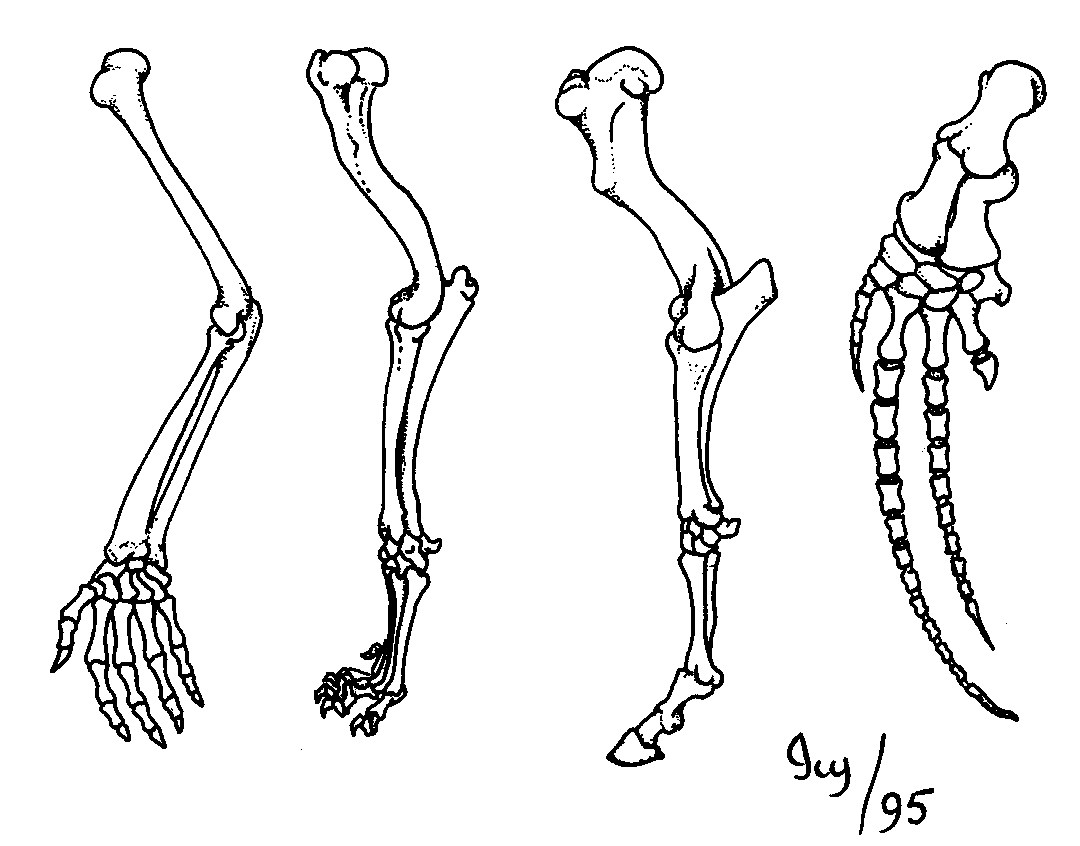
Structures with the same parts have different functions; suggests that organisms share a common ancestry
a)
vestigial structures
b)
homologous structures
c)
adaptive radiation
d)
fossil
19.

Two organisms that are closely related would have
a)
very similar DNA sequence
b)
exactly the same DNA sequences
c)
no proteins in common
d)
completely different DNA sequence
20.

Which layer is the oldest
a)
B
b)
A
c)
E
d)
C
21.
Individuals who are considered fit, have:
a)
Stronger genes
b)
Fewer mutations
c)
More food
d)
More offspring
22.

Which of the following is a term for a group of similar organisms that can reproduce fertile offspring?
a)
individual
b)
population
c)
species
d)
fossil
23.
Charles Darwin’s observation that finches of different species on the Galápagos Islands have many similar physical characteristics supports the hypothesis that these finches
a)
have the ability to interbreed.
have the ability to interbreed.
have the ability to interbreed.
b)
acquired traits through use and disuse.
c)
all eat the same type of food.
d)
descended from a common ancestor.
24.
Evolution is a change in _________ over time.
a)
Populations
b)
Individuals
c)
Ecosystems
25.
Change over time is
a)
evolution
b)
generation
c)
growth
d)
biogenesis
26.
What characteristic did Darwin observe about the finches on the Galapagos Islands?
a)
Their feathers
b)
Genotypes
c)
Their beaks
d)
Their body sizes
27.
In natural selection, the selective agent is the
a)
humans
b)
mutations
c)
breeders
d)
environment
28.

The difference in the physical traits of an individual from those of other individuals in a group is called a(n)
a)
change
b)
adaption
c)
species
d)
variation
29.
What does Darwin's theory of evolution suggest?
a)
species change over time
b)
extinct species are not related to living species
c)
different species can interbreed
d)
animals that look alike are most closely related
30.
An example of homologous structure is
a)
arms of man and wings of birds
b)
legs of man and wings of man
c)
bladder of whale and fin of shark
d)
wings of insects and birds
31.
This kingdom is unicellular and prokaryotic.
a)
Bacteria
b)
Protista
c)
Fungi
d)
Animalia
32.
Have human beings evolved from apes?
a)
Yes and we evolved through natural selection
b)
Yes and we evolved through survival of the fittest
c)
No but we share a common ancestor
d)
Yes and we evolved through adapting to the environment
33.
Animals must eat other organisms for food, so they are classified as--
a)
heterotrophs
b)
autotrophs
c)
eukaryotic
d)
prokaryotic
34.
When DNA is contained in a nucleus, the cell is
a)
eukaryotic
b)
prokaryotic
c)
unicellular
d)
multicellular
35.
All organisms that do not fit into plant, fungi, and animal kingdoms but have a nucleus are:
a)
archaebacteria
b)
eubacteria
c)
protists
d)
fungus
36.
Tigers, Jellyfish, Gorillas and Sponges are all part of kingdom _______.
a)
Animalia
b)
Plantae
c)
Fungi
d)
Bacteria
37.
Eubacteria...
a)
are eukaryotic
b)
live in normal conditions
c)
are non-living
d)
are multicellular
38.
What kingdom is always multicellular, heterotrophic and has NO cell wall?
a)
Protista
b)
Fungi
c)
Plantae
d)
Animalia
39.
All of the following have a nucleus except...
a)
Bacteria
b)
Animalia
c)
Plantae
d)
Protista
40.
Which kingdom is autotrophic AND has a cell wall?
a)
Bacteria
b)
Fungi
c)
Plantae
d)
Protista
41.
What is the difference between Archaebacteria and Eubacteria?
a)
Bacteria is eukaryotic
b)
Archaebacteria is multicellular
c)
Archaebacteria can live in extreme environments
d)
They are the same
42.
In which kingdom do I belong if I am unicellular, autotrophic, and eukaryotic?
a)
Archaebacteria
b)
Protista
c)
Animalia
d)
Plantae
43.

You would find mushrooms in which kingdom?
a)
Plantae
b)
Protists
c)
Fungi
d)
Animalia
44.
Which kingdom is a part of the domain Bacteria?
a)
Archaebacteria
b)
Animalia
c)
Eubacteria
d)
Protista
45.

This domain is characterized by ancient bacteria that can live in extreme environments, such as hot springs.
a)
Archaea
b)
Bacteria
c)
Eukarya
d)
Prokarya
46.

Which kingdom would this organism belong to?
a)
Plantae
b)
Archaebacteria
c)
Protista
d)
Animalia
47.

Which kingdom do humans belong to?
a)
Plantae
b)
Fungi
c)
Animalia
d)
Protista
48.
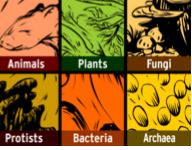
Which kingdoms are prokaryotic?
a)
Archaebacteria and Animalia
b)
Eubacteria and Archaebacteria
c)
Fungi and Protista
d)
Plantae and Eubacteria
49.
Which kingdom is part of the domain Archaea?
a)
Animalia
b)
Archaebacteria
c)
Eubacteria
d)
Plantae
50.

This organism is found in a normal environment. What kingdom does it belong to?
a)
Eubacteria
b)
Protista
c)
Archaebacteria
d)
Fungi
51.
What are the three domains?
a)
Archaea, Bacteria, and Eubacteria
b)
Archaea, Protista, and Eubacteria
c)
Archaea, Bacteria, and Eukarya
d)
Archaea, Fungi, Animalia
52.
Organisms that are classified as unicellular are --
a)
seen with the naked eye
b)
many celled organisms
c)
single celled organisms
d)
able to make their own food
53.
Which domain contains organisms that are unicellular, prokaryotic, and can cause strep throat or e. coli infections?
a)
Eukarya
b)
Archaea
c)
Fungi
d)
Bacteria
54.

Which word best describes the cell in the picture? (Click text to reveal picture)
a)
Multicelluar
b)
Prokaryotic
c)
Eukaryotic
d)
Abiotic
55.

What type of organism makes its own food internally?
a)
heterotroph
b)
autotroph
c)
carnivore
d)
omnivore
56.

Mold, yeast, and mushrooms all belong to the Kingdom _______.
a)
Archaebacteria
b)
Fungi
c)
Eubacteria
d)
Protista
57.

Most animals in this phylum have a backbone.
a)
Arthropoda
b)
Chordata
c)
Annelida
d)
Mollusca
58.

Choose the correct way to write the scientific name for humans:
a)
homo sapiens
b)
Homosapiens
c)
Homo sapiens
d)
Homo Sapiens
59.

Fungi are a type of...
a)
decomposer
b)
producer
60.
What is the genus name here:
Canis lupus
Canis lupus
a)
Canis
b)
lupus
61.
True or False: All living things are made of one or more cells.
a)
True
b)
False
62.
True or False: All cells have DNA.
a)
True
b)
False
63.
Organisms whose cells have NO nucleus are classified as...
a)
Eukaryotic
b)
Prokaryotic
c)
Dead
64.
To say that an organism is heterotrophic means...
a)
it cannot reproduce asexually
b)
it cannot make its own food
c)
it cannot breathe oxygen gas
65.

To which phylum do birds and cats belong?
a)
Arthropoda
b)
Chordata
c)
Echinodermata
d)
Cnidaria
66.

Which organism is most related to species E?
a)
D
b)
I
c)
G
d)
B
67.

Almost all bacteria are...
a)
Unicellular
b)
Multicellular
68.

Which domain is capable of living in extreme environments like hot springs, geysers, or very salty waters?
a)
Bacteria
b)
Archaea
c)
Eukarya
69.

A dichotomous key for trees is provided. Hikers found a tree that has large brown cones and single sharp needles. What species of tree have the hikers found?
a)
Juniper
b)
Pine
c)
Spruce
d)
Fir
70.

What trait separates sharks from ray-finned fish?
a)
Vertebrae
b)
Bony skeleton
c)
Four limbs
d)
None
71.

What traits do crocodiles and amphibians have in common?
a)
Vertebrae and hair
b)
Four limbs and amniotic eggs
c)
Bony skeleton and vertebrae
d)
Amniotic eggs and hair
72.
_____________________ is a process that produces cells with HALF the chromosomes.
a)
Budding
b)
Fragementation
c)
Regeneration
d)
Meiosis
73.
Which of the following cell types is formed by meiosis?
a)
muscle cells
b)
skin cells
c)
sperm cells
d)
blood cells
74.
What part of our cells holds our DNA?
a)
cytoplasm
b)
cell membrane
c)
nucleus
d)
ribosomes
75.

Which cellular process is shown?
a)
meiosis
b)
endocytosis
c)
mitosis
d)
phagocytosis
76.

a)
budding
b)
sporulation
c)
vegetative propagation
d)
binary fission
77.
Where is all the genetic material inside a cell?
a)
nucleus
b)
vacuole
c)
cell membrane
d)
ribosome
78.
Process through which living things produce other living things
a)
reproduction
b)
fertilization
c)
ovulation
79.
How are dominant traits represented?
a)
capital letters
b)
lower case letters
c)
cursive letters
d)
numbers
80.
If T=Tall and t=short, and my genotype if Tt, what is my phenotype?
a)
tall
b)
short
c)
dwarf
d)
medium height
81.
What word describes this genotype: Bb
a)
homozygous dominant
b)
homozygous recessive
c)
heterozygous
d)
dominant
82.
In mitosis, cells divide ________ time(s).
a)
1
b)
2
c)
3
d)
4
83.
One form of a gene is called_______________
a)
a DNA
b)
a Phenotype
c)
a trait
d)
an allele
84.
the condensed form of DNA is called________________
a)
an allele
b)
a gene
c)
a chromosome
d)
a phenotype
85.
Which of the following will only show if two alleles are present?
a)
a dominant trait
b)
a recessive trait
86.
Which of the following is a phenotype?
a)
Bb
b)
Black fur
87.

What is the percentage of offspring that have green pods?
a)
100%
b)
75%
c)
50%
d)
25%
88.

What percentage of the offspring in the punnett square are shown as a hybrid?
a)
100%
b)
75%
c)
50%
d)
25%
89.
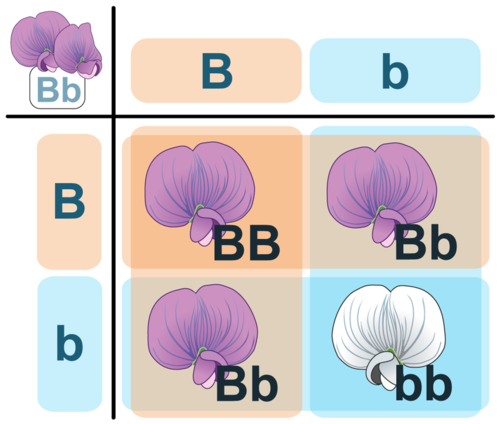
In this punnett square, which is the dominant trait?
The B stands for bud.
The B stands for bud.
a)
purple flower bud
b)
white flower bud
c)
dominant
d)
recessive
90.
Passing of traits from one generation to the next
a)
Heredity
b)
Genetics
c)
Inheritance
d)
Allele
91.
Segment of DNA on a chromosome that contains instructions for protein synthesis and controls a particular inherited trait
a)
Gene
b)
Pedigree
c)
Punnett Square
d)
Dominant
92.
An allele whose trait always shows up in the organism when the allele is present
a)
Gene
b)
Pedigree
c)
Punnett Square
d)
Dominant
93.
A chart that shows all the possible combinations of alleles that can result from a genetic cross
a)
Gene
b)
Pedigree
c)
Punnett Square
d)
Dominant
94.
A person who has one recessive allele for a trait, but does not have the trait
a)
Homozygous
b)
Selective Breeding
c)
Mutation
d)
Carrier
95.
Process by which humans cross organisms to produce offspring with certain desirable traits
a)
Homozygous
b)
Selective Breeding
c)
Mutation
d)
Carrier
96.
Having two identical alleles for a given trait, either both dominant or both recessive
a)
Homozygous
b)
Selective Breeding
c)
Mutation
d)
Carrier
97.

The gradual change in species over time is...
a)
Evolution
b)
Nucleotide
c)
Adaptation
d)
Natural Selection
98.
Butterflies blending their wing color with their environment is an example of what?
a)
Adaptation
b)
Evolution
c)
Camouflage
d)
None of the above
99.
A remnant or trace of an organism from the past is called a _______.
a)
Ancestor
b)
Skeleton
c)
Fossil
d)
Imprints
100.
Inherited trait that helps an organism survive is a(n) __________.
a)
Fossil
b)
Adaptation
c)
Ancestor
d)
Natural selection
101.
This occurs when no more of a species is living.
a)
Fossilization
b)
Adaptation
c)
Extinction
d)
Natural selection
102.
The man who studied genetics and came up with genetics is
a)
Watson
b)
Crick
c)
Mendel
d)
Darwin
103.

Genotype refers to the ...
a)
physical expression of the genes
b)
the possible combination of alleles in a gene
c)
whether an allele is dominant or recessive
d)
how an organism will appear
104.
having two of the same genes for the trait (sometimes called purebred).
a)
homozygous
b)
hetrozygous
c)
protein
d)
chromosome
105.
The struggle for existence against other members of an organisms species is
a)
Competition
b)
Natural Selection
c)
gene flow
d)
genetic drift
106.
Genetic differences between organisms of the same species
a)
Variation
b)
Adaptation
c)
Behavior
d)
Environment
107.

To adjust to a changing environment
a)
Mutation
b)
Adapt
108.
What are the evidences for Evolution?
a)
Fossil Records
b)
Embryology
c)
Similar body structure
d)
All the above
109.

Genetic variation can arise from a random change in the DNA of a gene. The change is called a(n)
a)
mutation
b)
gene flow
c)
gene pool
d)
allele
110.

When an animal tries to look, sound, or act like
another animal to fool predators into thinking it is poisonous or dangerous,
this is called?
a)
camouflage
b)
hibernation
c)
migration
d)
mimicry
111.
Individuals who are considered fit, have:
a)
Stronger genes
b)
Fewer mutations
c)
More food
d)
More offspring
112.

Farmers breed cows to produce high amounts of milk. This is an example of...
a)
Natural Selection
b)
Variations in a species
c)
Selective Breeding
113.

characteristic or trait that helps an organism survive in its environment
a)
skills
b)
speciation
c)
natural instinct
d)
adaptation
114.

What is this an example of?
a)
vestigial structures
b)
fossil record
c)
homologous structures
d)
embryology
115.

Which layer is the oldest?
a)
1
b)
2
c)
3
d)
4
116.
This domain contains organisms that have a true nucleus in each of their cells. This domain breaks down into four kingdoms.
a)
Animalia
b)
Archaea
c)
Bacteria
d)
Eukarya
117.
Organisms in the Kingdom Animalia are mostly unicellular Eukaryotes.
a)
True
b)
False
118.
How many kingdoms are there?
a)
3
b)
4
c)
6
d)
9
119.
How many parents do you have in asexual reproduction?
a)
1
b)
3
c)
2
d)
4
120.
How much DNA do you receive from one parent in asexual reproduction?
a)
25%
b)
50%
c)
75%
d)
100%
121.
In sexual reproduction offspring look___________from their parent.
a)
Identical
b)
different
c)
the opposite
d)
happy
122.
In asexual reproduction the offspring look ________ as their parent.
a)
identical
b)
different
c)
the opposite
d)
as happy
123.

Bacteria like salmonella reproduce________
a)
sexually
b)
asexully
124.
_____________________ is a process that produces cells with HALF the chromosomes.
a)
Budding
b)
Fragementation
c)
Regeneration
d)
Meiosis
125.
Which of the following cell types is formed by meiosis?
a)
muscle cells
b)
skin cells
c)
sperm cells
d)
blood cells
126.
Which cellular process is shown?
a)
meiosis
b)
endocytosis
c)
mitosis
d)
phagocytosis
127.
A male shark has 40 chromosomes in each of its sex cells. How many would be present in its BODY cells?
a)
20
b)
40
c)
80
d)
160
128.
Sexual reproduction requires _____ parents and asexual reproduction requires ___ parents
a)
1,1
b)
2,2
c)
2,1
d)
1,2
129.

What is the process in which the nucleus of a eukaryotic cell divides into two identical nuclei.
a)
Mitosis
b)
Meiosis
c)
Sexual Reproduction
d)
Asexual Reproduction
100 %

