
 Worksheets
Evolution Vann
Total questions: 43
Worksheet time: 1hrs 14mins
Name
Class
Date
1.
In natural selection, the selective agent is the
a)
humans
b)
mutations
c)
breeders
d)
environment
2.

what did Charles Darwin observe in finch populations of the Galapagos Islands off the coast of South America?
a)
different species on different islands
b)
all species on one of the islands
c)
identical species on all the islands
d)
the same species as North America
3.
Mutations are important because they bring about
a)
death of the organism in which they develop
b)
genetic variation needed for a population to evolve
c)
benefits for the individual, not for the population
d)
Hardey-Weinberg equilibrium within a population
4.
What is the term for a feature that allows an organism to survive better in its environemtn?
a)
variation
b)
adaptation
c)
homologous structure
d)
vestigial structure
5.
Natural selection results in change over time by acting on traits that are
a)
heritable
b)
new
c)
mutated
d)
better than the best
6.

The Physical remains of a plant or animal preserved in rock or Earth's crust.
a)
Adapt
b)
Fossil
7.

Charles Darwin came up with this theory
a)
Natural Selection
b)
Mutation
8.

To adjust to a changing environment
a)
Mutation
b)
Adapt
9.

Darwin wrote that organisms with traits that are best suited to the environment will ________________
a)
increase in number
b)
become extinct
10.

Some organisms that share a common ancestor have features that have different functions, but similar structures. These are known as
a)
vestigial structures
b)
analogous structures
c)
homologous structures
d)
fossil structures
11.

What increases genetic variation when animals move from one population to another
a)
genetic drift
b)
sexual selection
c)
bottleneck effect
d)
gene flow
12.
Choose which scientist corresponds best with the statement:
acquired characteristics are inherited
acquired characteristics are inherited
a)
Darwin
b)
Lamarck
13.

The gradual change in species over time is...
a)
Evolution
b)
Nucleotide
c)
Adaptation
d)
Natural Selection
14.
What is another name for natural selection?
a)
survival of the smartest
b)
survival of the fastest
c)
survival of the biggest
d)
survival of the fittest
15.
The opossum and kangaroo both incubate their young in a pouch. This provides evidence that they---
a)
are descended from a common ancestor
b)
Have very similar skeletal structures
c)
belong to the same species
d)
must range great distances to eat
16.

A graph regarding the effect of agricultural bioengineering on insect pests is shown below How has natural selection affected species of insect pests?
a)
A. Natural selection has not affected the number of species that are resistant to pesticides
b)
A. Natural selection has rapidly increased the number of species that are resistant to pesticides
c)
A. Natural selection has only affected the number of species that are resistant to pesticides
17.

Which of the following is a term for a group of similar organisms that can reproduce fertile offspring?
a)
individual
b)
population
c)
species
d)
fossil
18.

How would you describe these two features?
a)
Homologous structure
b)
Analogous structure
c)
Structural adaption
d)
Functional adaption
19.

If an organism has a vestigial structure, that structure likely once had a function in a(n)
a)
close relative
b)
early ancestor
c)
unrelated organism
d)
embryological stage
20.

which of the following is an example of a vestigial structure?
a)
the wings of a red-tailed hawk
b)
the hind limbs of a house cat
c)
the fins of sharks
d)
the wings of an ostrich
21.

a bird that can easily outcompete other birds for food and that can produce many eggs has a high
a)
sexuality
b)
mutation rate
c)
fitness
d)
adaptability
22.
Tiktaalik is close related to the...
a)
proa fish
b)
paddle fish
c)
tiktiklala fish
23.

What kid of isolation occurs when two populations of birds have different courtship dances?
a)
geographic
b)
sexual
c)
temporal
d)
behavioral
24.
Other insects cannot, but, a bumble bee has just enough weight to open up the snapdragon flower and pollinate. This adaption is ....
a)
convergent evolution
b)
co-evolution
c)
divergent evolution
d)
speciation
25.
Natural selection could not occur without
a)
geographic isolation
b)
variation in the population
c)
stable environments
d)
competition for unlimited resources
26.

According to the diagram, which bird has the most similar DNA to a large tree finch?
a)
small tree finch
b)
medium tree finch
c)
large ground finch
d)
green warbler finch
27.

According to the cladogram, which organism is most distantly related to the human?
a)
crayfish
b)
rat
c)
perch
d)
frog
28.

Which trait do only humans have, according to the cladogram?
a)
jaws
b)
mammary glands & hair
c)
terrestrial during all life stages
d)
opposable thumbs
29.
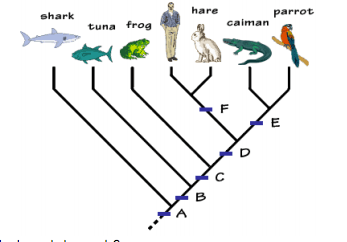
On the cladogram, which organism is the closest relative of the human?
a)
Frog
b)
Hare
c)
Caiman
d)
Parrot
30.
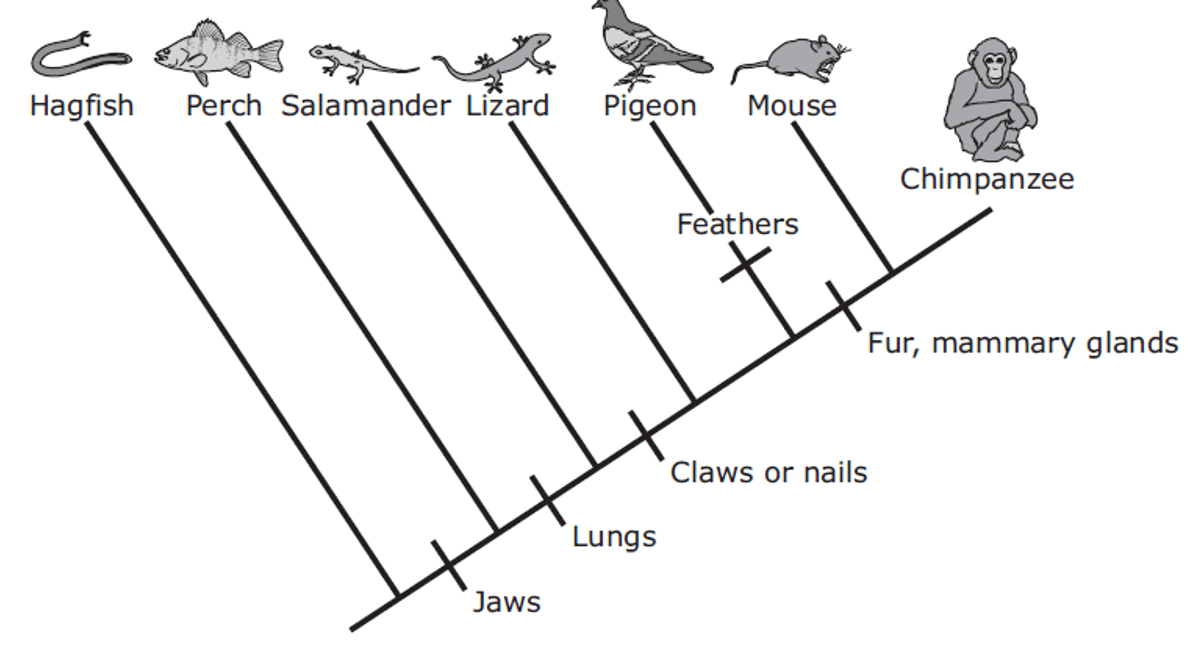
All the animals to the right of the hagfish would have the common characteristic of -
a)
Fur
b)
Claws or nails
c)
Lungs
d)
Jaws
31.
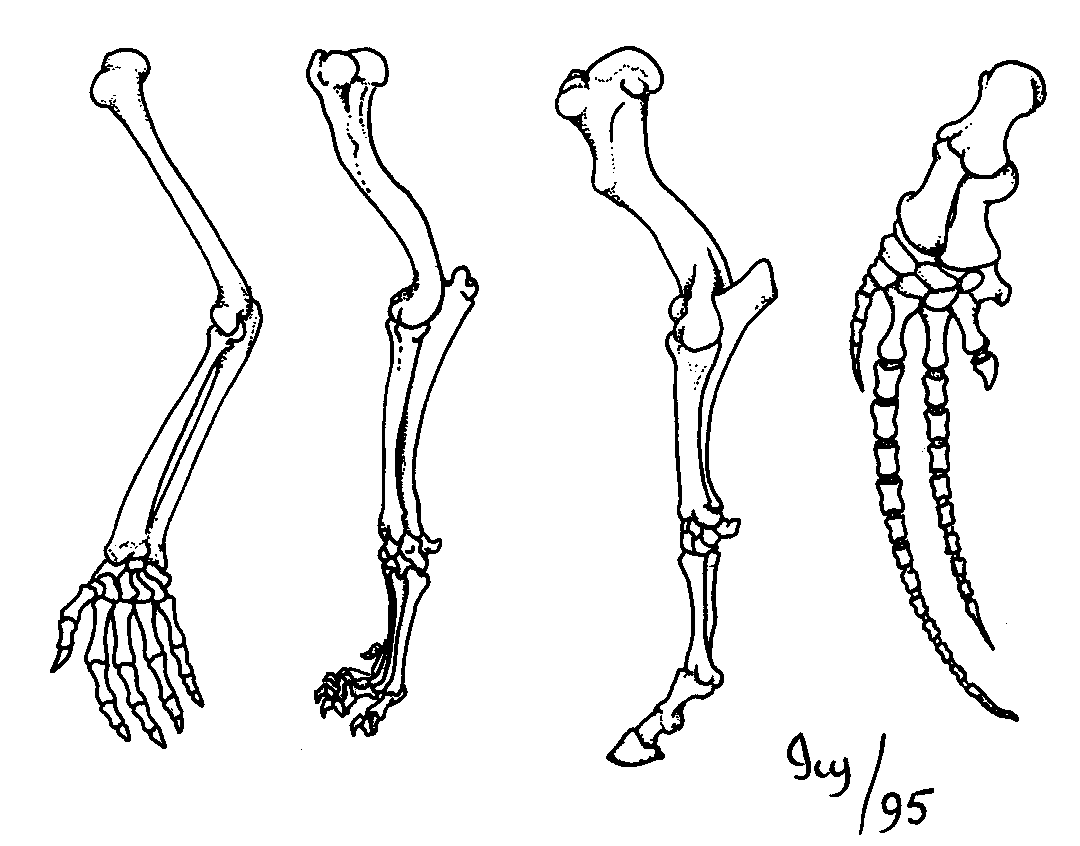
Structures with the same parts have different functions; suggests that organisms share a common ancestry
a)
vestigial structures
b)
homologous structures
c)
adaptive radiation
d)
fossil
32.

If an organism has a vestigial structure, that structure likely once had a function in a(n)
a)
close relative
b)
early ancestor
c)
unrelated organism
d)
embryological stage
33.
Crossing over occurs in which phase of meiosis?
a)
Metaphase 1
b)
Metaphase 2
c)
Prophase 1
d)
Prophase 2
34.
In the Hardy-Weinberg Equation, q2 is the frequency of what?
a)
The recessive allele
b)
the dominant allele
c)
the recessive genotype
d)
the dominant genotype
35.
What percentage of the offspring are homozygous recessive when you cross two heterozygotes for a trait?
a)
25%
b)
50%
c)
75%
d)
100%
36.
What does the variable q represent?
a)
Frequency of the heterozygote genotype
b)
Frequency of the homozygous recessive genotype
c)
The frequency of the recessive allele
d)
The frequency of the dominant allele
37.
A chance occurrence that negatively affects a population because the population is small.
a)
genetic drift
b)
mutation
c)
speciation
d)
migration
38.
Genetic drift is likely to be seen in a population
a)
That has a low mutation rate
b)
In which natural selection is occurring
c)
That is very small
d)
For which environmental conditions are changing
39.
What do you call all of the genes in a population?
a)
Gene pool
b)
Relative Frequency
c)
Genetic Drift
d)
Allele pool
40.
What does the Hardy-Weinberg equilibrium measure?
a)
changes in allele frequencies
b)
numbers of mutations
c)
goodness of fit
d)
genetic diversity
41.
Which disorder is characterized by degradation of the nervous system and usually results in death during infancy?
a)
Tay-Sachs
b)
Cystic fibrosis
c)
Huntington's
d)
PKU
42.

What disease is characterized by abnormally shaped red blood cells?
a)
hemophilia
b)
sickle cell anemia
c)
phenylketonuria
d)
Huntington's
43.
Which Hardy-Weinberg equation represents the genotype frequencies in a population?
a)
p + q = 1
b)
p2 + 2pq + q2 = 1
c)
p2 + pq2 + q2 = 1
d)
p + 2pq + q3 = 1
100 %

