
 Worksheets
Unit 9: Earth-Moon-Sun and Gravity
Total questions: 76
Worksheet time: 59mins
Name
Class
Date
1.

What season is it when the area you live in is tilted away from the sun?
a)
It is summer.
b)
It is spring.
c)
It is winter.
d)
It is fall.
2.

Why does the area around the equator stay the same temperature all year?
a)
The equator rotates slower than the poles.
b)
The equator remains the same distance from the sun.
c)
The equator always receives direct sunlight.
d)
The equator has 18 hour days.
3.
Day and night is caused by the _____________ of earth on its axis.
a)
revolution
b)
orbit
c)
rotation
d)
gravity
4.
Tides are mainly caused by
a)
strong winds that blow over ocean waters.
b)
the interaction of Earth, the moon and the sun.
c)
the shifting of the plates on the ocean floor.
d)
earthquakes
5.

What type of tides would this arrangement of earth-moon-sun create?
a)
neap tide
b)
spring tide
c)
new moon tide
d)
full moon tide
6.

What type of tide would this arrangement of earth-moon-sun create?
a)
full moon tide
b)
new moon tide
c)
neap tide
d)
spring tide
7.

Does this picture represent a waxing or waning moon?
a)
waxing
b)
waning
8.

The difference in levels of ocean water at high and low tides is the _________________.
a)
low tide
b)
tidal range
c)
high tide
d)
slack water
9.
________________ is the movement of an object around the center of another object. Also known as an orbit.
a)
Rotation
b)
Axis
c)
Revolution
d)
Waxing
10.
How much of the moon is always illuminated by the sun?
a)
1/2
b)
1/4
c)
1/3
d)
1/8
11.

What is the phase of this moon?
a)
Waning Crescent
b)
Waning Gibbous
c)
Waxing Gibbous
d)
Waxing Crescent
12.

What is the phase of the moon in the picture?
a)
New Moon
b)
Third Quarter
c)
First Quarter
d)
Waxing Gibbous
13.

What is the phase of this moon?
a)
Waxing Gibbous
b)
First Quarter
c)
Waning Gibbous
d)
Waning Crescent
14.

What is the phase of this moon?
a)
Waning Crescent
b)
Waxing Crescent
c)
Waning Gibbous
d)
Waxing Gibbous
15.
The _____________ is the imaginary line through the center of rotation of an object.
a)
Revolution
b)
Axis
c)
Rotation
d)
Phase
16.
What is NOT a benefit of using models in science?
a)
Allows us to see something we wouldn't normally see
b)
Helps us understand systems
c)
Helps us determine relationships
d)
Oversimplified
17.
How long is the moon's revolution around Earth?
a)
About a month
b)
About a year
c)
About a day
d)
About 3 - 4 days
18.
What is the reason why we experience seasons on Earth?
a)
Earth's distance from the Sun
b)
The speed of Earth's rotation
c)
The tilt of the Earth's axis
d)
The sun's orbit around Earth
19.

What is the phase of this moon?
a)
Waning Gibbous
b)
Waxing Gibbous
c)
Third Quarter
d)
Full Moon
20.

What is the phase of this moon?
a)
Third Quarter
b)
Waning Crescent
c)
First Quarter
d)
Waning Gibbous
21.
The spin of a body on it's axis is the definition of ___________________.
a)
Revolution
b)
Rotation
c)
Axis
d)
Eclipse
22.
What type of tide occurs during the first or third quarter moon?
a)
Neap tides
b)
Spring tides
c)
Normal tides
23.
If the Sun, Earth, and Moon are in perfect alignment, the Earth would have a _______ tide.
a)
Spring
b)
Neap
c)
Normal
24.
What type of tide occurs during a new and full moon?
a)
Neap tides
b)
Spring tides
c)
Normal tides
25.
If the Sun, Earth, and Moon create a 90 degree angle, the Earth would have __________.
a)
Spring tides
b)
Neap tides
c)
Normal tides
26.

What season is it in the Southern Hemisphere when it is fall in the Northern Hemisphere?
a)
winter
b)
spring
c)
summer
d)
fall
27.
One rotation of Earth is equal to
a)
a day.
b)
a year.
28.
The Northern Hemisphere gets __________ sunlight in the winter, which leads to _________ temperatures.
a)
less direct, hotter
b)
less direct, colder
c)
more direct, hotter
d)
more direct, colder
29.
You visited the beach at 12 pm (noon) and it is high tide. If you return 6 hours later what tide will you see?
a)
high
b)
low
c)
neap
d)
spring
30.
The Moon has a greater influence on Earth tides than the Sun because...
a)
it is farther away
b)
it has less mass
c)
it is closer
d)
it has more mass
31.
The bulge of water on the side of the Earth closest to the moon produces ___________.
a)
high tide
b)
low tide
c)
neap tide
d)
spring tide
32.
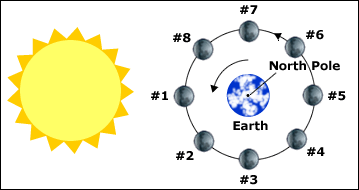
What phase is the moon when in position #5?
a)
New Moon
b)
First Quarter
c)
Full Moon
d)
Third Quarter
33.
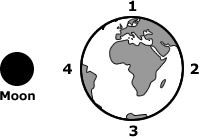
The diagram below shows Earth and the moon. In which position(s) will Earth's tidal bulge(s) occur?
a)
4 only
b)
1 and 4
c)
3 and 4
d)
2 and 4
34.
Which angle of sunlight would provide the most solar energy?
a)
25 degrees
b)
45 degrees
c)
90 degrees
d)
135 degrees
35.
Why do you always see the same side of the Moon?
a)
This is false- we only see one side at a time
b)
This is false- we see all sides of the Moon eventually
c)
We are sleeping when the other side is visible
d)
The moon rotates once on its axis each time it orbits Earth
36.
When the Moon appears to be shrinking, it is called:
a)
waxing
b)
waning
c)
crescent
d)
gibbous
37.
What phase occurs after a New Moon?
a)
waxing gibbous
b)
waxing crescent
c)
waning gibbous
d)
waning crescent
38.
When no sunlight hits the side of the Moon facing the Earth, what phase is it?
a)
new
b)
full
c)
1st quarter
d)
3rd quarter
39.
A year is measured by
a)
Earth's revolution around the sun
b)
Earth's rotation on its axis
c)
the tilt of the earth
d)
Earth's involvement in eclipses
40.

Name the phase of the moon that comes AFTER this moon phase.
a)
waxing gibbous
b)
full moon
c)
1st quarter
d)
3rd quarter/last quarter
41.

Name the phase of the moon that comes AFTER this moon phase.
a)
full moon
b)
3rd/last quarter
c)
waxing crescent
d)
new moon
42.

What Moon phase is this?
a)
Full Moon
b)
Waxing Gibbous
c)
New Moon
d)
Half Moon
43.

What phase comes AFTER this one?
a)
Waxing Crescent
b)
Waning Gibbous
c)
Waxing Gibbous
d)
Third Quarter
44.

What Moon phase is this?
a)
Old Moon
b)
Far Side of the Moon
c)
New Moon
d)
Waxing Gibbous
45.

What phase comes AFTER this one?
a)
Waning Crescent
b)
Waning Gibbous
c)
Waxing Crescent
d)
Third Quarter
46.

Label part 7 on the diagram of the sun.
a)
Prominences
b)
Corona
c)
Sunspots
d)
Photosphere
47.

Label part 1 on the diagram of the sun.
a)
Core
b)
Radiation zone
c)
Convection zone
d)
Photosphere
48.
What are the dark areas on the photosphere of the sun called? They form because they are cooler than surrounding areas.
a)
a sunspot
b)
solar wind
c)
a solar flare
d)
a prominence
49.
Energy is created in the core through nuclear fusion, which is when two _____________ atoms join together to form a ______________ atom.
a)
helium, hydrogen
b)
carbon, hydrogen
c)
nitrogen, helium
d)
hydrogen, helium
50.
Which layer of the sun contains visible light and is the layer we see when we look at the sun?
a)
photosphere
b)
chromosphere
c)
corona
d)
convection zone
51.
What layer of the sun's atmosphere gives the sun its "white halo" during a solar eclipse?
a)
chromosphere
b)
photosphere
c)
corona
d)
atmosphere
52.
What layer gives the sun its reddish color during a solar eclipse?
a)
convection zone
b)
corona
c)
chromosphere
d)
photosphere
53.
A release of high-energy radiation from the sun's surface that can be observed as a sudden flash of brightness
a)
prominences
b)
solar flares
c)
coronal loops
d)
solar wind
54.

#9 is pointing to an arch of red-glowing plasma that loops outward from the sun's photosphere, called a ____.
a)
#9 Prominences
b)
#9 Corona
c)
#9 Sunspots
d)
#9 Photosphere
55.

Why is it warmer in the summer?
a)
Closer to the sun
b)
More direct light from Earth's tilt
c)
Stronger light from the sun
d)
Earth spins slower
56.
Light Years are a measure of:
a)
time
b)
speed
c)
distance
d)
light
57.
Two objects will have the greatest gravitational attraction when they are
a)
large and far apart.
b)
small and close together
c)
large and close together.
d)
small and far apart.
58.
Gravitational force depends on
a)
mass and density
b)
weight and distance
c)
distance and mass
d)
weight and density
59.
. An object's orbital path is a result of the balance between
a)
gravity and mass
b)
gravity and inertia
c)
mass and distance
d)
mass and inertia
60.
The force of gravity on an object is the object's
a)
weight
b)
force
c)
mass
d)
inertia
61.
As the masses of two objects increase, the gravitational force between them
a)
stays the same
b)
decreases
c)
increases
62.
Which of these would affect the strength of gravity between the Earth and the Sun?
a)
The tilt of the Earth's axis
b)
The amount of energy the Earth receives from the Sun
c)
The movement of the magma inside of Earth
d)
The distance between the Earth and the Sun
63.
Which property of an object will be different on the Moon than on Earth?
a)
composition
b)
mass
c)
weight
d)
shape
64.
What happens to gravitational force when the distance between objects increases?
a)
it gets weaker
b)
it gets stronger
c)
it gradually disappears
d)
nothing
65.
An astronaut's mass on the Moon and on Earth are ____________________.
a)
the same
b)
different
66.
In order to have an eclipse, the Moon, Sun and Earth have to be?
a)
Below each other
b)
Above each other
c)
In alignment
67.
A lunar eclipse can occur only during the _________________.
a)
Full moon
b)
New moon
c)
Waxing moon
68.
A solar eclipse can occur only during the _________________.
a)
Full moon
b)
New moon
c)
Quarter moon
69.
Which type of eclipse occurs when the Moon comes directly between Earth and the Sun?
a)
Lunar eclipse
b)
Solar eclipse
70.
Which type of eclipse occurs when the Earth comes directly between the Sun and Moon?
a)
Lunar eclipse
b)
Solar eclipse
71.
During a lunar eclipse, what color does the moon appear?
a)
Black
b)
Red-orange
c)
Yellow-green
d)
White
72.
Why isn't there an eclipse every month?
a)
Because the moon orbits the sun differently than Earth does.
b)
Because the Earth's orbit and the moon's orbit are at the same angle, flat plane.
c)
Because the moon's orbit is offset from Earth's orbit by 1.5°, not in a flat plane.
d)
Because the lunar cycle is longer than a month.
73.
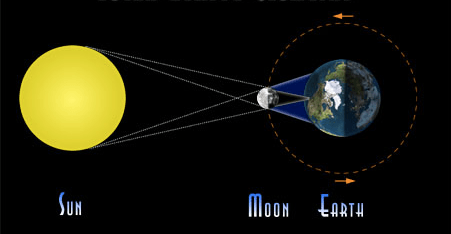
Which type of eclipse is shown in this picture?
a)
Solar Eclipse
b)
Orbit
c)
Lunar Eclipse
d)
Total Eclipse
74.
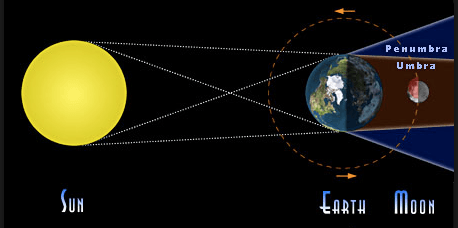
Which type of eclipse is shown in the diagram?
a)
Solar Eclipse
b)
Lunar Eclipse
c)
Total Eclipse
d)
Partial Eclipse
75.

What type of tides would this arrangement of earth-moon-sun create?
a)
neap tide
b)
spring tide
c)
new moon tide
d)
full moon tide
76.

What type of tide would this arrangement of earth-moon-sun create?
a)
full moon tide
b)
new moon tide
c)
neap tide
d)
spring tide
100 %

