
 Worksheets
STAAR 8th Grade Science: RC3
Total questions: 77
Worksheet time: 1hrs 2mins
Name
Class
Date
1.

What stars have a luminosity of around 102, and are not very hot comparatively?
a)
super giants
b)
white dwarfs
c)
main sequence
d)
red giants
2.
What instrument do we use to get most of our star information?
a)
binoculars
b)
stethescope
c)
spectroscope
d)
telescope
3.
What type of star is our sun?
a)
extremely large
b)
extremely small
c)
average
d)
its not a star
4.
What is our galaxy and where are we in it?
a)
andromeda, outer part
b)
milky way, outer part
c)
andromeda, inner part
d)
milky way, inner part
5.
Stars form from?
a)
galaxies
b)
moons
c)
nebulas
d)
comets
6.

What type of galaxy is pictured?
a)
eliptical
b)
irregular
c)
spiral
d)
round
7.
The main things we see in the universe are ________ and they are grouped in _______.
a)
galaxies, stars
b)
planets, solar systems
c)
galaxies, universe
d)
stars, galaxies
8.

Which star has the lowest temperature?
a)
A
b)
B
c)
C
d)
D
9.

Which star is considered a Main Sequence Star?
a)
A
b)
B
c)
C
d)
D
10.
A light year is...
a)
The speed light travels
b)
How long it takes light to get to you from the sun
c)
The distance light can travel in a year
d)
How many years it takes light to be emitted
11.

Which star has the lowest luminosity?
a)
A
b)
B
c)
C
d)
D
12.

Look at the H-R Diagram. Where is Polaris?
a)
In the main sequence
b)
with the Super Giants
c)
with the Giants
d)
with the White Dwarfs
13.

Look at the H-R Diagram. Where is the sun?
a)
In the main sequence
b)
with the Super Giants
c)
with the Giants
d)
with the White Dwarfs
14.

Stars are formed in a cloud of gas and dust called a
a)
nebula
b)
black hole
c)
white dwarf
d)
Super Giant
15.
Very massive stars die in a huge explosion called a ____________.
a)
solar flare
b)
super nova
c)
black hole
d)
neutron star
16.
Proxima Centauri is the closest star to Earth after the Sun and is located 4.3 light years away from Earth. How long does it take light from Proxima Centauri to reach Earth?
a)
1 year
b)
4.3 years
c)
43 years
d)
10 trillion years
17.
The event that marks the beginning of our known universe
a)
Theory of Evolution
b)
Big Bang Theory
c)
Cell Theory
d)
Blackhole theory
18.
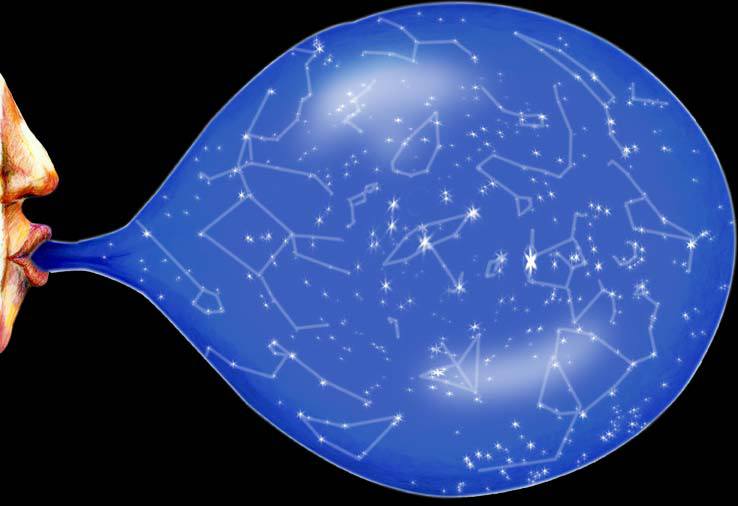
What does the Big Bang theory suggest?
a)
The universe was just there
b)
The Milky Way is the only solar system
c)
The universe is continually expanding
d)
The universe started as a point and is moving towards each other
19.
A[n] ___________ tide occurs when the sun, Earth, and the moon are nearly in a line.
a)
spring
b)
high
c)
low
d)
neap
20.
A[n] ______________ tide occurs when the sun is at right angles to the line between Earth and the moon.
a)
high
b)
neap
c)
low
d)
spring
21.

What type of tides would this arrangement of earth-moon-sun create?
a)
neap tide
b)
spring tide
c)
new moon tide
d)
full moon tide
22.

Which phase of the moon is represented in this diagram?
a)
new moon
b)
first quarter
c)
full moon
d)
last quarter/third quarter
23.

What is it called when you are able to see half the moon and the light on the moon is decreasing?
a)
New moon
b)
1st quarter
c)
Full Moon
d)
3rd quarter
24.

What is it called when more than half of the moon is lit on the right side and light is increasing?
a)
Waxing cresent
b)
Waxing gibbous
c)
Waning gibbous
d)
Waning cresent
25.
What phase of the moon does a solar eclipse occur?
a)
New moon
b)
1st quarter
c)
Full moon
d)
3rd quarter
26.
What moon phases do spring tides occur?
a)
new and full
b)
1st & 3rd quarters
27.

The hemisphere where you live
a)
equator
b)
southern
c)
northern
d)
eastern
28.

In winter, the axis of the earth is pointed away or toward the sun?
a)
towards
b)
up
c)
down
d)
away
29.

In summer, the axis of the earth is pointed away or toward the sun?
a)
towards
b)
up
c)
down
d)
away
30.

Which season is taking place in the Southern Hemisphere in Position 1?
a)
Winter
b)
Spring
c)
Summer
d)
Fall
31.

Which season is taking place in the Northern Hemisphere in Position 1?
a)
Winter
b)
Spring
c)
Summer
d)
Fall
32.

What will be the moon phase 7 nights later?
a)
F
b)
G
c)
H
d)
J
33.

Which moon phase occurred on January 21, 2011?
a)
Full Moon
b)
Waning Gibbous
c)
Waxing Gibbous
d)
First Quarter
34.

With this moon shining, which tide will be occurring?
a)
Spring Tide
b)
Neap Tide
35.
The moon is growing/getting bigger and light is on the right.
a)
Waxing
b)
Waning
36.
The moon is shrinking/getting smaller and light is on the left.
a)
Waxing
b)
Waning
37.
First phase of the lunar cycle; not visible and it's often represented by a black circle. (only lasts 1 day)
a)
Full Moon
b)
New Moon
38.
Appears after a new moon; you can see less than half of the light on the right side of the moon.
a)
Waxing Crescent
b)
Waning Crescent
39.
Appears before a new moon; you can see less than half of the light on the left side of the moon.
a)
Waxing Crescent
b)
Waning Crescent
40.
Light on the right; you can see 1/2 of the light. (Lasts 1 day)
a)
First Quarter
b)
Last Quarter
41.
Light on the left ; you can see 1/2 of the light. (Lasts 1 day)
a)
First Quarter
b)
Last Quarter
42.
Rising and falling of Earth's sea levels due to the gravitational pull of the moon and sun on earth as it rotates.
a)
Moon Phases
b)
Tides
c)
Seasons
43.
Strongest tides occurring during new and full moon
a)
Neap tides
b)
Spring tides
44.
Weakest tides occurring during 1st and last quarter
a)
Spring tide
b)
Neap tide
45.
The lunar cycle takes 29.5 days
a)
True
b)
False
46.

If there is a full moon on March 2, when would you expect the Third Quarter?
a)
March 5
b)
March 9
c)
March 16
d)
March 23
47.

If today was a full moon, what would be the moon phase in one week?
a)
New Moon
b)
First Quarter
c)
Third Quarter
d)
Full Moon
48.
If the current moon phase is at position 2, where would it be in two weeks?
a)
full moon
b)
waning gibbous
c)
third quarter
d)
back to position 2
49.

Approximately how much time passes between the new moon and full moon?
a)
one month
b)
two weeks
c)
3 days
d)
24 hours�
50.

What moon phase is shown in position 8
a)
waxing crescent
b)
waxing gibbous
c)
waning gibbous
d)
waning crescent
51.
The type of plate boundary where two plates come together is a .....
a)
Convergent Boundary
b)
Divergent Boundary
c)
Transform Boundary
d)
Plate Boundary
52.
Which of the following causes Earth's tectonic plates to move?
a)
Energy from the Sun
b)
Magnetic Pole Reversal
c)
Convection currents in the mantle
d)
Faults in Mountain Ranges
53.
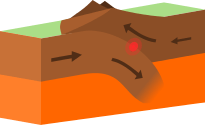
What type of plate boundary is this?
a)
Plate
b)
Divergent
c)
Convergent
d)
Transform
54.

What type of event will occur at this boundary?
a)
Earthquake
b)
Volcano Eruption
c)
Tornado
d)
Mountain Building
55.
A divergent boundary occurs when plates ....
a)
Pull apart
b)
Come together
c)
Slide past each other
d)
subducting
56.
Which of the following is the name of the ancient supercontinent formed 28 Million Years ago.
a)
Pangea
b)
Gondwanda
c)
Laurasia
d)
Neverland
57.
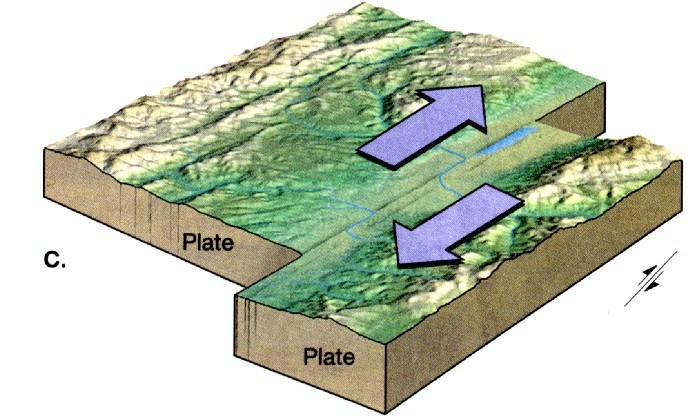
What type of plate boundary is this?
a)
Transform
b)
Convergent
c)
Divergent
d)
Plate
58.
Oceanic Trenches are formed by _______ plate boundaries
a)
Convergent
b)
Transform
c)
Plate
d)
Divergent
59.
A fault is formed by the movement of a __________ plate boundary
a)
Transform
b)
Convergent
c)
Divergent
60.
Islands can from from magma which is pushed up at a __________ plate boundary
a)
Divergent
b)
Convergent
c)
Transform
61.
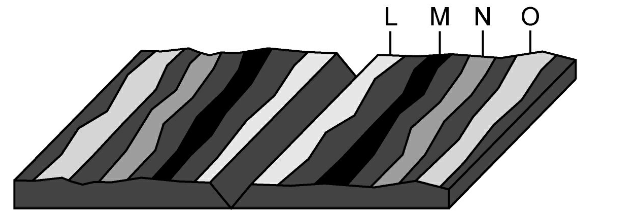
Where would the oldest rock be found?
a)
L
b)
M
c)
N
d)
O
62.
How is it possible for new crust to be formed without increasing the surface area of the Earth?
a)
Crust is destroyed at the same time it is created
b)
New crust is underwater where it sinks
c)
New crust breaks more easily than old crust
63.
Mountains are created when....
a)
Two continental plates collide
b)
Two oceanic plates pull apart
c)
An Oceanic plate subducts under a Continental Plate
d)
Two continental plates pull apart
64.

What is the elevation of point B?
a)
800 ft
b)
850 ft
c)
900 ft
d)
1000 ft
65.

In which direction is Mill River flowing?
a)
Southeast
b)
Southwest
c)
Northeast
d)
Northwest
66.

What is the elevation of Y?
a)
Between 120-140 meters
b)
Between 100-120 meters
c)
Between 140-160 meters
d)
Between 80-100 meters
67.

The distance from D to E is...
a)
A little over 2 km
b)
A little over 3 km
c)
A little over 4 km
d)
A little over 5 km
68.

What is the elevation of the peak of the small island on the left side?
a)
About 20 meters
b)
About 40 meters
c)
About 60 meters
d)
About 200 meters
69.

What is the elevation of A?
a)
10 meters
b)
20 meters
c)
40 meters
d)
120 meters
70.

What feature is formed at B?
a)
river
b)
rift valley
c)
sink hole
d)
mountain
71.

If we were in a plane, Path B --> C is about the same distance as path E --> N. But, which path is the easier walk?
a)
B --> C is the easier walk
b)
E --> N is the easier walk
c)
B --> C and E --> N are the same walking distance
72.
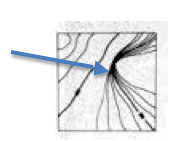
What feature is at the arrow?
a)
volcano
b)
mountain
c)
cliff
d)
river
73.
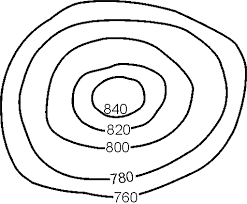
Determine the contour interval:
a)
5 m
b)
10 m
c)
15 m
d)
20 m
74.
What do contour lines that are farther apart represent?
a)
waterfall
b)
steep area
c)
gentle slope
d)
river
75.

How many mountain tops does this map have?
a)
one
b)
two
c)
three
d)
four
76.

What is the difference in elevation between Point X and Point Y?
a)
120 m
b)
240 m
c)
360 m
d)
340 m
77.
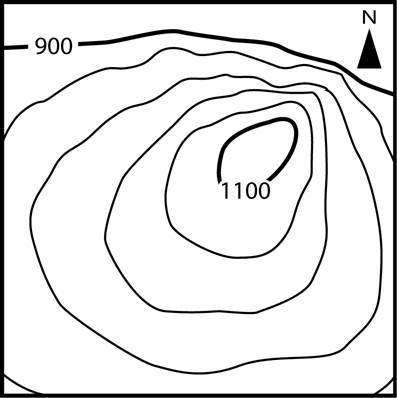
Provided is a topographic map of a hill with contour lines drawn showing elevation in meters.
The steepest slope on this hill can be found on the side that is facing which direction?
The steepest slope on this hill can be found on the side that is facing which direction?
a)
Southwest
b)
Northeast
c)
Northwest
d)
Southeast
100 %

