wayground logo

Free Printable Worksheets

NEW

Font size

S
M
L
XL
Worksheets

Geologic History-Honors

Total questions: 77

Worksheet time: 1hrs 17mins

Name
Class
Date
1.
Which of the following is NOT a method of finding the absolute age of rock?
a)
Applying pressure to the rock
b)
Carbon-14 dating
c)
Potassium-40 dating
d)
Uranium-238
2.
Popular theory suggests this ended the age of dinosaurs.
a)
asteroid impact
b)
ice age
c)
human predation
d)
the rise of mammals
3.
Which of  the following is not an example of a method of finding the absolute age of rock?
a)
Hydrogen-10 dating
b)
Carbon-14 dating
c)
Potassium-40 dating
d)
Uranium-238 dating
4.
How long is there in a geologic time period? 
a)
3 million years
b)
4.6 billion years
c)
a period doesn't have an exact length
d)
they are all the same length
5.
An undisturbed sedimentary layer is _________ than the layer above and _________ than the layer below. 
a)
younger - older
b)
younger - younger
c)
older - younger
d)
older - older 
6.
Fossils are most common in what rock types? 
a)
Sedimentary
b)
Igneous
c)
Metamorphic
d)
All rocks contain fossils
7.
Earth's history never changes.
a)
True
b)
False
8.
A scientist who studies fossils is a ____________.
a)
Paleontologist
b)
Biologist
c)
Archaeologist
d)
Hemotologist
9.
The process by which all living things have changed over time is____________.
a)
Evolution
b)
Change over Time
c)
Metamorphosis
d)
Changing
10.
The __________ is the number of years since the rock or fossil formed. 
a)
Absolute Age
b)
Relative Age
11.
Current scientific evidence shows that the Earth is estimated to be: 
a)
Less than 1 million years old
b)
Between 3 and 4 billion years old
c)
More than 4 billion years old
d)
Less than 2 billion years old
12.
The ___________ is the age of rocks or fossils compared with other rocks or fossils. 
a)
Absolute Age
b)
Relative Age
13.
Earth has evolved over geologic time due to natural processes.  Which of the following does NOT support that idea?
a)
Pollution
b)
Continents have moved
c)
Landforms have been built up or torn down
d)
Climate change supported by tree rings, ice cores and sea-floor sediments
14.
The Principle of Uniformitarianism states that:
a)
All rocks should be the same
b)
Older layers are under younger layers
c)
Younger layers are under older layers
d)
Geologic processes of the past are happening today
15.
Examples of trace fossils are:
a)
Tracks, burrows and coprolites
b)
Tracks, burrows and sediments
c)
Tracks, fossils and pottery
d)
None of these are correct
16.
The Law of Superposition helps scientists to determine what?
a)
The absolute age of rock layers
b)
The age of fossils
c)
The relative age of rock layers
d)
the super powers of rocks
17.
The Geologic Time Scale is a record of what?
a)
old geologists
b)
sweet geology music
c)
the known history of rocks and fossils
d)
a list of every living thing ever
18.
What is the best definition of relative dating?
a)
Measuring the age of an object in years
b)
Using radiometric dating to date rocks
c)
Using carbon dating to find the age of objects that were once alive
d)
A measure of a sequence of events without knowing the exact date at which the events occurred
19.
Which principle states that any feature that cuts across another rock or structure is younger than what it cuts across.
a)
Principle of superposition
b)
Principle of inclusion
c)
Principle of crosscutting
d)
Principle of unconformities
20.
How old do Paleontologists believe the Earth is?
a)
2015 years old
b)
3.6 billion years old
c)
4.6 billion years old
d)
4.6 million years old
21.
Which rock layer in the diagram seems to be the oldest?
a)
F
b)
E
c)
B
d)
A
22.
What can scientists learn from the sequence of rock layers?
a)
Geologic history of that area
b)
Future geological events
c)
The number of organisms that live in the area
d)
The impact that hikers have had on an area.
23.
A geologist is studying 3 layers of rock.  The layers have not shifted.  The geologist records the relative ages of the rocks.  The bottom layer is the oldest and top is the youngest.  What did the geologist use to determine the ages of the rocks?
a)
Mineral content
b)
Radioactive decay
c)
Principle of superposition
d)
Principle of unconformity
24.
Which of these choices is the best definition of absolute dating?
a)
Finding the age of an object compared to other objects
b)
Determining the amount of a radioactive isotope in an object
c)
Measuring the actual age of an object in years using any method
d)
Determining the age of a rock layer by studying the fossils present
25.
Imagine that you found several fossils like this fossil on a mountaintop.  What could you conclude from your discovery?
a)
This organism is now extinct.
b)
This trace fossil is older than the mountaintop.
c)
The mountaintop is made of metamorphic rock.
d)
The rocks on this mountaintop were once at the bottom of an ocean.
26.
A fossil similar to the tropical palm fossil shown below was found in Canada.  Which of the following is the best conclusion that you could make from this fossil discovery?
a)
The climate was cooler than it is at present.
b)
The climate was warmer than it is at present.
c)
The climate has not changed since the fossil formed.
d)
The climate will continue to get colder in the near future.
27.
The geologic time scale is a record of___
a)
the thickness of sedimentary rock layers
b)
the rate of fossil formation
c)
the life forms and geologic events in Earth's history
d)
the time since the evolution of dinosaurs
28.
Which type of dating method can be used on rock layers by applying the Law of Superposition?
a)
relative dating
b)
absolute dating
c)
radioactive dating
d)
radiometric dating
29.
States that all geological processes today that occurred in the past, happened in the same way.
a)
horizontality
b)
uniformitarianism
c)
superposition
d)
cross cutting
30.
Magma that cools and pushes into the rock inside the Earth
a)
intrusion
b)
extrusion
c)
absolute age
d)
relative age
31.
The age of rock given a a number of years
a)
intrusion
b)
extrusion
c)
relative age
d)
absolute age
32.
Which principle states that rock layers on bottom are the oldest.
a)
horizontality
b)
uniformitarianism
c)
superposition
d)
cross cutting
33.
Fossils are the preserved remains or traces of plants and animals that have lived on Earth throughout Earth's history.  How does the fossil record of animals compare to animals that exist today?
a)
Animals in the fossil record are ancestors of animals that exist today.
b)
Animals in the fossil record have no similarities to animals that exist today.
c)
Animals in the fossil record are the same as animals that exist today.
d)
Animals in the fossil record are more complex than animals that exist today.
34.
The picture shows the rock layers in one part of the Grand Canyon.  Based on the Law of Supersposition, what is the order of  these layers, from oldest to youngest?
a)
1,2,3,4
b)
2,1,4,3
c)
3,4,1,2
d)
4,3,2,1
35.
Sandra is making a poster of Earth's geologic history.  She wants to include a timeline on her poster.  Which date should Sandra use at the beginning of her timeline to show Earth's formation?
a)
3.5 billion years ago
b)
700 million years ago
c)
4.6 billion years ago
d)
14.2 billion years ago
36.
If one rock body contains fragments of another rock body, it must be younger than the fragments of rock it contains.
a)
True
b)
False
37.
Which of the following happened most recently?
a)
A. Deposition of layer C
b)
B. Deposition of layer B
c)
C. Deposition of layer F
d)
D. Tilting of layers C, D, E, and F
38.
Paleontologists infer that the earth is approximately how many years old?
a)
4.6 million years
b)
450 million years
c)
450 billion years
d)
4.6 billion years
39.
What do most scientists think caused the mass extinction of dinosaurs and other organisms at the end of the Mesozoic Era?
a)
an object from space struck Earth (Asteroid or Comet)
b)
volcanic eruptions covered large areas with lava
c)
an ice age covered most of Earth with ice
d)
The dinosaurs ate too many other organisms and then starved
40.
Absolute dating is also referred to as
a)
The law of superposition
b)
Radiometric Dating
c)
Uniformitarianism
d)
Half Life
41.
Julia has 2 samples of rocks for which she wants to find the absolute ages.  She has a sample of sandstone and a sample of basalt.  Which statement explains why she can probably only date the age of the basalt sample?
a)
The basalt is older.
b)
The basalt is igneous.
c)
The basalt is younger.
d)
The basalt is sedimentary.
42.
Put the layers in order from youngest to oldest. 
a)
C-E-D-B-A
b)
B-A-D-E-C
c)
A-B-D-E-C
d)
D-A-B-E-C
43.
How do scientists figure out the relative age of rocks/fossils?
a)
Use the Law of Superposition
b)
Use the Law of Uniformitarianism
c)
Use Catastrophism
d)
Use Original Horizontality
44.
When scientists use logic to determine the age of one fossil compared to another, they use this type of dating.
a)
Relative
b)
Carbon
c)
Absolute
d)
Index Fossil
45.
According to the law of superposition, the oldest fossils are found 
a)
At the top of the rock layers
b)
Near the bottom of the rock layers
c)
In the middle of the rock layers
d)
Somewhat near the surface
46.
If you have a radioactive sample that you were using for absolute dating of a rock sample, and there are more daughter isotopes than parent isotopes, what does that mean?
a)
The rock sample has more radioactive isotopes than non-radioactive isotopes and has gone through more than 1 half-life.
b)
The rock sample has more non-radioactive isotopes than radioactive isotopes and has gone through more than 1 half-life.
c)
The rock sample has gone through only 1 half life.
d)
The rock sample does not have any fossils in it.
47.
How many half lives has a rock layer gone through if there is only 12.5% of the parent isotopes left?
a)
1
b)
2
c)
3
d)
4
48.
A rock formed with 1000 atoms of a radioactive parent element, but only contains 250 radioactive parent atoms today. If the half-life of the parent element is one million years, how old is the rock?
a)
250,000 years old
b)
500,000 years old
c)
1,000,000 years old
d)
2,000,000 years old
49.
The half-life of strontium-90 is 25 years. How much strontium-90 will remain after 100 years if the initial amount is 4.0 g?
a)
3.0g
b)
0.25mg
c)
0.3g
d)
0.25g
50.
Which of the following is in the correct order for the geologic time scale?
a)
Period, Epoch, Era, Eon
b)
Eon, Era, Period, Epoch
c)
Eon, Epoch, Period, Era
d)
Epoch, Eon, Period, Era
51.
Why are index fossils important to scientists?
a)
They have no radioactive isotopes in them so scientists can touch them.
b)
They are hard to find, so they are rare and worth a lot of money
c)
Their geologic age is known, so they can be used to tell the age of rocks they are found in.
d)
Their appearance is much like all other fossils found at the time they formed.
52.
If you had a rock that you found out was 189,000 years old, what radiometric method of finding the age of the rock did you use?
a)
Carbon-14
b)
Potassium-40
c)
Uranium-238
d)
Index Fossils
53.
In the picture provided, which of the following is in the correct order from oldest to youngest?  (Only 4 layers are given, just tell if they are in order).
a)
1,y,x,6
b)
8,3,6,7
c)
2,5,x,3
d)
2,y,4,3
54.

How much parent material of a 10 g sample of Cobalt 60 would remain after 2 half lives (10.6 years) ?

a)

10 g

b)

5g

c)

2.5g

55.
Which layer is a result of an igneous intrusion?
a)
B
b)
C
c)
D
d)
E
56.
Which of the following correctly lists the layers of rock in order from youngest to oldest?
a)
A, B, C, D, E
b)
B, C, D, E, A
c)
E, D, A, B, C
d)
C, B, A, D, E
57.
Which example timeline best represents Earth's history?
a)
Timeline A
b)
Timeline B
c)
Timeline C
d)
Timeline D
58.
Which of the following is the oldest?
a)
Layer L
b)
Intrusion D
c)
Intrusion H
d)
Layer E
59.
Which best describes radiometric dating?
a)
using instruments that detect radioactivity to figure out how old something is
b)
measuring the relative amounts of a radioactive isotope and a daughter product to figure out the age of a sample
c)
measuring how quickly the different radioactive isotopes in a sample decay to figure out the age of the sample
d)
using short-wavelength electromagnetic radiation to determine the age of a sample
60.
The length of time required for half of the radioactive atoms in a sample to decay is its...
a)
era
b)
age
c)
half-life
d)
eon
61.
Geologic features, such as faults, and igneous intrusions are younger than the rocks they cut through...
a)
True
b)
False
62.
What is radio active decay?
a)
The preserved remains of an organism.
b)
Atoms in an unstable element break down to form another element.
c)
When things die and their remains are buried.
d)
The time it takes for 1/2 of the radioactive atoms to decay in an element.
63.

How much of the parent isotope is left after 3 half lives?

a)

100%

b)

50%

c)

25%

d)

12.5%

64.

The half-life of potassium-40 is 1.25 billion years. If you begin with 12 grams of potassium-40, how much is left after two half-lives?

a)

12 grams

b)

6 grams

c)

3 grams

d)

1.5 grams

65.

What percent of carbon-14 would be left after one half-life?

a)

100%

b)

75%

c)

50%

d)

25%

66.
what's the half life of this substance?
a)
1 day
b)
5 days
c)
3 days
d)
9 days
67.
As time passes, unstable parent materials decays into stable
a)
carbon
b)
daughter material
c)
uranium 238
d)
Argon
68.
An igneous rock that is newly cooled so has had NO time to age will contain
a)
only parent isotopes
b)
only daughter material
c)
an even mix of parent and daughter
d)
can't be determined
69.
If the half-life of a radioactive group of atoms is 100 years, then how old is the rock if the parent decays to 25%?
a)
25 years
b)
200 years
c)
400 years
d)
800 years
70.
What percent of carbon-14 would be left after 11,460 years?
a)
100%
b)
75%
c)
50%
d)
25%
71.
What percent of carbon-14 would be left after 5730 years?
a)
100%
b)
75%
c)
50%
d)
25%
72.
If one-fourth of the carbon-14 is remaining then how many half-lives have passed?
a)
1
b)
2
c)
3
d)
4
73.
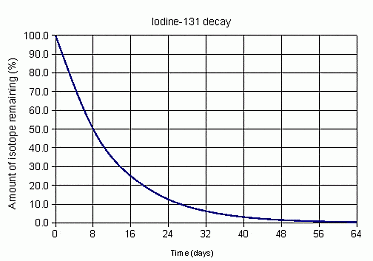
What is the half-life of iodine-131?
a)
32 days
b)
8 days
c)
16 days
d)
24 days
74.
If the  half-life of a radioactive group of atoms is 100 years, then how old is the rock if there have been two half-lives?
a)
50 years
b)
100 years
c)
200 years
d)
25 years
75.
After 4 half-lives, 1g of a sample of Krypton-85 remains unchanged.  What was the original mass of the sample?
a)
16g
b)
32g
c)
0.0625g
d)
4g
76.

If there is 25% of parent material remaining in the sample. How much daughter material must there be?

a)

25%

b)

50%

c)

75%

d)

12.5%

77.

A rock began with 800 parent isotopes, and today only 100 parent isotopes remain.

If this same isotope has a half-life of 1,000,000 years, how old is the rock?

a)

1,000,000 years

b)

2,000,000 years

c)

3,000,000 years

d)

4,000,000 years