
 Worksheets
Weather Unit Review
Total questions: 75
Worksheet time: 56mins
Name
Class
Date
1.
Which gas in our atmosphere is most abundant?
a)
Argon
b)
Oxygen
c)
Nitrogen
d)
Carbon Dioxide
2.
In which layer of the atmosphere does weather occur?
a)
Mesosphere
b)
Thermosphere
c)
Stratosphere
d)
Troposphere
3.
What causes the temperature to increase in the stratosphere?
a)
Nitrogen
b)
Ozone
c)
Water Vapor
d)
carbon dioxide
4.
What is the lowest main layer of Earth's atmosphere?
a)
Thermosphere
b)
Troposphere
c)
Stratosphere
d)
Mesosphere
5.
Which of the following is the correct order of the atmosphere layers from Earth to space?
a)
troposphere, stratosphere, mesosphere, thermosphere, exosphere
b)
troposphere, mesosphere, thermosphere, exosphere, stratosphere
c)
thermosphere, stratosphere, mesosphere, troposphere, exosphere
d)
troposphere, stratosphere, mesosphere, exosphere, thermosphere
6.
The average weather conditions for an area is the definition for ....
a)
weather
b)
climate
c)
humidity
d)
atmosphere
7.
Elevation, or how high up you are, is also called ...
a)
altitude
b)
atmosphere
c)
height
d)
decreasing
8.
The amount of water vapor in the air is ...
a)
temperature
b)
air pressure
c)
humidity
d)
altitude
9.
What is a true fact about the mesosphere?
a)
it is the hottest layer
b)
meteors burn up here
c)
the ozone layer is found here
d)
Northern Lights happen here
10.
In what layer of the atmosphere would you find clouds and weather?
a)
troposphere
b)
stratosphere
c)
mesosphere
d)
thermosphere
11.
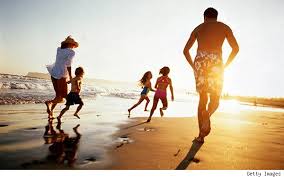
The sun shines down on this family as the play on the beach.
a)
conduction
b)
convection
c)
radiation
12.

A group of friends gather around a fire to stay warm.
a)
conduction
b)
convection
c)
radiation
13.
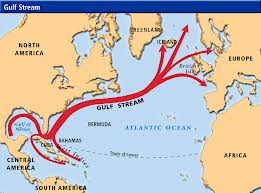
The Gulf Stream is a current that brings warm ocean water from the south to the north.
a)
conduction
b)
convection
c)
radiation
14.

Walking on the warm sand sand with your bare feet.
a)
conduction
b)
convection
c)
radiation
15.

Which direction will the heat flow while this person holds a hot cup of tea?
a)
from the cup to her hand
b)
from her hand to the cup
c)
no heat is transferred
16.
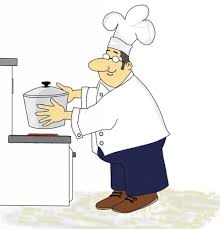
The man goes to take the hot pot off the stove with his bare hands.
a)
conduction
b)
convection
c)
radiation
17.
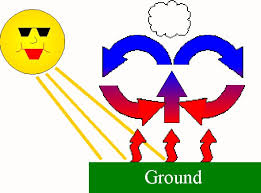
Warm air rises and the cool air sinks.
a)
conduction
b)
convection
c)
radiation
18.
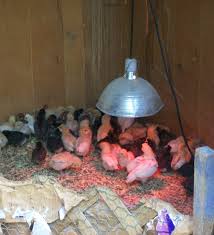
The baby chickens are kept warm from the heat lamps.
a)
conduction
b)
convection
c)
radiation
19.

In this experiment, the WARM red dye and the COLD blue dye was placed in the water at the same time. The warm red dye rose to the top while the cold blue dye sank to the bottom.
a)
conduction
b)
convection
c)
radiation
20.
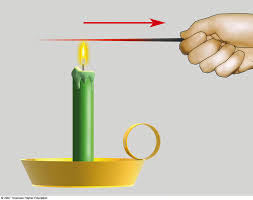
The candle will slowly heat the metal and transfer the heat directly to the mans hand.
a)
conduction
b)
convection
c)
radiation
21.
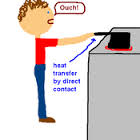
Johnny accidentally grabbed the handle of the hot pot.
a)
conduction
b)
convection
c)
radiation
22.

The warm air from this heater creates a current when the warm air rises and the cold air sinks.
a)
conduction
b)
convection
c)
radiation
23.

What does symbol # 1 mean?
a)
Occluded Front
b)
Stationary Front
c)
Warm Front
d)
Cold Front
24.
What type of of air mass is dry and warm?
a)
cP
b)
cT
c)
mP
d)
mT
25.
What type of of air mass is wet and warm?
a)
mP
b)
mT
c)
cT
d)
cP
26.
What type of of air mass is dry and cold?
a)
mP
b)
mT
c)
cP
d)
cT
27.
What type of air mass is wet and cold?
a)
mP
b)
MT
c)
cT
d)
cP
28.

What type of storm front if this?
a)
Warm Front
b)
Cold Front
c)
Stationary Front
d)
Occluded Front
29.

What type of storm front is this?
a)
Warm Front
b)
Cold Front
c)
Occluded Front
d)
Stationary Front
30.
_________front forms when warm air moves over cold air and slowly replaces the cold air
a)
warm front
b)
cold front
c)
occluded front
d)
stationary front
31.
_________front forms when a cold air mass and warm air mass meet, but stay still and separated. This can happen when there is not enough wind.
a)
warm front
b)
cold front
c)
occluded front
d)
stationary front
32.
_______front forms when rapidly moving cold air moves under slower moving warm air and pushes the warm air up. This can bring thunderstorms, heavy rain, or snow then cooler drier air after.
a)
cold front
b)
warm front
c)
stationary front
d)
occluded front
33.
What are thunderstorms?
a)
a storm with thunder and lighting and typically also heavy rain or hail
b)
a storm that can be the same as thunderstorms, but even more dangerous
c)
a mobile, destructive vortex of violently rotating winds having the appearance of a funnel shaped cloud and advancing beneath a large storm system.
d)
a huge storm with strong winds and storm surges
34.
What are tornadoes?
a)
a storm with thunder and lighting and typically also heavy rain or hail
b)
a storm that can be the same as thunderstorms, but can be even more dangerous
c)
a mobile, destructive vortex of violently rotating winds having the appearance of a funnel shaped cloud and beneath a large storm system.
d)
a huge storm with strong winds and storm surges
35.
A severe storm which involves a funnel cloud forming over land is:
a)
hurricane
b)
tornado
c)
thunderstorm
d)
blizzard
36.
A severe storm that involves high winds and forms over water is:
a)
tornado
b)
thunderstorm
c)
hurricane
d)
blizzard
37.
These can be produced by thunderstorms
a)
stationary fronts
b)
tornadoes
c)
volcanoes
d)
tsunamis
38.
How many categories are there for a hurricane?
a)
10 Category's
b)
5 Category's
c)
None
d)
6 Categorys
39.
What do hurricanes feed on?
a)
warm tropical water
b)
hot water
c)
cold artic water
d)
rain
40.
Hurricanes develop in ________ regions.
a)
Arctic
b)
Tropical
c)
Arid
d)
None of the above
41.
Where is Tornado Alley located?
a)
Near the equator of the Earth
b)
Near the North Pole
c)
South Central Los Angeles
d)
Middle states of United States
42.
This person studies the Earth's atmosphere and monitors and forecasts the weather
a)
Seismologist
b)
Meteorologist
c)
Volcanologist
d)
Geologist
43.

What is the scale that is used to measure tornadoes?
a)
Mohs Scale
b)
Enhanced Fujita Scale
c)
Saffir Simpson Scale
d)
McDonalds Scale
44.
What are the effects of a thunderstorm?
a)
destruction of property, storm surge, tidal flooding, high winds, possible tornadoes, heavy rain, flooding and loss of life.
b)
Major destruction of property, loss of life, lightning and hail.
c)
produces lightning, Strong winds, hail, and possible tornadoes.
d)
saturated soil, mud-slides, property damage and loss of life.
45.

What occurs when water flows or collects over land that is usually dry.
a)
dam
b)
flood
c)
floodway
d)
levee
46.
What is the meaning of Drought
a)
The process by which land becomes more and more dry until it turns into desert.This may be caused by climate change,human activities, or both
b)
Groups of herders who move with their animals from place to place in search of pasture and water
c)
An unusually long period in which little or no rain falls
d)
Selection of players for a team
47.

What happens if a hurricane moves over land or cold ocean water?
a)
it will get stronger
b)
it will get weaker
c)
it will upgrade its category
d)
it will morph into a typhoon
48.
What is thunder?
a)
Paul Bunyan and his ox fighting
b)
My brother jumping on the bed
c)
Heat from lightning causes air to expand quickly causing thunder
49.
What should I do in a thunderstorm?
a)
Play golf
b)
Climb a tree
c)
Stay indoors
50.
What causes the most damage from hurricanes?
a)
Sharks stranded on shore
b)
Storm surge
c)
Weathermen trapped in the storm
51.
What is the best way to survive a hurricane?
a)
Climb on top of the house
b)
In a boat
c)
Evacuate
52.
How can we stay safe in a tornado?
a)
Climb a tree
b)
Go for a ride in the car
c)
Go to an interior room in your house
53.
When do tornadoes occur most frequently?
a)
Winter
b)
Summer
c)
On the moon
54.
How do tornadoes form?
a)
When someone spins around too fast
b)
when warm, moist air meets cold, dry air
c)
sharknadoes are real
55.
This type of pressure system brings dry, clear skies.
a)
high pressure
b)
low pressure
c)
barometric pressure
d)
atmospheric pressure
56.
This type of air pressure is associated with warm air rising.
a)
high pressure
b)
low pressure
c)
barometric pressure
d)
atmospheric pressure
57.
This pressure system brings cloudy and stormy weather.
a)
high pressure
b)
low pressure
c)
barometric pressure
d)
atmospheric pressure
58.
This type of air mass is when cold air sinks.
a)
high pressure
b)
low pressure
c)
barometric pressure
d)
atmospheric pressure
59.

What does this symbol represent?
a)
high temperature
b)
low temperature
c)
high pressure
d)
low pressure
60.

What does this symbol represent?
a)
high temperature
b)
low temperature
c)
high pressure
d)
low pressure
61.

What kind of breeze is this & what time of day/night would it form?
a)
Land breeze - daytime
b)
Land breeze - nighttime
c)
Sea breeze - daytime
d)
Sea breeze - nighttime
62.
Which statement correctly defines wind?
a)
Wind is the movement of air from areas of low pressure to areas of high pressure
b)
Wind is the movement of air to a colder area in the atmosphere.
c)
Wind is the movement of air from areas of high pressure to areas of low pressure.
d)
Wind is the movement of air pushed around and bouncing off Earth's surface.
63.
Where does the initial source of energy come from that creates winds?
a)
the moon
b)
the sun
c)
the Earth's surface
d)
the rotation of the Earth
64.
What causes global winds and convection in the atmosphere?
a)
continental deflection
b)
the rotation of the Earth
c)
Moon's gravity
d)
unequal heating of the Earth by the sun
65.
The Coriolis effect causes ___________.
a)
the Earth to rotate on its axis
b)
continental deflection
c)
global winds and surface currents to move in a curved path instead of a straight line
d)
global winds and deep ocean currents to move in a curved path instead of a straight line.
66.
What impact does the Coriolis effect have upon global winds in the northern and southern hemispheres?
a)
Global winds blow counterclockwise in the northern hemisphere and clockwise in the southern hemisphere.
b)
Global winds blow clockwise in the northern hemisphere and counterclockwise in the southern hemisphere.
c)
Global winds flow clockwise in both the northern and southern hemispheres.
d)
The Coriolis effect has no impact upon global winds in the northern and southern hemispheres.
67.

Which diagram shows the formation of a sea breeze?
a)
diagram Y
b)
diagram X
c)
neither
d)
both
68.

Which diagram shows the formation of a land breeze?
a)
diagram Y
b)
diagram X
c)
neither
d)
both
69.
Which statement correctly describes the properties of cold air?
a)
less dense and less pressure than warm air
b)
more dense and more pressure than warm air
c)
more dense and less pressure than warm air
d)
less dense and more pressure than warm air
70.
Near the top of the troposphere is a narrow band of high speed winds called the______.
a)
westerlies
b)
jet stream
c)
trade winds
d)
local winds
71.
What is the coriolis effect?
a)
The influence of Earth's rotation on global winds
b)
the influence of Earth's rotation on local winds
c)
the influence of earth's rotation on both global and local winds
d)
all of the above
72.

Why does warm air rise?
a)
Warm air is more dense than cooler air.
b)
Warm air has more pressure than cooler air.
c)
Warm air is less dense than cooler air.
d)
Warm air has a higher dew point than cooler air.
73.

The curving of air to the right in the Northern hemisphere is caused by ___________ and is called the _________ effect.
a)
Earth's rotation...Coriolis
b)
Earth's revolution...Coriolis
c)
Earth's rotation...Doppler
d)
Earth's revolution...Doppler
74.
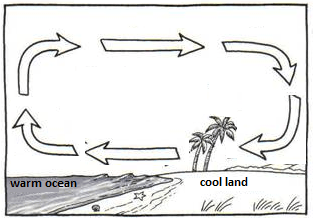
What kind of breeze is this and when would it form?
a)
Land breeze - daytime
b)
Land breeze - nighttime
c)
Sea breeze - daytime
d)
Sea breeze - nighttime
75.

Use the diagram to determine which statement is correct.
a)
The air at location 3 is more dense than the air at location 6.
b)
The air at location 2 is rushing in to take the place of the colder air at location 3.
c)
Location 1 heats up and cools down slower than location 7.
d)
High pressure air at location 2 is taking the place of the low pressure air at location 3.
100 %

