

wayground logo

Free Printable Worksheets

NEW

Font size

S
M
L
XL
Worksheets

Acid Base Practice

Total questions: 39

Worksheet time: 59mins

Name
Class
Date
1.
Which statement is true?
a)
Acids start with H and bases end with OH
b)
Acids start with OH and bases end with H
c)
Acids end with H and bases start with OH
d)
Acids end with OH and bases start with H
2.
A strong acid:  
a)
completely dissociates in water
b)
partly dissociates in water
c)
doesn't dissociate in water
d)
has a really high pH
3.
Name the correct definition of an acid and a base:  An acid ionizes to yield hydrogen ions (H+) in aqueous solution; a base ionizes to yield hydroxide ions (OH–) in aqueous solution.
a)
Lewis definition
b)
Arrhenius definition
c)
Bronstead-Lowry definition
d)
Jill Thompson definition
4.
What is the range of pH values in an acidic solution?
a)
0-7
b)
7-14
c)
15-239058204958
d)
pH = 7
5.
In a neutralization reaction, what are the products of a reaction between an acid and a base?
a)
Another acid and base
b)
Carbon dioxide and a salt
c)
Water and a salt
d)
Either two acids or two bases
6.
Who defined acids and bases this way:  An acid donates a hydrogen ion in a chemical reaction.  
a)
Bronstead-Lowry
b)
Lewis
c)
Arrhenius
d)
28 more days of school left!
7.
A substance that can act as both an acid and a base is:
a)
Polyprotic
b)
Neutral
c)
Anhydrous
d)
Amphoteric
8.
The table below shows the pH of several solutions. Which solution has the greatest concentration of H+ ions?
a)
vinegar
b)
milk
c)
water
d)
bleach
9.
What is the conjugate base of HCO3-?
a)
HCO3-
b)
H2CO3-
c)
H2CO3
d)
CO32-
10.
Which of the following is a conjugate acid/base pair?
a)
HCl/OCl-
b)
H2SO4/SO42-
c)
NH4+/NH3
d)
H3O+/OH-
11.
The solution on the right is ______.
a)
neutral
b)
an acid
c)
a base
d)
kool-aid
12.
You test a solution with pH paper, and the paper turns blue.  The solution is ______.
a)
neutral
b)
an acid
c)
a base
d)
toxic
13.
Indicator tests give you the following results:
-pH paper turns green
-Red litmus paper stays red
-Blue litmus stays blue
-With phenolphthalein the solution remains clear 
What do you conclude?
a)
the solution is acidic
b)
the solution is basic
c)
the solution will explode
d)
the solution is neutral
14.
NH3 + H2O --> NH4+ OH-
What is the conjugate acid according the Bronsted-Lowry model?
a)
NH3
b)
H2O
c)
NH4+
d)
OH-
15.
LiOH + HCl --> ???
What are the products in this neutralization reaction?
a)
HCl and H2O
b)
LiCl and H2O
c)
LiH and ClO
d)
Hand OH-
16.
NH3 + H2O --> NH4+ OH-
According to the Bronsted-Lowry model, what is H2O in this reaction?
a)
acid
b)
base
c)
conjugate acid
d)
conjugate base
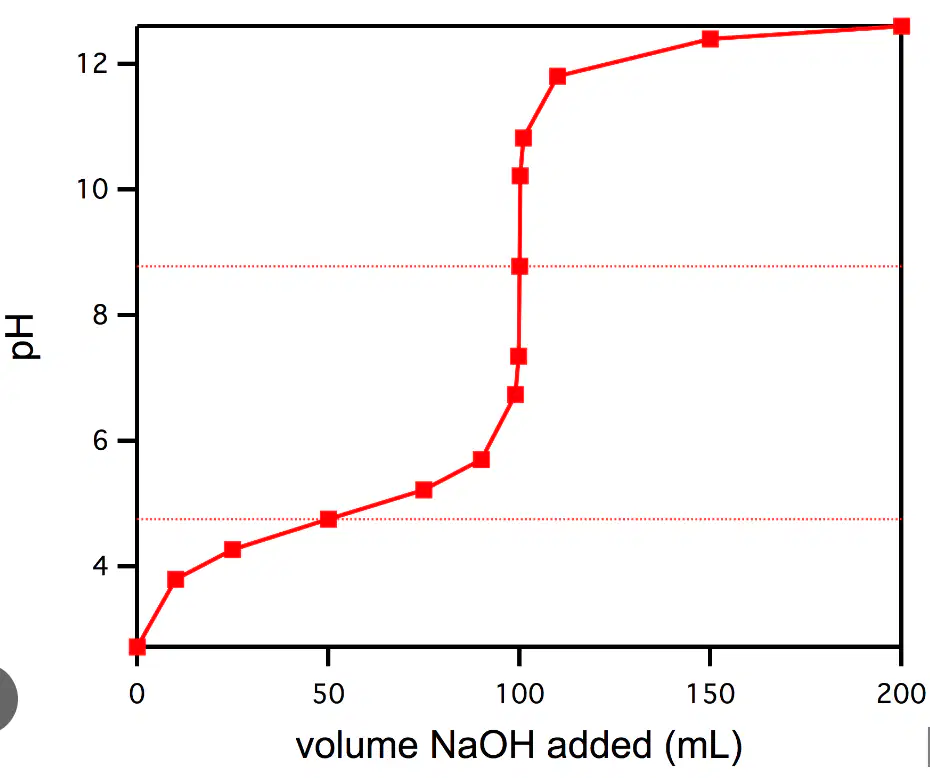
17.

What is the equivalence point on this titration graph?

a)

4.86

b)

7.0

c)

8.65

d)

11.99

18.

For a solution, pH + pOH =

a)

7

b)

1.0 x 10⁻¹⁴

c)

14

d)

-log (1.0 x 10⁻¹⁴)

19.

If the pH of a solution is 4.0, what is the pOH?

a)

4.0

b)

1.0 x 10⁻⁴

c)

10

d)

Cannot be determined from the information

20.

The pH of a solution is 8.43. What is the hydrogen ion H+ concentration?

a)

3.7 x 10⁻⁹ M

b)

2.7 x 10⁻⁶ M

c)

1.0 x 10-8.43 M

d)

1.0 x 10⁻¹⁴

21.

if the [H+] of a solution is 8.4 x 10⁻³ M, the pOH of the solution will be

a)

2.08

b)

11.92

c)

1.02

d)

12.98

22.

Limes have a [H+] of 1.3 x 10⁻² M. Their pOH is

a)

1.89

b)

12.11

c)

1.03

d)

12.97

23.

An Arrhenius base:

a)

donates H+

b)

accepts H+

c)

produces H+

d)

produces OH-

24.

An Arrhenius acid:

a)

donates H+ to another substance

b)

accepts H+ from another substance

c)

produces H+

d)

produces OH-

25.
A hydrogen ion, H+, is the same as a(n):
a)
neutron
b)
electron
c)
proton
d)
hydroxide ion
26.
Forms a OH- hydroxide ion
a)
Lewis Base
b)
Arrhenius Base
c)
Bronsted Lowry Base
d)
Bronsted Lowry Acid
27.

A Bronsted Lowry base:

a)

donates H+ to another substance

b)

accepts H+ from another substance

c)

produces H+

d)

produces OH-

28.

A pH of 3 is how many times more acidic than a pH of 5?

a)

2

b)

20

c)

10

d)

100

29.

A pH of 8 is how many times more acidic than a pH of 11?

a)

3

b)

30

c)

100

d)

1000

30.
Name HF
a)
hydrofluoric acid
b)
Hypofluoric acid
c)
hydrogen fluorine acid
d)
fluoric acid
31.
What is the formula for hydrochloric acid?
a)
HCl
b)
HClO
c)
H3ClO3
d)
HClO3
32.
What is the formula for nitric acid?
a)
HNO2
b)
HNO3
c)
HNO4
d)
H2NO3
33.
What is the formula for perchloric acid?
a)
H3ClO3
b)
H3ClO4
c)
HClO3
d)
HClO4
34.
HNO2
a)
hydronitrogen
b)
hydrogen nitrogen oxygen
c)
nitrous acid
d)
nitric acid
35.
Hydroiodic acid
a)
H2I2
b)
H1I1
c)
HI
d)

H5N1

36.
HBr
a)
hydrogen bromine acid
b)
hydrobromide acid
c)
hydrobromic acid
37.
carbonic acid
a)
H2CO3
b)
H2CrO4
c)
H2C2O4
d)
HCO3
38.

When naming oxyacids, change "-ite" to:

a)

-ate

b)

-ic

c)

-ous

d)

-ite

39.

When naming oxyacids, change "-ate" to:

a)

-ate

b)

-ic

c)

-ous

d)

-ite
