
 Worksheets
Ecology Review
Total questions: 35
Worksheet time: 27mins
Name
Class
Date
1.
What is the original source of almost all energy in most ecosystems?
a)
carbohydrates
b)
sunlight
c)
water
d)
carbon
2.
What is the term for each step in the transfer of energy and matter within a biological community?
a)
energy path
b)
food web
c)
trophic level
d)
food pyramid
3.
Autotrophs make up the _______ level in all ecosystems.
a)
First
b)
Second
c)
Third
d)
Fourth
4.

Which symbiosis is this an example of?
a)
parasitism
b)
mutualism
c)
commensalism
d)
nonalism
5.

What is a symbiotic relationship in which both organisms benefit called?
a)
competition
b)
Mutualism
c)
nitrogen fixation
d)
energy pyramid
6.

A living relationship between two species in which one organism is harmed is called...
a)
mutualism
b)
commensalism
c)
parasitism
d)
niche
7.

What does a food web represent?
a)
All connections of energy flow throughout all organisms in a habitat.
b)
The specific ways that mutualism is carried out.
c)
A single pathway or energy flow between organisms.
d)
How carnivores get their food.
8.
The amount of energy that usually transfers from one trophic level to the next...
a)
10%
b)
20%
c)
80%
d)
50%
9.
The nonliving aspects of an ecosystem.
a)
Abiotic factors
b)
Biotic factors
10.
A collection of organisms that belong to different populations but all live in the same area and interact with one another.
a)
Population
b)
Ecosystem
c)
Community
d)
Ecosphere
11.
A collection of organisms that make up a community as well as all of the nonliving aspects of the environment.
a)
Population
b)
Community
c)
Habitat
d)
Ecosystem
12.
Organisms that can capture energy from inorganic, nonliving sources.
a)
Producers
b)
Consumers
c)
Detritivores
d)
Carnivores
13.
An organism at the second trophic level would be considered a...
a)
Top carnivore
b)
Producer
c)
Herbivore
d)
Carnivore
14.

A food chain is illustrated below:
The arrows represented most likely indicate
The arrows represented most likely indicate
a)
A. Energy released from metabolism into the environment as heat.
b)
B. Oxygen released from metabolism produced by cellular respiration.
c)
C. The absorption of energy from the environment that has been created.
d)
D. The transport of glucose away from the organism through photosynthesis.
15.

A pond ecosystem is shown in this diagram. Which statement describes an interaction that helps maintain the dynamic equilibrium of this ecosystem?
a)
The frogs make energy available to this ecosystem through the process of photosynthesis.
b)
The algae directly provide food for both the rotifers and the catfish.
c)
The green-backed heron provides energy for the mosquito larvae.
d)
The catfish population helps control the populations of water boatman and waterfleas.
16.
What does not produce carbon dioxide?
a)
Photosynthesis
b)
Combustion
c)
Respiration
d)
Decomposition
17.
How do animals get the nitrogen that they need?
a)
From the soil
b)
From the air
c)
By performing photosynthesis
d)
Eating other organisms
18.
All organic molecules contain ____.
a)
gold
b)
silver
c)
carbon
d)
oxygen
19.
Steam from hot water is an example of ________.
a)
Condensation
b)
Evaporation
c)
Transpiration
d)
Infiltration
20.
Burning firewood uses the process of _____.
a)
decomposition
b)
respiration
c)
photosynthesis
d)
combustion
21.

What is number 2 showing?
a)
Evaporation
b)
Precipitation
c)
Transpiration
d)
Combustion
22.

What cycle is this?
a)
Carbon Cycle
b)
Nitrogen Cycle
c)
Water Cycle
d)
Cell Cycle
23.

What is the order of succession shown in this figure?
a)
A, B, C, D
b)
B, A, D, C
c)
C, D, A, B
d)
D, A, B, C
24.
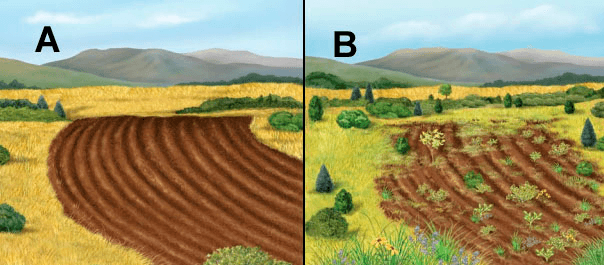
What type of succession is shown going from figure A to figure B?
a)
primary succession
b)
ecological succession
c)
secondary succession
d)
intermediate
25.
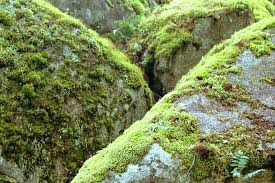
What are examples of pioneer species in a primary succession?
a)
Bushes and Shrubs
b)
Oak trees
c)
Mosses and Lichens
d)
A rose Bush
26.

Final illustration (#8) shows
a)
pioneer species
b)
climax community
c)
only biotic factors
d)
only abiotic factors
27.
Globally, the leading cause of biodiversity loss is
a)
invasive species
b)
poaching and over-harvesting
c)
pollution
d)
habitat change and loss
28.
Biodiversity refers to
a)
extinct species
b)
the variety of species on Earth
c)
nonrenewable resources
d)
the rate of species decline
29.

The biome known for trees with broad leaves that fall off the trees in the winter.
a)
Coniferous Forests
b)
Deciduous Forests
c)
Deserts
d)
Tropical Rain Forests
30.
The kangaroo rat is able to get all of the water it needs through it's food and therefore, never needs to drink liquid. This animal has adapted to survive in which biome that rains less than 2 inches a year?
a)
Forest
b)
Tundra
c)
Desert
d)
Grassland
31.
Which biome, because of its climate, has the largest number of species of plants and animals?
a)
Tundra
b)
Tropical Rainforest
c)
Desert
d)
Pineforest
32.
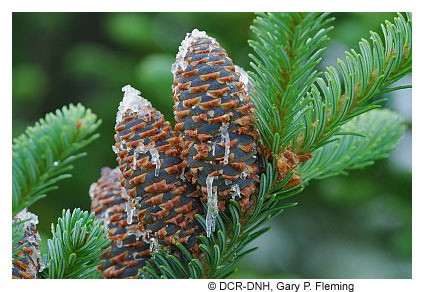
The trees in this forest biome have needle like leaves that are hard to eat.
a)
taiga
b)
deciduous forest
c)
Temperate grasslands
d)
deserts
33.

Treeless, dry lands north of the Arctic Circle.
a)
Savanna
b)
Chaparral
c)
Tundra
d)
Taiga
34.

Temperate grasslands are also known as
a)
Savanna
b)
Chaparral
c)
Prairie
d)
Taiga
35.

The grasslands of West Africa are an example of a
a)
Savanna
b)
Taiga
c)
Desert
d)
Chaparral
100 %

