
 Worksheets
Waves
Total questions: 57
Worksheet time: 2hrs 34mins
Name
Class
Date
1.
Wave that moves perpendicular to the direction of travel?
a)
Water
b)
Longitudinal
c)
Tranverse
d)
Seismic
2.
Why can you not hear sound in space?
a)
Distance is to great
b)
It has no medium
c)
The medium is too thin
3.
The louder a noise is? The greater the _________?
a)
amplitude
b)
medium
c)
wavelength
4.
Waves that move parallel to the direction of wave?
a)
Tranverse
b)
Longitudinal
c)
Seismic
d)
Water
5.
Distance between two successive points on a wave?
a)
Frequency
b)
Amplitude
c)
Crest
d)
Wavelength
6.
What waves have a greater energy; high amplitude or low amplitude?
a)
High
b)
Low
7.
Sound travels fastest through which medium?
a)
Solid
b)
Liquid
c)
Gas
8.
Sound travels the slowest in what media?
a)
Solid
b)
Liquid
c)
Gas
9.
The shorter the wavelength, the stronger or weaker the wave?
a)
Stronger
b)
Weaker
10.
What travels faster, the speed of sound or the speed of light?
a)
Sound
b)
Light
11.
The low point of a wave is called the?
a)
Crest
b)
Trough
c)
Wavelength
d)
transparency
12.
How are sound and light waves similar?
a)
both transmit energy
b)
both require a medium
c)
neither require a medium
d)
both transmit matter
13.
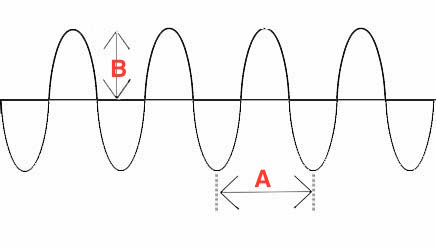
What property of this wave is represented by the letter "A"
a)
amplitude
b)
crest
c)
trough
d)
wavelength
14.
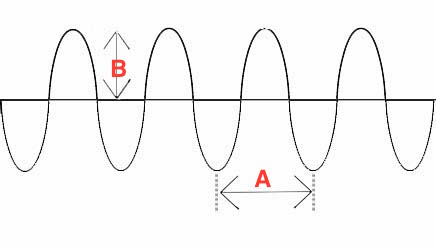
What property of the wave is represented by the letter "B"?
a)
amplitude
b)
crest
c)
trough
d)
wavelength
15.
The highest point on a wave is:
a)
the crest
b)
the trough
c)
the top
d)
the coast
16.
The lowest point on a wave is the:
a)
Amplitude
b)
Crest
c)
Trough
d)
Wavelength
17.
The number of wavelengths that pass a point each per second is:
a)
frequency
b)
period
c)
longitudinal
d)
transverse wave
18.
The type of waves that require medium to pass:
a)
Mechanical Waves
b)
Electromagnetic Waves
19.

Which vocabulary term is used to identify the distance between points C & G?
a)
Amplitude
b)
Crest
c)
Frequency
d)
Wavelength
20.
When the frequency of a wave increases, what happens to the wavelength?
a)
The wavelength is not directly affected by the frequency of a wave.
b)
The wavelength increases.
c)
The wavelength decreases.
d)
More specific information is needed to form a conclusion about the wavelength.
21.
A mechanical wave cannot travel through...
a)
a vacuum(empty space).
b)
water.
c)
air.
d)
glass.
22.
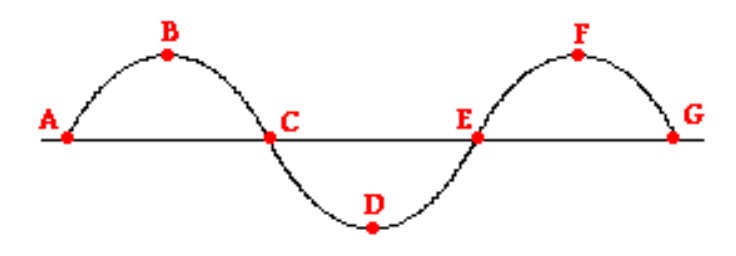
Which letter(s) represent the trough of the wave?
a)
A
b)
B & D
c)
D
d)
C & G
23.
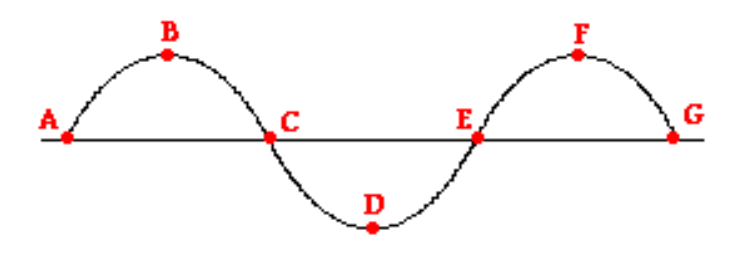
Which letter(s) represent the crest of the wave?
a)
A
b)
B & D
c)
B & F
d)
F
24.
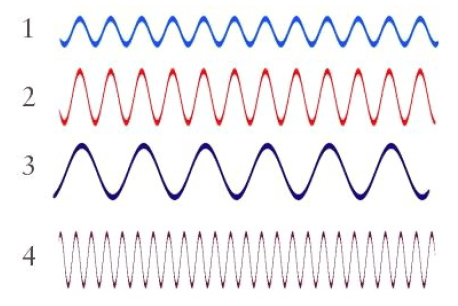
Which wave in the diagram has the greatest frequency?
a)
1
b)
2
c)
3
d)
4
25.
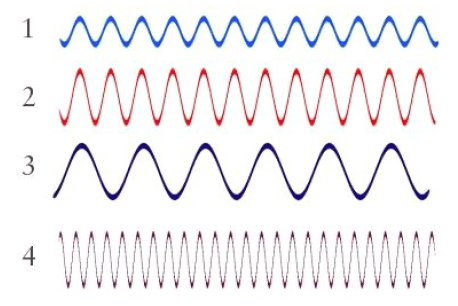
Which wave in the diagram has the greatest wavelength?
a)
1
b)
2
c)
3
d)
4
26.
Which of the following can sound travel through?
a)
solid
b)
liquid
c)
gas
d)
all of the above
27.
crest to crest or trough to trough
a)
crest
b)
trough
c)
amplitude
d)
wavelength
28.
True or false: as you move along the spectrum, left to right, the wavelengths decrease in size (get smaller)
a)
true
b)
false
29.
Which has the LONGEST wavelength and, therefore, the lowest frequency/energy
a)
Gamma Rays
b)
Radio Waves
c)
Visible Light
d)
Infrared rays
30.
Which section of the spectrum is the ONLY one we can see?
a)
X-rays
b)
Visible Light
c)
Gamma Rays
d)
Ultraviolet Rays
31.
The _______________ determines the color of visible light.
a)
wavelength
b)
speed
c)
amplitude
d)
light
32.
All EM waves travel at
a)
different speeds
b)
the speed of sound
c)
the speed of light
d)
the speed of a vacuum
33.

7 is
a)
Radio
b)
UV
c)
Infrared
d)
Gamma
34.

Wavelengths on the right side of the Electromagnetic spectrum are ______________.
a)
short
b)
long
c)
average
35.
Which waves are used to show heat loss with heat sensitive cameras?
a)
Infrared radiation
b)
ultraviolet radiation
c)
microwaves
d)
gamma rays
36.

The orange line is measuring the _________________________.
a)
wavelength
b)
amplitude
c)
crest
d)
trough
37.

This type of Electromagnetic wave shows a break in bones.
a)
gamma ray
b)
x-ray
c)
brokenometer
d)
radio wave
38.

Which letter shows reflection?
a)
Pathway A
b)
Pathway B
c)
Pathway C
d)
Pathway D
39.

Which term explains the path of the light ray in this diagram?
a)
Convection
b)
Scattering
c)
Absorption
d)
Refraction
40.
What do you see when water droplets refract and diffract sunlight?
a)
thunderstorm
b)
eclipse
c)
rainbow
d)
clouds
41.
What does it mean to refract?
a)
bounce off
b)
to bend
c)
curve outward
d)
reflect
42.
What happens when light hits a mirror?
a)
it makes a color
b)
it reflects
c)
it makes a rainbow
d)
it passes through
43.

A prism could best be described as which of the following?
a)
A triangle with an opening on one side and another side that absorbs light.
b)
A triangle object that allows light to enter and be refracted out into colors
c)
A pyramid shaped object that reflects the rats of the rainbow
d)
A triangular object that absorbs the light from a rainbow
44.
What is the name of a material in which waves, like sound waves, seismic waves, and waves in a slinky
a)
Vacuum
b)
Medium
c)
Mechanical
d)
Space
45.
Why would a wave change direction?
a)
Because it kept traveling through the same medium
b)
Because it went from one medium to another
c)
the amplitude was too large
d)
the frequency was too small
46.
All waves carry
a)
energy
b)
light
c)
matter
d)
particles
47.

What is diffraction?
a)
When light waves strike an obstacle and new waves are produced
b)
Takes place when two or more waves overlap
c)
Bent waves interfere and form a diffraction pattern
d)
The paths of wave fronts are shown when light strikes a big obstacle
48.

An instrument that uses reflected sound waves to find underwater objects
a)
Ultrasonic Technology
b)
Echo
c)
Series circuit
d)
Sonar
49.
The Law of Reflection states that
a)
the Angle of Incidence will always be greater than the Angle of Reflection.
b)
the Angle of Reflection will always be greater than the Angle of Incidence.
c)
the Angle of Incidence and the Angle of Reflection are never the same.
d)
the Angle of Incidence is equal to the Angle of Reflection.
50.

What does letter "A" represent?
a)
normal
b)
incident ray
c)
reflected ray
d)
angle of reflection
51.
What happens when parallel rays of light hit a smooth surface like a mirror?
a)
reflection
b)
transmission
c)
refraction
d)
diffraction
52.
When a pencil is placed in a glass of water, the pencil appears broken at the surface of the water. This is because the light:
a)
speeds up as it moves from water into air.
b)
slows down as it moves from water into air.
c)
stops when it hits the water.
d)
does not change speed.
53.
In a vacuum, all electromagnetic waves have the same
a)
speed
b)
frequency
c)
amplitude
d)
wavelength
54.
Electromagnetic waves can transfer energy without a(n)
a)
eletrical current
b)
magnetic field
c)
source
d)
medium
55.
The electromagnetic waves with the highest frequencies and the shortest wavelength are called
a)
radio
b)
gamma
c)
visible light
d)
xray
56.
Sound does not travel through
a)
solid
b)
liquid
c)
gas
d)
vacuum
57.
What happens when waves collide and either get larger or smaller because they overlap?
a)
interference
b)
diffraction
c)
absorbtion
d)
transmission
100 %

