
 Worksheets
6th Grade Science Review
Total questions: 153
Worksheet time: 2hrs 25mins
Name
Class
Date
1.
There are more _______ on the periodic table?
a)
Gases
b)
Solid
c)
Liquid
2.
An object floats in water because
a)
Its density is more than 1
b)
Its density is equal to 1
3.
There are more nonmetals on the periodic table
a)
True
b)
False
4.
The positive part of an atom is called the
a)
Electron
b)
Neutron
c)
Proton
d)
Nucleus
5.
The electron is the ________ part of the atom
a)
Negative
b)
Positive
c)
Neutral
6.
Which of the following is a good example of a conductor
a)
Plastic
b)
Rubber
c)
Metal Key
d)
Paper
7.
Which of the following is an example of a insulator?
a)
Copper
b)
Lead
c)
Rubber
d)
Aluminum
8.
When heat is transferred by DIRECT CONTACT its called
a)
Conduction
b)
Convection
c)
Radiation
9.
When heat is transferred through liquids or air, its called
a)
Conduction
b)
Convection
c)
Radiation
10.

What is this scientific instrument of measuring called?
a)
Triple Beam Balance
b)
Scale
c)
Thermometer
d)
Wheel and Axle
11.
Nonrenewable resources _________be replaced easily.
a)
can
b)
cannot
12.
petroleum, natural gas, coal, and nuclear energy are all examples of ________
a)
renewable resources
b)
nonrenewable resources
13.
Hydroelectric energy, geothermal energy, wind energy, and solar energy. are all examples of _____
a)
renewable resources
b)
nonrenewable resources
14.
________ is formed when the remains of plants and animals are buried quickly.
a)
renewable resources
b)
uranium
c)
fossils
d)
soil
15.
Air pollution, oil spills, and the production of soot and sulfur gases are problems of using _________
a)
wind energy
b)
Hydroelectric energy
c)
fossil fuel
d)
solar energy
16.
coal, natural gas, and petroleum come from_____
a)
fossil fuel
b)
minerals
c)
crude oil
17.
________ uses reservoirs to control the flow of water.
a)
Geothermal energy
b)
Water energy
c)
Hydroelectric energy
d)
nuclear energy
18.
Advantages of nuclear energy are
a)
efficient and clean
b)
inexpensive
c)
easy to store
d)
not dangerous
19.
_______ does not cause pollution, is a renewable resource, and requires little maintenance.
a)
hydroelectric energy
b)
wind energy
c)
nuclear enegy
d)
geothermal energy
20.
Disadvantages of nuclear energy
a)
there are none
b)
not very efficient
c)
requires special storage
d)
not clean
21.
disadvantage of wind energy and solar energy is
a)
requires large land area
b)
requires scientist to be onsite all the time.
22.
Advantage of using _______energy is that plants are inexpensive to build and operate.
a)
hydroelectiric
b)
geothermal
c)
wind
23.
__________ metals are able to be dented or shaped
a)
malleable
b)
nonmalleable
24.

Calculate the Volume
a)
410 cm3
b)
420 cm3
c)
402 cm3
d)
401 cm3
25.

Which of the following shows a month
a)
F
b)
G
c)
H
d)
J
26.
Which is a biotic factor in a deciduous forest?
a)
rocks
b)
soil
c)
hills
d)
deer
27.
Which of these contains biotic and abiotic factors in a tundra environment?
a)
rocks and ice
b)
ice and sea water
c)
polar bears and seals
d)
polar bears and ice
28.
Which best explains why cold-water currents flow beneath warm-water currents?
a)
Warm water has more potential energy than cold water.
b)
Cold water contains less pollution than warm water.
c)
Warm water contains more oxygen than cold water.
d)
Cold water is more dense than warm water.
29.

The energy of a bow changes when the string is pulled back.
Which change will occur in the bow after the string is released?
Which change will occur in the bow after the string is released?
a)
Nuclear
potential energy will decrease.
b)
Elastic
potential energy will
decrease.
c)
Gravitational
potential energy will increase.
d)
Chemical
potential energy will increase.
30.
A circuit contains a battery, wires, and a buzzer. The diagram represents the energy transformations that occur in the circuit.
Chemical Energy → ? → Sound Energy
Which type of energy is needed to complete the diagram?
Chemical Energy → ? → Sound Energy
Which type of energy is needed to complete the diagram?
a)
gravitational energy
b)
light energy
c)
electrical energy
d)
heat energy
31.
When a lamp is turned on, only about 10% of the energy is transformed into light. What happens to the rest of the energy?
a)
The remaining energy is destroyed.
b)
Energy that is not transformed into light becomes
thermal energy.
c)
The rest of the energy is changed into a solid state of
matter.
d)
Energy is recycled back into the electrical circuit.
32.
Which best demonstrates a transformation of chemical energy into mechanical energy?
a)
a marble rolling down a track
b)
a lantern burning fuel
c)
a motorcycle using gasoline
d)
a match lighting a candle
33.

At which point on the ramp will the toy car have the greatest kinetic energy?
a)
1
b)
2
c)
3
d)
4
34.

When the switch is in the “off” position, the lamp stays dark. Flipping the switch to the “on” position completes the circuit so that the lamp lights up. How does flipping the switch to the “on” position cause the lamp to light up?
a)
by multiplying the amount of energy, where it produces a
brighter light
b)
by reducing the amount of energy, where it remains in
the battery
c)
by allowing electrical energy to reach the lamp, where
it is transformed into light energy
d)
by allowing chemical energy to reach the lamp, where it
is transformed into electrical energy
35.

What type of object would most likely help energy flow through the circuit?
a)
an object that has a high melting point
b)
an object that is a good conductor of electricity
c)
an object that is more dense than the battery
d)
an object that has more chemical energy than the battery
36.
Lighting a match is best described as a transformation of
a)
mechanical energy into potential energy.
b)
kinetic energy into potential energy.
c)
chemical energy into light and heat energy.
d)
electrical energy into heat and chemical energy.
37.

Which best explains the energy transformation that occurs when sunlight strikes a car?
a)
Solar
energy is changed into electrical energy.
b)
Solar
energy is changed into thermal energy.
c)
Solar
energy becomes chemical energy.
d)
Solar
energy becomes mechanical energy.
38.
When a student pressed the button on a battery-powered flashlight, the light bulb began to glow. The first step in this energy transformation is mechanical. What are the next steps in this energy transformation?
a)
electrical
to light to chemical
b)
chemical
to electrical to
light
c)
chemical
to light to
electrical
d)
electrical
to chemical to light
39.
A coniferous forest biome has long, cold, snowy winters. It contains pine and spruce trees, elk, moose, and gray wolves. Which factor is an abiotic element in this biome?
a)
moose
b)
snow
c)
gray wolves
d)
spruce trees
40.
Which set of abiotic factors is typical in rain forest biomes?
a)
warm temperatures and large amounts of precipitation
b)
hot temperatures and very little precipitation
c)
cool temperatures and low amounts of precipitation
d)
extremely cold temperatures and freezing precipitation
41.

While running, the battery-operated toothbrush transforms electrical energy into
a)
light and heat energy
b)
sound and mechanical energy
c)
nuclear and solar energy
d)
chemical and potential energy
42.
What is the hardest known mineral?
a)
talc
b)
quartz
c)
diamond
d)
gold
43.
Rock that forms from the cooling f magma below the surface or lava at the surface is called
a)
sedimentary rock
b)
metamorphic rock
c)
igneous rock
d)
coarse-grained rock
44.
Igneous rock that formed from lava that erupted onto Earth's surface is called
a)
extrusive rock
b)
intrusive rock
c)
clastic rock
d)
sedimentary rock
45.
Scientists think that convection currents flow in Earth's
a)
continents
b)
mantle
c)
lithosphere
d)
inner core
46.
Rock whose name means "fire"
a)
metamorphic
b)
sedimentary
c)
igneous
d)
intrusive
47.
Rock whose name means "to change form"
a)
metamorphic
b)
sedimentary
c)
igneous
d)
extrusive
48.
Rock type that is layered and forms from compaction and cementation
a)
metamorphic
b)
sedimentary
c)
igneous
49.
Type of igneous rock that cools slowly within the Earth; allows grains to form
a)
intrusive
b)
extrusive
50.
Type of igneous rock that cools quickly above the crust.
a)
extrusive
b)
intrusive
51.
The color of the powdered mineral on a streak plate.
a)
streak
b)
luster
c)
hardness
d)
density
52.
The shininess of a mineral; the way it reflects light.
a)
streak
b)
hardness
luster
luster
c)
luster
d)
density
53.
Naturally occurring, inorganic, crystalline solid, with a definite chemical composition and a defined internal atomic pattern
a)
rock
b)
mineral
c)
mountain
d)
tectonic plate
54.

The riders on the triple beam balance "above" have been moved to measure the mass of the material in the in. The front rider is pointing to 5; the middle rider is pointing to 200; and, the back rider is pointing to 10. What is the mass of the material in the pan?
a)
125g
b)
521g
c)
215g
d)
105g
55.
When conducting an experiment you should never __________.
a)
wash you hands after handling a substance
b)
report spills imdietly
c)
clean up broken glass yourself
d)
unplug cords by pulling at the plug, not on the cord
56.
Heat is the movement of ______.
a)
radiation
b)
thermal energy
c)
cold
d)
fire
57.
Thermal energy ALWAYS moves from _____ to _____.
a)
solid to liquid
b)
ice to water
c)
hot to cold
d)
solid to gas
58.
Heat moves by ______ when it travels through waves.
a)
radiation
b)
conduction
c)
insulator
d)
convection
59.
Heat moves by ______ when it travels from one solid to another solid.
a)
radiation
b)
convection
c)
thermal energy
d)
conduction
60.
The way heat moves in liquids and gases is called _______.
a)
convection
b)
radiation
c)
conduction
d)
temperature
61.
If an object has particles that are moving very quickly, the object 's temperature is probably _____.
a)
cold
b)
slow
c)
big
d)
hot
62.
If an object has particles that are moving very slowly, the object's temperature is probably ______.
a)
hot
b)
small
c)
cold
d)
big
63.
Heat from the sun travels to Earth by _____.
a)
conduction
b)
convection
c)
insulation
d)
radiation
64.
The energy of moving particles in matter is called _____.
a)
thermal energy
b)
chemical energy
c)
electrical energy
d)
mechanical energy
65.
The flow of thermal energy from warmer objects to cooler objects is called ______.
a)
heat
b)
movement
c)
friction
d)
energy
66.
To measure the temperature difference between two cups of water, you would use a _____.
a)
measuring cup
b)
ruler
c)
thermometer
d)
balance scale
67.
Glass, steel, and aluminum are good examples of ______.
a)
insulators
b)
thermal energy
c)
conductors
d)
radiation
68.
Which is a conductor?
a)
wool sweater
b)
aluminum foil
c)
oven mitt
d)
wooden spoon
69.
Which is an insulator?
a)
wooden spoon
b)
silver spoon
c)
steel spoon
d)
aluminum foil
70.
How does thermal energy move in solids?
a)
insulation
b)
conduction
c)
radiation
d)
convection
71.
Which material would NOT make a good baking pan (for high temperatures in the oven)?
a)
aluminum
b)
plastic
c)
steel
d)
glass
72.

The heat from a hot burner to a pot is transferred by ______.
a)
convection
b)
insulation
c)
radiation
d)
conduction
73.

The way the heat is moving from the hot coffee is called...
a)
convection
b)
radiation
c)
insulation
d)
conduction
74.
A metal spoon placed in a bowl of hot soup is heated by _____.
a)
radiation
b)
conduction
c)
friction
d)
convection
75.
When holding a cup of ice water, your warm hand becomes cold. How does the heat transfer?
a)
From the cold cup to your hand
b)
From the cold cup to the warm air
c)
From the ice to your hand
d)
From your warm hand to the cold cup.
76.

A group of friends gather around a fire to stay warm.
a)
conduction
b)
convection
c)
radiation
77.
Which of the following is an example of convection?
a)
A hair dryer is drying up your hair.
b)
When the AC or heater changes the temperature.
c)
When a car engine turns hot after being turned on.
d)
When you are making soup and the water is rising and lowering.
78.

This is a lava lamp. When the light bulb heats the wax, the wax rises. When the wax cools, it falls. This cycle of rising/falling is an example of:
a)
Conduction.
b)
Convection.
c)
Radiation.
79.

Warm air rises and the cool air sinks demonstrates this type of heat transfer.
a)
conduction
b)
convection
c)
radiation
d)
Insolation
80.

Walking on the warm sand sand with your bare feet demonstrates this type of heat transfer.
a)
conduction
b)
convection
c)
radiation
81.

The Gulf Stream is a current that brings warm ocean water from the south to the north. What type of heat transfer is this?
a)
conduction
b)
convection
c)
radiation
d)
Insolation
82.
Ironing a shirt is an example of...
a)
condensation
b)
conduction
c)
convection
d)
radiation
83.
Warm air is __________ dense than cold air and rises creating convection currents.
a)
more
b)
less
84.

The candle will slowly heat the metal and transfer the heat directly to the mans hand.
a)
conduction
b)
convection
c)
radiation
85.
What is the most abundant gas found in the atmosphere?
a)
Carbon Dioxide
b)
Nitrogen
c)
Oxygen
d)
Water Vapor
86.
What is the density of this object:
Mass 81
Volume 9
Mass 81
Volume 9
a)
9
b)
yes
c)
no
d)
42
87.
What is density
a)
42
b)
D=M/V
c)
Yes
d)
No
88.
Which of these grouping of elements could have the characteristic of brittle?
a)
Metal
b)
Nonmetal
89.
Which of the following is a good conductor of heat?
a)
Metal
b)
Nonmetal
c)
Metalloid
90.
If a material can easily be drawn into the shape of a wire, it is
a)
Ductile
b)
Magnetic
c)
Malleable
d)
Reactive
91.
Iron is a good conductor, malleable and magnetic. What type of element is Iron?
a)
Metal
b)
Nonmetal
c)
Metalloid
d)
Pretty
92.
Silicon is a semiconductor and has properties of both metals and nonmetals. What type of element is Silicon?
a)
Metal
b)
Nonmetal
c)
Metalloid
d)
Pretty
93.
Which elements are found on the right side of The Periodic Table?
a)
Metals
b)
Nonmetals
c)
Metalloids
d)
Water
94.
One property of a nonmetals is that it is a good conductor of electricity?
a)
true
b)
false
95.
Metalloids are weak conductors of heat and electricity.
a)
TRUE
b)
FALSE
96.

Elements with properties that are between metals and nonmetals are _____.
a)
Shiny
b)
Malleable
c)
Metalloids
d)
Bom
97.
Density is...
a)
the amount of mass in an object
b)
the amount of space an object takes up
c)
the amount of mass in a given space
d)
the weight of an object
98.
Density is calculated by dividing the mass of a substance by its -
a)
volume
b)
weight
c)
length
d)
temperature
99.

Which cube has the highest density?
a)
Cube 2
b)
Cube 3
c)
Cube 1
d)
none of these
100.

Put the liquids in order from most dense to least dense?
a)
4, 3, 2, 1
b)
1, 2, 3, 4
c)
3, 4, 2, 1,
d)
4, 3, 1, 2
101.

Which liquid is the most dense?
a)
oil
b)
water
c)
syrup
d)
plastic bottle
102.

Which box has a higher density?
a)
Box A
b)
Box B
c)
cannot be determined
d)
they are the same
103.
If an object has a density of 3.6 g/mL and you put it into water, will it sink or float?
a)
sink
b)
float
104.
If an object has a density of .6 g/mL and you put it into water, will it sink or float?
a)
sink
b)
float
105.
What physical properties are used to classify elements as metals, non-metals, or metalloids?
a)
Color, smell, physical state
b)
Reactivity, streak, hardness
c)
Ability to burn, mass, density
d)
Luster, conductivity, malleability
106.
The word “luster” refers to which property of matter?
a)
The ability to conduct electrical or thermal energy
b)
Capable of being drawn out into thin wires
c)
The way a surface appears when it reflects light
d)
Suitable for being shaped by beating or rolling
107.
Which of these is a property of metals?
a)
It's malleable
b)
It can't conduct electricity
c)
They are used in food
d)
It's very brittle
108.

Which liquid is the least dense?
a)
oil
b)
water
c)
syrup
d)
plastic bottle
109.
Jacob is on the track team and runs the 200 meter dash. It takes him 25 seconds to reach the finish line. What was his average speed?
a)
25 m/s
b)
8 m/s
c)
4 m/s
d)
.125 m/s
110.
The formula for calculating speed is:
a)
Distance x Time
b)
Distance + Time
c)
Time ÷ Distance
d)
Distance ÷ Time
111.
Mary is swimming at a speed of 2 m/s. He swims for a total of 50 meters. How long will it take him to complete the race?
a)
100 seconds
b)
50 seconds
c)
25 seconds
d)
10 seconds
112.
Lilly walks to school in the morning. She walks at a speed of 2 m/s and it takes her 5 minutes (300 seconds) to get to school. How far away does she live from the school?
a)
400 meters
b)
500 meters
c)
600 meters
d)
700 meters
113.
_________ is described as the energy of motion.
a)
Potential Energy
b)
Chemical Energy
c)
Kinetic Energy
d)
Gravitational Potential Energy
114.
__________ is described as the stored energy in an object due to its position or composition.
a)
Potential Energy
b)
Thermal Energy
c)
Kinetic Energy
d)
Mechanical Energy
115.
Standing on the top of a ladder.
a)
Kinetic Energy
b)
Potential Energy
116.
Jumping from a tree.
a)
Kinetic Energy
b)
Potential Energy
117.
A spring that has been compressed.
a)
Kinetic Energy
b)
Potential Energy
118.
Book sitting on a desk.
a)
Kinetic Energy
b)
Potential Energy
119.
Football that has just been thrown.
a)
Kinetic Energy
b)
Potential Energy
120.
Person running.
a)
Kinetic Energy
b)
Potential Energy
121.
Ball rolling down a hill.
a)
Kinetic Energy
b)
Potential Energy
122.
At which point on a roller coaster would you have the most amount of potential energy?
a)
At the top of the hill
b)
At the bottom of the hill
c)
In the middle of the hill
d)
At the end of the ride
123.
At which point on a roller coaster would you have the most amount of kinetic energy?
a)
At the top of a hill
b)
At the bottom of a hill
c)
In the middle of the hill
d)
At the beginning of the ride
124.
On a distance time graph, what would the line look like if the object stopped moving?
a)
Positive slope
b)
Negative slope
c)
Flat line
d)
Uphill line
125.
On a distance time graph, what would the line look like if the object were moving away from its starting point?
a)
Flat line
b)
Horizontal line
c)
Positive Slope
d)
Downhill line
126.
On a distance time graph, ________ would be labeled on the x axis.
a)
Distance
b)
Time
c)
Speed
d)
Velocity
127.
On a distance time graph, ________ would be labeled on the y axis.
a)
Distance
b)
Time
c)
Speed
d)
Velocity
128.

Flagpole
a)
wedge
b)
pulley
c)
incline plane
d)
wheel and axle
129.

Stairs
a)
wedge
b)
pulley
c)
inclined plane
d)
wheel and axle
130.
What two measurements are necessary for calculating speed?
a)
mass and time
b)
temperature and mass
c)
mass and distance
d)
distance and time
131.
Scott travels north 5 miles and then goes west 3 miles before coming straight back south 2 miles. What is his distance?
a)
10
b)
7
c)
8
d)
6
132.
Jermaine runs exactly 2 laps around a 400 meter track. What is the displacement?
a)
800
b)
400
c)
0
d)
200
133.
How far an object has moved?
a)
displacement
b)
distance
c)
motion
d)
reference point
134.
David walks 3 km north, and then turns east and walks 4 km. What is the distance?
a)
7 km
b)
3 km
c)
4 km
d)
1 km
135.
1. Amy runs 2 miles south, then turns around and runs 3 miles north. What is displacement?
a)
5 miles
b)
1 miles
c)
2 miles
d)
3 miles
136.
Which of the following could never be negative?
a)
a distance
b)
a velocity
c)
a displacement
d)
a vector
137.
What is force?
a)
Work on an object
b)
A push or pull
c)
The distance an object goes
d)
How long something takes to go a distance.
138.
A simple machine used to assist getting things to a higher position
a)
Inclined Plane
b)
Pulley
c)
Wheel and axle
d)
Screw
139.
A simple machine that is used to lift things
a)
Lever
b)
Inclined Plane
c)
Pulley
d)
Wedge
140.

A battery converts what type of energy to another?
a)
sound to kinetic
b)
light to heat
c)
mechanical to electrical
d)
chemical to electrical
141.

At which point is potential energy greatest?
a)
W
b)
X
c)
Y
d)
Z
142.
A student makes the following list of things in her backyard: squirrels, birds, worms, trees, flowers. What does it describe?
a)
biome
b)
population
c)
ecosystem
d)
community
143.

How many layers does the Earth have?
a)
Four
b)
Two
c)
Three
d)
Five
144.

Which of these is NOT a layer of the Earth?
a)
Crust
b)
Mantle
c)
Water Level
d)
Inner Core
145.
What type of plate tectonic boundary forms an ocean basin?
a)
divergent
b)
convergent
c)
transform
d)
missing
146.
If you lived near a transform boundary you would practice a/an _________________________ drill while in school.
a)
fire
b)
tornado
c)
earthquake
d)
lock down
147.
A mid-ocean ridge forms at a divergent boundary when 2 plates are moving __________________________ from each other allowing ________________________________ to flow upward & spread the seafloor.
a)
toward, volcanoes
b)
away, magma
c)
away, volcanoes
d)
toward, mountains
148.
The Himalayas were formed when 2 tectonic plates ______________________ (a motion) at a _____________________________ boundary.
a)
collide, convergent
b)
separate, divergent
c)
move past, transform
d)
subduction, convergent
149.
What is the order of the layers?
a)
inner core, lithosphere, mesosphere, outer core, asthenosphere
b)
asthenosphere, lithosphere, mesosphere, outer core, inner core
c)
lithosphere, asthenosphere, mesosphere, outer core, inner core
d)
crust, core, mantle
150.
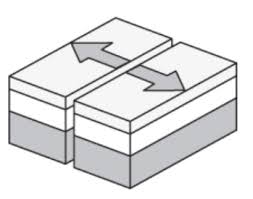
Name the boundary
a)
convergent boundary
b)
divergent boundary
c)
transform boundary
d)
sergent boundary
151.

Name the boundary
a)
convergent boundary
b)
divergent boundary
c)
transform boundary
d)
sergent boundary
152.
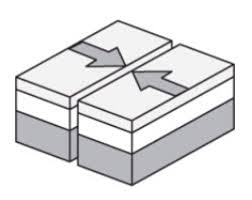
Name the boundary
a)
convergent boundary
b)
divergent boundary
c)
transform boundary
d)
sergent boundary
153.
Mountains form from ...
a)
plates sliding past one another
b)
collision of plates
c)
plates moving away from each other
100 %

