
 Worksheets
Ch 16 Review
Total questions: 78
Worksheet time: 1hrs 18mins
Name
Class
Date
1.

What is it called when plants give off water vapor as a waste product?
a)
condensation
b)
evaporation
c)
sublimation
d)
transpiration
2.

What part of the water cycle does this picture show?
a)
condensation
b)
precipitation
c)
evaporation
3.
When water _________, dew forms.
a)
Melts
b)
Evaporates
c)
Condenses
d)
Precipitates
4.

Which stage does the #3 show in the diagram?
a)
condensation
b)
evaporation
c)
precipitation
d)
run off
5.
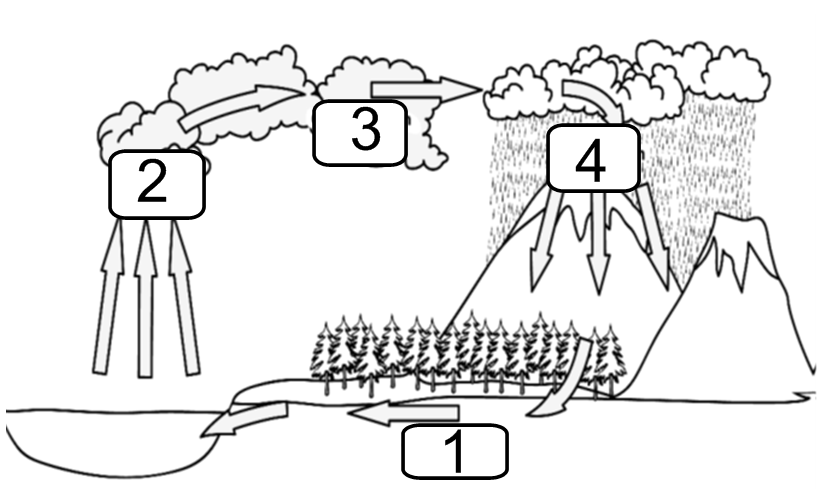
Which stage does the #2 show in the diagram?
a)
condensation
b)
evaporation
c)
precipitation
d)
run off
6.

what does the #4 show in the diagram?
a)
condensation
b)
evaporation
c)
precipitation
d)
run off
7.
The first step in the water cycle
a)
evaporation
b)
condensation
c)
precipitation
d)
there is no first step
8.

what type of cloud is shown?
a)
cumulus
b)
cirrus
c)
stratus
d)
altostratus
9.

what type of cloud is shown?
a)
cumulus
b)
cirrus
c)
stratus
d)
nimbostratus
10.
These clouds are the closest to the ground. Their name means layer- or sheet like. They bring light & continuous rain or snow and cover most of the sky.
a)
Cirrus
b)
Stratus
c)
Cumulonimbus
d)
Cumulus
11.
They are low in the sky and look soft and fluffy. They have flat bases that are usually a little darker than the heaping top.
a)
Cirrus
b)
Cumulonimbus
c)
Cumulus
d)
Stratus
12.
This is sometimes called a thunderhead cloud. It looks very tall like mountains and heavy rain/thunderstorms comes from it.
a)
Cumulus
b)
Cirrus
c)
Stratus
d)
Cumulonimbus
13.

what type of cloud is shown?
a)
cumulus
b)
cirrus
c)
stratus
d)
cumulonimbus
14.

Type of cloud seen here?
a)
cirrus
b)
stratus
c)
cumulus
d)
cumulonimbus
15.
What does nimbus mean?
a)
storm
b)
nimble
c)
rain
d)
rainbow
16.

What type of cloud is this?
a)
cirrus
b)
cumulus
c)
stratus
d)
fog
17.

This diagram shows how a certain type of precipitation is formed. Water drops are caught in up-drafts and down-drafts, over and over, before they fall to Earth as
a)
dew.
b)
hail.
c)
rain.
d)
snow.
18.
What type of precipitation forms when raindrops fall through cold layer of air and freeze before they hit the ground?
a)
Sleet
b)
Snow
c)
Rain
d)
Hail
19.

Dew Point is the
a)
temperature air cools down to reach condensation (or turn into a liquid)
b)
temperature where ice melts to liquid water
c)
temperature where ice turns directly into water vapor
d)
time of day when dew on the ground disappears
20.

If the air is "saturated", that means:
a)
the air is full of water
b)
the air is partially full of water
c)
it's amount of water vapor in the atmosphere right now
d)
how much liquid water it potentially can hold
21.
What is relative humidity?
a)
humidity that is related to other humidity
b)
condensation
c)
clouds
d)
the amount of water in the air compared to the amount of water the air can hold - a ratio
22.
The temperature at which air is saturated with water vapor and condensation occurs is called
a)
humidity
b)
air pressure
c)
dew point
d)
relative humidity
23.
How do we name air masses?
a)
Water and temperature
b)
Air pressure
c)
Humidity and temperature
d)
Cold and warm
24.
Describe an arctic air mass.
a)
Dry
b)
Wet
c)
Cold
d)
Warm
25.
Describe a continental air mass.
a)
Dry
b)
Wet
c)
Cold
d)
Warm
26.
Describe a maritime air mass.
a)
Dry
b)
Wet
c)
Cold
d)
Warm
27.
Describe a tropical air mass.
a)
Dry
b)
Wet
c)
Cold
d)
Warm
28.
What types of air masses form over oceans?
a)
Maritime
b)
Continental
c)
Polar
d)
Tropical
29.
What types of air masses form over land?
a)
Maritime
b)
Continental
c)
Polar
d)
Tropical
30.
What's the humidity and temperature of a continental tropical air mass?
a)
Wet and cold
b)
Dry and warm
c)
Wet and warm
d)
Dry and cold
31.
What's the humidity and temperature of a maritime tropical air mass?
a)
Wet and cold
b)
Dry and warm
c)
Wet and warm
d)
Dry and cold
32.
What's the humidity and temperature of a continental arctic air mass?
a)
Wet and cold
b)
Dry and warm
c)
Wet and warm
d)
Dry and cold
33.
A wet and cold air mass would be a...
a)
Maritime polar
b)
Continental polar
c)
Maritime tropical
d)
Continental tropical
34.
A dry and cold air mass would be...
a)
Maritime polar
b)
Continental polar
c)
Maritime tropical
d)
Continental tropical
35.
The boundary between two air masses is called a/an -
a)
flood
b)
front
c)
climate
d)
storm
36.
When a warm air mass and a cold air mass meet, but they push at each other and neither one can move, it is called a/an -
a)
warm front
b)
cold front
c)
occluded front
d)
stationary front
37.
When a fast moving cold air mass moves into a slower moving warm air mass, we may experience severe storms and we will have cooler weather. What type of front is this?
a)
warm front
b)
cold front
c)
occluded front
d)
stationary front
38.
When a warm air mass slides on top of a cold air mass, and you have drizzly rain and then warmer weather, what type of front is it?
a)
warm front
b)
cold front
c)
occluded front
d)
stationary front
39.
A/An ____ is a large body of air that has the same properties as the Earth's surface over which it develops.
a)
front
b)
air mass
c)
cloud
d)
tornado
40.

What does this image show?
a)
A flag banner
b)
Blue alligator teeth
c)
Warm Front
d)
Cold Front
41.

What does this image represent?
a)
Cold front
b)
Red bulbous things
c)
Warm front
d)
Sarah Ju
42.

What type of front is this?
a)
Occluded
b)
stationary
c)
cold
d)
Warm
43.

This symbol represents
a)
a cold front
b)
an occluded front
c)
a stationary front
d)
a warm front
44.

This symbol represents
a)
a cold front
b)
an occluded front
c)
a stationary front
d)
a warm front
45.

What type of air mass is D?
a)
Maritime Polar
b)
Maritime Tropical
c)
Continental Polar
d)
Continental Tropical
46.
What type of air mass is B?
a)
Maritime Polar
b)
Maritime Tropical
c)
Continental Polar
d)
Continental Tropical
47.
What type of air mass is C?
a)
Maritime Polar
b)
Maritime Tropical
c)
Continental Polar
d)
Continental Tropical
48.
What type of air mass is E?
a)
Maritime Polar
b)
Maritime Tropical
c)
Continental Polar
d)
Continental Tropical
49.
A severe storm that involves high winds and forms over water is:
a)
tornado
b)
thunderstorm
c)
hurricane
d)
blizzard
50.
A severe storm which involves a funnel cloud forming over land is:
a)
hurricane
b)
tornado
c)
thunderstorm
d)
blizzard
51.
How many categories are there for a hurricane?
a)
10 Category's
b)
5 Category's
c)
None
d)
6 Categorys
52.
The powerful spiral wind action carries water a couple of feet high and lashes it ashore?
a)
Storm Surge
b)
Hurricane
c)
Tropical Wave
d)
Tropical storm
53.
Hurricanes develop in ________ regions.
a)
Arctic
b)
Tropical
c)
Arid
d)
None of the above
54.

What is the scale that is used to measure tornadoes?
a)
Mohs Scale
b)
Enhanced Fujita Scale
c)
Saffir Simpson Scale
d)
McDonalds Scale
55.

What happens if a hurricane moves over land or cold ocean water?
a)
it will get stronger
b)
it will get weaker
c)
it will upgrade its category
d)
it will morph into a typhoon
56.
Thunderstorms form in what type of environment?
a)
warm and stable
b)
cold and stable
c)
warm and unstable
d)
cold and unstable
57.

Most of the damage done by a hurricane is the result of _____
a)
water
b)
wind
c)
tornadoes
d)
lightning
58.
Why do hurricanes inflict more damage than tornadoes?
a)
they are larger
b)
longer duration
c)
also associated with flooding and strong rains
d)
all of the rest
59.
In _________ pressure systems, air sinks:
a)
high
b)
low
c)
medium
d)
none
60.
In _______ pressure systems, air rises
a)
high
b)
low
c)
medium
d)
none
61.
Calmest winds of a hurricane
a)
Eye wall
b)
Eye
c)
Upper elevations
d)
Storm surge
62.
What do hurricanes feed on?
a)
warm tropical water
b)
hot water
c)
cold artic water
d)
rain
63.
What is the difference between a hurricane, a typhoon, and a tropical cyclone?
a)
Begin on different dates
b)
Begin in warm waters
c)
Begin in different locations
d)
Begin/end on time
64.
The center of a hurricane is called the ______.
a)
center
b)
brain
c)
eye
d)
circle
65.
Where are the highest winds in the hurricane found?
a)
at the extreme outside, because they have to move faster the further they are from the middle
b)
in the center, called the eye of the hurricane
c)
in the storm surge of the hurricane
d)
in the eyewall of the hurricane
66.
A drop in atmospheric pressure usually indicates the approach of a storm, such as a hurricane.Which weather instrument do meteorologists use to predict this drop in pressure?
a)
anemometer
b)
barometer
c)
thermometer
d)
psychrometer
67.
An isobar map measures...
a)
Temperature
b)
Wind
c)
Precipitation
d)
Air pressure
68.
This weather tool measures wind speed and direction
a)
thermometer
b)
barometer
c)
anemometer
d)
psychrometer
69.
__________ are used on weather maps to indicate high and low pressure systems.
a)
isotherms
b)
circles
c)
triangles
d)
isobars
70.
The information on a ________ ________can include cloud cover, temperature, wind direction and speed, precipitation and barometric pressure.
a)
station model
b)
wind vane
c)
wind sock
d)
tornado scale
71.
A meteorologist would use what to predict rainfall?
a)
Satellite
b)
Radar
c)
Weather map
d)
Station model
72.

What does the letter "H" on a weather map mean?
a)
high temperature
b)
high winds
c)
high humidity
d)
high pressure
73.
_________ are used on a weather map to indicate temperature ranges.
a)
isobars
b)
isotherms
c)
triangles
d)
circles
74.

This weather instrument is a...
a)
anemometer
b)
barometer
c)
wind vane
d)
thermometer
75.

This weather instrument is an...
a)
wind vane
b)
anemometer
c)
barometer
d)
thermometer
76.

A weather vane tells what time of day it is
a)
true
b)
false
77.
How are a windsock and weather vane alike?
a)
They both measure wind.
b)
The both measure the amount of rain.
c)
They both measure the temperature outside.
78.
What would you use to find out the wind direction of a hurricane?
a)
Anenometer
b)
Psychrometer
c)
Wind vane
d)
Thermometer
100 %

