
 Worksheets
Sound and Waves
Total questions: 79
Worksheet time: 1hrs 28mins
Name
Class
Date
1.
Waves transfer
a)
water.
b)
wind.
c)
energy.
d)
particles.
2.
Sound reflecting off a surface produces a(n)
a)
wave.
b)
echo.
c)
transverse.
d)
reflection.
3.
Sound travels as a ___________ wave.
a)
longitudinal
b)
transverse
c)
water
d)
slinky
4.
________ can be described as how high or low a sound is.
a)
wave.
b)
pitch.
c)
longitude.
d)
amplitude.
5.
________ can be described as how high or low a sound is.
a)
wave.
b)
pitch.
c)
longitude.
d)
amplitude.
6.
Sound waves are ___________ waves that can only travel through ______.
a)
transverse, air
b)
transverse, matter
c)
longitudinal, liquids
d)
longitudinal, matter
7.
A sound wave can travel through a vacuum or empty space.
a)
True
b)
False
8.
A sound wave requires a medium, or material, to travel through.
a)
True
b)
False
9.
The distance from one point on a wave to that same point on the next wave is known as
a)
amplitude.
b)
frequency.
c)
wavelength.
d)
reflection.
10.
Wave frequency is measured in the unit of
a)
hertz.
b)
pings.
c)
clicks.
d)
tones.
11.

What is A in this image?
a)
amplitude
b)
compression
c)
rarefaction
d)
trough
12.

What is B in this image?
a)
wavelength
b)
rarefaction
c)
frequency
d)
amplitude
13.
The number of wavelengths that pass a point every second is:
a)
frequency
b)
period
c)
longitudinal
d)
transverse wave
14.
The type of waves that require medium to pass:
a)
Mechanical Waves
b)
Electromagnetic Waves
15.

Which vocabulary term is used to identify the distance between points C & G?
a)
Amplitude
b)
Crest
c)
Frequency
d)
Wavelength
16.
When the frequency of a wave increases, what happens to the wavelength?
a)
The wavelength is not directly affected by the frequency of a wave.
b)
The wavelength increases.
c)
The wavelength decreases.
d)
More specific information is needed to form a conclusion about the wavelength.
17.
A mechanical wave cannot travel through...
a)
a vacuum(empty space).
b)
water.
c)
air.
d)
glass.
18.
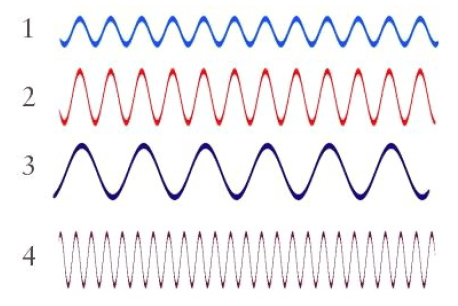
Which wave in the diagram has the greatest frequency?
a)
1
b)
2
c)
3
d)
4
19.
regular disturbances that carry energy through matter or space
a)
crest
b)
energy
c)
wave
d)
trough
20.
A wave in which the particles of the medium vibrate parallel to the direction of the wave motion
a)
A. mechanical wave
b)
B. surface wave
c)
C. longitudinal wave
d)
D. wave
21.
A wave in which the particles of the medium move perpendicularly to the direction the wave is traveling
a)
A. surface wave
b)
B. transverse wave
c)
C. electromagnetic wave
d)
D. longitudinal wave
22.
Due to the Doppler effect, if a sound source (like an ambulance) is moving toward you, how will the sound change as it approaches?
a)
pitch sounds higher
b)
amplitude sounds louder
c)
pitch sounds lower
d)
amplitude sounds quieter
23.
Sonar and ultrasound are examples of what process that uses reflected sound waves to find objects?
a)
radar
b)
photography
c)
echolocation
d)
illumination
24.
An object that does not vibrate cannot produce
a)
sound
b)
light
c)
heat
d)
electricity
25.

Sound travels through solids.
a)
True
b)
False
26.

Measure of how high or low a sound is
a)
amplitude
b)
compression
c)
wave speed
d)
pitch
27.

Sound waves move more quickly through _________________ matter.
a)
dense
b)
liquid
c)
hot
d)
gas
28.
What happens to the sound an object makes when the speed of vibrations decreases (slow down)?
a)
its volume will increase
b)
its pitch rises
c)
its pitch becomes lower
d)
its volume decreases
29.
Why is sound able to travel faster through a solid than a gas?
a)
Gas molecules are packed tightly.
b)
Sound does not travel faster through a solid than a gas.
c)
Solid molecules are packed tightly.
d)
Gas molecules move slowly.
30.
Sound will travel slowest through which of the following forms of matter?
a)
liquid
b)
gas
c)
solid
d)
outer space
31.
Sound travels FASTEST through which of these materials?
a)
Air
b)
Outer space
c)
Water
d)
Metal
32.
The amplitude of a sound's wave determines the sound's
a)
PITCH
b)
LOUDNESS
c)
RESONANCE
d)
SOUND QUALITY
33.
Which of these waves do NOT require a medium?
a)
OCEAN WAVES
b)
SEISMIC WAVES
c)
SOUND WAVES
d)
RADIO WAVES
34.
For a laboratory experiment, Miss Forrest wants to measure the amplitude of a transverse wave. Which of the following distances is equal to the amplitude of a transverse wave?
a)
THE DISTANCE FROM ONE CREST TO THE NEXT
b)
THE DISTANCE FROM THE HIGHEST POINT TO THE LOWEST POINT
c)
THE DISTANCE FROM ONE TROUGH TO THE NEXT
d)
THE DISTANCE FROM THE REST POSITION OF THE WAVE TO THE HIGHEST POINT
35.
Which statement about sound is NOT true?
a)
AIR PARTICLES TRAVEL WITH SOUND WAVES
b)
SOUND WAVES CANNOT TRAVEL THROUGH A VACUUM
c)
SOUND WAVES EXIST EVEN IF NO ONE HEARS THEM
d)
AIR PARTICLES VIBRATE ALONG THE PATH OF A SOUND WAVE
36.
An echo is most likely to result when sound hits a surface that is
a)
BUMPY AND SOFT
b)
SMOOTH AND SOFT
c)
SMOOTH AND HARD
d)
BUMPY AND HARD
37.
High frequency =______________pitch
a)
HIGH
b)
LOW
c)
MEDIUM
d)
STRAIGHT
38.
Low frequency =_________pitch
a)
HIGH
b)
LOW
c)
MEDIUM
d)
STRAIGHT
39.
Which of the following is NOT something in which a sound wave could travel through?
a)
SOLID
b)
GAS
c)
LIQUID
d)
SPACE
40.
As frequency increases energy
a)
increases
b)
decreases
41.
Amplitude is a measure of a waves
a)
distance
b)
frequency
c)
energy
d)
speed
42.
Sound will travel slowest through which of the following forms of matter?
a)
milk
b)
desk
c)
air
d)
door
43.
A longer string makes a _______ pitch than a short string.
a)
louder
b)
softer
c)
higher
d)
lower
44.
The highest pitch is made by the _______ instrument.
a)
biggest
b)
wooden
c)
smallest
d)
shiniest
45.

Why is the school library covered with carpet?
a)
So everyone can make a lot of noise
b)
to help absorb sounds to keep it quiet
c)
because it looks good
d)
to help absorb sounds so it can stay noisy
46.

Why does cupping your hands around your mouth when you shout make the sound travel further?
a)
The sound spreads out.
b)
Your voice gets louder.
c)
You are screaming.
d)
The sound energy is directed in one direction.
47.
Bats use ________ TO LOCATE MOSQUITOES IN THE AIR.
a)
solar
b)
ecology
c)
echolocation
d)
evolution
48.
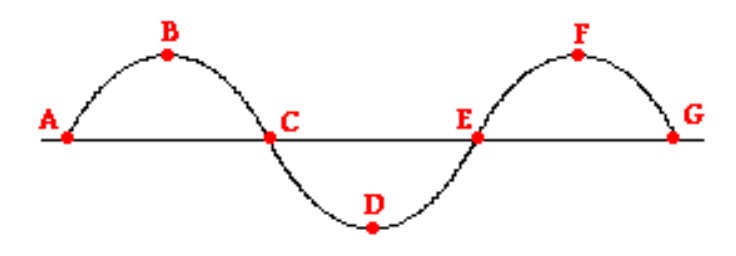
Which letter(s) represent the trough of the wave?
a)
A
b)
B & D
c)
D
d)
C & G
49.
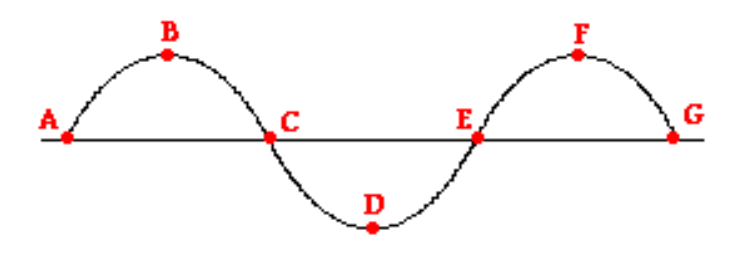
Which letter(s) represent the crest of the wave?
a)
A
b)
B & D
c)
B & F
d)
F
50.
Which part of the ear acts as the sound collector?
a)
outer ear
b)
ear canal
c)
middle ear
d)
inner ear
51.
Which part of the ear is the sound amplifier?
a)
outer ear
b)
ear canal
c)
middle ear
d)
inner ear
52.
When sound waves cause the eardrum to vibrate, these vibrations are immediately passed on to the_________.
a)
outer ear and ear canal
b)
inner ear
c)
tiny hairs
d)
three small bones in the middle ear
53.
What is the first place in the ear where sound vibrations traveling in air are transferred?
a)
the ear bones
b)
the eardrum
c)
the ear liquid
d)
the ear hairs
54.
Containing three tiny bones( hammer,anvil,and stirrup).
a)
Cochlea
b)
Inner ear
c)
Middle ear
d)
None
55.
What are the three parts of the ear?
a)
Outer ear, middle ear and inner ear
b)
Cochlea,middle ear and inner ear
c)
Frequency,audition,and pitch,
d)
Neither
56.

If wave length decreases, then frequency ______________.
a)
decreases
b)
increases
c)
stays the same
57.
A medium can be a .....
a)
solid
b)
liquid
c)
gas
d)
all of the above
58.
What type of waves are sound waves?
a)
Longitudinal
b)
Electromagnetic
c)
Mechanical
d)
Both Mechanical and Longitudinal
59.

What happens in the inner ear?
a)
Sound waves are captured.
b)
Sound waves move deeper into the ear.
c)
Sound waves are reflected.
d)
Sound waves are converted into nerve impulses.
60.
Which part of your ear contains earwax?
a)
outer ear
b)
middle ear
c)
inner ear
d)
eardrum
61.
Where does HEARING (interpreting the nerve impulses) take place?
a)
outer ear
b)
middle ear
c)
inner ear
d)
brain
62.

What is #13?
a)
Eardrum
b)
Anvil
c)
Hammer
d)
Cochlea
63.

What is #19?
a)
Semicircular Canals
b)
Ear Canal
c)
Auditory Nerve
d)
Cochlea
64.

What is #2?
a)
Ear Canal
b)
Pinna
c)
Hammer
d)
Anvil
65.

What is #1?
a)
Pinna
b)
Eustachian Tube
c)
Cochlea
d)
Eardrum
66.
Are volume and pitch the same thing?
a)
No
b)
Yes
67.
Light is a form of energy that travels in a wave. It does not need any material to carry its energy. Humans can see the range of light in the visible light spectrum. Based on this description, how is sound different than light?
a)
Sound does not travel in a wave
b)
Sound is not a form of energy
c)
Sound cannot be perceived by humans
d)
Sound needs a material to carry its energy
68.
The reason the mosquito ring tone works is
a)
adult selective attention ignores the sound
b)
we begin to lose higher pitches when we get older
c)
Young people hear low tones much better
d)
it doesn't really change from teens to older adults
69.
What is supersonic travel?
a)
Where an object travels faster than light.
b)
When an object travels faster than sound.
c)
When an object travels more than 300m/second.
d)
When an object travels more than 30 000m/s.
70.

What type of wave is pictured?
a)
Transversal
b)
Longitudinal
c)
Surface
d)
Seismic
71.

What kind of wave is pictured?
a)
compressional wave
b)
transverse wave
c)
sound wave
d)
mechanical wave
72.

Which wave has a greater frequency?
a)
A
b)
B
73.

You can't hear sounds in outer space because there is no
a)
matter
b)
light
c)
energy
d)
heat
74.

Constructive interference results in ____.
a)
larger amplitude.
b)
larger frequency.
c)
lower amplitude.
d)
lower wavelength
75.
When two or more waves are at the same place at the same time, the resulting effect is called
a)
a standing wave
b)
a doppler wave
c)
a shock wave
d)
interference
76.

True or False: Sound waves move outward in circles from the person hearing the sound.
a)
True
b)
False
77.

True or False: You cannot see sound waves.
a)
True
b)
False
78.

Sound waves, like waves in a pond, move ______________ in circles from their source.
a)
inward
b)
outward
79.

____________________ is the number of waves that move past one spot in a second
a)
energy
b)
amplitude
c)
wavelength
d)
frequency
100 %

