
 Worksheets
Regents Chem Review 1
Total questions: 125
Worksheet time: 2hrs 19mins
Name
Class
Date
1.
The correct formula for calcium phosphate
a)
Ca3PO4
b)
Ca6PO4
c)
Ca3(PO4)2
d)
Ca2 (PO4)3
2.
On the periodic chart, Ge and Sb are
a)
metals
b)
non-metals
c)
metalloids
d)
transition metals
3.
How much Iodine-125 will remain after 100 years if the original sample had a mass of 80 grams and the half-life of I-125 is 25 years?
a)
20 grams
b)
2.5 grams
c)
5 grams
d)
10 grams
4.
An atom's mass number equals the number of...
a)
protons plus the number of electrons
b)
protons plus the number of neutrons
c)
protons
d)
neutrons
5.
Which of the following is a chemical property?
a)
how something tastes
b)
ability to explode
c)
ability to float in water
d)
size of an object
6.
In the modern periodic table elements are arranged by:
a)
atomic mass
b)
atomic number
c)
valence electrons
d)
number of isotopes
7.
As you move down the periodic table atoms get bigger. This is because ____________.
a)
The atoms have more mass.
b)
The atoms have more protons.
c)
The atoms have more energy levels
d)
The atoms have more nuetrons
8.
Two naturally occurring isotopes of an element have masses and abundance as follows: 54.00 amu (20.0%) and 56.00 amu ( 80.0%). What is the relative atomic mass of the element?
a)
54.20
b)
54.40
c)
54.80
d)
55.60
9.
Atoms of 38 Ca and 40 Ca differ with respect to number of
a)
protons
b)
electrons
c)
neutrons
d)
orbitals
10.

Arrange in order of increasing ability to penetrate matter.
a)
Beta, gamma, alpha
b)
Alpha, gamma, beta
c)
Gamma, beta, alpha
d)
Alpha, beta, gamma
11.

Classify this process.
a)
Nuclear fission
b)
Nuclear fusion
c)
Alpha decay
d)
Beta decay
12.

Which process involves the splitting of large nuclei?
a)
Beta decay
b)
Alpha decay
c)
Nuclear fission
d)
Nuclear fusion
13.
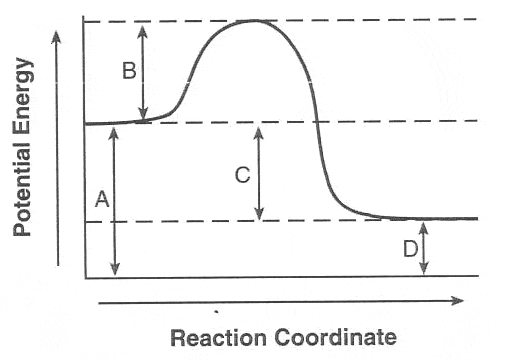
What type of reaction is this?
a)
Endothermic
b)
Exothermic
14.
How many moles of Na2SO4 is needed to make 2.5 L of 2.0 M solution?
a)
5 moles
b)
1 moles
c)
1.25 moles
d)
0.80 moles
15.
N2 + 3H2 → 2NH3
How many moles of hydrogen are needed to react with 5 moles of nitrogen?
How many moles of hydrogen are needed to react with 5 moles of nitrogen?
a)
6 mol H2
b)
2 mol H2
c)
3 mol H2
d)
15 mol H2
16.
How many neutrons would Potassium-41 (K) have?
a)
22
b)
19
c)
41
d)
1
17.
What bonds to make an ionic bonds?
a)
metals and metals
b)
metals and nonmetals
c)
nonmetals and metalloids
d)
nonmetals and nonmetals
19.
The general formula for a synthesis reaction
a)
A + B--> AB
b)
AB--> A + B
c)
A + BX--> AX + B
d)
AX + BY --> AY+ BX
19.
The general formula for a synthesis reaction
a)
A + B--> AB
b)
AB--> A + B
c)
A + BX--> AX + B
d)
AX + BY --> AY+ BX
20.
Elements in the same group have the same ____.
a)
number of protons
b)
number number of neutrons
c)
# valence electrons
d)
color
21.
In the formation of a covalent bond, electrons are _____.
a)
transferred
b)
shared
c)
exchanged
d)
lost
22.
All atoms of the same element have the same ____.
a)
number of neutrons
b)
number of protons
c)
number of electrons
d)
mom and dad
23.
Isotopes of the same element have different ____.
a)
hair
b)
protons
c)
neutrons
d)
electrons
24.
When the solution is holding more solute than its maximum (by raising the temperature saturating the solution and then lowering the temperature) it is said to be
a)
Supersaturated
b)
Saturated
c)
Unsaturated
d)
Undefined
25.
What is a solution called where more amount of solute CAN BE dissolved at a specific temperature and pressure?
a)
Supersaturated
b)
Saturated
c)
Unsaturated
d)
Undefined
26.
What is the molecular shape for CH4?
a)
Trigonal planar
b)
Trigonal pyramid
c)
Tetrahedral
d)
Bent
27.
What is the empirical formula of the following molecular formula: C3H6
a)
C3H6
b)
CH2
c)
C2H4
d)
CH3
28.
Name this reaction, Cl2 + 2KI --> I2 + 2KCl
a)
Synthesis
b)
Single Replacement
c)
Double Replacement
d)
Decomposition
29.
Balance this equation: H2 + N2 → NH3
a)
H2 + 4N2 → NH3
b)
H2 + 3N2 → 2NH3
c)
3H2 + N2 → 2NH3
d)
2H2 + 2N2 → 2NH3
30.
What is the equation for the positron emission by oxygen-16?
a)
168O + 0+1e --> 169F
b)
168O --> 42He + 126C
c)
168O --> 0-1e + 169F
d)
168O --> 0+1e + 167N
31.
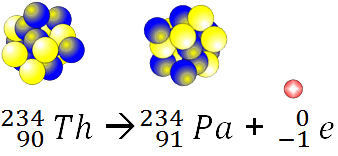
Which type of nuclear radiation is being emitted here?
a)
Alpha
b)
beta
c)
gamma
d)
none
32.
2NH3+22kJ↔N2+3H2
Which direction does the reaction shift if N2 was removed?
Which direction does the reaction shift if N2 was removed?
a)
Shift right
b)
Shift left
c)
No shift
d)
Shift both directions
33.
The idea that when a system at equilibrium is stressed, it will react to relieve that stress and return to equilibrium is known as:
a)
Boyle's Law
b)
Le Chatelier's Principle
c)
Charles Law
d)
Denninger's Law
34.

At what time the reaction reached equilibrium?
a)
t1
b)
t2
c)
t3
d)
t4
35.
2NH3+22kJ↔N2+3H2
Which direction does the reaction shift if NH3 was added?
Which direction does the reaction shift if NH3 was added?
a)
Shift right
b)
Shift left
c)
No shift
d)
Shift both directions
36.
Why can ionic compounds not conduct electricity when they are solid?
a)
their electrons are not free to move
b)
their ions are free to move
c)
their ions are not free to move
d)
their electrons are free to move
37.
What would the charges be on the ions that make up Al2O3?
a)
Al2+ and O3-
b)
Al2- and O3+
c)
Al3+ and O2-
d)
Al3- and O2+
38.
A 2.7L sample of nitrogen is collected at 1.19 atm and 288 K. If the volume decreases to 1.70L and the temperature lowers to 197 K, what will the pressure be?
a)
4.3 atm
b)
1.3 atm
c)
131 atm
d)
141 atm
39.
Gases have...
a)
A definite shape and volume
b)
A definite shape but no definite volume
c)
No definite shape but a definite volume
d)
No definite shape or volume
40.
Name this compound:
CuS
CuS
a)
Copper (IV) sulfate
b)
Copper (II) sulfite
c)
Copper (III) sulfide
d)
Copper (II) sulfide
41.
Name this compound:
NiPO4
NiPO4
a)
Nickel (I) phosphate
b)
Nickel (II) phosphate
c)
Nickel (IV) phosphate
d)
Nickel (III) phosphate
42.
Write the formula for copper (I) phosphide
a)
Cu3P
b)
CuP
c)
Cu1P
d)
CuP3
43.
Polyatomic ions are
a)
ions formed from one atom
b)
ions formed from more than one atom
c)
ions formed in compounds
44.
Disulfur trioxide
a)
S3O2
b)
SO
c)
S2O3
d)
S2O
45.

At approximately what temperature does the solubility of sodium chloride, NaCl, match the solubility of potassium dichromate, K2Cr2O7?
a)
60 ºC
b)
30 ºC
c)
50 ºC
d)
83 ºC
46.

Which substance is MOST soluble at 0 ºC?
a)
KI
b)
NaNO3
c)
NaCl
d)
Ce2(SO4)3
47.

A solution of potassium chlorate, KClO3, has 20 grams of the salt dissolved in 100 grams of water at 70 ºC. Approximately how many more grams of the salt can be added to the solution before reaching the saturation point?
a)
10 grams
b)
30 grams
c)
80 grams
d)
60 grams
48.
How many significant figures are in this measurement? 420 g
a)
1
b)
4
c)
3
d)
2
49.
HOw many sig figs are in the following measurement? 0.410 m
a)
2
b)
3
c)
1
d)
4
50.
Calculate the following and answer with the proper number of sig figs. 241.5 cm + 22.34 cm
a)
263.8 cm
b)
263.84 cm
c)
264 cm
d)
263.45 cm
51.
Calculate the number of moles in 85.3g of water.
a)
.211 g
b)
.211 moles
c)
4.73 moles
d)
4.73 g
52.
What is the percentage by mass of calcium in CaCl2?
a)
32%
b)
34%
c)
36%
d)
38%
53.
The strongest acid would have a pH of _______.
a)
1
b)
5
c)
8
d)
14
54.

Attractions between water molecules are called
a)
Covalent bonds
b)
Ionic bonds
c)
Polar bonds
d)
Hydrogen bonds
55.
What is 0*C in Kelvin?
a)
110 *K
b)
100 *K
c)
273 *K
d)
210 *K
56.

What is happening in section C-D?
a)
A. There is an increase in the kinetic energy of the molecules
b)
B. There is an increase in the electrical potential energy of the molecules
c)
There is a decrease in the electrical potential energy of the molecules
d)
A and B
57.

What is happening in section A-B?
a)
A. There is an increase in the kinetic energy of the molecules
b)
B. There is an increase in the electrical potential energy of the molecules
c)
There is a decrease in the electrical potential energy of the molecules
d)
A and B
58.
The minimum amount of energy required by reacting particles in order to react.
a)
Kinetic Energy
b)
Enthalpy
c)
Activation Energy
d)
Chemical Potential Energy
59.

What type of reaction is this?
a)
Exothermic
b)
Endothermic
60.

What type of reaction is this?
a)
Exothermic
b)
Endothermic
61.
Acid + Base ₋-->
a)
salt + hydrogen
b)
salt + water
c)
salt + carbon dioxide + water
d)
salt
62.
If it takes 50 mL of 0.5 M Ca(OH)2 to neutralize 125 mL of sulfuric acid, what is the concentration of the acid?
a)
0.2 M
b)
5 M
c)
0.5 M
63.
3KOH + H3PO4 --> K3PO4 + 3H2O
a)
Synthesis
b)
Decomposition
c)
Single displacement
d)
Double displacement
64.
2Pb(NO3)2 --> 2PbO + 4NO2 + O2
a)
Synthesis
b)
Decomposition
c)
Single Displacement
d)
Combustion
65.
Why must chemical equations be balanced?
a)
So that the equation doesn't explode
b)
The reaction won't happen until it is balanced
c)
Matter cannot be created or destroyed, merely rearranged
d)
None of these
66.
What is the ground state electron configuration of Bromine?
a)
2-8-18-7
b)
2-8-18-8
c)
2-3
d)
2-8-17-8
67.

Which of the following elements make up the unknown sample?
a)
A and B
b)
B and C
c)
C and D
d)
B and C
68.
Which is a possible excited state electron configuration for Silicon?
a)
2-8-4
b)
1-9-4
c)
2-8-8
d)
2-8-3-1
69.
Light is emitted when an electron moves from the ________ state to the _________ state
a)
excited, ground
b)
ground, excited
70.

Rutherford's gold foil experiment provided evidence that...
a)
Negative and positive charges are spread evenly throughout the atom.
b)
Alpha particles have a positive charge.
c)
Gold is not a dense as previously thought.
d)
There is a dense positively charged nucleus at the center of an atom.
71.

What scientist is best known for his "Plum Pudding" model of the atom?
a)
J.J. Tomson
b)
Ernest Rutherford
c)
John Dalton
d)
Democritus
72.

What's a valence electron?
a)
electrons in the second energy level
b)
electrons in the outermost energy level
c)
the atomic number
d)
electrons in the first level
73.

This picture represents which of the following?
a)
Element
b)
Compound
c)
Mixture
74.

This picture represents which of the following?
a)
element
b)
compound
c)
mixture
75.

This picture represents which of the following?
a)
element
b)
compound
c)
mixture
76.

This picture represents which of the following?
a)
element
b)
compound
c)
mixture
77.
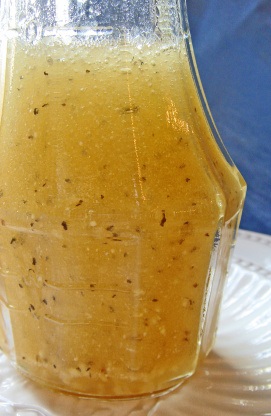
Italian Salad Dressing
a)
heterogeneous mixture
b)
homogeneous mixture
78.
Two or more substances mingled together, but not chemically combined are known as a
a)
residue
b)
solution
c)
distillate
d)
mixture
79.

Elements and compounds are always ___.
a)
pure
b)
mixed
80.
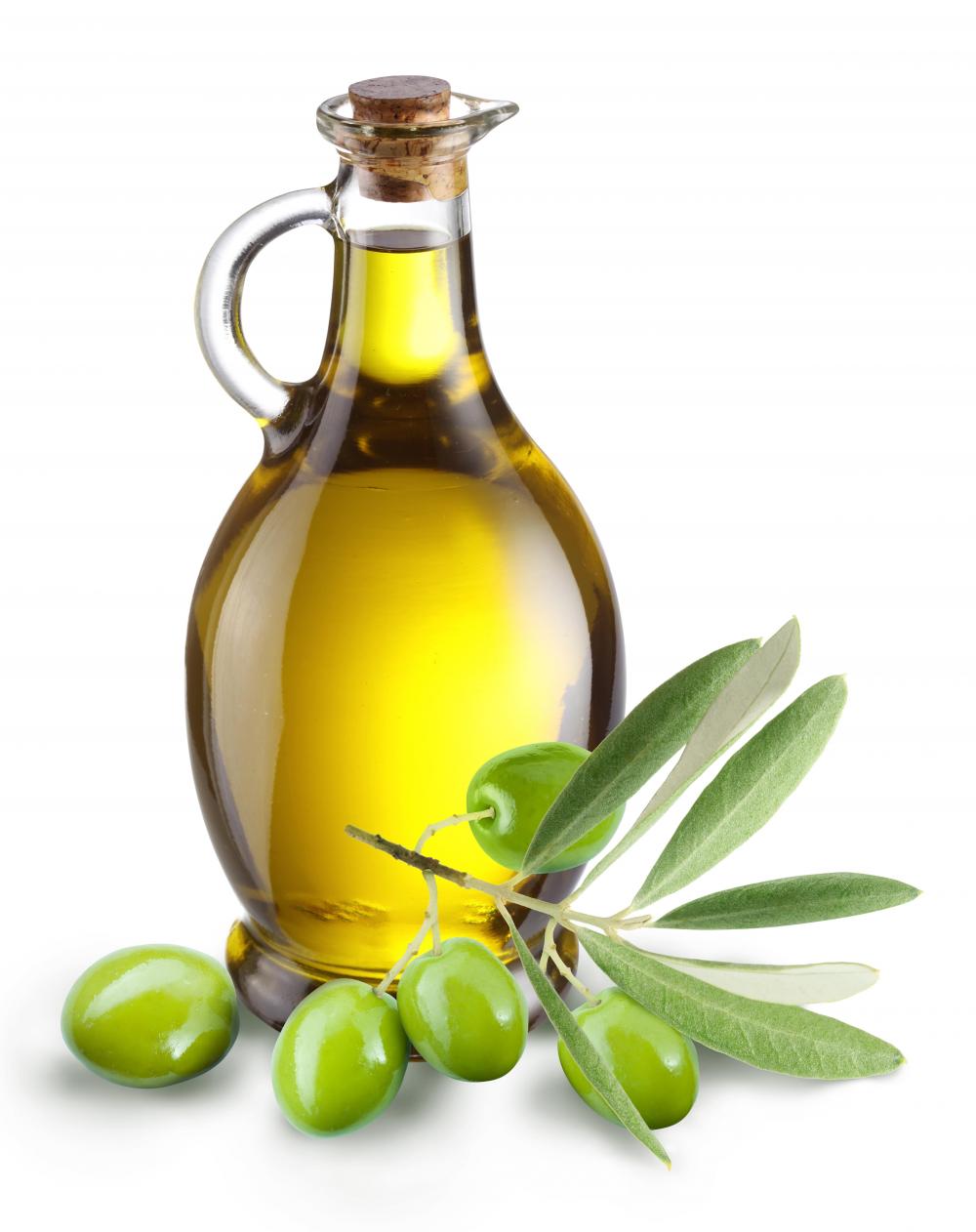
Olive Oil
a)
Heterogeneous mixture
b)
Homogeneous mixture
81.
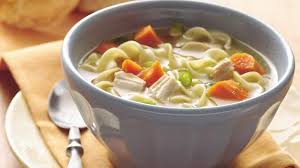
Chicken noodle soup
a)
heterogeneous mixture
b)
homogeneous mixture
82.
Collisions between gas particles are said to be "elastic" because _________________________.
a)
they have a stretchy waistband
b)
kinetic energy is lost between particles
c)
kinetic energy is not lost between particles and is instead transferred
d)
particles move in a straight line
83.
Gas particles are in _______________ motion.
a)
constant
b)
random
c)
constant and random
d)
perpetual
84.

a)
Gas particles are elastic and do not attract each other.
b)
The kinetic energy of gas is dependent on temperature
c)
Energy is not lost when gas particles collide with each other or with the walls of the container.
d)
All of the above
85.
Under which of the following conditions do REAL gases behave most like IDEAL gases?
a)
High pressure and high temperature
b)
High pressure and low temperature
c)
Low pressure and low temperature
d)
Low pressure and high temperature
86.
True or False? At STP, two samples of a gas will have the same number of particles if they have the same volume.
a)
True
b)
False
87.
The higher the average kinetic energy the __________________
a)
the higher the volume
b)
the higher the mass
c)
the higher the temperature
d)
the higher the density
88.
The model of the atom that scientists use today is?
a)
Billiard Ball Model
b)
Plum Pudding Model
c)
Quantum mechanical model
d)
Planetary model
89.
In the gold foil experiment, most of the positively charged alpha particles passed through the gold foil, but some were deflected or bounced back. What did this prove?
a)
Atoms are small indivisible spheres
b)
Atoms are mostly empty space with a small, dense, positive center
c)
Atoms have negatively charged particles which orbit the nucleus
d)
Light is a wave, not a particle
90.

Where are the metalloids / semimetals located on the periodic table?
a)
Blue
b)
Red
c)
Green
91.

Where are metals located on the periodic table?
a)
Blue
b)
Green
c)
Red
92.

Where are the nonmetals located on the periodic table?
a)
Blue
b)
Red
c)
Green
93.

Which type of force is this?
a)
Intramolecular
b)
Intermolecular
94.
What intermolecular force is present in a sample of pure Cl2?
a)
dipole-dipole attraction
b)
H-bonds
c)
London dispersion forces
d)
molecule-ion attraction
95.
What is the oxidation number of Fe in FeO?
a)
+1
b)
-1
c)
+2
d)
-2
96.
What is oxidation number of Cr in Cr2O7-2?
a)
-2
b)
+2
c)
+6
d)
+12
97.
Is calcium oxidized or reduced in the following reaction?
2CaO--> 2Ca + O2
2CaO--> 2Ca + O2
a)
Oxidized
b)
Reduced
98.
In a voltaic cell involving zinc metal and one of its salts and copper metal and one of its salts, which metal would be used as the anode?
a)
zinc
b)
copper
99.
Type of electrochemical cell in which a spontaneous chemical reaction produces a flow of electrons.
a)
voltaic cell
b)
electrolytic cell
100.
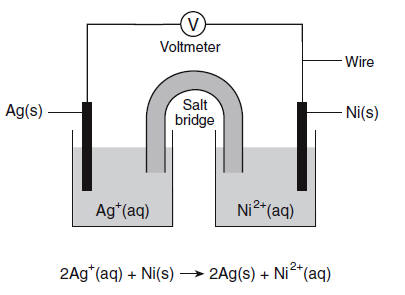
What reaction occurs at the anode?
a)
Ag+ + e- →Ag
b)
Ag → Ag+ + e-
c)
Ni2+ + 2e- → Ni
d)
Ni → Ni2+ + 2e-
101.
Which of the following is the balanced half -reaction for the oxidation of Cu to Cu+2?
a)
Cu --> Cu+2
b)
Cu + 2 e- --> Cu+2
c)
Cu --> Cu+2 + 2 e-
d)
Cu - 2e- --> Cu+2
102.
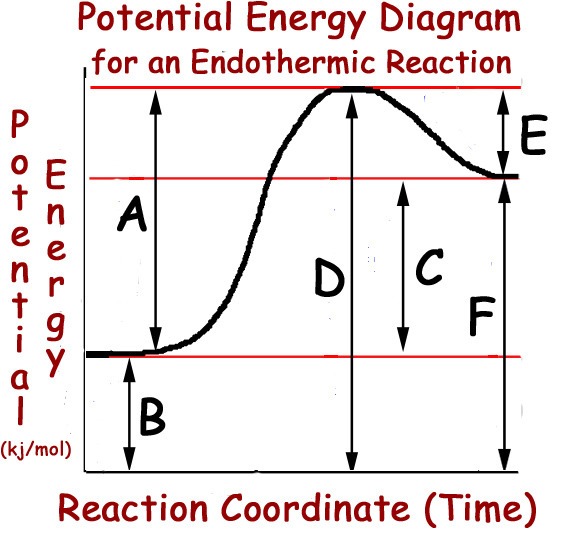
What letter represents the activation energy of the forward reaction?
a)
A
b)
B
c)
C
d)
D
103.
What factors are required for a chemical reaction to occur?
a)
collision of reactant particles
b)
sufficient energy
c)
favorable orientation of particles
d)
all of these
104.
Which of the following equations represents an endothermic reaction?
a)
N2O4(g) + 59 kJ → 2NO2(g)
b)
2H2(g) + O2(g) → 2H2O(l) + 572 kJ
c)
2BrCl(g) -29.3 kJ →Br2(g) + Cl2(g
d)
2H2(g) + O2(g) → 2H2O(l) ΔH = -572 kJ
105.
Collision theory states that
a)
particles that collide will always undergo a reaction
b)
collisions between particles may result in a reaction if the temperature is low enough
c)
collision between molecules are sometimes needed before a reaction occurs, but not always
d)
reacting particles must collide with enough energy and at the proper angle in order to react
106.
An electrolyte is...
a)
The rapid, random movement of particles in colloidal dispersion.
b)
A substance that dissolves in water and conducts electric current.
c)
A substance that dissolves in water and does not conduct electric current.
d)
The solution process when water is the solvent.
107.
Which substance on Table H has the strongest intermolecular forces of attraction?
a)
propanone
b)
ethanol
c)
water
d)
ethanoic acid
108.
Which substance on Table H has the lowest normal boiling point?
a)
propanone
b)
ethanol
c)
water
d)
ethanoic acid
109.
Which substance on Table G has the lowest solubility at 70oC?
a)
NaNO3
b)
HCl
c)
NH4Cl
d)
KClO3
110.
Which substance on Table G is not a gas?
a)
HCl
b)
KCl
c)
NH3
d)
SO2
111.
If 0.002 g of PbCl2 are dissolved in 2000.0g of water, how many parts per million are dissolved? (Assume density of water is 1 g/mL)
a)
10ppm
b)
1ppm
c)
2ppm
d)
20ppm
112.
Which of the following solutions will have the highest boiling point?
a)
1M NaCl (aq)
b)
2M C6H12O6 (aq)
c)
2M CaCl2
d)
1M NaNO3
113.
Colligative properties depend on the _____ of solute particles in solution.
a)
type
b)
number
c)
pH
d)
nature
114.
Which reaction between halogens and halide salts will occur?
a)
F2(g) + FeI2(aq) → FeF2(aq) + I2 (g)
b)
Cl2(g) + SrF2(aq) → SrCl2(aq) + F2(g)
c)
I2(g) + MgBr2(aq) → MnI2(aq) + Br2(g)
d)
Br2(l) + CoCl2(aq) → CoBr2(aq) + Cl2(g)
115.
Is MgS soluble or insoluble?
a)
Soluble
b)
Insoluble
c)
Neither
d)
Both
116.
Is NaCl soluble or insoluble?
a)
Soluble
b)
Insoluble
c)
Neither
d)
Soluble and Insoluble
117.
Is AgCl soluble or insoluble?
a)
Soluble
b)
Insoluble
c)
Neither
d)
Both
118.
What are the products of the following unbalanced reaction?
NaF + Cl2 ->
NaF + Cl2 ->
a)
NaCl + F2
b)
NaF2 + Cl2
c)
Na + F2 + Cl2
d)
no reaction
119.
Will the following reaction take place?
AuNO3 + Li ->
AuNO3 + Li ->
a)
yes
b)
no
120.

Which term refers to how strongly an atom of an element attracts electrons in a chemical bond with an atom of a different element?
a)
entropy
b)
electronegativity
c)
activation energy
d)
first ionization energy
121.
At STP, which substance has metallic bonding?
a)
ammonium chloride
b)
iodine
c)
barium oxide
d)
silver
122.
Compared to the boiling point and the freezing point of water at 1 atmosphere, a 1.0 M CaCl2(aq) solution at 1 atmosphere has a...
a)
lower boiling point and lower freezing point
b)
lower boiling point and higher freezing point
c)
higher boiling point and lower freezing point
d)
higher boiling point and higher freezing point
123.
In a redox reaction, which particles are lost and gained in equal numbers?
a)
electrons
b)
hydroxide ions
c)
neutrons
d)
hydronium ions
124.
Which compounds are classified as electrolytes?
a)
KNO3 and H2SO4
b)
KNO3 and CH3OH
c)
CH3OCH3 and H2SO4
d)
CH3OCH3 and CH3OH
125.
What is the density of an object having a mass of 8.0 g and a volume of 25 cm3?
a)
0.32 g/cm3
b)
2.0 g/cm3
c)
3.1 g/cm3
d)
200 g/cm3
100 %

