
 Worksheets
Chemistry--Final Exam Review
Total questions: 65
Worksheet time: 4hrs 37mins
Name
Class
Date
1.
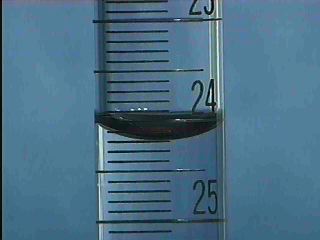
What is the volume in this buret?
a)
24.1mL
b)
24.3mL
c)
24.2L
d)
24.2mL
2.
As the temperature of a sample of H2O(l) deceases, the average kinetic energy of its molecules will
a)
a. decrease
b)
b. increase
c)
c. remain the same
3.
What kelvin temperature is equivalent to -24 0C?
a)
a. 226 K
b)
b. 249 K
c)
c. 273 K
d)
d. 297 K
4.
The atomic mass of titanium is 47.88 atomic mass units. This atomic mass represents the
a)
a. total mass of all of the protons and neutrons in the atom of Ti
b)
b. total mass of all the protons, neutrons, electrons in an atom of Ti
c)
c. weighted average mass of the most abundant isotope of Ti
d)
d. weighted average mass of all the naturally occurring isotopes of Ti
5.
More than two-thirds of the elements are classified as
a)
a. nonmetals
b)
b. metals
c)
c. metalloids
d)
d. noble gases
6.
The arrangement of the elements in the present Periodic Table is based on atomic
a)
a. mass
b)
b. number
c)
c. radius
d)
d. density
7.
Atoms of elements in a group on the Periodic Table have similar chemical properties. This similarity is most closely related to the atoms'
a)
a. number of principal energy levels
b)
b. number of valence electrons
c)
c. atomic numbers
d)
d. atomic masses
8.
The elements in the modern Periodic Table are arranged according to their
a)
a. atomic number
b)
b. oxidation number
c)
c. atomic mass
d)
d. nuclear mass
9.
Which part of the Periodic Table contains elements with the strongest metallic properties?
a)
a. upper left
b)
b. upper right
c)
c. lower left
d)
d. lower right
10.
In the ground state, atoms of the elements in Group 15 of the Periodic Table all have the same number of
a)
a. filled principal energy levels
b)
b. occupied principal energy levels
c)
c. neutrons in the nucleus
d)
d. electrons in the valence shell
11.
Which list of elements contains two metalloids?
a)
a. Si, Ge, Po, Pb
b)
b. As, Bi, Br, Kr
c)
c. Si, P, S, Cl
d)
d. Po, Sb, I, Xe
12.
According to the Periodic Table, which element has more than one positive oxidation state (number)?
a)
a. cadmium
b)
b. iron
c)
c. silver
d)
d. zinc
13.
As the elements in Period 3 are considered from left to right, they tend to
a)
a. lose electrons more readily and increase in metallic character
b)
b. lose electrons more readily and increase in nonmetallic character
c)
c. gain electrons more readily and increase in metallic character
d)
gain electrons more readily and increase in nonmetallic character
14.
As the elements in Group 2 are considered in order of increasing atomic number, the atomic radius of each successive element increases. This increase is primarily due to an increase in the number of
a)
a. occupied principal energy levels
b)
b. electrons in the outermost shell
c)
c. neutrons in the nucleus
d)
d. unpaired electrons
15.
Which element has chemical properties that are most similar to the chemical properties of sodium?
a)
a. Mg
b)
b. K
c)
c. Se
d)
d. Cl
16.
An element that is malleable and a good conductor of heat and electricity could have an atomic number of
a)
a. 16
b)
b. 18
c)
c. 29
d)
d. 35
17.
A substance that is composed only of atoms having the same atomic number is classified as
a)
a. a compound
b)
b. an element
c)
c. a homogeneous mixture
d)
d. a heterogeneous mixture
18.
Which element is a noble gas?
a)
a. krypton
b)
b. chlorine
c)
c. antimony
d)
d. manganese
19.
All the elements in Period 3 have the same number of
a)
a. occupied sublevels
b)
b. principal energy levels
c)
c. electrons
d)
d. protons
20.
The process of filtration is performed in the laboratory to
a)
a. form precipitates
b)
b. remove water from solutions
c)
c. separate dissolved particles from the solvent
d)
d. separate insoluble substances in an aqueous mixture
21.
A bunsen burner flame is sooty black and mixed with an orange-yellow color. Which is the probable reason for this condition?
a)
a. No oxygen is mixing with the gas
b)
b. No gas is mixing with the oxygen.
c)
c. Insufficient oxygen is mixing with the gas.
d)
d. Insufficient gas is mixing with the oxygen.
22.

Identify the two gases in the unknown mixture.
a)
a. Gas A & Gas C
b)
b. Gas B & Gas C
c)
c. Gas A & Gas D
d)
d. Gas C & Gas D
23.

Which segment of the graph represents the gas phase only?
a)
a. A-B
b)
b. B-C
c)
c. C-D
d)
e. E-F
24.
A cube has a volume od 8.0 cm3 and a mass of 21.6 grams. The density of the cube, in grams per cubic centimeter, is best expressed as
a)
a. 2.7
b)
b. 2.70
c)
c. 0.37
d)
d. 0.370
25.
Which gas has properties that are most similar to those of an ideal gas?
a)
a. N2
b)
b. O2
c)
c. He
d)
d. Xe
26.
Which nonmetallic element is a liquid at STP?
a)
a. mercury
b)
b. bromine
c)
c. iodine
d)
d. hydrogen
27.
Which substance has vibrating particles in regular fixed positions?
a)
a. Ca(s)
b)
b. Hg(l)
c)
c. Cl2(g)
d)
d. CaCl2(aq)
28.
When an equation is correctly balanced, it must show conservation of
a)
a. charge but not of mass
b)
b. mass but not of charge
c)
c. both charge and mass
d)
d. neither charge nor mass
29.
Which type of matter is composed of two or more different elements that are chemically combined in a definite ratio?
a)
a. a solution
b)
b. a compound
c)
c. a homogeneous mixture
d)
d. a heterogeneous mixture
30.
Two basic properties of the gas phase are
a)
a. a definite shape and definite volume
b)
b. a definite shape but no definite volume
c)
c. no definite shape but a definite volume
d)
d. no definite shape and no definite volume
31.
Which terms are used to identify pure substances?
a)
a. an element & a mixture
b)
b. an element and a compound
c)
c. a solution & a mixture
d)
d. a solution & a compound
32.

Based on the data table, what is the melting point, in degrees Celsius, of this substance?
a)
a. 15
b)
b. 32
c)
c. 53
d)
d. 65
33.
Which two substances can not be broken down by chemical change?
a)
a. C & CuO
b)
b. C and Cu
c)
c. CO2 & CuO
d)
d. CO2 & Cu
34.

a)
a. A
b)
b. B
c)
c. C
d)
d. D
35.

a)
a. chemically combined in a fixed proportion
b)
b. chemically combined in proportions that vary
c)
c. physically mixed in a fixed proportion
d)
d. physically mixed in proportions that vary
36.
What is represented by the dots in a Lewis electron-dot diagram of an atom of an element in Period 2 of the Periodic Table?
a)
a. the number of neutrons in the atom
b)
b. the number of protons in the atom
c)
c. the number of valence electrons in the atom
d)
d. the total number of electrons in the atom
37.
An element in an atom moves from the ground state to an excited state, the potential energy of the electron
a)
a. decreases
b)
b. increases
c)
c. remains the same
38.
What causes the emission of radiant energy that produces the characteristic spectral lines?
a)
a. neutron absorption by the nucleus
b)
b. gamma ray emission from the nucleus
c)
c. movement of electrons to higher energy levels
d)
return of electrons to lower energy levels
39.
Which is an electron configuration for an atom of chlorine in the excited state?
a)
a. 2-8-7
b)
b. 2-8-2
c)
c. 2-8-6-1
d)
d. 2-8-7-1
40.
A chemical bond between two atoms results from a simultaneous
a)
a. attraction by the protons for the neutrons
b)
b. attraction by the two nuclei for the electrons
c)
c. repulsion by the valence electrons of the atoms
d)
d. repulsion by the protons of the two nuclei
41.
When a metal atom combines with a nonmetal atom, the nonmetal atom will
a)
a. lose electrons and decrease in size
b)
b. lose electrons and increase in size
c)
c. gain electrons and decrease in size
d)
d. gain electrons and increase in size
42.
Covalent bonds are formed when electrons are
a)
a. transferred from one atom to another
b)
b. captured by the nucleus
c)
c. mobile within a metal
d)
d. shared between two atoms
43.
Metallic bonding occurs betwee atoms of
a)
a. fluorine
b)
b. neon
c)
c. sulfur
d)
d. copper
44.
The atomic number of an atom is always equal to the total number of
a)
a. neutrons in the nucleus
b)
b. protons in the nucleus
c)
c. neutrons plus protons in the atom
d)
d. protons plus electrons in the atom
45.
All the atoms of argon have the same
a)
a. mass number
b)
b. atomic number
c)
c. number of neutrons
d)
d. number of nucleons
46.
Mobile electrons are a distinguishing characteristic of
a)
a. an ionic bond
b)
b. an electrovalent bond
c)
c. a metallic bond
d)
d. a covalent bond
47.
How many milliliters of 0.50M KOH are needed to exactly neutralize 10 milliliters of a 1.5M HNO3
a)
a. 5.0 ml
b)
b. 12 ml
c)
c. 25 ml
d)
d. 30 ml
48.
Which indicator is blue in a solution that has a pH of 5.6?
a)
a. bromcresol green
b)
b. bromothymol blue
c)
c. methyl orange
d)
d. thymol blue
49.

a)
a. A
b)
b. B
c)
c. C
d)
d. D
50.
The atomic mass of an element is defined as the weighted average mass of that element's
a)
a. most abundant isotope
b)
b. least abundant isotope
c)
c. naturally occurring isotopes
d)
d. radioactive isotopes
51.
The nucleus is part of the atom that
a)
a. consists mostly of empty space
b)
b. has a negative charge
c)
c. occupies most of the atom's volume
d)
d. contains most of the atom's total mass
52.
What is the mass number of an atom which contains 21 electrons, 21 protons, and 24 neutrons?
a)
a. 21
b)
b. 42
c)
c. 45
d)
d. 66
53.
What can be determine if only the atomic number of an atom is known?
a)
a. the total number of neutrons in the atom, only
b)
b. the total number of protons in the atom, only
c)
c. the total number of protons and the total number of neutrons in the atom
d)
d. the total number of protons and the total number of electrons in the atom
54.
Which statement best describes the nucleus of an aluminum atom?
a)
a. It has a charge of +13 and is surrounded by a total of 10 electrons
b)
b. It has a charge of +13 and is surrounded by a total of 13 electrons
c)
c. It has a charge of -13 and is surrounded by a total of 10 electrons
d)
d. It has a charge of -13 and is surrounded by a total of 13 electrons
55.
What is the total number of neutrons in an atom of 7Li3?
a)
a. 7
b)
b. 10
c)
c. 3
d)
d. 4
56.
What is the total number of electrons in a Mg2+ ion?
a)
a. 10
b)
b. 2
c)
c. 12
d)
d. 24
57.
A K atom differs from a K+ ion in that the K atom has one
a)
a. more electron
b)
b. less electron
c)
c. more proton
d)
d. less proton
58.
What is the net charge of an ion that consists of 10 electrons, 11 protons, and 12 neutrons?
a)
a. 1+
b)
b. 2+
c)
c. 1-
d)
d. 2-
59.
Different isotopes of the same element must have a different
a)
a. mass number
b)
b. atomic number
c)
c. number of protons
d)
d. number of electrons
60.
Which is the most likely pH for a solution of a weak acid?
a)
a. 1
b)
b. 5
c)
c. 11
d)
d. 14
61.
Which pH value indicates the most basic solution?
a)
a. 7
b)
b. 8
c)
c. 3
d)
d. 11
62.
Water containing phenophthalein will change from colorless to pink with the addition of
a)
a, HOH
b)
b. HCl
c)
c. KOH
d)
d. KCl
63.
Atoms of different isotopes of the same element differ in their total number of
a)
a. electrons
b)
b. neutrons
c)
c. protons
d)
d. valence electrons
64.
Which change is exothermic?
a)
a. freezing water
b)
b. melting iron
c)
c. vaporization of ethanol
d)
d. sublimation of iodine
65.
Under which conditions does a real gas behave most like an ideal gas?
a)
a. at low temperature and high pressure
b)
b. at low temperatures and low pressures
c)
c. at high temperatures and high pressures
d)
d. at high temperatures and low pressures
100 %

