
 Worksheets
Stoichiometry Review
Total questions: 60
Worksheet time: 4hrs 44mins
Name
Class
Date
1.
In chemistry, a "mole" is:
a)
The mass of an atom
b)
a large number used to count particles
c)
based on the volume of a substance
2.
Which has more molecules?
a)
1 mole H2O
b)
1 mole Al(OH)3
c)
1 mole NaCl
d)
There are all the same
3.
How many molecules are in 2.5 mol of NaCl?
a)
1.51x10²³
b)
146
c)
4.15
d)
1.51x1024
4.
How many molecules of sugar (C6H12O6) are in a mole?
a)
24 molecules
b)
180 molecules
c)
180 g
d)
6.02 x 10²³ molecules
5.
How many moles are in 16.94g of water?
a)
16.94 mol H2O
b)
0.9401 mol H2O
c)
305.3 mol H2O
d)
1.063 mol H2O
6.
How many molecules are in 9.44 moles of AlCl3?
a)
5.68 molec AlCl3
b)
5.68x1024 molec AlCl3
c)
0.705 molec AlCl3
d)
1.25x10²³ molec AlCl3
7.

Which of the following dimensional analysis setups will correctly convert 27.76g of Li to atoms of Li?
a)
A
b)
B
c)
C
d)
D
8.
Find the percent composition of hydrogen in (NH4)2S.
a)
11.8%
b)
41.1%
c)
47.1%
9.
Which conversion factor should be used to solve the following, "How many moles in 28 grams of CO2?"
a)
1 mol = 22.4 L
b)
1 mol = 44.01 g
c)
1 mol = 6.02x10²³ atoms
d)
more than one
10.
Which conversion factor should be used to solve the following, "Find the mass in grams of 2.00 x 10²³ molecules of F2."
a)
1 mol = 22.4 L
b)
1 mol = 38.00 g
c)
1 mol = 6.02x10²³ atoms
d)
more than one factor is needed
11.
What is the molar mass of Hydrogen Peroxide (H2O2)?
a)
48 g/mole
b)
34.02 g/mole
c)
36.5 g/mole
d)
35.5 g/mole
12.
How many particles are in 13.5 grams of Beryllium?
a)
1.5 particles
b)
9 particles
c)
4x10²³ particles
d)
9x10²³ particles
13.
How many grams are in 1.2 x 1024 molecules of CO?
a)
28 grams
b)
56 grams
c)
6.02 grams
d)
1.2 grams
14.
What is the percent by mass of magnesium in MgO?
a)
20%
b)
40%
c)
50%
d)
60%
15.
What is the empirical formula if you have 88.80% copper and 11.20% oxygen?
a)
Cu3O8
b)
CuO4
c)
Cu2O
d)
Cu4O10
16.
Which one is empirical?
a)
H2O2
b)
C2H6O12
c)
CaCl2
d)
N2O8
17.
What is the empirical formula for the following molecular formula: C6H14
a)
C6H14
b)
C3H7
c)
CH2
d)
CH3
18.
What is the molecular formula if the empirical formula is C2H5 and the molecular molar mass is 58.14 g/mol?
a)
C2H5
b)
C4H10
c)
C1H2.5
d)
C4H8
19.
Glycerol has a molar mass of 92.09g/mol. Its percent composition is: 39.12% C, 8.75% H, and 51.12% O. What is the molecular formula for glycerol?
a)
C2H3O2
b)
CH2O
c)
C2H4O2
d)
C3H8O3
20.
What can be determined from a balanced chemical equation?
a)
Mole ratio of any two substances in the reaction
b)
Energy released in the reaction.
c)
Electron configuration of each element in the reaction.
d)
Mechanism involved in the reaction.
21.
In the equation 2Al2O3 --> 4Al + 3O2, what is the mole ratio of aluminum to oxygen?
a)
10:6
b)
3:4
c)
4:3
d)
2:3
22.
Which of the following represents a mole ratio between silver nitrate and copper(II) nitrate in the following reaction:
2AgNO3 + Cu --> Cu(NO3)2 + 2Ag
2AgNO3 + Cu --> Cu(NO3)2 + 2Ag
a)
2molAgNO3 : 2molAg
b)
2molAg : 2molAgNO3
c)
2molAgNO3 : 2molCu(NO3)2
d)
2molAgNO3 : 1molCu(NO3)2
23.
For the following reaction, how many moles of silver is produced, if 10 moles of silver nitrate is completely reacted during the reaction?
2AgNO3 + Cu --> Cu(NO3)2 + 2Ag
2AgNO3 + Cu --> Cu(NO3)2 + 2Ag
a)
2 moles
b)
2.5 moles
c)
5 moles
d)
10 moles
24.
For the following UNBALANCED reaction, how many moles of copper is need to produce 8 moles of silver?
AgNO3 + Cu --> Cu(NO3)2 + Ag
AgNO3 + Cu --> Cu(NO3)2 + Ag
a)
1 moles
b)
2 moles
c)
4 moles
d)
8 moles
25.
Given the reaction: 6 Mg + P4 → 2 Mg3P2
How many grams of P4 are needed to react with 90 grams of Mg?
How many grams of P4 are needed to react with 90 grams of Mg?
a)
1858 grams
b)
76.44 grams
c)
11150 grams
d)
4.36 grams
26.
When 12 moles of O2 reacts with 1.1 mole of C10H8 what is the limiting reactant? C10H8 + 12 O2 --> 10 CO2 + 4 H2O
a)
Oxygen
b)
C10H8
c)
Water
d)
Carbon Dioxide
27.
What is the limiting reactant if 10 moles of NH3 react with 30.0 moles of NO?
4NH3+6NO --> 5N2 + 6H2O
4NH3+6NO --> 5N2 + 6H2O
a)
NH3
b)
NO
c)
N2
d)
water
28.
Theoretical yield = 73g
Actual yield = 62g
Calculate the percent yield.
Actual yield = 62g
Calculate the percent yield.
a)
1.16%
b)
116%
c)
85%
d)
76%
29.
If a chemist calculates the maximum amount of product that could be obtained in a chemical reaction, he or she is calculating the
a)
theoretical yield
b)
mole ratio
c)
actual yield
d)
percentage yield
30.
What is the measured amount of a product obtained from a chemical reaction?
a)
mole ratio
b)
theoretical yield
c)
percentage yield
d)
actual yield
31.
The limiting reactant
a)
slows the reaction down
b)
is used up first
c)
is the reactant that is left over
d)
controls the speed of the reaction
32.
When does a chemical reaction stop?
a)
When the lab is finished
b)
When the excess reactant is used up
c)
When the limiting reactant is used up
d)
Chemical reactions never stop
33.
3. The reactant that is not completely used up in a chemical reaction is called the __________ .
a)
spectator reagent
b)
limiting reagent
c)
excess reagent
d)
catalyst
34.
10. Which of the following is NOT a factor that may cause percent yields to be less than 100%
a)
Purity of reactants
b)
Competing side reactions
c)
Inacurate measurement
d)
All are factors that may affect reaction efficiency
35.
LiOH + KCl → LiCl + KOH
I actually produced 6 grams of lithium chloride and I began this reaction with 20 grams of lithium hydroxide. What is my percent yield?
I actually produced 6 grams of lithium chloride and I began this reaction with 20 grams of lithium hydroxide. What is my percent yield?
a)
16.9%
b)
5.91%
c)
1.88%
d)
12.3%
36.
Appriximately how many grams of MgCl2 will be produced when 6.00 g HCl combines with 5.00 g Mg?
a. Mg + 2HCl --> MgCl2 + H2
b. a. Mg + 2HCl --> MgCl2 + H2
a. Mg + 2HCl --> MgCl2 + H2
b. a. Mg + 2HCl --> MgCl2 + H2
a)
19.6 g
b)
39.4 g
c)
7.72 g
d)
1.08 g
37.
Fe (s) + S (l) --> FeS (s)
In the experiment above, 7.62 g of Fe are allowed to react with 8.67 g of S.
How much FeS is formed?
In the experiment above, 7.62 g of Fe are allowed to react with 8.67 g of S.
How much FeS is formed?
a)
14.8 g
b)
12.2 g
c)
13.7 g
d)
19.9 g
38.
The number 6.02 x 10²³ is called...
a)
Obama's number
b)
Bohr's number
c)
Trump's number
d)
Avogadro's number
39.
If you do not understand a direction or part of a lab procedure, you should
a)
skip it and go on to the next part.
b)
ask the instructor before proceeding
c)
try several methods until something works
d)
figure it out as you do the lab
40.
After completing an experiment, all chemical wastes should be
a)
taken home
b)
dumped in the sink
c)
disposed of according to your instructor’s directions
d)
left at your lab station for the next class
41.
You are heating a piece of glass and now want to pick it up. You should
a)
pour cold water on it
b)
use tongs
c)
pick up the end that looks cooler
d)
use a rag or paper towels
42.
Long hair in the laboratory must be
a)
tied back or kept entirely out of the way with a hair band, hairpins, or other confining device
b)
always neatly groomed
c)
held away from the experiment with one hand
d)
cut short
43.

The proper technique for smelling chemicals is ______________
a)
Keeping your nose close to the glassware
b)
WAFT it toward your nose
c)
to sniff only a small amount
d)
Trick question; you never are allowed to smell chemicals in class
44.
How many estimated digits should there be in an accepted measurement?
a)
0
b)
1
c)
2
d)
3
45.

length?
a)
3.2 cm
b)
3.12 cm
c)
3 cm
d)
3.219 cm
46.

The metal is 7.1 cm long
a)
7 is the estimated digit
b)
1 is the estimated digit
c)
7 is the uncertain digit
d)
Both 7 and 1 are estimated digits
47.
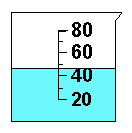
volume?
a)
48 mL
b)
48.2 mL
c)
48.25 mL
d)
4 mL
48.
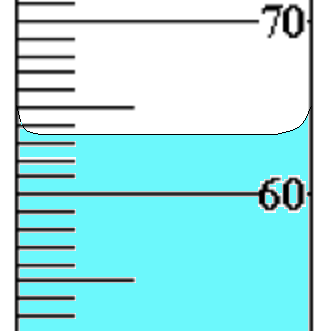
Volume?
a)
63.5 mL
b)
63 mL
c)
63.55 mL
d)
6 mL
49.
How many significant figures does the following number have: 100.3
a)
4
b)
3
c)
5
d)
2
50.
How many significant figures does the following number have: 0.9870477
a)
8
b)
6
c)
5
d)
7
51.
How many significant figures does the following number have: 0.045960
a)
3
b)
5
c)
6
d)
7
52.
How many significant figures does the following number have: 1740200
a)
2
b)
1
c)
3
d)
5
53.
In the measurement 0.503 L, which digit is the estimated digit?
a)
5
b)
the 0 immediately to the left of the 3
c)
3
d)
the 0 to the left of the decimal point
54.
If the mass of a rock is measured as 5.00g and the volume is 130 mL, what is it's density?
a)
650 g/mL
b)
0.0385g/mL
c)
0.038 g/mL
d)
380 g/mL
55.
Calculate 12.34 + 1.234 + 0.1234
a)
13.6974
b)
13.697
c)
13.70
d)
13.7
56.
Calculate 12.34 × 1.234 × 0.1234
a)
1.87908
b)
1.879
c)
1.9
d)
1.8790809
57.
How would you write 564,000,000 in scientific notation?
a)
5.64 x 10⁻⁷
b)
5.64 x 10⁶
c)
5.64 x 10⁸
d)
56.4 x 10⁷
58.
How would you write 4.3756 x 10⁴ in standard form?
a)
437,560,000
b)
0.00043756
c)
43,756
d)
4,3756
59.
How would you write 0.0005 in scientific notation?
a)
50 x 105
b)
5 x 10⁴
c)
5 x 10³
d)
.5 x 103
60.
Scientific Notation is made up of two number parts. The first part should be a number between 1 and 100.
a)
True
b)
False
100 %

