
 Worksheets
Periodic Table & the Elements
Total questions: 60
Worksheet time: 47mins
Name
Class
Date
1.
Which of the following will have a higher electronegativity than arsenic (As)?
a)
Carbon (C)
b)
Neon (Ne)
c)
Antimony (Sb)
d)
Germanium (Ge)
2.
Which of the following will have a lower ionization energy than Scandium (Sc)?
a)
Helium (He)
b)
Titanium (Ti)
c)
Calcium (Ca)
d)
Magnesium (Mg)
3.
As atoms of elements in group 16 are considered in order from top to bottom, the electronegativity of each successive element....
a)
decreases
b)
increases
c)
remains the same
d)
none of the above
4.
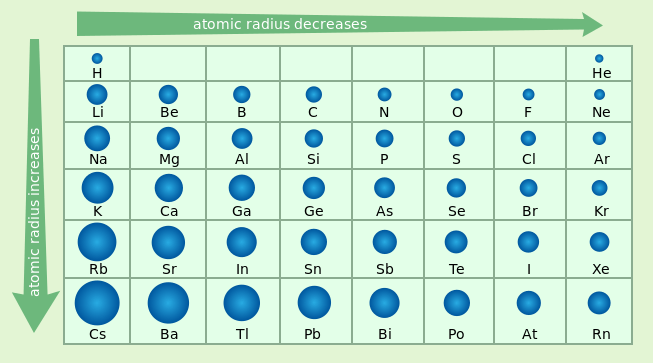
Which atom has the largest atomic radius?
a)
potassium
b)
rubidium
c)
francium
d)
cesium
5.
Atoms that have a high electronegativity, _______________.
a)
give up their electrons more easily.
b)
hold on to their electrons more tightly.
c)
have more electron shells.
6.
As you move across the periodic table atoms tend to get smaller because, ______________.
a)
the atoms have more mass.
b)
the atoms have less mass
c)
the atoms have more protons.
d)
the atoms have less electrons.
7.
Ionization energy is...
a)
the energy required to add an electron to a specific atom
b)
how much energy it takes to remove an electron from an atom
c)
the energy required to shield the outer electrons from the nucleus
d)
a measure of the ability of an atom to attract electrons
8.
Metals are good conductors of heat and electricity.
a)
true
b)
false
9.
The atom with the largest atomic radius in Group 18 is -
a)
Ar
b)
He
c)
Kr
d)
Rn
10.
The element with the largest electronegativity in the halogens is -
a)
At
b)
F
c)
Cl
d)
Br
11.
The element with the lowest electronegativity in Period 3 is -
a)
Na
b)
Cl
c)
Ar
d)
Mg
12.
Which periodic group has the smallest atomic radius?
a)
Alkali metals
b)
Halogens
c)
Noble Gases
d)
Transition metals
13.
Atomic radius generally increases as we move __________.
a)
down a group and from right to left across a period
b)
up a group and from left to right across a period
c)
down a group and from left to right across a period
d)
up a group and from right to left across a period
14.
Electronegativity __________ from left to right within a period and __________ from top to bottom within a group.
a)
decreases, increases
b)
increases, increases
c)
increases, decreases
d)
stays the same, increases
15.
Which has the greater EN:
Cl or Al?
Cl or Al?
a)
Cl
b)
Al
16.
Which has the greater EN:
N or C?
N or C?
a)
C
b)
N
17.
Which has the greater EN:
H or F?
H or F?
a)
H
b)
F
18.
Which of the following will have a larger radius than Zinc?
a)
Gallium
b)
Aluminum
c)
Magnesium
d)
Strontium
19.
Which orbital block corresponds to transition metals in the periodic table?
a)
s
b)
p
c)
d
d)
f
20.
A group of elements that includes the most active of the elements is the -
a)
halogens.
b)
noble gases.
c)
nitrogen group.
d)
alkaline earth metals.
21.
An electron that resides in the outermost shell, or principal quantum level, of an atom
a)
periodic trend
b)
electron shell
c)
ionic radius
d)
valence electron
22.
Vertical columns of elements (families) on the periodic table with similar valence electron configurations and similar properties
a)
groups
b)
periods
c)
quadrants
d)
rows
23.
A measure of the size of an atom, and is generally defined as the distance from the nucleus to the outermost electron orbit
a)
chemical reactivity
b)
atomic radius
c)
energy levels
d)
orbit
24.
Which is larger:
P or P-3
P or P-3
a)
P
b)
P-3
c)
both are same size
25.

The atoms along the staircase are called
a)
metals
b)
nonmetals
c)
metalloids
d)
noble gases
26.
Which is larger:
Ca or Ca+2
Ca or Ca+2
a)
Ca
b)
Ca+2
c)
both are same size
27.

Which of the following will have a lower ionization energy than Scandium (Sc)?
a)
Helium (He)
b)
Titanium (Ti)
c)
Calcium (Ca)
d)
Magnesium (Mg)
28.
The horizontal rows in the periodic table are called __________
a)
groups
b)
periods
c)
columns
d)
rows
29.
What does the Periodic Law state?
a)
The probability of finding an electron a certain distance from the nucleus
b)
When elements are arranged in order of increasing atomic mass, there is a periodic repetition of their physical and chemical properties
30.
___________ have an effect on group trends.
a)
Neutrons
b)
Energy levels
c)
Nuclear charges
d)
Orbitals
31.
________ have an effect on period trends.
a)
Neutrons
b)
Energy levels
c)
Nuclear charges
32.
Atomic size _______ as you move down a group.
a)
increases
b)
stays the same
c)
decreases
d)
doesn't follow a pattern
33.
Which of the following is formed by losing electrons?
a)
ions
b)
anions
c)
cations
d)
dogions
34.
Metalloids can be described as...
a)
same as nonmetals
b)
bad conductors
c)
characteristics of metals and nonmetals
d)
same as metals
35.
Noble gases would fit into which group?
a)
metals
b)
nonmetals
c)
metalloids
d)
diatomic molecules
36.
The halogens are ____________.
a)
diatomic molecules
b)
metalloids
c)
nonmetals
d)
metals
37.
Which family of metals is most reactive?
a)
Boron
b)
Halogens
c)
Noble Gases
d)
Alkali Metals
38.
As you move across the periodic table atoms tend to get smaller because, ______________.
a)
the atoms have more mass.
b)
the atoms have less mass
c)
the atoms have more protons.
d)
the atoms have less electrons.
39.
Silicon is a semiconductor and has properties of both metals and nonmetals. What type of element is Silicon?
a)
Metal
b)
Nonmetal
c)
Metalloid
d)
Pretty
40.
Which of these is a property of metals?
a)
It's malleable
b)
It can't conduct electricity
c)
They are used in food
d)
It's very brittle
41.
Which of the following is NOT true about cations?
a)
They have a positive charge
b)
Non-metals form cations
c)
They are formed by losing electrons
d)
They are formed from metals
42.
Which of the following element have the LARGEST atomic radius?
a)
Silver
b)
Rubidium
c)
Cadmiun
d)
Tin
43.
Which of the following elements has the least metallic characteristics?
a)
Zinc
b)
Cadmium
c)
Mercury
d)
Gold
44.
As one proceeds from fluorine to iodine in the Halogen family, the electronegativity ____.
a)
Decreases and atomic radius increases
b)
Decreases and atomic radius decreases
c)
Increase and atomic radius increases
d)
Increases and atomic radius decreases
45.
Which of the following elements has the LEAST electronegativity?
a)
Barium
b)
Iron
c)
Silver
d)
Gold
46.
Who first arranged the elements according to atomic mass?
a)
Louis Pasteur
b)
Henry Moseley
c)
John Dalton
d)
Dmitri Mendeleev
47.
The actinides are of greatest interest because of their
a)
abundance
b)
brilliance
c)
reactivity
d)
radioactivity
48.
Choose the atom or ion that has the largest radius
a)
Na
b)
Na+
c)
Both are the same size
49.
Choose the atom or ion that has the largest radius
a)
N
b)
N³⁻
c)
Both are the same size
50.
Who was responsible for establishing the order in which the elements are presented in the modern periodic table?
a)
Dmitri Mendeleev
b)
Ernest Rutherford
c)
Henry Moseley
d)
Robert Bunsen
51.
In the ground state, how many electrons are in the outermost energy level of each element in Group 17 (VII A)?
a)
8
b)
2
c)
7
d)
5
52.
Which element is a halogen?
a)
Iron
b)
Nitrogen
c)
Iodine
d)
Neon
53.
Which is NOT a property of metals?
a)
Good conductor
b)
High boiling point
c)
Form negative ions (anions)
d)
Malleable
54.
Which is NOT one of the 6 elements essential for life?
a)
Calcium
b)
Nitrogen
c)
Sulfur
d)
Hydrogen
55.
Which block or blocks are included in the Representative Elements?
a)
s & p
b)
s & d
c)
d
d)
d & f
56.
Which block is known as the Transition Elements?
a)
s
b)
p
c)
d
d)
f
57.
Which of these is NOT a metal?
a)
Calcium
b)
Silicon
c)
Gallium
d)
Aluminum
58.
Which of these is a metalloid?
a)
Antimony
b)
Lead
c)
Carbon
d)
Bromine
59.
How many valence electrons do the elements in group 13 have?
a)
3
b)
4
c)
8
d)
2
60.
What does the E in MERI stand for?
a)
electrons
b)
energy
c)
electronegativity
d)
element
100 %

