
 Worksheets
Gas Laws Review
Total questions: 55
Worksheet time: 54mins
Name
Class
Date
1.
What does Boyle's law relate to?
a)
Temperature and Volume
b)
Volume and Pressure
c)
Temperature and Pressure
2.
When the temperature of matter increases the particles...
a)
speed up and move closer
b)
speed up and move farther apart
c)
slow down and move closer together
d)
slow down and move farther apart
3.
How do gas molecules move?
a)
in an orderly fashion
b)
constantly and randomly
c)
in straight line paths
d)
in a circular motion
4.
In Charles' Law the pressure remains constant.
a)
True
b)
False
5.
What type of relationship is Charles' Law?
a)
Inverse
b)
Direct
c)
Not enough information
d)
#goals
6.
True or False: Gases can be compressed.
a)
True
b)
False
7.
When Pressure increases then the Volume must...
a)
Increase
b)
decrease
8.
When Volume increases then Pressure must...
a)
Increase
b)
Decrease
9.
What type of relationship to pressure and volume have?
a)
direct
b)
inverse
c)
no relationship
d)
I don't know
10.
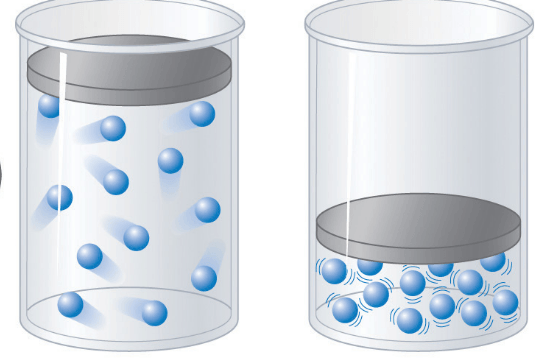
Which container will have a lower pressure?
a)
left
b)
right
c)
they both have the same pressure
d)
I don't know
11.
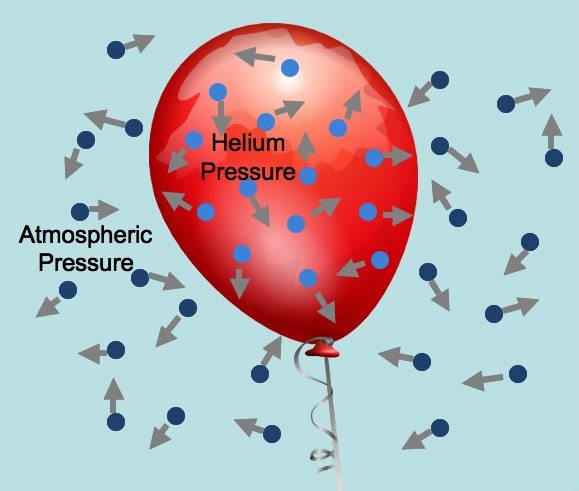
What causes pressure?
a)
The walls of the container
b)
The vacuum in the container
c)
The collisions of the particles
d)
Atmospheric pressure acting on the outside walls
12.
The relationship of which two variables are compared in Boyle's Law?
a)
pressure & volume
b)
volume & temperature
c)
temperature & pressure
d)
volume & moles (amount of gas)
13.
Boyle's law : When _______ is held constant, the pressure and volume of a gas are ________ proportional
a)
temperature, equally
b)
mass, inversely
c)
temperature, inversely
d)
mass, equally
14.
Boyle's law : When _______ is held constant, the pressure and volume of a gas are ________ proportional
a)
temperature, equally
b)
mass, inversely
c)
temperature, inversely
d)
mass, equally
15.
What type of relationship is Charles' Law?
a)
Inverse
b)
Direct
c)
Not enough information
d)
#goals
16.
Should experiments be repeated over and over to see if the results are the same each time?
a)
yes
b)
no
17.
TRUE/ FALSE: Science is a continually ongoing process.
a)
True
b)
False
18.
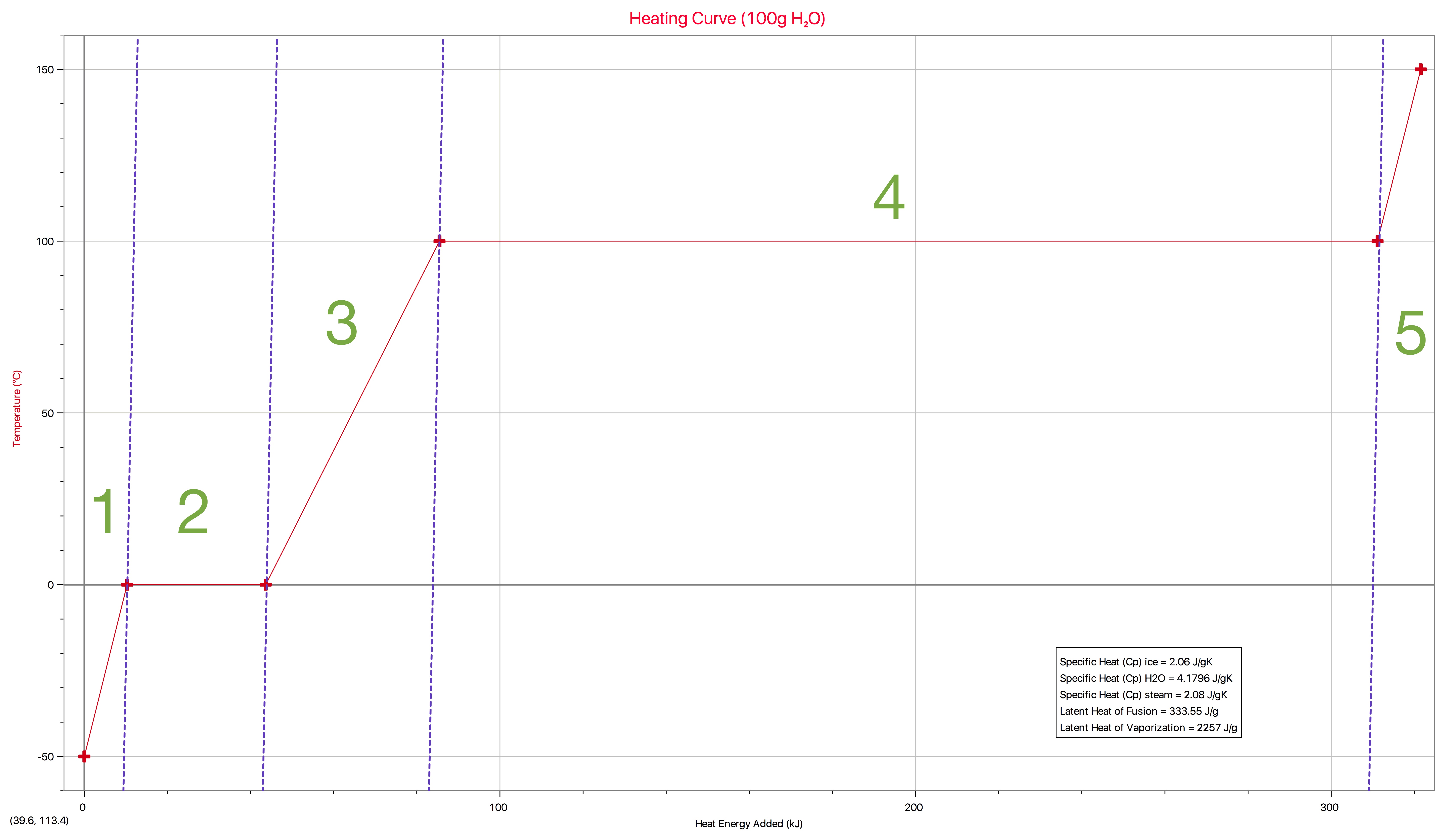
In which region(s) does temperature remain constant?
a)
Region 1, 3, & 5
b)
Region 2 & 4
c)
Region 1 only
d)
Region 1 & 2
19.
In which region(s) does temperature increase?
a)
Region 1, 3, & 5
b)
Region 2 & 4
c)
Region 1 only
d)
Region 1 & 2
20.
In which region(s) of the graph does a phase change occur?
a)
Region 1, 3, & 5
b)
Region 2 & 4
c)
Region 1 only
d)
Region 1 & 2
21.
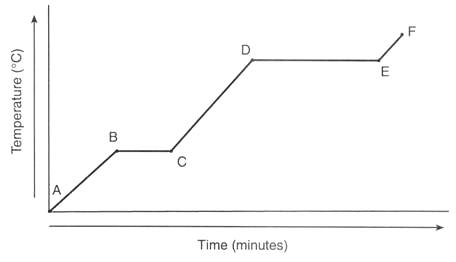
Between which points is the substance changing its state of matter?
a)
A-B only.
b)
A-B, C-D, E-F
c)
B-C only.
d)
B-C, D-E
22.
Thermal energy always moves:
a)
From a high temperature object to a lower temperature object.
b)
From a lower temperature object to a higher temperature object.
c)
From an object with lower kinetic energy to an object with higher kinetic energy.
d)
From an object of higher mass to an object of lower mass.
23.

Decreasing the temperature of something is called ______.
a)
heating
b)
cooling
c)
non-reversible change
d)
reversible change
24.

Increasing the temperature of something is called _______.
a)
heating
b)
cooling
c)
non-reversible change
d)
reversible change
25.

Describe the substance between letters A and B.
a)
Solid
b)
Liquid
c)
Melting
d)
Evaporating
26.

Describe the substance between letters D and E.
a)
Gas
b)
Liquid
c)
Melting
d)
Evaporating
27.

Describe the substance between letters E and F.
a)
Gas
b)
Liquid
c)
Melting
d)
Evaporating
28.

The melting point of the sample is
a)
-60 ºC
b)
-100 ºC
c)
60 ºC
d)
100 ºC
29.
freezing
a)
change of state from solid to liquid
b)
change of state from liquid to solid
30.
In which region(s) of the graph does a phase change occur?
a)
Region 1, 3, & 5
b)
Region 2 & 4
c)
Region 1 only
d)
Region 1 & 2
31.
In which region(s) of the graph would the substance be a solid only?
a)
Region 1
b)
Region 2
c)
Region 3
d)
Region 4
32.
In which region(s) of the graph would the substance be a solid and a liquid?
a)
Region 1
b)
Region 2
c)
Region 3
d)
Region 4
33.
In which region(s) of the graph would the substance be a liquid and a gas?
a)
Region 2
b)
Region 3
c)
Region 4
d)
Region 5
34.
In which region(s) of the graph would the substance be a gas only?
a)
Region 2
b)
Region 3
c)
Region 4
d)
Region 5
35.
In which region(s) of the graph does melting take place?
a)
Region 2
b)
Region 3
c)
Region 4
d)
Region 5
36.
In which region of the graph would be used to find the boiling point of the substance?
a)
Region 2
b)
Region 3
c)
Region 4
d)
Region 5
37.
In which region of the graph would be used to find the melting of the substance?
a)
Region 2
b)
Region 3
c)
Region 4
d)
Region 5
38.
What Is Matter?
a)
Anything That has weight and takes up space.
b)
Anything that you can see or taste.
c)
What you can touch.
d)
you and go throught this.
39.
What Is Volume?
a)
How heavy something is.
b)
The amount of space taken up by and object.
c)
How a liquid flows.
d)
The international unit of measurement.
40.

A gas
a)
has a definite shape but no definite volume
b)
has a definite volume but no definite shape
c)
has fast-moving particles
41.

At higher temperatures
a)
particles in an object have less energy
b)
particles in an object move faster
c)
a gas contracts
42.
The opposite phase of melting is
a)
freezing
b)
sublimation
c)
condensation
d)
deposition
43.
Melting
a)
liquid to solid
b)
solid to liquid
c)
solid to gas
d)
gas to liquid
44.
Freezing
a)
Solid to gas
b)
Liquid to solid
c)
Gas to solid
d)
Liquid to gas
45.
Boiling
a)
liquid to gas
b)
gas to solid
c)
gas to liquid
d)
solid to liquid
46.

Which state of matter has tightly packed molecules?
a)
solid
b)
liquid
c)
gas
47.
What are the states of matter?
a)
solid, liquid, and juice
b)
solid and liquid
c)
solid and gas
d)
solid, liquid, and gas
48.

The drops of water that appear on the outside of a glass of cold juice on a warm day are an example of?
a)
sublimation
b)
condensation
c)
evaporation
49.
Define a liquid.
a)
Indefinite shape, indefinite volume
b)
Definite shape, definite volume
c)
Found in stars
d)
Definite volume, indefinite shape
50.
Which of these is an example of sublimation?
a)
water turning to ice
b)
ice cream dripping
c)
a puddle drying up
d)
dry ice being used to make fog
51.
How are the particles moving in liquids?
a)
Sliding past one another
b)
moving past one another with great speed
c)
vibrating in a fixed postion
52.
What would cause a decrease in particle movement?
a)
decrease atoms
b)
increase in space between atoms
c)
decrease in temperature
d)
increase in mass
53.
The phase change when a liquid becomes a gas.
a)
melting
b)
boiling
c)
sublimation
d)
evaporation
54.
Liquids and gases are similar because __________________________.
a)
they both take the shape of their container
b)
they both have their own shape
c)
liquids pour and gases don't
d)
liquids take the shape of the container but gases have their own shape
55.

What phase of matter is shown in the diagram?
a)
solid
b)
liquid
c)
gas
d)
physical changes
100 %

